
Most real estate investors assume AI cold calling means one thing: a robot dialing numbers. That assumption is costing them deals. The AI cold call simulator real estate space has split into two very different categories, each with a distinct purpose. One trains you to handle objections from distressed sellers. The other qualifies leads automatically while you sleep. Knowing which tool does what, and how to use both legally, is the difference between wasted tech spend and a real competitive edge. This guide breaks it all down.
Table of Contents
- Key Takeaways
- AI Cold Call Simulators and Their Role in Real Estate Training
- Production AI Voice Agents for Live Lead Qualification
- Compliance: What You Must Know Before Dialing
- Best Practices for Integrating AI Cold Call Tools
- Emerging Trends Shaping AI Cold Calling in Real Estate
- My Take on AI Simulators and What Actually Changes Behavior
- Practice Smarter with Closersleague
- FAQ
Key Takeaways
| Point | Details |
|---|---|
| Two types of AI cold call tools | Training simulators build your skills; production voice agents handle live lead qualification at scale. |
| Compliance is non-negotiable | The FCC’s 2024 ruling requires prior written consent for all AI-generated outbound calls. |
| Test before you deploy | Run at least 15 simulated calls and hit 80% qualification agreement before going live with any AI voice agent. |
| Customize your practice | Tailoring objection sets to specific seller types drives real behavior change, not just repetition. |
| AI augments, not replaces | Human oversight remains a legal and professional requirement, especially in licensed real estate markets. |
AI Cold Call Simulators and Their Role in Real Estate Training
AI cold call simulators divide into two types: training roleplay simulators built for practicing conversations, and production AI voice agents built for live lead engagement. If you are an investor or wholesaler trying to get better at talking to distressed sellers, you need the first type.
Roleplay simulators put you in a live voice conversation with an AI that behaves like a real homeowner. The AI pushes back, goes quiet, gets defensive, or asks hard questions, depending on how you have configured it. You can set the difficulty level, define the seller persona (think: grieving heir, burned-out landlord, or homeowner behind on taxes), and load in the specific objections you hear most on your calls.
The best platforms let you build custom talk tracks and score your performance across categories like tone, objection handling, and call structure. This matters because tailoring objection sets to specific seller profiles drives real behavior change. Generic practice makes you comfortable. Specific practice makes you effective.
Here is what to look for in a solid AI real estate training simulator:
- Adjustable difficulty so you can start with cooperative sellers and work up to hostile ones
- Custom seller personas mapped to your actual lead types: probate, pre-foreclosure, code violations, tax delinquent
- Objection libraries you can edit based on what you actually hear in the field
- Voice-based conversation rather than text chat, because your real calls happen on the phone
- Scoring and feedback tied to your actual sales process, not generic metrics
Pro Tip: Before your first live call of the day, run one five-minute simulator session using the seller type you are most likely to reach. It primes your brain for the conversation and cuts down on stumbling through your opener.
The goal of cold call practices for agents and investors is not to memorize a script. It is to build the mental flexibility to handle whatever a seller throws at you. A good simulator gives you hundreds of reps without burning a single real lead.
Production AI Voice Agents for Live Lead Qualification
This is where AI stops being a training tool and starts doing the actual work. Production AI voice agents call your leads automatically, qualify them in real time, and push structured data into your CRM. For high-volume investors running skip-traced lists, this changes the math entirely.

PropertyBots’ AI Voice Connect Pro calls leads in under 3 seconds after they are captured. It handles the initial qualification conversation, asks about motivation, timeline, and property condition, then logs scores and books appointments without any human involvement. That kind of speed matters more than most investors realize.
Here is why speed-to-lead is not just a nice metric. Contacting leads within the first 5 minutes improves conversion likelihood by 21 times compared to reaching out later. No human team can consistently hit that window across hundreds of leads per week. AI can.
A well-configured production voice agent handles these tasks in sequence:
- Initiates the call within seconds of lead capture from your CRM, landing page, or lead source
- Conducts a natural qualification conversation covering motivation, property details, and timeline
- Handles voicemails and sends SMS follow-up automatically if no one answers
- Scores the lead based on qualification criteria you define upfront
- Updates your CRM with structured answers, scores, and next-step recommendations
- Routes hot leads via warm transfer to you or your acquisitions team with full conversation context
The warm transfer piece is underrated. Your team picks up the phone already knowing the seller’s situation. No cold start. No repeating questions the AI already asked.
Pro Tip: Set your routing threshold carefully. If you route every lead that answers, you will overwhelm your team. Define what a “hot” lead looks like for your market, whether that is a motivated seller with equity and a 90-day timeline, and only trigger warm transfers for those.
Pushing structured qualification data automatically to your CRM removes manual data entry and keeps your pipeline moving without gaps. This is one of the highest-leverage ways AI improves real estate calls at scale.
Compliance: What You Must Know Before Dialing
This section is not optional reading. Skipping it can cost you six figures in fines.
The FCC issued a ruling in February 2024 that classifies AI-generated voice calls as artificial or prerecorded voice under the TCPA. That single change rewrote the rules for every investor running outbound AI call campaigns. Prior express written consent is now required before your AI agent can call anyone.
Here is what a compliant outbound AI voice program looks like in practice:
- Written consent documentation that names your company specifically, not just a generic marketing consent
- Caller ID accuracy so your displayed number matches your actual business identity
- Disclosure at the start of every call that the caller is an AI
- Opt-out handling that immediately removes anyone who says stop, do not call, or similar language
- DNC list scrubbing before every dial session, including the national registry and your internal suppression list
- Reassigned number checks to avoid calling someone who no longer owns the number you have on file
| Compliance Element | Requirement | Risk if Skipped |
|---|---|---|
| Prior written consent | Named, documented, per-call basis | Up to $1,500 per violation under TCPA |
| AI disclosure | Required at call start | Regulatory complaint, call blocking |
| DNC scrubbing | Pre-dial, every session | Federal and state fines |
| Opt-out processing | Immediate, automated | Continued violations, escalating fines |
| Audit trail | Logged consent and call records | No defense in litigation |
“Treating AI disclosure as a positive feature, rather than a legal burden, helps maintain answer rates while drastically reducing legal risks.” DILR.ai TCPA Compliance Guide
California adds another layer. The California DRE advises treating AI as assistive technology with active broker oversight. Licensees remain responsible for the accuracy and truthfulness of everything their AI says on a call. That means you cannot set it and forget it. You review, you supervise, and you stay accountable.
Compliance architecture for AI outbound campaigns requires ongoing investment in consent management, DNC infrastructure, disclosure scripting, and audit trails. This is not a one-time setup. It is a recurring operational function.
Best Practices for Integrating AI Cold Call Tools
Getting the technology is the easy part. Deploying it well is where most investors stumble.
Test before you go live
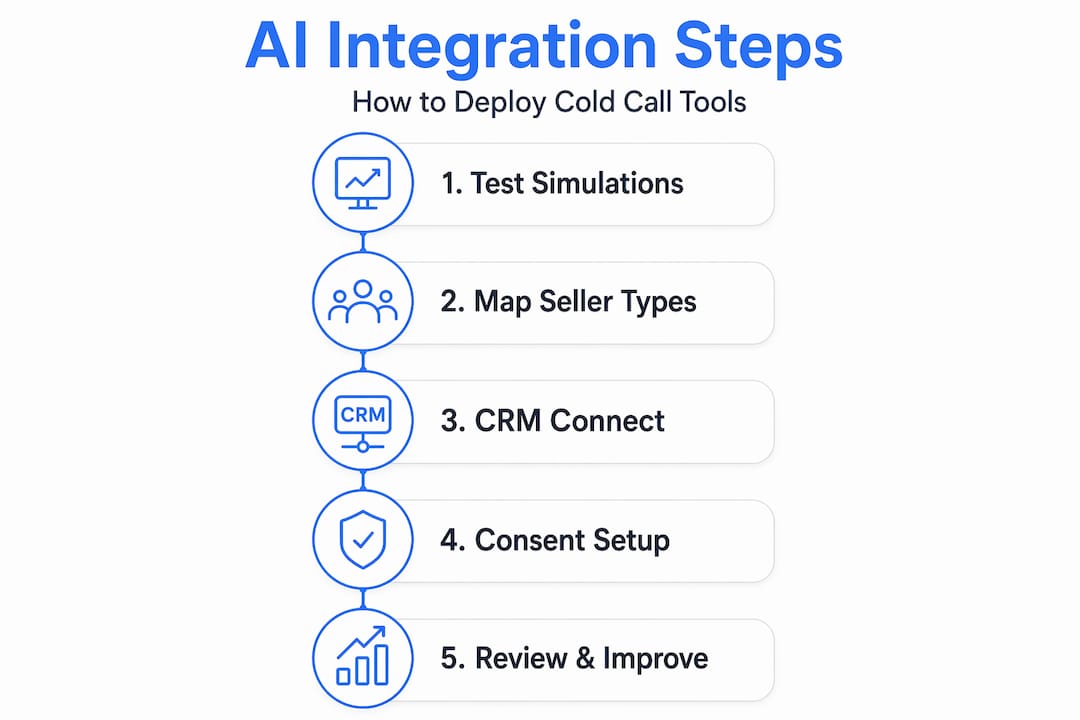
Run at least 15 simulated calls using a realistic mix of lead types before your AI voice agent touches a real prospect. Benchmark its qualification decisions against how a trained human would score the same conversation. You want at least 80% agreement before you trust it with live leads.
Review transcripts from those test calls carefully. Look for moments where the AI misunderstood the seller, gave a wrong answer, or failed to handle an objection correctly. Fix those gaps in your script and conversation flow before going live.
Customize for your actual seller types
A generic AI configuration will produce generic results. Map your conversation flows to the specific seller situations you target: probate heirs, pre-foreclosure homeowners, tired landlords, out-of-state owners. Each group has different emotional triggers, different objections, and different timelines.
Pro Tip: Record your best live calls and use them to build your AI’s conversation model. Your actual top-performing calls are better training data than any template.
Connect your AI to your CRM from day one
Structured qualification data pushed automatically to your CRM transforms your workflow. Every lead that goes through your AI agent should arrive in your CRM with answers to your standard qualification questions, a lead score, and a recommended next step. No manual entry. No lost notes.
| Setup Stage | What to Configure | Why It Matters |
|---|---|---|
| Pre-launch | Consent capture, DNC scrubbing, disclosure script | Legal protection before first dial |
| Conversation design | Seller personas, objection handling, qualification criteria | Call quality and lead accuracy |
| CRM integration | Score fields, routing rules, follow-up triggers | Pipeline speed and team efficiency |
| Ongoing monitoring | Transcript review, compliance audits, performance scoring | Continuous improvement and risk management |
Develop a written policy for your team that defines who reviews AI call transcripts, how often, and what triggers a manual review. This keeps your operation compliant and your team sharp.
Emerging Trends Shaping AI Cold Calling in Real Estate
The tools available today are already powerful. What is coming next will change the game further.
- Agentic AI workflows are moving beyond single calls. These systems handle multi-step sequences: initial call, follow-up SMS, email drip, and callback scheduling, all triggered by seller behavior without manual input.
- Adaptive conversations are getting more sophisticated. AI agents are learning to read conversational cues and adjust tone, pacing, and question order in real time based on how a seller responds.
- Omnichannel outreach is becoming standard. The best AI real estate training and outreach platforms now connect phone, SMS, email, and chat into one unified lead engagement system.
- Compliance as architecture is replacing compliance as afterthought. Platforms are building consent management, DNC scrubbing, and audit logging directly into their core infrastructure rather than treating it as an add-on.
- Confidence metrics are emerging as a training output. Simulators are starting to measure not just what you say, but how you say it, tracking pace, filler words, and vocal confidence as part of your performance score.
The investors who will win in this environment are the ones who treat AI as a skill to develop, not a button to push. That means continuous learning, regular practice, and staying current on both the technology and the regulatory environment.
My Take on AI Simulators and What Actually Changes Behavior
By Dave
I’ve worked with a lot of investors who think the problem with their cold calls is their script. They rewrite their opener five times and wonder why their conversion rate stays flat. In my experience, the script is rarely the issue. The issue is that they freeze when a seller goes off script.
That is exactly what a good AI cold call simulator fixes. When you have practiced handling a grieving probate heir who does not want to talk about money, or a landlord who has heard every investor pitch before, you stop freezing. You start responding. That shift from reactive to responsive is what actually moves the needle on your numbers.
What I have also learned is that compliance cannot be an afterthought. I have seen investors build out impressive AI outreach systems and then get hit with TCPA complaints because they skipped the consent documentation step. The technology is only as good as the infrastructure around it. Build the compliance layer first, then build the call volume.
The other thing worth saying plainly: AI does not replace you. The California DRE’s position on AI oversight reflects what good operators already know. Your judgment, your relationship-building, and your ability to close a motivated seller are not things any AI replicates. What AI does is handle the volume, the repetition, and the practice reps so that when you get a real seller on the line, you are ready. Use it that way and it pays for itself fast.
— Dave
Practice Smarter with Closersleague
If you are serious about improving your cold calls, the practice environment matters as much as the effort you put in. Closersleague is built specifically for real estate investors and wholesalers who want to get sharper at talking to distressed sellers.
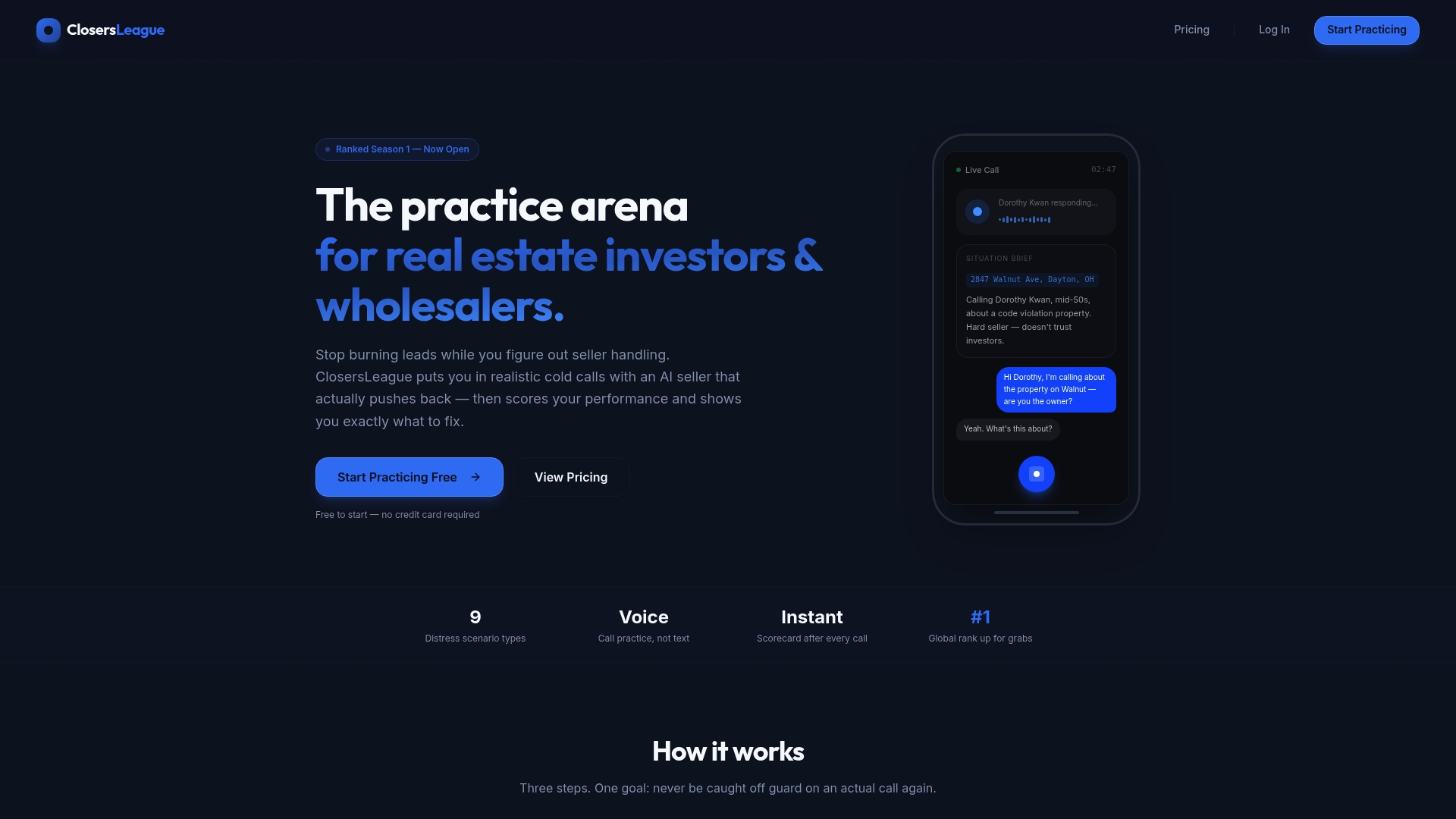
The platform gives you AI roleplay modules built around the seller types you actually call: inherited property owners, code violation properties, tired landlords, and out-of-state owners. Every session scores your performance and gives you specific feedback so you know exactly what to fix. Stop winging it. Start drilling. Visit Closersleague and run your first practice session today.
FAQ
What is an AI cold call simulator for real estate?
An AI cold call simulator for real estate is a voice-based training tool that lets investors and wholesalers practice conversations with AI-powered seller personas. It scores your performance and helps you improve objection handling before you call real leads.
How is an AI simulator different from a production AI voice agent?
A simulator is for training. A production AI voice agent makes real outbound calls to leads, qualifies them, and updates your CRM automatically. They serve completely different purposes and should not be confused.
Do AI cold calls require consent under TCPA?
Yes. The FCC’s 2024 ruling classifies AI voice calls as artificial or prerecorded voice, requiring prior express written consent before any outbound AI call is made.
How many test calls should I run before deploying an AI voice agent?
Run at least 15 simulated calls with a realistic lead mix and verify that your AI’s qualification decisions match a human benchmark at least 80% of the time before going live.
Can AI replace a real estate investor on cold calls?
No. AI handles volume, speed, and repetitive qualification tasks well. But closing motivated sellers, building trust, and making judgment calls still require a skilled human. The California DRE confirms that licensees retain full responsibility for AI-assisted communications.
Recommended
- Vacant Property Cold Calling Practice — AI Roleplay for Real Estate Investors & Wholesalers
- Top 6 Coldcall.coach Alternatives 2026 – ClosersLeague Blog
- Tired Landlord Cold Calling Practice — AI Roleplay for Real Estate Investors & Wholesalers
- Inherited Property Cold Calling Practice — AI Roleplay for Real Estate Investors & Wholesalers