Speech-based AI emotion detection gives real-estate callers live cues on hesitation, frustration, and interest as the seller talks, so you pivot the script instead of finishing the call blind. The platform builds this into practice calls by scoring prosody and pacing alongside pauses and word choice, then feeding that into a live scorecard. The rest of this guide breaks down how the tech works, what to track, and how to turn it into fewer hang-ups.
TL;DR:
- Callers who speak more than 40% of the time tend to miss key buying signals, limiting their ability to assess seller motivation accurately.
- Rapid speech, filler words, and long pauses after price questions often indicate seller hesitation or uncertainty rather than rejection.
- Emotions like frustration, guilt, hesitation, and urgency can be identified through specific voice cues and mapped to appropriate coaching pivots for better engagement.
- False positives are common with prosody analysis, so flags should be validated against transcripts and corroborated with multiple signals before action.
- Real-time emotion detection mainly benefits coaching and practice drills; it is less reliable for fully automated agents due to nuance and regional accent challenges.
Table of Contents
- How Does AI Emotion Detection Work on Cold Calls?
- Which Voice Signals Actually Predict a Motivated Seller?
- How Do You Turn Emotion Data Into Better Scripts?
- Implementation Checklist for Adding Emotion Detection to Training
- Where Emotion Detection Gets It Wrong
- Beyond Voice: Other Ways AI Reads Emotion
- Where Else Emotion AI Shows Up
- How Do Emotion Detection Platforms Actually Differ?
- Why Mixed or Subtle Emotions Are Hard to Read
- Do Accents and Dialects Affect Emotion Detection Accuracy?
- What ClosersLeague Actually Watches on Practice Calls
- Get Started With Emotion-Aware Cold Call Practice
- Sources
- FAQ
How Does AI Emotion Detection Work on Cold Calls?
Emotion detection on a sales call is not one piece of software. It is a chain of four steps that has to run fast enough to matter mid-conversation.
- Audio capture. The call, whether live or a practice roleplay, streams as raw audio through a phone or web connection.
- Speech-to-text (STT). The audio converts to a transcript in near real time, with word-level timestamps.
- Sentiment and prosody analysis. Natural language processing (NLP) reads the transcript for emotional language while a parallel layer analyzes pitch, pace, and pause length. The two together catch what words alone miss. Someone can say “sure, that works” in a flat, clipped tone that signals irritation, not agreement.
- Scorecard and prompt generation. The system scores the call across dimensions like talk-to-listen ratio, filler words, and objection handling, then pushes a coaching prompt if it’s running live.
This is where real-time versus post-call matters. Post-call analysis is useful for training review, but it can’t stop a hang-up while it’s happening. Real-time processing can nudge a caller mid-sentence, and that adaptability is tied to better qualification accuracy and fewer dropped calls in emotionally intelligent voice AI.
Open-source demo builds show the actual plumbing. One public architecture routes calls through Twilio ConversationRelay for streaming, uses an OpenRouter-hosted model (gpt-4o-mini in the reference build) to generate a seller persona’s responses, and hands the reply to ElevenLabs for natural-sounding text-to-speech. That loop, phone in, coached voice out, is close to what a practice platform runs behind the scenes.
Which Voice Signals Actually Predict a Motivated Seller?
Not every metric matters equally on a distressed-property call. A handful of signals correlate with what a seller is actually feeling, and each one maps to a specific fix.
- Talk-to-listen ratio. Callers who talk more than roughly 40% of the time on a discovery call tend to miss buying signals. If you’re above that, the seller doesn’t get room to reveal their real timeline or price flexibility.
- Words per minute (WPM). Sellers speeding up often signal urgency or stress (a foreclosure deadline, a probate court date). Callers speeding up usually signal nervousness, which reads as pushy.
- Filler words and pauses. A spike in “um,” “uh,” or a long pause after a price question usually flags uncertainty, not rejection, and calls for reassurance rather than a harder pitch.
- Prosody shifts. A drop in pitch or a flattened tone partway through a call, especially after a personal topic like divorce or an inherited property, often marks a guarded or guilty emotional state.
Platforms that score calls this way, breaking down opening effectiveness, talk-to-listen, filler words, pacing, and objection handling into a single per-dimension scorecard, give coaches something concrete to drill instead of a vague “do better” note.
Pro Tip: Track one metric per week instead of five. A caller trying to fix talk-to-listen, pacing, and filler words simultaneously usually improves none of them.
When sentiment shifts sharply, mature systems don’t just log it, they route it: emotion-responsive frameworks push high-intent signals into same-day callback queues and drop cooler leads into a longer nurture sequence.
How Do You Turn Emotion Data Into Better Scripts?
A scorecard is only useful once it changes what you say next. The goal is matching a detected emotion to a specific pivot, not a generic “be more empathetic” reminder.
- Frustration (sharp tone, short answers): Pivot to acknowledgment before continuing. “Sounds like this has been a lot to deal with” buys you room before the next question.
- Guilt (flattened tone on inherited or divorce properties): Slow down and remove judgment from your language. Avoid framing the sale as a “problem” to solve.
- Hesitation (fillers, long pauses on price): Don’t fill the silence with a discount. Ask an open question instead, “What would need to be true for this to make sense for you?”
- Urgency (fast WPM, short sentences near a deadline): Match the pace, then slow it down deliberately once you’ve addressed the timeline. Speeding up with them escalates stress instead of calming it.
Building this into a repeatable practice loop matters more than any single insight. Set a drill around one detected pattern, run five to ten practice calls against that scenario (a pre-foreclosure seller stalling on price is a good starting point), then review the scorecard for movement on that one metric before adding a second focus.
Coaches running this loop should treat the scorecard as a script-editing tool, not just a grading sheet, using resources tailored for real-estate professionals like those found at HomePilot for agents. If callers repeatedly trip on the same objection language, that’s a sign the script itself needs a rewrite, not just more repetitions from the caller. Real-time prompts that surface a short, specific line, a pace alert or a suggested empathy phrase, mid-call tend to outperform feedback that only arrives after the call ends, since the caller can act on it while the seller is still on the line.
Implementation Checklist for Adding Emotion Detection to Training
Rolling this out doesn’t require a full engineering team, but skipping the planning step is how pilots stall. Work through these in order.
- Decide real-time or post-call first. Real-time coaching benefits live calls and roleplay drills where a prompt can change the outcome. Post-call analytics work better for team-wide review and pattern spotting across many calls.
- Map the minimum components. You need a phone or webhook connection, an STT layer accurate enough for transcript-based scoring, a sentiment/prosody engine, and a dashboard that surfaces scores per call.
- Set data handling rules before the first call. Decide retention windows, who can access transcripts, and whether recordings need a consent disclosure.
- Pilot on one segment, not the whole team. Run it against a single seller type first, pre-foreclosure or probate tends to generate the most emotional variance to train against.
- Measure before expanding. Watch connect-to-meeting rate and one core KPI (talk-to-listen or filler-word frequency) over a defined window before rolling it to the full roster.
Before launch, confirm the basics:
- Recording and consent notices are in place for any live call analysis.
- Transcript storage has a defined retention limit, not indefinite storage by default.
- The dashboard shows per-call and rolling averages, not just a single-session snapshot.
- Someone on the team owns weekly review of flagged calls, not just the AI’s output alone.
Where Emotion Detection Gets It Wrong
No model reads a seller’s mind, and treating a flag as gospel is how coaches lose trust in the tool. Prosody analysis can misread a naturally flat speaker as disengaged, or a fast talker as anxious when they’re just excited. Validate flags against the actual transcript before treating them as fact.
There’s also a trust risk on the human side. Fully automated voice agents still struggle with emotional nuance, and prospects who sense they’re talking to a bot disengage fast, which is exactly why the strongest use of this tech assists a human caller rather than replacing them.
Guard against false positives with a few habits:
- Require multiple corroborating signals (tone plus pause plus word choice) before routing a call as “high intent” or “cold.”
- Have a human reviewer spot-check flagged calls weekly rather than trusting thresholds blindly.
- Recalibrate scoring models periodically instead of treating day-one settings as permanent.
- Disclose recording and practice-call analysis clearly, and keep transcript retention limited.
Beyond Voice: Other Ways AI Reads Emotion
Speech analysis is one branch of a broader field called affective computing, AI systems built to detect and interpret human emotional states. Facial expression recognition analyzes micro-movements around the eyes and mouth to infer states like surprise or concern, and it shows up in video interview screening and in-store retail analytics. Physiological sensors, wearables tracking heart-rate variability or galvanic skin response, add another layer, mostly in clinical and research settings where a subject is instrumented directly.
None of that applies to a phone call. A cold call has no camera and no sensor, only audio. That’s precisely why voice-based emotion recognition technology, reading tone, pace, and word choice from a transcript and an audio stream, is the only branch of affective computing that fits a real-estate cold-calling workflow. Any platform promising facial or biometric emotion reading for phone-based sales training is solving a problem you don’t have.
Where Else Emotion AI Shows Up
Sentiment analysis tools and affective computing AI now touch a wide range of industries, and it helps to know cold calling isn’t a niche use case. Customer support centers analyze call sentiment to flag escalations before a customer hangs up angry. Market research firms run sentiment analysis on focus-group audio to gauge reaction to a new product concept. Healthcare systems experiment with vocal biomarkers to screen for depression or cognitive decline during routine check-ins.
Sales organizations broadly, not just real estate, use call sentiment analysis to coach reps on tone and pacing across cold outreach, account management, and retention calls. Real estate cold calling is a specific and demanding version of this: sellers are often in genuine distress (foreclosure, divorce, an inherited property they don’t want), so the emotional stakes on each call run higher than a typical retention call. That’s part of why seller emotion analysis tuned to distressed-property language, “behind on payments,” “the estate,” “code violation,” outperforms generic sentiment scoring built for retail support tickets.
How Do Emotion Detection Platforms Actually Differ?
Every emotion detection setup for cold calling relies on the same rough stack, but the pieces get combined differently depending on what the platform optimizes for. Some tools focus almost entirely on post-call analytics: they transcribe, score, and generate a report after the conversation ends, which suits managers reviewing team performance in bulk. Others prioritize real-time delivery, streaming audio through a service like Twilio ConversationRelay so a coaching prompt can land while the caller is still talking.
The technical building blocks that matter for comparison are STT accuracy (usable transcript-based scoring generally needs high-accuracy transcription, often cited in the 95 to 98% range), how sentiment and prosody layers are combined versus scored separately, and whether a platform includes a synthetic voice for roleplay practice, typically built on a TTS engine like ElevenLabs, versus only analyzing live human-to-human calls.
For real-estate investors specifically, the comparison that matters isn’t feature count. It’s whether the platform trains on distressed-seller scenarios (pre-foreclosure, probate, tax delinquent) or generic B2B sales scripts. A tool built for SaaS demo calls will misread the emotional cues on a probate call, because the vocabulary, pacing, and stakes are entirely different. ClosersLeague builds its scoring and roleplay scenarios specifically around those property types rather than adapting a general sales-training tool after the fact.
Why Mixed or Subtle Emotions Are Hard to Read
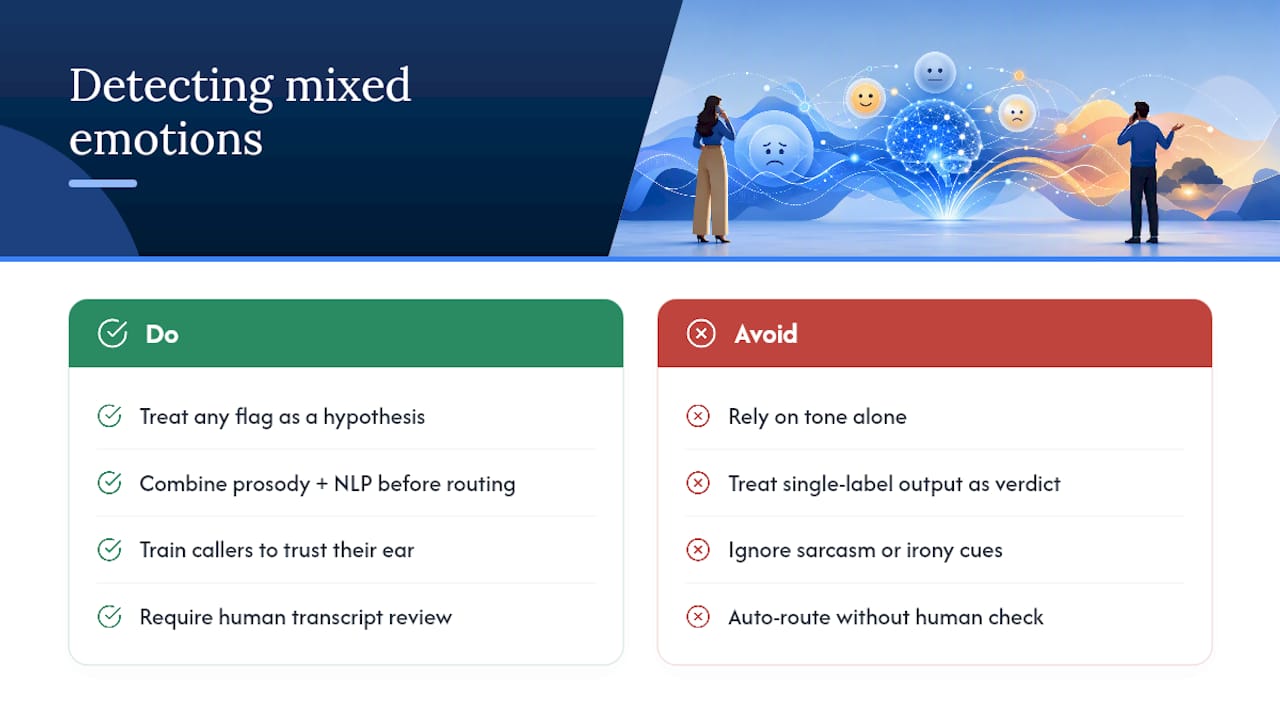
A seller rarely feels one thing. Someone facing foreclosure might sound relieved to finally talk about it and defensive about the debt in the same breath, sometimes in the same sentence. Detection models trained on single-label emotions (happy, sad, angry) struggle with that blend, because the prosody signals for relief and defensiveness can overlap almost completely: a slight pitch rise, a short pause, a controlled pace.
Sarcasm and dry humor compound the problem. “Oh sure, the bank’s been real patient with me” carries frustration wrapped in irony, and a model reading tone alone can miss the sarcasm entirely and score it as neutral or even positive. Layering NLP sentiment scoring on top of prosody helps catch some of this, since the word choice (“real patient” used ironically) gives context that tone alone doesn’t, but it isn’t foolproof.
The practical fix isn’t a better algorithm alone. It’s treating any single flag as a hypothesis, not a verdict, and training callers to trust their ear over the score when the two disagree. A model that combines multiple signals before routing a call as “hot” or “cold” reduces false confidence, but the most reliable check remains a human reviewing the actual transcript against the flag.
Do Accents and Dialects Affect Emotion Detection Accuracy?
Regional accents, code-switching, and dialect-specific speech patterns all shift how STT engines transcribe audio, and a garbled transcript feeds bad data into the sentiment layer downstream. A caller from the Gulf Coast and a caller from the Upper Midwest can express identical frustration with different pacing and pitch baselines, and a model calibrated on one region’s “normal” tone can flag the other as unusually flat or unusually intense.
Cultural norms around directness compound this. A seller who answers questions tersely because that’s a regional communication style, not because they’re annoyed, can trip a frustration flag that has nothing to do with their actual feelings about selling the property.
The safest approach is calibrating thresholds against a broad, varied set of practice calls rather than a narrow sample, and treating flags for less common accents with extra human review until the model’s track record on that population is proven. This is exactly the kind of drift a practitioner cited in emotion AI development warns against: gradually adjusting thresholds and auditing flags with human reviewers instead of trusting a fixed model to generalize across every voice it hears.
What ClosersLeague Actually Watches on Practice Calls
ClosersLeague runs roleplay against the seller types that generate the most emotional variance: pre-foreclosure, probate, inherited, tax delinquent, code violation, divorce, out-of-state, vacant, and tired landlords. Each scenario scores your call on opener strength, pacing, and objection handling, alongside the tone and hesitation cues covered above.
Day to day, that means running a call against a probate scenario, getting a scorecard back within minutes, and seeing exactly where your talk-to-listen ratio spiked or where a filler-word cluster gave away uncertainty. Leaderboards let you compare your scores against other callers working the same type, which turns a solo practice habit into something closer to competitive drilling.
The platform doesn’t promise to read a seller’s mind. It gives you a consistent, repeatable way to see the same emotional patterns real sellers show, in a low-stakes setting, before you’re on a live call with someone facing an actual deadline.
— Dave
Get Started With Emotion-Aware Cold Call Practice
This platform is a practical way to put everything above into daily practice, not just theory you read once and forget. Instead of guessing why a call went cold, you run scenario-based roleplay against distressed-seller types like foreclosure, probate, and divorce, and get a scorecard back on tone, pacing, and objection handling before you ever pick up a real phone.

Start with a free trial and run five practice calls against one seller type you’re weakest on. Track two numbers only: your talk-to-listen ratio and your filler-word count per call. By week two, watch whether your opener score moves before chasing every other metric. By week four, compare your scorecard trend against the leaderboard to see if your pacing has actually tightened up or just feels better.
If you want to see the full range of roleplay scenarios before committing, or you’re specifically working code-violation leads, there’s a scenario built for that seller type too. Either way, the fastest way to know if this works for your calls is to run the trial and read your first scorecard.
Sources
- Getsyou
- AI Cold Call Simulator – Practice Sales Calls With AI | Vozah
- The Impact of AI on Cold Calling: What’s Real and What’s Hype | Televista Blog
- Sales practice agent (example architecture) — GitHub
FAQ
What Is AI Emotion Detection in Cold Calling?
It’s the use of speech-to-text, sentiment analysis, and prosody tracking to infer a seller’s emotional state (frustration, hesitation, urgency) from tone, pace, and word choice during a call.
Does Emotion Detection Work in Real Time or Only After the Call?
Both are possible, but real-time analysis lets a coaching prompt change the outcome mid-call, while post-call analysis works better for reviewing patterns across many calls at once.
What Metrics Matter Most for Distressed-Seller Calls?
Talk-to-listen ratio, words per minute, filler-word frequency, and prosody shifts (pitch and pause changes) are the signals most tied to hesitation, guilt, or urgency on foreclosure, probate, and divorce calls.
Can Emotion Detection Misread a Seller’s Tone?
Yes. Flat speakers, regional accents, sarcasm, and mixed emotions can all trigger false flags, which is why any alert should be checked against the transcript before you act on it.
How Does ClosersLeague Use Emotion Detection Differently?
ClosersLeague scores practice calls against specific distressed-property scenarios, probate, pre-foreclosure, code violation, and more, rather than generic sales scripts, so the scoring reflects the emotional patterns real sellers actually show.
Recommended
- Tired Landlord Cold Calling Practice — AI Roleplay for Real Estate Investors & Wholesalers
- Foreclosure Cold Calling Practice — AI Roleplay for Real Estate Investors & Wholesalers
- Pre-Foreclosure Cold Calling Practice — AI Roleplay for Real Estate Investors & Wholesalers
- Distressed Seller Cold Calling Scripts That Convert