
Most new investors assume a profitable real estate deal is just about finding a cheap house and flipping it fast. That mindset leads to lost money, missed contracts, and a lot of frustration. The reality is that seasoned wholesalers follow a repeatable system built on specific formulas, seller psychology, and buyer relationships. Understanding the mechanics behind a deal is what separates investors who close consistently from those who chase leads with nothing to show for it. This article breaks down every component of a real estate deal so you can approach each opportunity with clarity and confidence.
Table of Contents
- Defining a real estate deal for investors and wholesalers
- The anatomy of a profitable real estate deal
- How to find and approach the right sellers
- Securing contracts and maximizing your assignment fee
- Building a cash buyer pipeline for consistent success
- Most new wholesalers underestimate the real work and opportunity in deals
- Level up your deal-making: practice and close more deals
- Frequently asked questions
Key Takeaways
| Point | Details |
|---|---|
| Understand deal components | Profitable real estate deals require sourcing, analysis, and proper contracting. |
| Use proven formulas | The 70% rule and assignment fee benchmarks are essential for safe profit calculation. |
| Target motivated sellers | Distressed owners are prime opportunities for below-market acquisitions. |
| Build a cash buyer list | A strong network of buyers is critical for rapid contract assignment and repeated deals. |
Defining a real estate deal for investors and wholesalers
The word “deal” gets thrown around loosely in real estate circles. For investors and wholesalers, it has a very specific meaning. A deal is not just any property for sale. It is a distressed property available at a price low enough to generate profit after repairs, fees, and closing costs.
A distressed property is one where the owner is motivated to sell quickly, often due to financial hardship, life circumstances, or deferred maintenance. These sellers prioritize speed and certainty over top dollar. That is your opportunity.
A real estate deal for wholesalers involves acquiring distressed properties from motivated sellers at below-market value, analyzing profitability using formulas like the 70% rule, securing a purchase contract with an assignment clause, finding cash buyers, and assigning the contract or double-closing for an assignment fee.
For a deal to work financially, the purchase price typically needs to be at least 30% below the after-repair value (ARV). ARV is the estimated market value of the property after all renovations are complete. This buffer covers repairs, your wholesale fee, and the buyer’s profit margin.
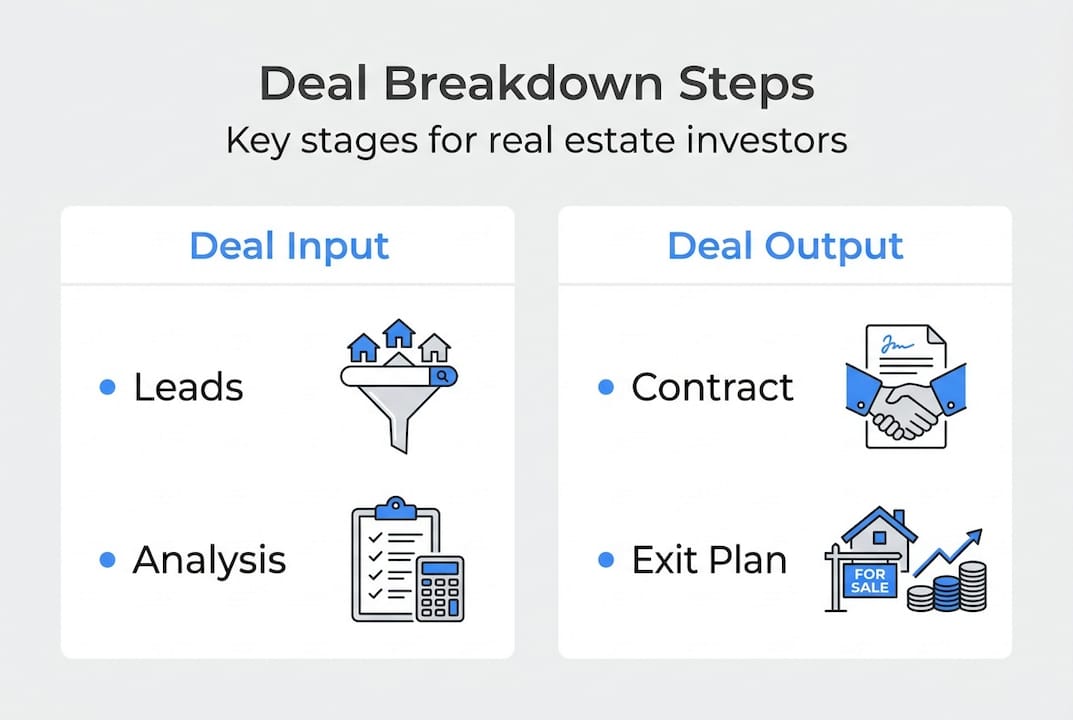
The typical deal process follows four stages:
- Identify: Find a motivated seller with a distressed property
- Analyze: Run the numbers using ARV, repair estimates, and fee calculations
- Contract: Secure a purchase agreement that includes an assignment clause
- Exit: Assign the contract to a cash buyer or double-close for your fee
Every stage requires skill. Identifying sellers takes consistent lead generation. Analyzing deals requires knowing your market. Contracting requires clear communication. Exiting requires a reliable buyer pipeline. Practicing each stage through real estate cold calling roleplay builds the muscle memory that makes the whole process feel natural. You can also find tactical breakdowns on the wholesaling tips blog to sharpen your approach at each stage.
The anatomy of a profitable real estate deal
Now that we have defined the deal, let us break down the mechanics that make a real estate transaction profitable.
Every wholesale deal revolves around four core numbers: ARV, repair costs, your wholesale fee, and the maximum allowable offer (MAO). Get these right and your deal works. Miss one and your margin disappears.
The 70% rule is the standard formula wholesalers use:
MAO = (ARV x 0.70) – Repairs – Wholesale Fee
Here is a quick example. If a property has an ARV of $200,000 and needs $30,000 in repairs, and you want a $10,000 wholesale fee:
- Multiply ARV by 70%: $200,000 x 0.70 = $140,000
- Subtract repairs: $140,000 – $30,000 = $110,000
- Subtract your fee: $110,000 – $10,000 = $100,000 MAO
Your offer to the seller should be no more than $100,000. Profitability drops without a 30%+ discount below ARV after repairs and fees, so do not stretch your numbers to make a deal “work” on paper.
Once you have a deal under contract, you have two main exit strategies:
| Exit strategy | How it works | Best for |
|---|---|---|
| Assignment | Sell your contract rights to a buyer for a fee | Beginners, simple deals |
| Double-close | Buy the property, then immediately resell | Privacy, higher-fee deals |
Assignment is faster and requires no capital. Double-closing gives you more control but involves two sets of closing costs. Most beginners start with assignment.
Pro Tip: Always use motivated seller opening lines that establish trust early. Sellers who feel respected are far more likely to accept your offer without pushing back on price.
The sequence that drives every deal is: Lead generation, then analysis, then contract, then exit strategy. Skipping or rushing any step is where deals fall apart.
How to find and approach the right sellers
With the deal structure in mind, the next step is finding sellers who fit the criteria.
Not every homeowner is a motivated seller. You are looking for people facing circumstances that make a fast, as-is sale appealing. The most common distressed seller profiles include:
- Foreclosure: Owners behind on mortgage payments who need to sell before the bank takes the property
- Inherited properties: Heirs who do not want to manage or maintain a property they did not plan for
- Absentee owners: Landlords managing properties from a distance who are tired of the hassle
- Tax delinquent owners: Homeowners who owe back taxes and face losing the property
- Divorce: Couples who need to liquidate shared assets quickly
Distressed owners in foreclosure or inheritance situations are key targets, and direct mail and cold calling are the central strategies for reaching them at scale.
Cold calling remains one of the most cost-effective lead generation tools available. It gives you real-time feedback, lets you qualify sellers instantly, and builds rapport faster than any mailer. Real estate cold calling done consistently, even 1 to 2 hours per day, compounds over time into a steady deal flow.
When you contact a seller, transparency is not optional. It is strategic. Disclose that you are an investor looking to purchase the property as-is. Sellers who feel misled will back out of contracts and damage your reputation in the market.
Pro Tip: Lead with empathy, not your offer. Ask open-ended questions about their situation before you ever mention price. Sellers who feel heard are far more likely to trust your numbers.
Your script should establish three things quickly: who you are, why you are calling, and how you can help. Credibility comes from confidence, not credentials. Practice until your opening feels natural, not rehearsed.
Securing contracts and maximizing your assignment fee
Once you have identified a deal, it is time to secure it and determine your profit.

A purchase contract with an assignment clause is the legal foundation of every wholesale deal. The assignment clause gives you the right to transfer your interest in the contract to another buyer. Without it, you cannot wholesale the deal. Always have a real estate attorney review your contract template before you use it.
Here is the typical sequence from contract to close:
- Negotiate and sign the purchase agreement with the seller
- Conduct due diligence: verify ARV, get repair estimates, confirm title is clean
- Market the deal to your cash buyer list
- Collect your assignment fee at closing
Your pre-foreclosure seller scripts should be refined enough to handle objections during the negotiation phase. Sellers in distress often have emotional barriers that a well-practiced script can address calmly.
Assignment fees vary widely based on experience and deal quality. Beginner wholesale fees average $3,000 to $5,000 per deal, while experienced wholesalers average $12,000 to $18,000. Fees are typically 5 to 8% of the property value.
| Experience level | Average assignment fee |
|---|---|
| Beginner | $3,000 to $5,000 |
| Intermediate | $8,000 to $12,000 |
| Experienced | $12,000 to $18,000+ |
To maximize your fee, focus on three factors: buying as far below ARV as possible, getting accurate repair estimates, and having a strong buyer list ready before you even go under contract.
Pro Tip: Red flags that kill deals include repair costs you cannot verify, sellers with title issues, and buyers who cannot close quickly. Vet all three before you commit.
Building a cash buyer pipeline for consistent success
Securing the contract is only half the battle. Now you need a plan for selling the deal.
Disposition, or selling your contract, can be harder than acquisition and is the key variable in whether deals actually close. Many new wholesalers spend all their energy finding deals and almost none building the buyer relationships needed to move them.
A strong cash buyer pipeline is built through consistent networking and relationship maintenance. Here is how to grow yours:
- Attend local real estate investment association (REIA) meetups
- Connect with buyers on platforms like BiggerPockets and Facebook groups
- Build a simple database with buyer criteria: location, price range, property type, and timeline
- Follow up after every deal, whether they bought or passed
- Ask every buyer for referrals to other active investors
Your buyer list is your business. A wholesaler with 50 vetted cash buyers can move deals in days. A wholesaler with no list sits on contracts until they expire.
Vetting buyers matters as much as finding them. A real buyer can provide proof of funds, has closed deals recently, and gives you a clear answer within 24 to 48 hours. Time-wasters cost you earnest money and seller trust.
Practicing your pre-foreclosure cold calling and vacant property calling skills also helps you understand what buyers are looking for, because you start recognizing deal patterns faster. Pairing that with foreclosure calling practice gives you a full picture of the distressed seller landscape.
Consistency in follow-up separates top wholesalers from average ones. Most sellers do not say yes on the first call. Most buyers do not buy the first deal you show them. The relationship compounds over time.
Most new wholesalers underestimate the real work and opportunity in deals
Here is something most wholesaling content will not tell you directly: the mechanics of a deal are learnable in a week. The discipline to execute them consistently is what takes months to build.
New wholesalers often stall because they are waiting to feel ready. They study formulas but avoid making calls. They build scripts but never practice objection handling. The learning curve is real, but it shortens dramatically with deliberate repetition.
What actually drives profits is not fancy negotiation. It is transparent communication, accurate numbers, and reliable follow-through. Sellers remember how you made them feel. Buyers remember whether you delivered. Both relationships feed your next deal.
Assignment fees add up faster than most people expect when you stop chasing home runs and focus on consistent singles. A $10,000 fee every three weeks is $170,000 a year. That is not a fantasy. That is what disciplined wholesalers on the real stories from the field are doing right now. The edge is not secret knowledge. It is showing up and practicing when others do not.
Level up your deal-making: practice and close more deals
Ready to put these strategies into action? The fastest way to close more deals is to sharpen the skills that drive them, especially your ability to connect with distressed sellers on the phone.
At Closers League, our AI-powered platform lets you practice real conversations with simulated sellers, including inherited property practice and tired landlord practice scenarios. You get scored on empathy, objection handling, and closing technique so you know exactly where to improve. Whether you are new or scaling up, our AI roleplay for cold calling gives you the reps that turn strategy into results. Stop winging it. Start drilling.
Frequently asked questions
How do you calculate if a real estate deal is profitable?
Use the 70% rule: Maximum Allowable Offer = (ARV x 0.70) minus repairs minus your wholesale fee. If your offer exceeds this number, the deal likely does not have enough margin to work.
What is a typical wholesale fee in real estate?
Most wholesale fees average $8,000 to $12,000 per deal, which typically represents 5 to 8% of the property value. Experienced wholesalers can earn significantly more on higher-value properties.
How long does it take to close your first wholesale deal?
Your first deal averages 2 to 3 months from start to close. Consistent lead generation and a pre-built buyer list can shorten that timeline considerably.
What are the key risks to avoid in wholesale deals?
Avoid deals with tight margins and unclear repairs, and never skip due diligence on title status or buyer credibility. These are the three most common reasons deals fall apart at the last minute.
Recommended
- Real Estate Cold Calling Practice — AI Roleplay for Every Seller Type | ClosersLeague
- AI Cold Calling Practice for Real Estate Investors & Wholesalers | ClosersLeague
- Cold Calling Tips & Real Estate Wholesaling Blog — ClosersLeague
- The Exact Opening Line to Keep Motivated Sellers Talking — ClosersLeague