
You’re two sentences into your pitch when the homeowner says it. “I’m not interested.” Click. Knowing how to handle “I’m not interested” on a real estate cold call is one of the most valuable skills you can build as an investor or wholesaler. Most agents treat it as a dead end. It isn’t. That phrase is almost always an emotional reflex, not a logical decision. The homeowner didn’t evaluate your offer. They reacted to the pressure of an unexpected call. Understanding that difference is what separates agents who convert distressed leads from agents who burn through lists and quit.
Table of Contents
- Key Takeaways
- Understanding the psychology behind “I’m not interested”
- Preparation techniques that reduce instant disinterest
- Execution strategies when you hear “I’m not interested”
- Handling rejection and building resilience across calling sessions
- My take on turning “not interested” into an opportunity
- Practice “not interested” responses before your next live call
- FAQ
Key Takeaways
| Point | Details |
|---|---|
| “Not interested” is a reflex | Prospects react emotionally to cold calls, not logically, so emotional responses outperform logical rebuttals. |
| Preparation reduces flat rejections | Researching property details and tailoring your opener creates immediate relevance and lowers instant disinterest. |
| Agree first, then redirect | Emotionally aligning with the prospect before asking a follow-up question keeps the conversation alive. |
| Rejection is a numbers game | Knowing your conversion rate depersonalizes each “no” and protects your long-term resilience. |
| Practice changes your default response | Drilling objection handling in a safe environment rewires how you respond under pressure on real calls. |
Understanding the psychology behind “I’m not interested”
Most real estate investors hear “I’m not interested” and immediately reach for a counter-argument. That instinct is wrong. The phrase is almost always an emotional reflex designed to end an uncomfortable situation, not a reasoned decision based on your offer.
Think about what the homeowner is experiencing when your call comes in. They don’t know you. They weren’t expecting the call. Their guard goes up instantly. In that moment, the fastest way to make the discomfort stop is to say “not interested” and hang up. They aren’t rejecting your deal. They’re rejecting the pressure.
Here’s why this matters for how you respond:
- Logical pitches fail at this stage. If you immediately explain your offer, your cash closing timeline, or your no-fee process, you’re speaking to a brain that has already decided to shut down. Logic doesn’t land on a defensive prospect.
- Emotional mirroring disarms the reflex. When you acknowledge their reaction instead of pushing past it, the homeowner feels heard. That’s when their guard starts to come down.
- The real objection is often hidden. Many prospects who say “not interested” are actually dealing with probate delays, uncertainty about selling, or family disagreements. Understanding real objections only happens after you get past the reflex.
- Tone matters more than words. A calm, unhurried voice signals that you’re not a pushy salesperson. That signal alone buys you extra seconds on the call.
Pro Tip: Before your next calling session, record yourself saying your opener out loud. Listen for urgency or tension in your voice. If you sound rushed, prospects will feel it before they even process your words.
The shift from “how do I overcome this objection” to “how do I acknowledge this emotion” is what changes your results. Emotional responses work better than logical ones at this stage of the conversation, every single time.
Preparation techniques that reduce instant disinterest
The best time to handle “I’m not interested” is before the call starts. Agents who walk in cold, with a generic opener and no property context, are practically inviting the reflex response. Preparation changes that.
Researching the prospect’s property details and the local market before you dial gives you the ammunition to open with something specific. Specific beats generic every time. “I noticed your home on Maple Street has been in the family for over 30 years” is a completely different opener than “I’m looking to buy homes in your area.” One creates relevance. The other sounds like every other wholesaler who called that week.
Here’s how to build a preparation routine that reduces flat rejections:
- Pull property records before every call. Know the owner’s name, how long they’ve owned the property, and whether there are any tax liens, code violations, or probate flags attached to it.
- Check the neighborhood. Has the area seen recent distress sales? Are values dropping? Context gives you something to open a real conversation with.
- Write three custom openers per list segment. A foreclosure lead, a probate lead, and a divorce lead each need a different first line. One script doesn’t fit all three emotional states.
- Avoid intrusive openers. Starting with “I know you’re going through a tough time” sounds presumptuous. Instead, lead with a factual observation that shows you’ve done your homework.
| Opener type | Example | Why it works |
|---|---|---|
| Property-specific | “I saw your property on Oak Ave has been vacant for about a year.” | Shows research, creates relevance immediately |
| Market-informed | “I’ve been buying in your zip code and wanted to reach out directly.” | Positions you as active and local, not random |
| Empathy-led | “I work with homeowners in situations like yours and wanted to learn more.” | Lowers guard without assuming their circumstances |
| Curiosity-driven | “I came across your property and had a quick question for you.” | Triggers natural curiosity before any pitch |
Using curiosity in your opener is particularly effective. Tracking and testing different scripts on small call batches lets you identify which openers produce the most conversation time before a hang-up. That data is more useful than any generic script.
Execution strategies when you hear “I’m not interested”
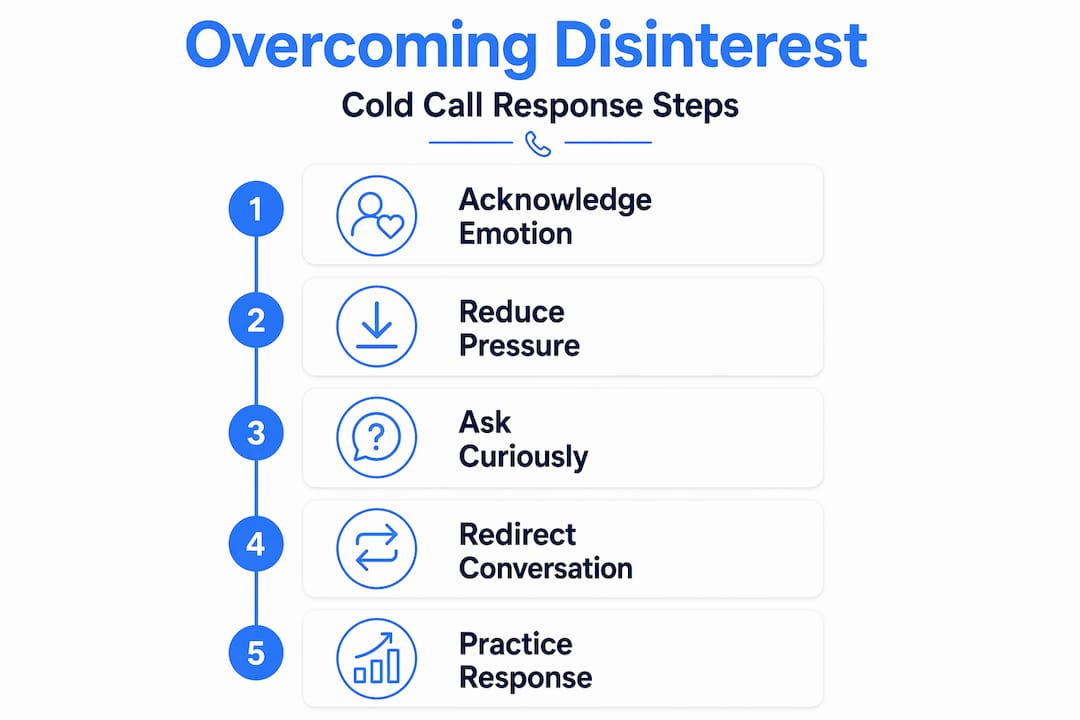
This is where most investors either recover the call or lose it permanently. Your first three seconds after hearing “not interested” define the entire outcome. Here’s a step-by-step framework that actually works.
-
Agree with them immediately. Don’t pause, don’t stammer. Say something like: “That’s completely fair. Most people I call feel the same way at first.” This does something powerful. It removes the argument. The homeowner expected pushback. When they don’t get it, curiosity takes over.
-
Use brief self-deprecation to humanize the call. Saying “I know this is probably the last call you wanted today” is disarming. Acknowledging the call is cold with a touch of humor buys you roughly 15 more seconds, and those seconds matter.
-
Ask one specific follow-up question. This is the pivot point. Instead of re-pitching, ask: “Can I ask what specifically you’re not interested in? I just want to make sure I’m not wasting your time.” Asking this question encourages the prospect to open up, often revealing the actual barrier underneath the reflex.
-
Ask permission to take 30 seconds. If the homeowner is still on the line, say: “Would you give me 30 seconds to explain why I called? If it still doesn’t make sense, I’ll let you go.” This repositions you as respectful of their time, not desperate.
-
Listen more than you talk. Allowing prospects to speak 70% of the time during a recovered conversation uncovers real pain points. You learn whether it’s a pricing concern, a family situation, or simply bad timing. That information shapes every future touchpoint.
Pro Tip: Write out your “agree and redirect” response and practice it until it sounds completely natural. If it sounds rehearsed on the call, it loses its effect. The goal is to respond to “not interested” the same way you’d respond to a friend saying they’re busy.
Here’s what a solid full response sounds like in practice: “That’s completely fair. Most people feel that way when I call out of nowhere. Can I just ask what specifically isn’t a fit? I want to make sure I’m not calling back at the wrong time.” Clean. Non-pushy. Respectful. And it keeps the door open.

Handling rejection and building resilience across calling sessions
Even with the best scripts and preparation, rejection is constant in real estate cold calling. The agents who last are the ones who manage their emotional response to rejection as deliberately as they manage their scripts.
Sales experts consistently advise treating rejection as a statistical necessity rather than a personal failure. If your conversion rate is one lead per 20 calls, then every “not interested” is simply one step closer to the next deal. That reframe sounds simple. It’s actually one of the most productive mental shifts you can make.
Here’s how to build resilience into your daily workflow:
- Take physical reset breaks after tough calls. Stand up, walk around, get water. A two-minute break resets your vocal tone and mental state for the next dial. Calling back-to-back through frustration puts tension in your voice, and prospects hear it.
- Track your outcomes, not just your feelings. Keep a simple call log: total dials, conversations, callbacks, leads. Seeing your numbers in front of you makes rejection feel like data. Knowing your conversion metrics depersonalizes each “no” and keeps your focus on the process.
- Automate your post-call notes. Manual note-taking after calls creates backlogs and drains mental energy. Use CRM automation to log call outcomes, schedule follow-ups, and capture key details while you stay focused on the next conversation.
- Review your call patterns weekly, not daily. Daily reviews make bad sessions feel catastrophic. Weekly reviews reveal trends. That’s when you start to see which list segments respond better, which openers fall flat, and which follow-up timing works.
- Set a minimum call goal, not a result goal. You can’t control whether a homeowner answers or wants to sell. You can control how many calls you make. Focus on the input, and the output follows.
Persistence paired with strategic breaks maintains your energy across long sessions. Cold calling is a skill built through volume and reflection. Not one without the other.
My take on turning “not interested” into an opportunity
I’ve reviewed hundreds of real estate cold calls, and the pattern is almost identical every time an investor struggles. They hear “not interested” and their brain shifts into argument mode. They start explaining the offer. They push harder. The homeowner hangs up.
What I’ve learned from the calls that actually convert is that emotional intelligence matters more than any script. The agents who perform consistently don’t have better words. They have better instincts about when to slow down and when to ask a question instead of making a statement.
The most common mistake I see is treating “not interested” as the homeowner telling you something about your deal. They’re not. They’re telling you something about how they feel in that moment. When you respond to the feeling instead of the objection, the dynamic shifts. I’ve watched investors turn what started as a one-second hang-up attempt into a 20-minute conversation with a motivated seller, simply by saying “That makes total sense. Can I ask why?”
Mindset is the part of cold calling that almost no one trains for deliberately. You can improve your cold calling approach with better scripts and research. But if you’re carrying the emotional weight of the last 10 rejections into the next call, your tone will betray you before you finish your opener. The work is internal as much as it is tactical.
Stop treating every rejection as something to fix. Start treating it as information.
— Dave
Practice “not interested” responses before your next live call
Knowing how to respond to disinterest is one thing. Doing it smoothly under pressure is another. That’s exactly where most investors lose ground. The theory is clear, but the execution breaks down on live calls because you’ve never actually drilled it.
Closersleague is built for this. Our AI-powered cold calling practice platform puts you in realistic roleplay scenarios with every seller type: foreclosure, probate, divorce, tax delinquent, and more. You’ll hear “I’m not interested” the way real homeowners say it, and you’ll get scored on how you respond. Every session builds the muscle memory you need to stay calm, stay on script, and turn more conversations into leads. Stop winging it. Start drilling.
FAQ
What does “I’m not interested” really mean on a cold call?
It almost always means the homeowner is reacting to the pressure of an unexpected call, not evaluating your offer. It’s an emotional reflex, not a logical decision, which is why emotional responses work better than counter-arguments.
What’s the best response to “I’m not interested” on a real estate cold call?
Agree with the objection first to reduce pressure, then ask a specific follow-up question like “What specifically aren’t you interested in?” This keeps the conversation open and often reveals the real barrier beneath the reflex.
How do I stop taking cold call rejection personally?
Track your call metrics and know your conversion rate. Viewing rejection statistically shifts your mindset from personal failure to necessary process. If one in 20 calls converts, every “no” is simply progress toward the next “yes.”
How can I reduce “not interested” responses before they happen?
Research each prospect’s property details and tailor your opener to their specific situation. A specific, relevant opener dramatically lowers the chance of an instant reflex rejection because it signals you’re not just another generic caller.
How does practice improve objection handling in real estate cold calls?
Repetition rewires your default response under pressure. Drilling objection scenarios in a roleplay environment, like the AI practice sessions on Closersleague, trains you to respond calmly and effectively before you’re in a live situation where the stakes are real.
Recommended
- Real Estate Cold Calling Practice — AI Roleplay for Every Seller Type | ClosersLeague
- 10 proven cold calling tips for real estate investors – ClosersLeague Blog
- Distressed Seller Cold Calling Scripts That Convert
- Vacant Property Cold Calling Practice — AI Roleplay for Real Estate Investors & Wholesalers