
Cold calling distressed property owners is one of the most direct paths to real estate deals, and also one of the most humbling. Even the best investors hear “no” nine times out of ten. But here is the reality: the right script does not just make you sound better. It makes you think faster, handle pressure more calmly, and turn more conversations into contracts. Cold calling fills 15-20% of pipelines for active investors when done consistently. This guide walks you through exactly how to build scripts that work, handle objections without freezing, and track results so your process keeps improving.
Table of Contents
- Understand your audience and goals before dialing
- Essential components of an effective real estate call script
- Handling objections and keeping the conversation alive
- Measuring, adapting, and scaling your cold call scripting process
- What most real estate cold calling guides miss
- Level up your real estate calls with ClosersLeague
- Frequently asked questions
Key Takeaways
| Point | Details |
|---|---|
| Know your audience | Scripts that fit the seller’s unique situation get better results. |
| Follow proven structure | Use a script with a clear opener, purpose, credibility, and qualifying questions. |
| Expect objections | Be ready for rejection; effective responses turn conversations into deals. |
| Track and adapt | Regular tracking and script tweaks lead to higher conversion rates over time. |
Understand your audience and goals before dialing
Before you write a single word of your script, you need to know who you are calling and why they might want to talk to you. Distressed sellers are not a single type. A homeowner facing foreclosure has a very different emotional state and timeline than someone managing a probate property or going through a divorce. Your script must reflect that difference.
Foreclose sellers are often scared and embarrassed. They need to feel safe before they will open up. Probate sellers may be grieving and overwhelmed by paperwork. Divorce sellers can be frustrated, impatient, or just ready to move on quickly. Each of these motivations changes what you lead with and what questions you ask.
Your call objective also shifts depending on who you are calling. For a pre-foreclosure lead, your goal might be to book an appointment. For a vacant property owner, your first goal might just be to confirm ownership and gather basic information. For a probate lead, building rapport over two or three calls is often more realistic than closing anything on the first contact. Practice pre-foreclosure call scenarios and vacant property calls separately so you build the right instincts for each.
Seller motivation triggers to listen for:
- Mentions of a court date or bank letters (foreclosure)
- References to a deceased family member or estate attorney (probate)
- Frustration about a spouse or co-owner (divorce)
- Long-distance ownership or vacant home mentions (absentee/vacant)
- Complaints about tenants or unpaid taxes (tired landlord or tax delinquent)
| Seller type | Primary emotion | Call objective |
|---|---|---|
| Pre-foreclosure | Fear, urgency | Book appointment |
| Probate | Grief, overwhelm | Build rapport, gather info |
| Divorce | Frustration, speed | Qualify and schedule |
| Vacant/absentee | Indifference | Confirm ownership, open dialog |
| Tax delinquent | Stress, avoidance | Educate, offer solution |
Pro Tip: Always open with a question that shows you understand their specific situation. “I noticed the property on [street name] may be going through some changes. Is that something you are looking to resolve soon?” That kind of opener signals empathy before you say anything about buying.
Essential components of an effective real estate call script
With your audience and goals clear, you can build a script that fits both you and the seller. A script is not a rigid speech. It is a framework that keeps you on track when nerves kick in or the conversation goes sideways.
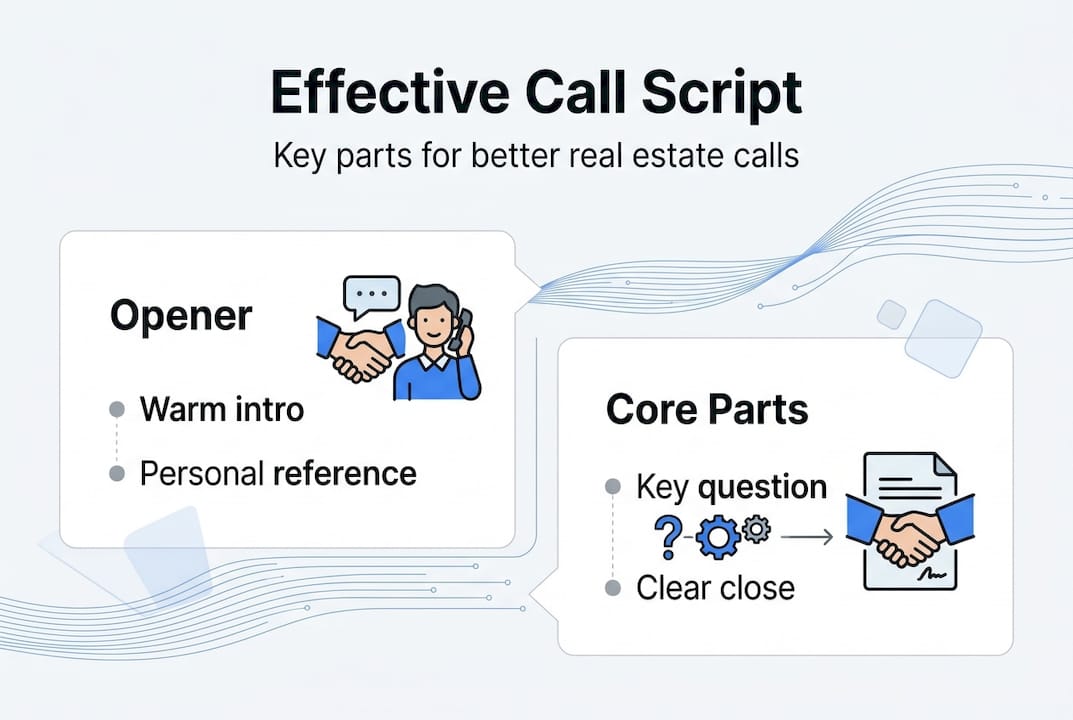
Every strong script follows a logical flow. Sellers decide in the first 10 seconds whether they want to keep talking, so your opener carries serious weight. Skip the generic “Hi, my name is…” pitch. Instead, reference something specific: the property address, a recent notice, or a neighborhood they know.

Best performers convert 5.2% of calls into appointments, while the average sits at just 1.7%. That gap is almost entirely explained by script quality and delivery. And since 68% of calls hit voicemail, your script also needs a tight voicemail version that earns a callback without sounding like a sales robot.
Step-by-step script structure:
- Greeting and name use — Use their first name immediately. It signals you are not a random robocall.
- Purpose statement — Be honest and brief. “I work with homeowners in [city] who are looking for a fast, simple sale.”
- Credibility line — One sentence that establishes you are real. “We have closed deals in your neighborhood recently.”
- Empathy bridge — Acknowledge their situation without assuming. “I know this kind of situation can feel overwhelming.”
- Qualifying question — Open-ended and low pressure. “Are you open to exploring your options at all?”
- Next step — Always close toward something specific: a call back, a meeting, or permission to follow up.
| Script version | Opener style | Best for |
|---|---|---|
| Foreclosure script | Reference the notice or timeline | Urgency-driven sellers |
| Probate script | Lead with condolences, then purpose | Sensitive, longer sales cycle |
| Divorce script | Neutral tone, focus on speed and simplicity | Sellers wanting quick resolution |
| Vacant/absentee script | Curiosity-based, non-threatening | Low-engagement owners |
Practice these variations using AI cold calling scripting tools and run through divorce property scenarios until the flow feels natural, not rehearsed.
Handling objections and keeping the conversation alive
Even with a strong script, you will get pushback. What matters is how you handle it. Most investors freeze when they hear “not interested” because they treat it as a final answer. It rarely is. It usually means “I do not trust you yet” or “I do not understand what you are offering.”
Rejection is part of the game; persistence is what separates investors who build real pipelines from those who quit after two bad days.
“Even the top closers in real estate hear ‘no’ the vast majority of the time. The difference is they do not take it personally. They treat every objection as a question in disguise.” — Real estate coaching principle shared across top investor training programs
Common objections and how to respond:
- “I am not interested.” Reply: “That is completely fair. Can I ask, is it the timing or the idea of selling that does not feel right?”
- “I am already working with an agent.” Reply: “Great, I respect that. We actually work alongside agents sometimes. Would it hurt to hear what we could offer as a backup option?”
- “Now is not the right time.” Reply: “I understand. When do you think would be a better time to revisit this? I am happy to follow up then.”
- “How did you get my number?” Reply: “Public records, actually. I focus on properties in this area and yours came up. Is that okay?”
- “I do not want to sell below market.” Reply: “That makes sense. We are not always the right fit, but can I share how our process works so you can decide for yourself?”
Pro Tip: Mirror the seller’s language. If they say “the house,” say “the house,” not “the property.” Small word matches build subconscious trust faster than any scripted line.
When a conversation stalls, ask more questions rather than making more statements. Silence feels uncomfortable, but sellers often fill it with useful information. Practice foreclosure objection handling and tired landlord objections until your responses feel automatic.
Measuring, adapting, and scaling your cold call scripting process
Mastering objection handling is only half the battle. Ongoing tracking and improvement drive true results. If you are not measuring what happens on each call, you are guessing at what to fix.
Metrics to track on every call:
- Connect rate — How many calls result in a live conversation?
- Objection type — What is the most common pushback you hear?
- Next step rate — How often do you close toward a specific action?
- Appointment rate — How many conversations convert to a scheduled meeting?
- Lead to deal conversion — How many leads eventually close?
100 calls typically yield 10 to 20 conversations, 3 to 5 qualified leads, and roughly 1 deal. Top performers beat those numbers through consistent script refinement, not just more volume.
| Metric | Average performer | Top performer |
|---|---|---|
| Connect rate | 10-15% | 20-25% |
| Appointment rate | 1.7% | 5.2% |
| Leads per 100 calls | 3-5 | 6-10 |
| Deals per 100 calls | 1 | 2-3 |
AI dialers and bulk calling tools are great for volume, but they work best once your script is already proven. Use personal one-to-one calls to test and refine language first. Once you know what works, scale with technology. Track results for inherited property leads and tax delinquent call tracking separately, since each audience responds differently.
Review your numbers monthly. Make one or two small script changes at a time so you can actually measure what moved the needle. Changing everything at once makes it impossible to know what worked.
What most real estate cold calling guides miss
Here is something worth saying plainly: most cold calling guides focus almost entirely on what to say. They hand you a script and send you off. But the investors who build real, lasting pipelines rarely credit a specific line. They credit consistency and genuine listening.
There is a growing overreliance on tech shortcuts. AI dialers, automated follow-up, skip tracing tools. These are useful. But they do not replace the moment when a seller feels heard and decides to trust you. That moment is human. It comes from practice, not software.
Seasoned investors will tell you the same thing: they stopped reading their scripts years ago. What they remember is the pause they took when a seller mentioned a sick family member, or the time they asked one more question instead of pitching. Those moments built the deals.
Empathy and persistence outlast any platform update. Use deep practice tools to drill real objections, not just read scripts silently. The goal is to internalize the framework so you can be fully present in the conversation, not just reciting lines.
Level up your real estate calls with ClosersLeague
If you are ready to see your results improve, there is a faster way to close the gap between knowing the script and owning the conversation.

ClosersLeague is an AI powered cold calling training platform built specifically for real estate investors and wholesalers. You can practice real estate cold calling scenarios across every major seller type, from inherited property situations to vacant property roleplay. The platform gives you instant feedback on tone, objection handling, and script flow. Stop winging it. Start drilling with scenarios that match your actual leads, and watch your connect rates climb.
Frequently asked questions
How many cold calls does it take to get a real estate deal?
On average, 100 calls yield 1 deal, but top performers close more often by refining their scripts and staying consistent with follow-up.
What’s the best opener for real estate cold calls?
Personalized openers that use the seller’s name and acknowledge their specific situation, such as referencing the property address or a known life event, consistently outperform generic pitches because they signal genuine intent rather than mass outreach.
How should I handle rejection on real estate calls?
Expect most calls to end in a “no” or voicemail since 68% hit voicemail; treat every objection as a question in disguise and use it to sharpen your script for the next call.
Do AI dialers or scripts outperform personal calls?
AI tools accelerate volume and are great for scaling a proven script, but the initial trust that converts a distressed seller into a real lead still comes from a human, empathetic conversation.
Recommended
- Real Estate Cold Calling Practice — AI Roleplay for Every Seller Type | ClosersLeague
- Tired Landlord Cold Calling Practice — AI Roleplay for Real Estate Investors & Wholesalers
- Vacant Property Cold Calling Practice — AI Roleplay for Real Estate Investors & Wholesalers
- Pre-Foreclosure Cold Calling Practice — AI Roleplay for Real Estate Investors & Wholesalers