
Most real estate investors and wholesalers know the frustration: you spend 20 minutes on a call, think you have a warm lead, and then the seller ghosts you. Knowing how to uncover seller motivation in real estate separates professionals who close deals consistently from those who chase dead ends. True motivation is rarely announced upfront. It lives beneath the surface, buried in context clues, public data, and the questions you ask. This guide shows you how to find it, verify it, and act on it before your competition does.
Table of Contents
- Key Takeaways
- How to uncover seller motivation real estate: the foundational framework
- Reading public records before first contact
- Probing questions that reveal true seller intent
- Common mistakes in seller motivation assessment
- Verifying motivation and building a high-quality pipeline
- My take on what actually works
- Practice your way to better deals with Closersleague
- FAQ
Key Takeaways
| Point | Details |
|---|---|
| Motivation beats price every time | Truly motivated sellers prioritize speed and certainty over getting top dollar for their property. |
| Data stacking reveals real intent | Combining three or more public record signals creates a high-confidence lead before you make first contact. |
| Probing questions unlock pain points | Open-ended questions that make sellers describe their problem in their own words reveal genuine urgency. |
| Timing matters in probate | The 4-6 month post-filing window is the highest-conversion period for probate outreach. |
| Follow-up confirms evolving motivation | A single conversation never tells the full story. Consistent outreach reveals how motivation changes over time. |
How to uncover seller motivation real estate: the foundational framework
Before you dial a number or send a text, you need a model for understanding what motivation actually means. A motivated seller is not just someone who wants to sell. It’s someone who needs to sell, and that need creates urgency that price alone can’t explain. Motivated sellers prioritize quick closing due to financial or personal distress, often accepting below-market offers in exchange for speed and certainty.
Think of real estate seller motivations through what we call the motivation triangle: pressure, timeline, and options. Pressure is the force driving action (financial stress, a looming foreclosure date, a divorce decree). Timeline is the window they’re working within. Options represent how many alternatives they believe they have. The fewer the options and the tighter the timeline, the stronger the motivation.
The four pillars that make this framework operational are:
- Condition: Is the property distressed, neglected, or carrying deferred maintenance the seller can’t afford?
- Timeline: Does the seller have a hard deadline, like an auction date or a court order?
- Motivation: What life event is forcing action? Job loss, death in the family, relocation?
- Price: Are they anchored to a number, or are they flexible based on terms and speed?
A seller who scores high on all four pillars is your best lead. One who only has a low asking price is just a negotiator. Don’t confuse the two.
Factors driving home sales in the distressed space include pre-foreclosure notices, probate filings, divorce proceedings, tax delinquency, and code violations. Each of these creates a different emotional state and a different outreach approach. Understanding seller psychology at this level is what separates average investors from top closers.
Reading public records before first contact
The best conversations start before you ever pick up the phone. Public records give you a preview of seller motivation that most investors ignore entirely.

Here’s a comparison of the most common public record indicators and what each tells you:
| Indicator | Motivation signal strength | Best use case |
|---|---|---|
| Pre-foreclosure notice | Very high | Immediate financial pressure, short timeline |
| Tax delinquency (2+ years) | High | Financial strain, often absentee or overwhelmed owner |
| Probate filing | High (timing-dependent) | Life event driver, property often not maintained |
| Absentee ownership | Moderate | Owner not managing property actively, potential burden |
| Vacancy + code violations | High (combined) | Property is a liability, seller may be eager to exit |
| Divorce filing | High | Forced sale often required by court order |
The real power comes from stacking multiple distress indicators to create a high-confidence signal. A single indicator like absentee ownership is weak on its own. Add tax delinquency and a code violation, and you’re looking at a seller who is almost certainly feeling the pressure of ownership without the capacity to act. Three or more overlapping indicators outperform any single-signal list in terms of lead conversion.
Pro Tip: When running your list, filter for at least three co-occurring indicators before prioritizing a lead. This cuts your outreach list in half but dramatically improves your conversion rate per call.
For probate specifically, timing is everything. 90% of probate properties close within 12 months of filing, but the peak motivation window sits at 4-6 months post-filing. Too early and the family is grieving. Too late and another investor beat you to it. Your skip tracing and data alerts should be set up to surface probate leads right in that window.
Automated data platforms save time but carry a risk: stale data. A lead that was pre-foreclosure six months ago might have already resolved the notice. Always verify contact information and record dates before calling. Manual cross-referencing with county records takes more time but catches errors that automated feeds miss. Your lead qualification process should include a data freshness check as a standard step.
Probing questions that reveal true seller intent
Data tells you who to call. Your conversation tells you why they’ll sell to you. This is where identifying seller intent moves from research into execution.
There’s an important distinction between discovery questions and probing questions. Discovery questions gather basic facts: how long have you owned the property, is it occupied, are you behind on payments? Probing questions go deeper. They ask sellers to describe the emotional and financial weight of their situation in their own words. Top sales professionals use open-ended diagnostic questions that compel sellers to articulate their problem rather than just confirm facts.
Questions that consistently surface real motivation:
- “What’s changed recently that has you thinking about selling?”
- “If you didn’t sell in the next 60 days, what does that look like for you?”
- “Have you explored other options, like renting it out or refinancing?”
- “What would the ideal outcome look like for you if everything went smoothly?”
- “Is there a date on the calendar that matters to you, like a court date or a move date?”
The third question is especially revealing. Motivated sellers rationally prioritize speed and certainty to avoid carrying costs and emotional burden. If they’ve already ruled out other options or haven’t even considered them, they’re operating with limited alternatives, which places them firmly in the motivated category.
Watch for what sellers say and how they say it. Motivated sellers discuss specific deadlines and show flexibility on terms like closing date and repairs. A seller who says “I need to be out by March 15 because the bank is moving forward” is giving you a timeline you can work with. A seller who says “I’d like to sell sometime this year if the price is right” is giving you a stall.
Pro Tip: After every probing question, stay quiet for at least five seconds. Silence creates discomfort that sellers fill with information. The most useful things sellers tell you often come right after a pause.
Warning signs of low motivation: vague timelines, refusal to disclose financial status, reluctance to let you see the property, and conversation that keeps circling back to price. These are not bad leads necessarily. They’re just not ready yet. Tag them and re-engage in 30 to 60 days.
70% of purchasing decisions are driven by solving a problem, not by features or price points. The same principle applies to motivated sellers. Your job on the call is to help them clearly see the cost of not acting, which is what quantifying the cost of inaction through probing questions accomplishes.
Common mistakes in seller motivation assessment
Even experienced investors misread seller motivation. Here are the most common errors and how to correct them:
-
Over-relying on a single data signal. A tax delinquent property sounds like a great lead until you find out the owner is a serial real estate investor using delinquency as a cash flow strategy. Stacking matters.
-
Talking more than the seller. If you’re pitching your offer before you’ve asked three probing questions, you’ve made the call about you instead of them. Ask, listen, repeat.
-
Ignoring deadline nuances. A seller with a foreclosure auction in 45 days needs a different conversation than one with a probate case at month two. Calendar context shapes your entire approach.
-
Treating motivation as static. A seller who wasn’t motivated in January might be in crisis by April. Failing to re-engage leads with scheduled follow-ups means missing conversions that were already earned.
-
Using generic scripts for every seller type. A divorce seller has a completely different emotional state than a probate seller. Generic messaging feels disconnected and kills trust instantly. Tailor your language to the specific life event driving the sale.
Verifying motivation and building a high-quality pipeline
Once a conversation confirms potential motivation, your job shifts to verification and prioritization. This is where your real estate outreach methods need structure.
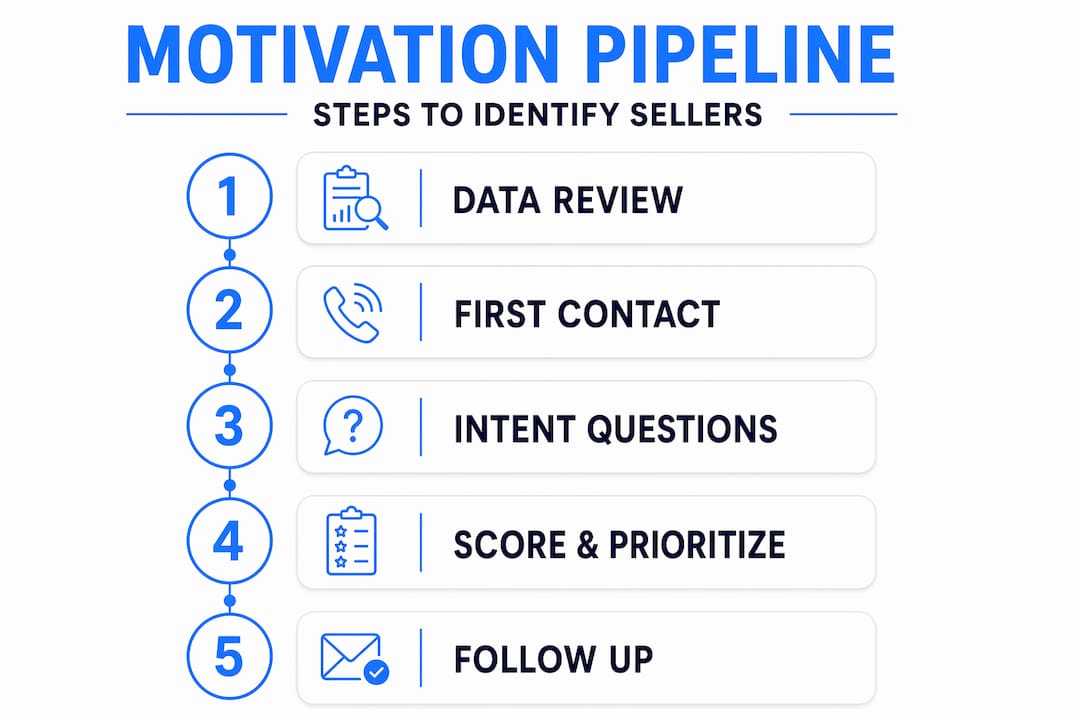
A scoring framework keeps your pipeline honest. Consider scoring leads across these dimensions:
| Scoring category | Low (1) | Medium (3) | High (5) |
|---|---|---|---|
| Timeline clarity | Vague or no deadline | 3-6 months out | Hard deadline under 60 days |
| Financial pressure | No distress signals | One indicator present | Multiple stacked indicators |
| Communication responsiveness | Hard to reach | Responsive but guarded | Actively engaged, asks questions |
| Flexibility on terms | Fixed on price and close | Open to one concession | Flexible on price, date, and repairs |
| Options exhausted | Many alternatives | Some alternatives | No alternatives left |
Motivated sellers show high responsiveness during outreach. A seller who calls you back within hours, volunteers information without being asked, and asks about your process is signaling genuine urgency. Prioritize those leads for same-week follow-up.
Three core qualification questions cover situation, timeline, and price expectations. Use these to quickly assign an initial score and determine follow-up cadence. High-score leads get weekly contact. Mid-score leads get bi-weekly nurturing. Low-score leads stay in a monthly drip until circumstances change.
Data freshness should be reviewed at least every 30 days for active leads. A pre-foreclosure notice resolved is a cold lead. A probate case that just entered month four is now hot. Build data alerts into your workflow so changes surface automatically. Pair those alerts with your prospecting workflow so nothing falls through the cracks.
My take on what actually works
I’ve worked with hundreds of real estate investors and wholesalers, and the pattern I see most often is this: investors who struggle to close are usually gathering information, while investors who close consistently are diagnosing problems.
There’s a real difference. Gathering information means asking questions to fill out your intake form. Diagnosing means asking questions that help the seller understand their own situation more clearly. When a seller says “I hadn’t really thought about it like that,” you’ve moved from interview to advisor. That shift changes everything.
The hidden cost of missing motivation signals isn’t just a wasted call. It’s a wasted week chasing follow-ups on cold leads while your actual deals sit unworked in a spreadsheet. I’ve seen investors with 500 leads close fewer deals than investors with 80 well-scored, data-stacked leads. Volume without quality is just noise.
Motivation stacking changed my perspective on lead generation entirely. Once I started requiring at least three distress indicators before prioritizing a call, my connect-to-offer ratio improved significantly. Not because I was making better offers, but because I was having better conversations with people who actually needed help.
Empathy matters more than most investors admit. You’re often calling someone on the worst day of their financial life. The investors who close most consistently aren’t the ones with the sharpest negotiation tactics. They’re the ones who make sellers feel heard. That takes deliberate practice, not just a script.
— Dave
Practice your way to better deals with Closersleague
Understanding seller motivation theory is one thing. Executing it live on a cold call is another. Closersleague is an AI-powered cold calling training platform built for real estate investors and wholesalers who want to sharpen their skills before the stakes are real.

With Closersleague, you can practice probing questions in AI roleplays that simulate motivated sellers across every scenario: pre-foreclosure, probate, divorce, and tax delinquency. Each session scores your performance and shows you exactly where conversations break down. You can also drill pre-foreclosure cold calling conversations specifically, building the confidence to handle high-pressure timelines without fumbling your opener. Stop winging it. Start drilling.
FAQ
What makes a seller truly motivated in real estate?
A truly motivated seller prioritizes speed and certainty over price, often because of financial distress, a life event, or a hard deadline. Sellers in this category typically need to close within 30 days and have limited alternatives available.
How many public record signals should I stack before calling a lead?
Stacking at least three co-occurring distress indicators, such as absentee ownership, tax delinquency, and vacancy, creates a high-confidence lead that significantly outperforms single-signal lists. This approach reduces wasted calls and improves your offer conversion rate.
What questions reveal genuine seller motivation on a call?
Ask about their timeline, what happens if they don’t sell, and whether they’ve explored other options. Open-ended questions that make sellers describe their situation in their own words expose urgency far better than yes/no qualification questions.
When is the best time to contact probate leads?
The peak conversion window for probate sellers is 4-6 months after the initial filing. This period balances emotional readiness with mounting financial pressure, making sellers more receptive to a serious offer.
How often should I re-evaluate a seller’s motivation level?
Motivation changes. Review active leads at least every 30 days and update your scoring based on any new data signals, changes in responsiveness, or shifts in their stated timeline. A cold lead in January can become your best deal in April.
Recommended
- Real estate outreach: proven methods for investors
- Boost Real Estate Deals with a Proven Investor Script Workflow – ClosersLeague Blog
- Real Estate Cold Calling Practice — AI Roleplay for Every Seller Type | ClosersLeague
- Vacant Property Cold Calling Practice — AI Roleplay for Real Estate Investors & Wholesalers