
Most investors assume more dials equal more deals. That logic is costing you time and money. Cold calling yields a call-to-appointment rate of just 1.7%, which means volume alone will never save a weak strategy. The real edge comes from targeting the right sellers, using the right message, and layering in AI to sharpen every rep. This guide breaks down exactly how to build a lead generation system that works, from choosing your lists to measuring what matters. If you’re ready to stop grinding through bad leads and start closing motivated sellers, this is your roadmap.
Table of Contents
- Understanding real estate lead types for investors and wholesalers
- Comparing lead generation methods: what works and why
- Cold calling fundamentals: targeting, timing, and conversations that convert
- Scaling with AI: Automating and optimizing distressed seller outreach
- Measuring success: Metrics and troubleshooting for continuous improvement
- Why prioritizing quality and compliance outperforms brute force outreach
- Level up your lead generation with hands-on AI cold calling practice
- Frequently asked questions
Key Takeaways
| Point | Details |
|---|---|
| Target quality leads | Focus on absentee, vacant, tax-delinquent, and inherited owners to boost response and conversion rates. |
| Know your numbers | Benchmarks—1.7% call-to-appointment and 2.5% close rate—help set realistic goals and measure success. |
| Leverage AI tools | AI platforms multiply touches, track metrics, and train callers while amplifying compliance and consistency. |
| Stay legally compliant | Always disclose AI outreach and obtain proper opt-in to avoid fines and protect your business. |
| Continuous improvement wins | Track contact rates and tweak approach to compound growth in deal flow over time. |
Understanding real estate lead types for investors and wholesalers
With the challenge of connecting with real sellers in mind, let’s break down exactly who you want to target and why.
A motivated seller isn’t just someone who might sell. It’s someone who needs to sell, often because of financial pressure, life changes, or a property burden they can no longer carry. That distinction matters because it determines how your call lands and how fast a deal can close.
The most effective lists include absentee owners, vacant properties, tax-delinquent homes, inherited properties, and pre-foreclosures. These aren’t random homeowners. They’re people already experiencing distress signals that make them far more open to a conversation.
Here’s a quick breakdown of each list type:
- Absentee owners: Property owners who don’t live at the address. Often landlords tired of managing from a distance.
- Vacant homes: Properties sitting empty, often costing the owner money with no income coming in.
- Tax-delinquent: Owners behind on property taxes, facing potential liens or loss of the property.
- Pre-foreclosure: Homeowners who have received a notice of default and are under serious time pressure.
- Inherited properties: Heirs who didn’t ask for a property and often want a fast, clean exit.
- High-equity owners: Sellers with significant equity who can accept a discount and still walk away with cash.
| List type | Distress level | Typical motivation |
|---|---|---|
| Pre-foreclosure | Very high | Avoid credit damage |
| Tax-delinquent | High | Clear debt, avoid liens |
| Inherited property | High | Simplify estate, quick cash |
| Vacant homes | Medium-high | Stop carrying costs |
| Absentee owners | Medium | Exit landlord role |
You can build these lists through county records, data providers like PropStream or BatchLeads, or by driving for dollars. Practicing your pitch on these specific scenarios, like vacant property cold calling or inherited property cold calling, puts you in a much stronger position before you ever dial.
Comparing lead generation methods: what works and why
After selecting the right lists, the next decision is which lead generation tactics are most effective and most scalable.
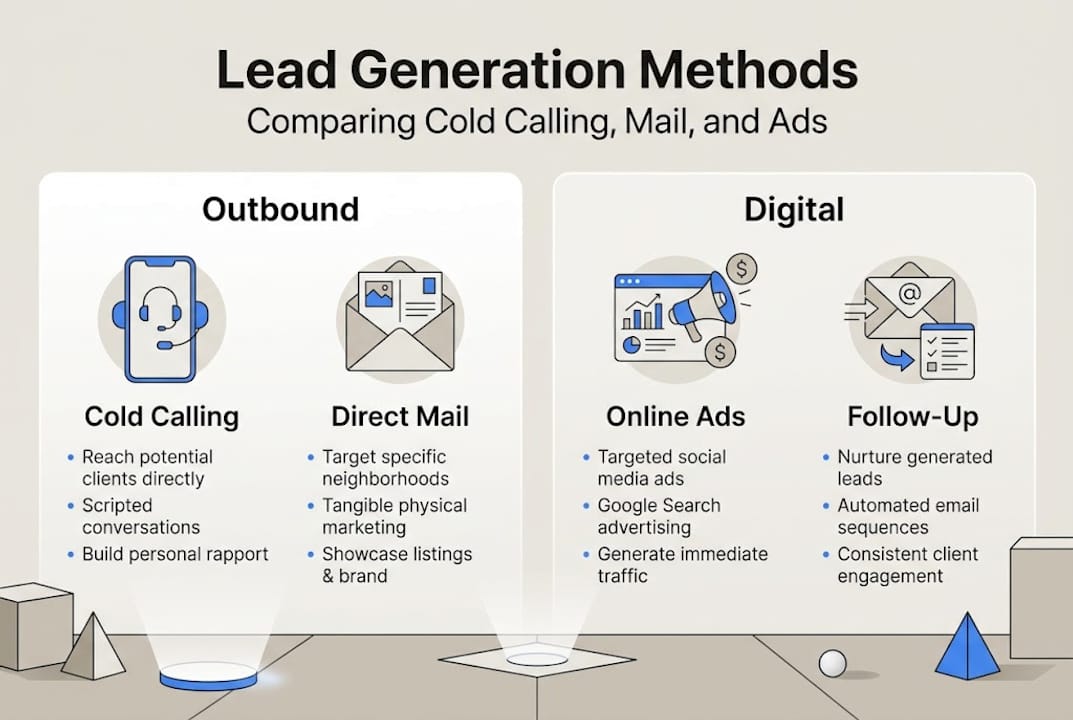
Direct mail, cold calling, and digital ads each have distinct cost and response profiles. Cold calling remains vital for direct engagement because it’s the only method where you get real-time feedback and can adjust your message on the spot.
Here’s how the major methods stack up:
| Method | Avg. cost per lead | Typical response rate | Scalability |
|---|---|---|---|
| Cold calling | Low ($1-5) | 1-2% | High with systems |
| Direct mail | Medium ($5-15) | 1-3% | Medium |
| PPC (Google Ads) | High ($20-100) | Varies | High with budget |
| Facebook Ads | Medium ($10-40) | Low-medium | High |
| Driving for dollars | Very low | Varies | Low (time-heavy) |
| Networking/referrals | Very low | High | Low (relationship-dependent) |
Cold calling response rates sit at 1-2%, direct mail at 1-3%, and PPC can cost $20-100 per lead. Those numbers look small, but on a targeted list of 500 motivated sellers, even a 1.5% conversion means 7-8 real conversations with people who want out.
“The goal isn’t to reach everyone. It’s to reach the right people at the right moment with the right message.”
Here’s what separates top performers from average callers:
- They call segmented lists, not generic homeowner databases.
- They track response rates by list type, not just total dials.
- They combine cold calling with follow-up mail or text for multi-touch impact.
- They use real estate cold calling best practices to refine their openers and objection handling continuously.
More volume isn’t the answer. Better targeting, smarter follow-up, and deliberate practice are.
Cold calling fundamentals: targeting, timing, and conversations that convert
Understanding the strengths of each method, let’s zero in on why cold calling continues to outpace other tactics in direct engagement when executed strategically.
List segmentation is the foundation. Calling a pre-foreclosure list with a generic script designed for absentee owners is like using a hammer to drive a screw. Each seller type has a different emotional state and a different reason to sell. Your opener, your questions, and your empathy all need to match that context.

Timing matters more than most callers realize. Agents dialing 1,200 numbers per month generate roughly 25 leads, with the best answer rates on Tuesday through Thursday between 10am-12pm and 6-8pm. Calling outside those windows doesn’t just reduce pickups. It also catches people in worse moods, which tanks your conversion rate.
Here’s a simple framework for structuring your calls:
- Open with context, not a pitch. State your name, why you’re calling, and tie it to their situation. Keep it under 15 seconds.
- Ask one open question. “Are you still the owner of the property on Maple Street?” gets them talking.
- Listen for pain signals. Late taxes, vacant property, inherited burden. These are your cues to go deeper.
- Acknowledge before you offer. Empathy isn’t soft. It’s strategic. Sellers who feel heard are far more likely to keep talking.
- Handle objections with curiosity. “Not interested” often means “I don’t understand yet.” Ask a follow-up question instead of backing off.
Pro Tip: Sellers in distress are often embarrassed or defensive. Matching your tone to their emotional state, calm, patient, and non-pushy, will increase cold call conversion faster than any script tweak alone.
Quick stat: Top cold callers close 5% or more of their appointments. That’s not luck. It’s repetition, feedback, and refinement.
Scaling with AI: Automating and optimizing distressed seller outreach
Now that you know how to make each call count, let’s take it to the next level by using AI to multiply your output and track what matters.
AI is not a replacement for a skilled caller. It’s a force multiplier. Here’s what AI can realistically do for your outreach:
- Automate follow-up sequences across calls, texts, and voicemails for 5-8 touches per lead.
- Score and prioritize leads based on engagement signals, like how many times someone picked up or how long they stayed on the call.
- Analyze talk-time ratios to flag when callers are talking too much and listening too little.
- Simulate real seller conversations for training, so your team practices on AI before they practice on real leads.
- Track appointment-to-close ratios across different list types and scripts.
AI coaching can optimize rep talk-time and appointment ratios, but legal compliance and opt-in standards are non-negotiable. Under the TCPA (Telephone Consumer Protection Act), using AI or automated systems to contact people without proper disclosure and consent can result in fines of $500 to $1,500 per violation. That adds up fast.
Pro Tip: Use AI for vacant property outreach and AI for inherited properties as training tools first. Get your reps scoring well in simulated calls before they touch your live lists. This protects your data and your reputation.
Multi-touch sequences are where AI earns its keep. A single call rarely closes a deal. But a well-timed sequence of call, voicemail, text, and follow-up call over two weeks? That’s where motivated sellers start responding.
Measuring success: Metrics and troubleshooting for continuous improvement
Once your outreach is in motion, ongoing performance tracking ensures that each tweak powers long-term growth.
You can’t improve what you don’t measure. These are the KPIs (key performance indicators) every serious investor or wholesaler should track:
| Metric | What it measures | Benchmark to aim for |
|---|---|---|
| Connect rate | % of dials that reach a live person | 8-15% |
| Talk time % | % of call time in actual conversation | 30%+ |
| Appointment rate | % of conversations that book a meeting | 5-10% |
| Close rate | % of appointments that result in a contract | 5%+ |
Key performance metrics like connect rate, talk time, and appointment rate determine campaign success. Top cold callers close 5% or more of their leads. If you’re not hitting those numbers, here’s how to troubleshoot:
- Low connect rate? Check your calling hours, caller ID reputation, and list quality.
- Short talk times? Your opener may be triggering hang-ups. Test a new first sentence.
- Conversations but no appointments? Your qualifying questions or offer framing needs work.
- Appointments but no closes? Practice your in-person or follow-up pitch with real objections.
The 5-8 touch rule is real. Most sellers don’t say yes on the first call. Consistent follow-up, tracked through your CRM and supported by AI automation, is what turns a cold lead into a signed contract. Monitor your real estate cold calling metrics weekly and adjust one variable at a time for clean, compounding results.
Why prioritizing quality and compliance outperforms brute force outreach
After seeing the power of metrics and automation, here’s what years of coaching top cold callers reveals that data alone cannot.
The biggest mistake we see investors make isn’t a bad script. It’s measuring success by the number of dials instead of the quality of conversations. Hitting 300 calls a day on a generic list feels productive. It rarely is.
AI is not a silver bullet. It’s a lever. Used ethically, with proper compliance and targeted lists, it compounds your results over time. Used carelessly, it burns through leads, invites legal exposure, and damages your reputation in a market where word travels fast.
Real estate is a small world. The seller you offend today might be connected to the motivated seller you need tomorrow. Staying compliant isn’t just about avoiding TCPA fines. It’s about building a brand that sellers trust.
The investors who win long-term combine smart data, genuine empathy, and iterative coaching. They review their cold calling real-world insights weekly. They practice their objection handling. They treat every call as a rep, not just a dial. Stop winging it. Start drilling.
Level up your lead generation with hands-on AI cold calling practice
Ready to apply these strategies and turn best practices into habits? Here’s where to start.
Knowing the right tactics is step one. Executing them under pressure, with a skeptical seller on the line, is where most callers fall apart. That’s exactly what AI-powered roleplay solves. You can practice inherited cold calls or sharpen your approach with vacant seller cold calling practice in a realistic, low-stakes environment before you touch your live pipeline.
ClosersLeague gives you scenario-specific AI simulations built for the exact seller types that drive real estate deals. Whether you’re new to cold calling or coaching a team, our real estate cold caller training platform helps you build the reps that turn conversations into contracts. Start practicing today and close more deals tomorrow.
Frequently asked questions
What is the most effective lead list for real estate cold calling?
Absentee owners, vacant properties, tax-delinquent homes, and inherited properties are the highest-converting lists because owners in these situations have the strongest motivation to sell quickly.
How many calls should I make to get a deal?
On average, dialing 1,200 numbers per month yields roughly 25 solid leads, with a call-to-appointment rate of about 1.7%, so consistent volume on targeted lists is key.
How does AI improve real estate lead generation?
AI scales outreach by automating multi-touch follow-up sequences, analyzing talk-time ratios, and providing realistic call simulations that sharpen caller skills before they hit live lists.
What are the key compliance rules for AI cold calling?
Legal compliance requires proper disclosure and opt-in consent for any AI-assisted contact, with TCPA violations potentially costing $500 to $1,500 per incident, making compliance non-negotiable.
Recommended
- Real Estate Cold Calling Practice — AI Roleplay for Every Seller Type | ClosersLeague
- Vacant Property Cold Calling Practice — AI Roleplay for Real Estate Investors & Wholesalers
- Tired Landlord Cold Calling Practice — AI Roleplay for Real Estate Investors & Wholesalers
- Inherited Property Cold Calling Practice — AI Roleplay for Real Estate Investors & Wholesalers
- Lead Generation • Design Box Digital
- Exploring the Dual Approaches to Lead Generation Strategies