
Most investors work from a single lead list and wonder why their conversion rates stay stuck below 2%. The answer isn’t more leads. It’s smarter targeting. Understanding what is real estate list stacking changes how you approach every marketing campaign you run. Instead of blasting outreach to thousands of lukewarm prospects, you identify the handful of properties that show up on multiple distress lists simultaneously. Those overlapping leads convert at 3-5x the rate of single-list contacts, and they cost far less to reach.
Table of Contents
- Key Takeaways
- What is real estate list stacking and how it works
- Benefits and measurable results from list stacking
- Common pitfalls to avoid when stacking lists
- How to implement list stacking with a real estate CRM
- Real-world examples that show the power of list stacking
- My take on list stacking as a long-term strategy
- Turn your stacked leads into closed deals with Closersleague
- FAQ
Key Takeaways
| Point | Details |
|---|---|
| List stacking targets overlap | Properties appearing on multiple distress lists signal higher seller motivation and convert at significantly better rates. |
| Quality beats quantity | Starting with 2-3 high-intent lists outperforms large, unfocused lead pools that drain your budget without results. |
| Data hygiene is non-negotiable | Deduplication and invalid address removal improve deliverability and reduce wasted marketing spend by 10-20%. |
| CRM automation is the unlock | Modern CRM tools tag overlapping leads automatically, saving up to 190 hours of admin time per campaign. |
| Lead recency matters | Prioritize properties that recently appeared on multiple lists. Fresh distress signals mean fresh motivation to sell. |
What is real estate list stacking and how it works
List stacking is the practice of combining multiple motivated seller lists to identify properties that appear on two or more of them at the same time. Think of it as a Venn diagram. Each circle represents a different distress category. The overlap in the middle is where your best leads live.
Here is why the overlap matters so much. A homeowner who is simply behind on taxes might still have options and time. But a homeowner who is behind on taxes, has been absent from the property for over a year, and has a vacant home sitting in disrepair? That person is facing multiple financial and logistical pressures at once. Their motivation to sell is exponentially higher. That is the logic behind list stacking for investors.
The lists most commonly used in real estate list building include:
- Tax delinquent lists: Homeowners behind on property taxes, often facing eventual foreclosure
- Pre-foreclosure lists: Owners who have received a notice of default from their lender
- Absentee owner lists: Owners who do not live at the property, indicating less emotional attachment
- Vacant property lists: Homes confirmed as unoccupied, often deteriorating without active management
- Probate lists: Properties tied up in estate proceedings where heirs may want a fast sale
- High equity lists: Owners with significant equity who can accept a discounted offer and still walk away clean
- Code violation lists: Properties flagged by local municipalities for structural or maintenance issues
When you stack these lists, you are not just adding data together. You are filtering for motivation. A property appearing on the absentee owner, tax delinquent, and vacant lists simultaneously tells a very specific story about the owner’s situation.
Pro Tip: Start with just two or three high-intent lists before expanding. Combining tax delinquent and absentee owner data is a proven starting point. Adding more lists later is far better than drowning in low-quality overlap from the beginning.
Benefits and measurable results from list stacking
The numbers behind list stacking are hard to ignore. Single-list campaigns typically convert at 1-3%. Stacked list campaigns convert at 4-8%. That is not a marginal improvement. That is a fundamentally different business outcome for the same marketing spend.
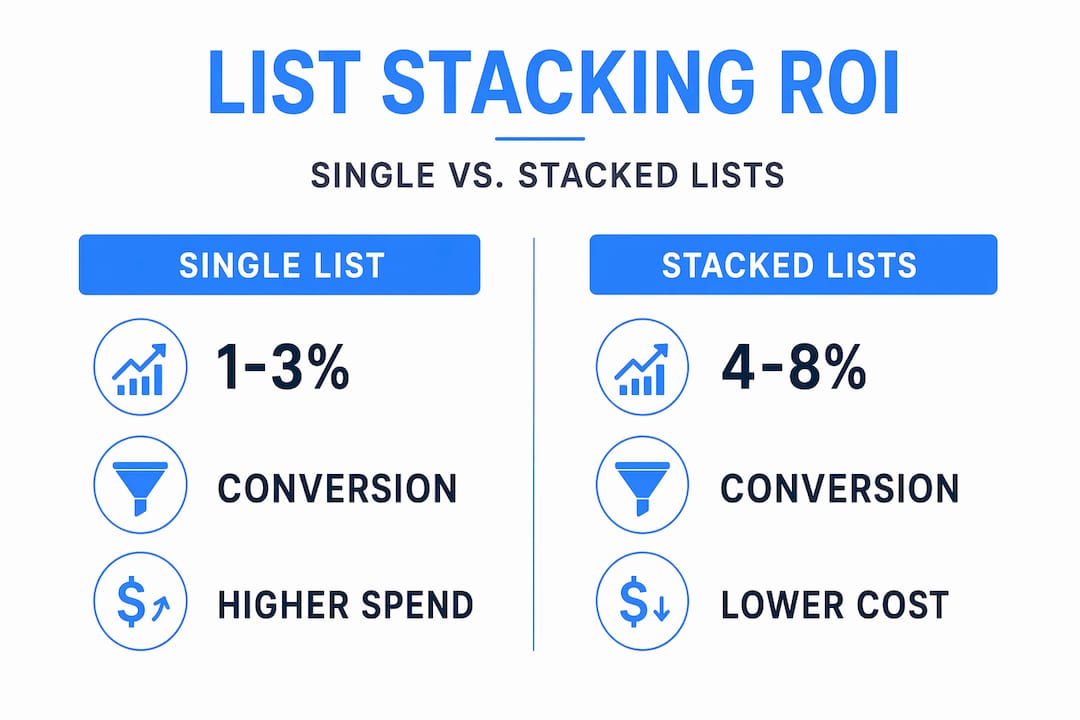
Here is how those benefits break down in practical terms:
| Metric | Single-List Campaign | Stacked List Campaign |
|---|---|---|
| Conversion rate | 1-3% | 4-8% |
| Marketing cost per deal | High | Up to 76% lower |
| Admin time per campaign | Baseline | Reduced by ~190 hours |
| Duplicate mailers sent | Common | Eliminated through deduplication |
| Skip tracing effort | Applied broadly | Focused on top-priority leads |
The cost savings come from two places. First, you are spending skip tracing budget only on leads with multiple motivation signals rather than everyone on a raw list. Second, proper deduplication reduces wasted direct mail by 10-20%, which adds up fast when you are running consistent campaigns across a market.

There is also a less obvious benefit: brand perception. When a homeowner receives three separate mailers from you in the same week because they appeared on three different lists in your unsorted database, that does not feel like professional outreach. It feels like spam. Filtering duplicates protects your reputation and improves response rates at the same time.
Pro Tip: If your CRM does not automatically tag and deduplicate overlapping leads, you are leaving money on the table. Look for CRM platforms built for real estate that handle list merging natively rather than forcing you to manage it manually in spreadsheets.
Common pitfalls to avoid when stacking lists
Knowing how to stack real estate lists is only half the equation. Knowing what can go wrong saves you from wasting weeks of effort and a significant chunk of your marketing budget.
The most common mistakes investors make include:
- Over-stacking with poor-quality data. Adding ten lists sounds powerful until you realize half of them are outdated county records with 30% invalid addresses. Too many low-quality lists shrinks your usable lead pool and makes it harder to identify genuine overlap patterns.
- Skipping data hygiene. Stacking raw, uncleaned lists produces garbage results. Before any merging happens, each list needs deduplication and invalid address removal. Otherwise, your “high-priority” segment is polluted with bad data from the start.
- Ignoring lead recency. Not all overlap is equal. A property that appeared on both the tax delinquent and absentee owner lists three years ago and has not moved since is a cold lead. A property that just landed on two lists in the past 60 days is someone worth calling immediately. Tracking recency is what separates warm leads from stale ones.
- Treating list stacking as a manual task. Trying to manage this in Excel works until it doesn’t. Once you are pulling from more than two sources or covering more than a few hundred properties, manual merging becomes error-prone and time-consuming. This is not a clerical task. It is a strategic alignment process that benefits enormously from automation.
- Building the stack once and never updating it. Markets move. Owners sell, catch up on taxes, or let new violations accumulate. A stack that is six months old is a snapshot of a market that no longer exists.
Avoiding these pitfalls is not complicated, but it does require discipline and the right tools.
How to implement list stacking with a real estate CRM
The process of building and using a stacked list is straightforward when you have the right system in place. Here is a practical step-by-step approach:
- Pull your source lists. Gather data from county records, data providers, and your own previous campaigns. Common sources include county tax assessor databases, MLS data, and specialized real estate data platforms.
- Upload each list separately into your CRM. Keep them as distinct sources so the system can track which lists each property appears on.
- Run deduplication and address validation. Most modern CRMs handle this automatically. This step alone cuts wasted outreach by 10-20%.
- Let the CRM tag overlapping leads. Properties appearing on two or more lists get tagged automatically with all relevant distress categories, such as “vacant + tax delinquent” or “absentee + pre-foreclosure.”
- Filter and segment by overlap count. Leads on three or more lists become your top-priority segment. Leads on two lists form your secondary tier.
- Launch targeted campaigns from each segment. Direct mail, cold calling, and SMS outreach should all be calibrated to the specific distress profile of each segment.
A few additional practices that separate good list stacking from great list stacking:
- Run skip tracing only on your top-tier stacked segment first to preserve budget
- Set up automated follow-up sequences tied to each distress profile
- Review and refresh your stacks every 60-90 days as new county data becomes available
- Use automation tools for investors to keep tags current without manual intervention
Pro Tip: Track how recently each property joined your stacked list. A lead that appears on three lists for the first time this month is a higher priority than one that has sat on three lists for over a year without responding.
Real-world examples that show the power of list stacking
Consider a practical scenario. An investor in a mid-sized market pulls a tax delinquent list with 800 properties and a vacant property list with 600 properties. Separately, each list requires significant skip tracing effort and produces modest results. After merging and deduplication, they find 140 properties that appear on both lists. These are homes where the owner is not living there and also not paying taxes. That 140-property segment gets the full marketing treatment first.
Here is what the comparison typically looks like before and after implementing list stacking:
| Campaign Type | Total Leads | Marketing Spend | Deals Closed | Cost Per Deal |
|---|---|---|---|---|
| Single-list (tax delinquent only) | 800 | $4,000 | 8 | $500 |
| Stacked (tax delinquent + vacant) | 140 | $1,200 | 9 | $133 |
Same market. More deals from a fraction of the leads. The investor also saved hours of skip tracing effort by focusing only on the overlap segment. Using direct mail targeting on leads with multiple risk factors is a proven way to shrink cost per deal while maintaining or improving close rates.
Another real-world application involves absentee owners with high equity who also have a code violation. These owners often live out of state, are not managing the property, and are staring at a municipal fine they cannot easily resolve from a distance. That combination of distance, equity, and legal pressure creates a very motivated seller. Your outreach to these sellers should reflect an understanding of exactly those pressures.
My take on list stacking as a long-term strategy
I have watched investors spend thousands of dollars on data without ever looking at what it actually tells them. They buy a list, blast out 500 mailers, get three callbacks, and conclude that direct mail is dead. It is not dead. Their targeting is just lazy.
What I have found is that list stacking is less of a technique and more of a mindset shift. Once you start thinking about motivation stacking, you stop caring about how big your list is. You start caring about how many signals each lead is sending. In my experience, a focused stack of 150 highly motivated leads will outperform a raw list of 2,000 every single time.
The mistake I see constantly is investors treating list stacking as something you do once before a campaign. The real edge comes from treating it as an ongoing process. Refresh your data. Track which leads recently joined your stacks. Update your tags in the CRM. The investors who do this consistently are the ones who always seem to have deals in the pipeline, even in slower markets.
The other thing I will say plainly: if you are still managing this in spreadsheets, you are wasting hours every week that should be spent calling and closing. Real estate CRM tools have made list stacking accessible to solo investors and small teams. There is no excuse for doing it manually. The technology exists. Use it.
List stacking is not optional if you want to compete in 2026. It is the baseline.
— Dave
Turn your stacked leads into closed deals with Closersleague
You have identified your best leads through list stacking. Now comes the part that actually closes deals: the conversation.

Closersleague is an AI-powered cold calling practice platform built specifically for real estate investors and wholesalers. Once your list stacking surfaces high-priority sellers, including inherited property owners, out-of-state absentees, and code violation homeowners, Closersleague helps you practice the exact calls you need to make. You can drill scenarios for inherited property sellers, out-of-state owners, and every other distressed seller profile your stacked lists produce. Stop leaving deals on the table because the conversation fell apart. Practice the call before it counts at Closersleague.
FAQ
What is real estate list stacking?
Real estate list stacking is the process of combining multiple motivated seller lists to identify properties that appear on two or more simultaneously, signaling higher seller motivation and producing conversion rates of 4-8% compared to 1-3% for single-list campaigns.
What types of lists are used in list stacking?
Investors commonly stack tax delinquent, pre-foreclosure, absentee owner, vacant property, probate, and code violation lists. The more distress categories a property appears in, the higher its likelihood of producing a motivated seller.
How many lists should you stack?
Starting with 2-3 high-intent lists is the recommended approach, as over-stacking with low-quality data reduces your usable lead pool and leads to analysis paralysis without improving results.
Do you need a CRM to stack lists effectively?
You do not technically need a CRM, but automated tagging and deduplication from modern CRM tools save significant time and produce far more accurate results than manual spreadsheet methods.
How often should you refresh your stacked lists?
Refreshing every 60-90 days is a practical standard. Lead recency tracking ensures you prioritize properties that recently appeared on multiple lists over leads that have sat dormant in your stack for months.