
Picture this: you finally get a motivated seller on the line, someone facing foreclosure, and within 20 seconds they hang up. Not because you had a bad script. Because your tone felt like a sales pitch when they needed to hear a calm, trusted voice. That gap between what you planned to say and how it actually landed is exactly what targeted roleplay closes. This guide walks you through why roleplay is non-negotiable for real estate investors calling distressed homeowners, what tools and setups you actually need, and a step-by-step process to build the kind of call confidence that shows up when it counts most.
Table of Contents
- Why roleplay is critical for cold calling distressed homeowners
- What you need for effective investor cold call roleplaying
- Step-by-step: How to roleplay investor cold calls for maximum impact
- Troubleshooting and optimizing your cold call roleplay results
- The uncomfortable truth about cold call roleplaying for investors
- Take your cold call roleplay to the next level
- Frequently asked questions
Key Takeaways
| Point | Details |
|---|---|
| Empathy is the edge | Roleplaying tone and empathy leads to greater trust with distressed sellers. |
| Rehearse edge cases | Practicing tough scenarios prepares you for real objections in the field. |
| Benchmark what matters | Track your calls by funnel stage to measure real improvement over time. |
| Layer your practice | Mix solo, partner, and AI roleplay to accelerate cold calling mastery. |
| Iterate, don’t improvise | A repeatable roleplay process prevents costly mistakes and builds skill faster. |
Why roleplay is critical for cold calling distressed homeowners
Calling someone in foreclosure, probate, or going through a divorce is nothing like a standard sales call. These homeowners are under financial pressure, often emotionally raw, and almost always suspicious of strangers calling about their property. You have seconds to establish enough trust for them to stay on the line.
Most investors underestimate this challenge. They memorize a script, make their first 20 calls, and wonder why conversations keep stalling. The problem usually is not the words. It is the delivery, the pacing, and the complete absence of emotional calibration. Winging it rarely works when the person on the other end is in crisis mode.
This is where real estate cold calling practice built around realistic roleplay becomes your most valuable training asset. Roleplay creates a safe environment to fail fast, adjust, and build muscle memory before real deals are on the line.
Here is what makes distressed seller calls uniquely difficult:
- Defensiveness on contact. Many distressed homeowners have already been approached by other investors or scammers. They start with walls up.
- Emotional unpredictability. A foreclosure seller might sound defeated one moment and aggressive the next. You need to stay grounded regardless.
- Trust windows are tiny. You do not get a long runway to build rapport. The first exchange either opens the conversation or ends it.
- Silence and hesitation carry meaning. Missing subtle cues like pauses, tone shifts, or short answers means you miss real signals about where the seller actually is emotionally.
“A key expert nuance for distressed situations is tone control in the first seconds: roleplay should remove high-energy sales persona cues and instead train callers to sound calm, professional, and empathetic to reduce defensiveness.”
That quote should reset how you think about practice. You are not drilling a pitch. You are training your nervous system to project calm under pressure. That only happens through repetition in realistic scenarios.
Now that you know what’s at stake, let’s identify exactly what you’ll need to build effective cold call roleplay sessions.
What you need for effective investor cold call roleplaying
Before you run a single mock call, you need the right setup. Jumping into roleplay without structure is almost as ineffective as skipping practice entirely. Think of this phase as building your training gym before you start lifting.
Core materials you need:
- A tested call script tailored to the seller situation (foreclosure, probate, divorce, tax delinquent)
- A list of common objections with your planned responses written out
- Multiple mock seller personas, each with a different emotional profile and scenario
- A timer to keep practice calls realistic (most effective opening conversations are under 4 minutes)
- A recording device or software so you can review your calls afterward
Environment matters more than you think:
- Find a quiet space free from background noise and interruptions
- Use the same phone setup you use for real calls (headset, mobile, or desk phone)
- Treat every roleplay session as if the seller is real. Low-stakes practice builds low-stakes habits.
Pro Tip: Always rehearse “edge cases,” not just the easy scripts. The edge cases to rehearse include owners who already have a plan in place, sellers who push back hard on the foreclosure topic, and calls where you need to transition smoothly into making an offer. These uncomfortable scenarios are exactly where most investors freeze on real calls.
You also need to choose the right practice format. Not all roleplay methods are created equal:
| Method | Best for | Limitations |
|---|---|---|
| AI-powered roleplay | Anytime practice, instant feedback, consistent scenarios | Requires platform access; less emotionally unpredictable |
| In-person partner practice | Realistic emotional reactions, peer feedback | Scheduling dependent; partner quality varies |
| Solo script practice | Memorizing structure, pacing, and initial lines | No real-time objection handling; low realism |
The most effective investors cycle through all three formats. They use solo practice for script memorization, peer roleplay for emotional realism, and AI platforms for volume and consistency. The foreclosure roleplay practice format specifically helps you get reps in on one of the highest-pressure seller types you will encounter.
A useful resource for building strong call habits is reviewing cold calling tips designed specifically for real estate investors before you set up your first session.
With your tools at the ready, let’s dig into the step-by-step process that will turn dry practice into real cold calling results.
Step-by-step: How to roleplay investor cold calls for maximum impact
Good roleplay is not just picking up the phone and pretending. It has structure. That structure is what separates investors who improve fast from those who practice for months and still sound the same.

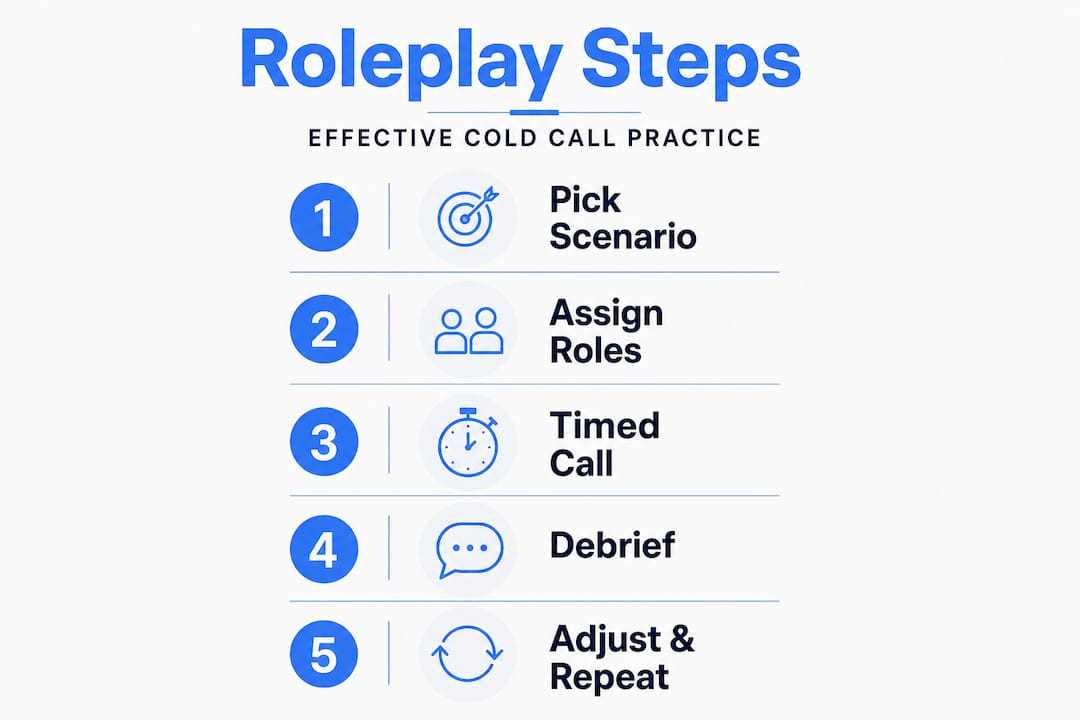
Step 1: Choose and brief your scenario
Pick a specific seller situation before every session. Are you calling a pre-foreclosure owner who is 90 days behind? A recently widowed homeowner dealing with probate? A tired landlord fed up with tenants? Define the persona fully before the call begins. The more specific the scenario, the more realistic your preparation.
Step 2: Assign roles clearly
If you are working with a partner, one person plays the seller and one plays the investor. The “seller” should receive a written brief describing their emotional state, financial situation, and likely objections. This makes their responses realistic rather than improvised guessing.
Step 3: Run the timed call
Set a timer for a realistic call length, usually 3 to 5 minutes for an opening conversation. The caller should treat this as a real call. No stopping to ask “wait, what would you say here?” If you stumble, push through it. That discomfort is the training.
Step 4: Debrief immediately
Directly after the call, both parties share feedback before memories fade. The seller-role person shares what made them feel heard or dismissed. The investor-role person notes what felt off in real time. Then you play back the recording together and look for tone mismatches, missed objections, and pacing problems.
Step 5: Adjust and repeat
Change one specific thing based on feedback. Run the same scenario again. This targeted repetition is how you build lasting skill, not by doing 100 different calls but by doing the same hard scenario 10 times until it becomes automatic.
Pro Tip: Record every session. You will spot subtle errors in tone or phrasing that you completely miss in the moment. Most investors are surprised at how rushed or flat they sound on playback, even when the live call felt fine.
You can compare the three core roleplay approaches side by side to understand which fits different skill goals:
| Approach | Skill focus | Feedback quality | Availability |
|---|---|---|---|
| Solo practice | Script fluency, pacing | None (self-assessment only) | Anytime |
| Peer roleplay | Emotional realism, objection handling | High (human perspective) | Scheduled |
| AI-facilitated roleplay | Volume, consistency, scenario variety | High (instant and objective) | Anytime |
For scenario-specific depth, pre-foreclosure practice modules let you drill the specific language patterns that work for that seller type. Similarly, tired landlord roleplay sessions build the empathy-heavy tone those conversations require.
Tracking your outcomes matters as much as the practice itself. Benchmarking roleplay outcomes by funnel stage means you can tie improvements to specific behaviors instead of just counting how many calls you made.
Mastering the basics is powerful, but the best investors push beyond. Let’s see how to troubleshoot, optimize, and benchmark your roleplay.
Troubleshooting and optimizing your cold call roleplay results
Even with good structure, most investors hit the same walls in their practice. Knowing what these pitfalls look like makes it easier to correct them before they become habits baked into real calls.
The most common mistakes in investor cold call roleplay:
- Sounding too scripted. You memorized the lines but forgot to make them sound like you. Sellers can hear when you are reading. Practice until the words feel like your own, not like lines from a sheet.
- Not adapting to pushback. When a mock seller throws a curveball, many callers either freeze or barrel past the objection. Real sellers notice when you skip over their concern. Roleplay specifically for this by having your partner interrupt or challenge you mid-sentence.
- Skipping emotional validation. A seller says “I just don’t know what to do.” Too many investors respond with information instead of acknowledgment. Saying “That makes complete sense, this is a lot to deal with” before anything else builds more trust than a perfectly worded follow-up question.
- Rushing the early seconds. The instinct under pressure is to talk fast and prove you are credible. The opposite works better. Slow down in the first 15 seconds and your caller ID anxiety drops significantly.
- Only practicing comfortable scenarios. If your mock seller always cooperates, you are not actually building resilience. Force yourself to practice the hard calls: the angry seller, the dismissive “not interested,” the one who says their cousin is a realtor.
Benchmarking your outcomes by funnel stage, from initial connects to conversations to appointments to actual contracts, lets you see exactly where your roleplay improvements are making a difference. If you are booking more conversations but the same number of appointments, your opening is improving but your pivot to asking for a meeting still needs work. That specificity is what drives focused practice.
Pro Tip: Set a concrete goal for each roleplay session. Something like “I will successfully handle 3 price objections today” gives you a clear benchmark rather than just logging practice time. Focused sessions build skills faster than long unfocused ones.
For property-type-specific skill building, vacant property roleplay sessions help you practice the distinct emotional and logical patterns those owners present, which differ meaningfully from foreclosure or probate sellers.
You’ve now covered the practice and troubleshooting loop. Next, let’s reveal the insider truths about what really separates effective investor roleplayers from the pack.
The uncomfortable truth about cold call roleplaying for investors
Here is what we have observed working with real estate investors across experience levels: most people practice the wrong thing. They drill scripts. They time themselves saying the opener. They feel prepared. Then they hit a real distressed seller who pauses for five full seconds after being asked about their situation, and everything falls apart.
That silence was not in the script.
The investors who consistently convert distressed seller leads are not the ones with the cleverest words. They are the ones who trained specifically for emotional discomfort. They practiced sitting in awkward pauses. They rehearsed what to do when a seller cries, when a seller gets angry, when a seller gives a one-word answer to every question.
Most roleplay sessions in real estate skip these scenarios entirely. They start with a friendly seller, run through the script cleanly, and call it a rep. That is the equivalent of a boxer only sparring with partners who never punch back.
The other gap we see is benchmarking. Elite performers obsess over where in the funnel their calls are breaking down. They do not measure success by how many dials they made. They track connects, conversations, motivated leads, appointments set, and contracts signed. When you see that your roleplay improved your connects-to-conversation rate but not your conversation-to-appointment rate, you know exactly what to fix next.
Tone control is the most under-trained skill of all. As expert guidance confirms, removing the high-energy sales persona from your voice in the first seconds and replacing it with calm professionalism is the single biggest lever most investors can pull. And that is only built through deliberate, recorded, reviewed AI-powered roleplay practice, not by reading about it.
Stop treating roleplay as something you do once before a big calling session. Treat it as the work itself. Every rep makes the real call easier.
Take your cold call roleplay to the next level
Knowing what to practice is only half the battle. You also need the right environment to practice it consistently and get feedback that actually makes a difference.

ClosersLeague is built specifically for real estate investors and wholesalers who want to sharpen their cold calling skills through scenario-based AI-powered practice. Whether you are working on inherited property roleplay to navigate sensitive probate conversations, building confidence with foreclosure roleplay, or drilling a full range of distressed seller scenarios, the platform gives you on-demand reps with instant feedback. Real results do not come from reading better scripts. They come from focused, repeatable practice built into your weekly routine. Visit the cold calling practice platform and start drilling the scenarios that matter most to your business today.
Frequently asked questions
What is the number one mistake investors make in cold call roleplaying?
Most investors focus only on memorizing scripts instead of practicing tone, empathy, and handling pushbacks in realistic scenarios. Tone control in the first seconds is the most overlooked and highest-impact skill to train.
How do you benchmark improvements from cold call roleplay?
Track progress by call funnel stage, including connects, conversations, appointments, shows, and contracts, not just total call volume. Tracking by funnel stage ties your practice directly to behavioral improvements rather than activity metrics.
Should I always roleplay with a partner, or can AI and solo practice work?
Both methods are effective, and combining peer, AI, and solo practice provides the broadest skill set and the fastest improvement. Each format trains a different layer of the skill set and they work best together.
How do you roleplay for highly emotional or resistant sellers?
Focus roleplay specifically on the first 30 seconds and practice maintaining a calm, professional tone while handling emotional reactions with empathy before responding with information. Sounding calm and empathetic in those opening moments is the fastest way to reduce a defensive seller’s resistance.
Recommended
- Inherited Property Cold Calling Practice — AI Roleplay for Real Estate Investors & Wholesalers
- Tired Landlord Cold Calling Practice — AI Roleplay for Real Estate Investors & Wholesalers
- Probate Cold Calling Practice — AI Roleplay for Real Estate Investors & Wholesalers
- Out-of-State Owner Cold Calling Practice — AI Roleplay for Real Estate Investors & Wholesalers