
AI is reshaping how real estate investors source deals, underwrite assets, and manage portfolios. But the role of AI in real estate investing is not the uniform transformation many headlines suggest. Only 25% of real estate firms qualify as true AI leaders, and the industry invests about half the cross-industry average in AI. The gap between using AI as a productivity tool and trusting it for high-stakes decisions is wide. This article breaks down where AI actually delivers, where it falls short, and how you can use it to gain a concrete edge as an investor.
Table of Contents
- Key takeaways
- How AI improves data processing in real estate investing
- AI impact varies by asset class and market
- Trust gaps and adoption barriers in AI use
- Practical AI applications across the investment lifecycle
- Future outlook: building structural AI advantages
- My take on AI’s real role in real estate investing
- Practice the skills AI cannot replace
- FAQ
Key takeaways
| Point | Details |
|---|---|
| Adoption is uneven | Most firms use AI for support tasks, but few embed it deeply enough to gain full competitive advantage. |
| AI cuts due diligence time | Machine learning tools reduce document review cycles by 40 to 60%, freeing analysts for higher-value work. |
| Trust lags behind usage | 66% of professionals use AI regularly, but only 5% trust it for final deal decisions. |
| Impact varies by asset class | Logistics and industrial assets see stronger AI-driven gains than office or retail, which remain scenario-dependent. |
| Early movers compound gains | Firms that embed AI end-to-end now will widen their speed and accuracy advantage over late adopters. |
How AI improves data processing in real estate investing
The most immediate benefit of AI in property investment is not prediction. It is speed and throughput in processing the raw material of real estate decisions: data.
Machine learning models can synthesize thousands of comparable sales, rent trends, zoning records, and demographic datasets in minutes. What used to take an analyst two days of spreadsheet work now takes an AI tool two hours, with fewer transcription errors. That shift matters when you are evaluating multiple deals simultaneously or trying to move faster than competing buyers.

Document extraction is another area where AI adds measurable value. Lease abstracts, title reports, environmental assessments, and inspection summaries contain critical deal data buried in unstructured text. AI tools can parse these documents, flag material clauses, and populate your underwriting model automatically. The AI impact on due diligence is documented at a 40 to 60% reduction in cycle times, with market study timelines compressing from six weeks to 48 to 72 hours.
Standardized appraisal data in structured formats supports validation and reuse across AI valuation workflows. When your data inputs are clean and consistent, your AI outputs are more auditable and more defensible to investment committees.
Pro Tip: Before trusting any AI-generated valuation or market analysis, trace it back to the source data. Ask: Is this comp set current? Is this rent data from a verified feed or a scraped estimate? AI amplifies the quality of your inputs, so bad data in means bad analysis out.
Here is what strong AI-assisted data workflows look like in practice:
- Automated comp pulling from MLS, CoStar, and public records, filtered by your criteria
- Sentiment and demand signal analysis from permit filings, job postings, and migration data
- Lease abstraction and clause flagging across hundreds of documents simultaneously
- Portfolio-level rent roll analysis that identifies anomalies and underperforming assets
- Automated NOI and cash flow modeling updated dynamically as inputs change
Real estate firms that invest in AI workflows gain speed and decision-quality advantages that compound over time. The gap between those firms and everyone else is already measurable.
AI impact varies by asset class and market
One of the most underappreciated facts about AI in real estate is that its benefits are not evenly distributed. AI creates a dispersion story across markets and property types, with dramatically different outcomes depending on what you own and where.
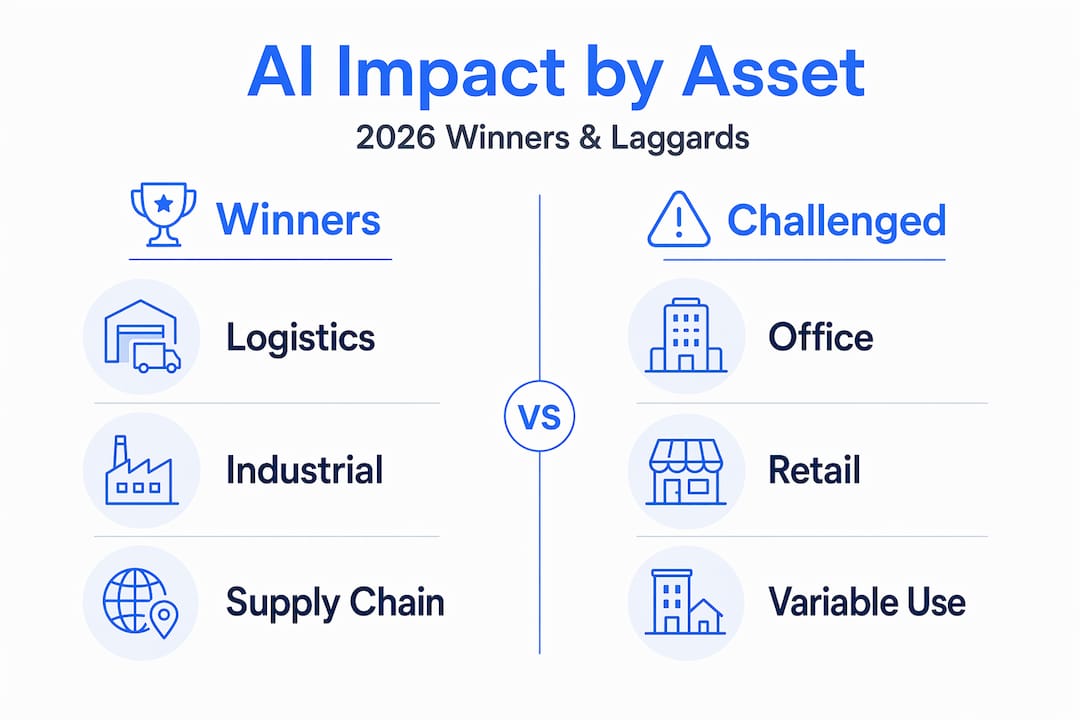
Logistics and industrial assets are the clearest winners. AI drives productivity gains in the supply chains that occupy these buildings, which translates directly into stronger occupier demand, lower vacancy risk, and more predictable income streams. If you own last-mile distribution centers or fulfillment facilities near major population centers, AI tailwinds are already in your favor.
Office and retail are a different story. The impact on these sectors is highly scenario-dependent. Remote work patterns, AI-driven workforce changes, and shifting retail behavior create a wide range of plausible futures. No AI model can tell you with certainty how downtown office demand will look in five years. What AI can do is help you stress-test multiple scenarios and understand your exposure under each one.
| Asset Class | AI Impact Level | Key Driver | Investor Implication |
|---|---|---|---|
| Logistics / Industrial | High, positive | Supply chain productivity gains | Stronger occupier demand, lower vacancy risk |
| Multifamily | Moderate, positive | Demographic and migration modeling | Better site selection and rent forecasting |
| Office | Variable, scenario-dependent | Remote work and workforce AI shifts | Requires scenario analysis, not point estimates |
| Retail | Variable, scenario-dependent | Consumer behavior and e-commerce | Stress-test assumptions across multiple futures |
| Data Centers | High, positive | AI infrastructure demand surge | Rapid cap rate compression in prime markets |
Sophisticated investors use AI to generate explicit sensitivity tables and test assumptions against multiple scenarios rather than relying on a single base case. If your underwriting still relies on one set of projections, you are leaving risk management on the table.
Trust gaps and adoption barriers in AI use
Here is the number that should give every investor pause. 66% of commercial real estate professionals use AI regularly, but only 5% trust it for high-stakes final decisions. That gap is not irrational. It reflects real problems with the tools and the data.
The major barriers are tool confusion and data inconsistencies. There are dozens of AI tools for property analysis, and they do not all perform equally. Some are trained on stale or geographically limited datasets. Others produce confident-sounding outputs with no transparency about how they arrived at a number. When you cannot audit an AI recommendation, you cannot defend it in an investment committee meeting.
Closing this trust gap requires moving AI from a standalone productivity tool to a verified component of your existing workflow. That means treating AI outputs as a first draft, not a final answer.
Pro Tip: Layer AI outputs into your existing review process rather than replacing it. Run AI-generated valuations alongside your analyst’s independent assessment. When they diverge, that divergence is a signal worth investigating, not a problem to ignore.
Common pitfalls to avoid when adopting AI for real estate decisions:
- Treating confidence as accuracy. AI tools often present estimates with high apparent precision that does not reflect real uncertainty in the underlying data.
- Skipping source verification. Always confirm whether AI-pulled comps and market data come from verified, current sources.
- Using one tool for everything. Different AI tools perform better on different tasks. Use purpose-built tools for valuation, document review, and market forecasting rather than one general platform.
- Ignoring model assumptions. Every AI model is built on assumptions. If you do not know what they are, you cannot evaluate when the model will break down.
- Over-automating final decisions. AI should accelerate your analysis, not replace your judgment on deals where context, relationships, and local knowledge matter.
Practical AI applications across the investment lifecycle
This is where the benefits of AI in real estate investing become concrete. Across the full investment lifecycle, AI is already deployed in ways that cut time and improve accuracy.
- Site sourcing and screening. AI tools scan thousands of properties, filter by your acquisition criteria, flag motivated seller signals, and surface leads that would take weeks to find manually. What used to take a sourcing team three weeks now takes three days.
- Automated market studies. AI-driven market analysis pulls current rent comps, absorption data, and supply pipeline information dynamically. You get a market study that reflects this week’s data, not data from a report published six months ago.
- Due diligence document review. AI can review lease agreements, title commitments, inspection reports, and environmental assessments at volume, flagging material issues for human review. Cycle times drop 40 to 60%, which matters when you are trying to close before a competing buyer.
- Pro forma modeling and sensitivity analysis. AI-powered financial models run hundreds of sensitivity scenarios, testing your returns across different rent growth, vacancy, and cap rate assumptions. You understand your downside before you commit capital.
- Automated valuation models. AI-driven automated valuation models (AVMs) provide real-time pricing estimates calibrated to local market conditions. They work best when paired with human review and structured appraisal data.
- Asset management and construction monitoring. AI tools track construction schedules, flag budget variances, and monitor operating performance against benchmarks across a portfolio. You catch problems earlier and with less manual oversight.
- Deal communication and seller outreach. AI assists in identifying distressed properties and preparing outreach, but the actual conversation with a homeowner still requires skill that no model can replace. That is where your training matters. Tools like AI cold call simulators help you practice those conversations before they count.
Future outlook: building structural AI advantages
The firms pulling ahead in 2026 are not using AI as a series of disconnected point solutions. They are embedding it across the full value chain. AI value compounds when sourcing, screening, underwriting, and asset management all share data and reinforce each other.
BCG research shows that AI transformation can improve operating profits by 400 to 700 basis points for developers who fully commit. That is not a rounding error. It is a structural competitive advantage that gets harder to close the longer you wait.
Ongoing data standardization efforts, including the BRAVE standard for appraisal data, will improve auditability and decision confidence across AI workflows. As structured data becomes more available, AI valuation tools will get more accurate and more defensible. Early adopters will have refined their models on more historical data by the time this infrastructure matures, widening the gap further.
Pro Tip: Start AI adoption with your highest-frequency workflows, not your most complex ones. If you review 50 lease documents a month, automate that first. The time savings are immediate, the risk of error is manageable, and you build confidence in AI outputs before applying them to capital allocation decisions.
Firms that do not adopt AI face real erosion of competitiveness, not theoretical risk. When your competitor can underwrite a deal in 48 hours and you need two weeks, you will lose on speed before you even get to price.
My take on AI’s real role in real estate investing
From Dave:
I’ve watched investors make two opposite mistakes with AI. Some ignore it entirely, convinced that real estate is a relationship business where data does not matter. Others hand over their underwriting to an AI tool and accept the output without question. Both are wrong, and both will cost you.
In my experience, the investors who benefit most from AI treat it the way a surgeon treats imaging technology. The scan informs the decision. It does not make the decision. You still need judgment, context, and the willingness to override a model when local knowledge tells you something the data cannot see.
What I’ve learned is that the trust gap is real but closeable. The key is not finding a better AI tool. It is building a workflow where AI outputs are always verified against a second source and reviewed by someone who understands the asset. When you do that consistently, you stop being afraid of the AI being wrong, because you have built a process that catches it.
Early movers have a real advantage here. The firms that started embedding AI two years ago are now sitting on iterative models trained on their own deal history. That proprietary edge is genuinely hard to replicate. If you have not started yet, start now with something small and deliberate. Stop waiting for AI to be perfect. It does not need to be perfect to be useful.
— Dave
Practice the skills AI cannot replace

AI can surface leads, compress timelines, and generate market studies. What it cannot do is have a skilled, empathetic conversation with a homeowner facing foreclosure, probate, or divorce. That conversation is still yours to win or lose, and it requires practice.
Closersleague is an AI-powered cold calling training platform built specifically for real estate investors and wholesalers. You practice real conversations with AI-simulated homeowners across the scenarios that matter most: inherited property calls, tax delinquent outreach, code violation properties, and out-of-state owners. You get scored, you get feedback, and you improve before the call counts. Visit Closersleague to start drilling the skills that close deals.
FAQ
What is the role of AI in real estate investing today?
AI automates data-heavy workflows including due diligence, market analysis, and property valuation while providing decision support to investors. Most firms use AI for productivity, but only a small minority trust it for final investment decisions.
How does AI improve real estate due diligence?
AI tools can review lease documents, title reports, and inspection summaries automatically, reducing due diligence cycle times by 40 to 60% and compressing market studies from six weeks to under 72 hours.
Which property types benefit most from AI?
Logistics and industrial assets see the strongest near-term AI benefits due to supply chain productivity gains. Office and retail sectors have more scenario-dependent outcomes and require stress-testing across multiple futures.
Why do so few investors trust AI for final deal decisions?
Only 5% of commercial real estate professionals trust AI for high-stakes decisions, primarily due to concerns about data quality, lack of tool transparency, and the inability to audit how AI models reach their outputs.
How should investors start integrating AI into their workflows?
Begin with high-frequency, repetitive tasks like document review or comp analysis where errors are catchable and time savings are immediate. Layer AI outputs into existing review processes rather than replacing human judgment on capital allocation decisions.