
Most people assume real estate investing requires a hefty down payment, a real estate license, or years of industry experience. That assumption stops a lot of motivated people before they ever get started. Real estate wholesaling flips that script entirely. A wholesaler can earn thousands of dollars per deal without ever owning a property, taking out a mortgage, or needing significant capital. This article breaks down exactly what a real estate wholesaler does, how the process works from start to finish, what you can realistically earn, and the legal rules you need to follow to stay out of trouble.
Table of Contents
- What is a real estate wholesaler?
- How the real estate wholesaling process works
- How much do real estate wholesalers make?
- Legal requirements and risks for real estate wholesalers
- The real story: What most people miss about wholesaling
- Get better at wholesaling with practice tools
- Frequently asked questions
Key Takeaways
| Point | Details |
|---|---|
| Wholesalers act as middlemen | They connect motivated sellers with cash buyers without buying homes themselves. |
| Low capital, high effort | Wholesaling requires little money to start but heavy outreach and marketing for success. |
| Profits vary widely | Most wholesalers earn $5,000 to $30,000 per deal but face income inconsistency. |
| Legal compliance is essential | Wholesalers must follow state laws and always disclose intent to avoid fines. |
| Practice builds skill | Simulated cold calling and deals prep you for real-world negotiations and pitfalls. |
What is a real estate wholesaler?
A wholesaler is the connector in a real estate transaction. They sit between a motivated seller who needs to move a property fast and a cash buyer who wants to acquire it at a discount. The wholesaler never actually buys the home. Instead, they secure the right to purchase it through a contract and then sell that right to an investor for a fee.
A real estate wholesaler finds discounted or distressed properties from motivated sellers, puts them under contract at below-market price, and assigns the contract to an end buyer, typically a cash investor like a flipper, for a fee, without taking ownership or funding the purchase.
This model makes wholesaling one of the most accessible entry points in real estate. You do not need to qualify for a loan. You do not need to fund repairs. What you do need is the ability to find the right sellers and negotiate effectively.
Here is what a wholesaler brings to the table:
- Finds motivated sellers who are facing foreclosure, divorce, probate, or other distressed situations
- Negotiates a purchase price below market value and locks it in with an assignable contract
- Markets the deal to a list of cash buyers looking for investment properties
- Assigns the contract to the buyer and collects an assignment fee at closing
- Never takes title to the property at any point in the process
The key legal tool here is the assignment clause. This is a provision in the purchase agreement that gives the wholesaler the right to transfer their contractual interest to a third party. Without it, the deal cannot be assigned. Most experienced wholesalers use contracts specifically written to include this language.
For new investors, real estate cold calling practice is one of the fastest ways to build the outreach skills needed to find motivated sellers consistently. Reaching distressed homeowners requires confidence and a clear script, and those skills take practice to develop. You can also explore a broader wholesale real estate overview to understand how this strategy fits into the larger investing landscape.
How the real estate wholesaling process works
Now that you know the basic definition, let’s walk through what wholesalers actually do step by step. The process is more structured than most beginners expect.
- Market research and comps analysis — Identify target neighborhoods and study recent comparable sales to understand property values.
- Find motivated sellers — Use direct mail, cold calling, driving for dollars, or online lists to reach pre-foreclosure, inherited, divorce, or tired landlord situations.
- Negotiate and sign a purchase agreement — Lock in a below-market price using a contract that includes an assignment clause.
- Calculate your Maximum Allowable Offer (MAO) — Use the formula: (ARV x 70%) minus repairs minus wholesale fee. This protects your buyer’s profit margin and ensures your deal is attractive.
- Build and market to your cash buyers list — Reach out to investors, flippers, and landlords who are actively looking for deals.
- Assign the contract or double close — Transfer your contractual rights to the buyer for your fee, or in some cases, do a simultaneous double closing.
- Collect your assignment fee at closing — This is your core wholesaling process payoff, typically ranging from $5,000 to $30,000 per deal.
Here is a quick look at the MAO formula in action:
| Variable | Example value |
|---|---|
| After Repair Value (ARV) | $200,000 |
| 70% of ARV | $140,000 |
| Estimated repairs | $20,000 |
| Wholesale fee | $10,000 |
| Maximum Allowable Offer | $110,000 |
The MAO formula is your guardrail. It keeps you from overpaying and ensures the end buyer still has room to profit. Skip this step and your deal will not sell.
Pro Tip: Your opening lines for motivated sellers matter more than most wholesalers realize. A strong first 10 seconds on a cold call can be the difference between a hung-up phone and a scheduled appointment. Practice those lines until they feel natural.
Finding sellers is the hardest part. Most prospects will say no. That is normal. Rejection rates above 90% are standard in this business, and the wholesalers who succeed are the ones who keep dialing. Check out wholesaling step-by-step guides for deeper breakdowns on each phase. You can also review a detailed wholesaling process to compare approaches.
How much do real estate wholesalers make?
Understanding the process is great, but what about the real earnings? Let’s be direct about what is realistic.
Typical wholesale fees range from $5,000 to $30,000 per deal, representing roughly 5 to 10% of the property’s value. Beginners usually earn between $3,000 and $10,000 on their first few deals. Experienced wholesalers with strong buyer lists and consistent lead flow can earn $10,000 to $25,000 or more per deal.
Here is what annual income looks like based on deal volume:
| Experience level | Deals per month | Avg. fee per deal | Annual income |
|---|---|---|---|
| Beginner | 1 | $8,000 | $96,000 |
| Intermediate | 2-3 | $12,000 | $288,000 |
| Top performer | 4+ | $15,000+ | $300,000+ |
Those numbers are real, but they are not automatic. Volume is the engine. One deal a month at $8,000 puts you at $96,000 annually, which is a solid full-time income. But getting to one deal a month consistently requires relentless outreach, a working buyer list, and sharp negotiation skills.

The income can also be inconsistent. Some months you close two deals. Other months you close none. This is the reality of wholesaling, especially in the early stages. Treat it like a business, not a side hustle, and your results will reflect that.
Pro Tip: Track every lead, every follow-up, and every offer. Most deals come from sellers who said no the first time. A wholesale fee breakdown can help you understand how fees are structured and what buyers expect to see in a deal package.
Stat to know: A wholesaler closing just one deal per month at an average fee of $8,000 generates $96,000 annually. Top performers doing four or more deals monthly can exceed $300,000 per year.
Legal requirements and risks for real estate wholesalers
Potential profits come with real risks and responsibilities. This part of wholesaling is often glossed over, and that is a mistake.
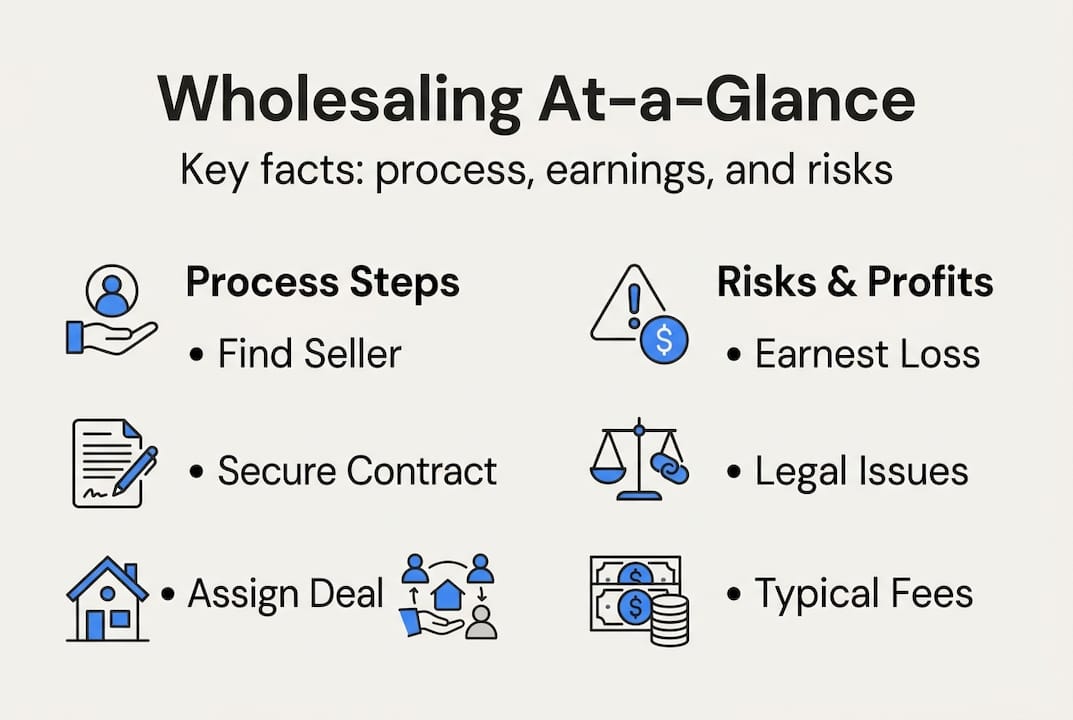
First, the legal landscape. Wholesaling is legal in all 50 states when done correctly, but some states, including Illinois, Oklahoma, Pennsylvania, Oregon, and South Carolina, require a real estate license or registration if your wholesaling activities resemble brokerage. Specifically, marketing a property you do not own can cross a legal line in these states.
Key legal rules to follow:
- Always disclose your intent to assign the contract to the seller upfront
- Use contracts with a proper assignment clause reviewed by a real estate attorney
- Avoid marketing the property directly as if you own it, especially in regulated states
- Do not act as a broker by representing both parties for compensation without a license
- Register your business and keep clear records of every transaction
Pro Tip: Hiring a real estate attorney to review your contracts once is one of the best investments you can make as a new wholesaler. It costs a few hundred dollars and can save you from legal fines over $25,000 for unlicensed brokerage activity.
The risks go beyond legal exposure. If you cannot find a buyer before your contract expires, you may lose your earnest money deposit (EMD) and damage your reputation with the seller. Repeated deal fallout makes it harder to build trust in your local market.
Some wholesalers also engage in deceptive practices like bait-and-switch pricing or clouding a seller’s title. These tactics harm vulnerable homeowners and attract regulatory scrutiny. Avoid them entirely.
Understanding how to handle specific seller situations reduces your risk significantly. Knowing the challenges around vacant property cold calling, navigating pre-foreclosure deal challenges, and managing tired landlord risks will help you approach each scenario with the right strategy.
The real story: What most people miss about wholesaling
Here is what people rarely tell you before you start: wholesaling is a sales business first and a real estate business second. The property is almost secondary to your ability to have difficult conversations with distressed homeowners and convince cash buyers that your deal is worth their money.
Wholesaling offers low-barrier entry with no capital or credit required, making it ideal for beginners to build skills and networks. But success benchmarks show that most beginners close their first deal in 2 to 3 months, and a 90% rejection rate on outreach is completely normal.
That rejection rate is the part nobody advertises. You will make dozens of calls before a seller agrees to a conversation. You will run comps on properties that never become deals. That is not failure. That is the job.
In 2026, regulation and reputation matter more than ever. States are tightening rules around wholesaling, and sellers are more informed. The wholesalers who will win long-term are those who operate transparently, communicate clearly, and build genuine relationships. Shady tactics that worked a decade ago now lead to fines and lawsuits.
If you want to build real skill in this space, real-world cold calling practice is not optional. It is the foundation.
Get better at wholesaling with practice tools
Ready to boost your skills and confidence before your next deal? The conversations you have with motivated sellers are where deals are won or lost. Practicing those conversations in a low-stakes environment means you show up prepared when it counts.

Our AI cold calling practice platform is built specifically for real estate investors and wholesalers. You can run realistic roleplay scenarios for every seller type, from inherited property roleplay to tired landlord cold calling situations. Get scored on your objection handling, tone, and script accuracy. Stop winging it. Start drilling.
Frequently asked questions
Do you need a license to wholesale real estate?
Most states do not require a license to wholesale, but some states require licensing or registration, including Illinois, Oklahoma, Pennsylvania, Oregon, and South Carolina, if your activity resembles brokerage.
How much does a real estate wholesaler make per deal?
Typical assignment fees range from $5,000 to $30,000 per deal, with beginners earning $3,000 to $10,000 and experienced wholesalers earning $25,000 or more on strong deals.
What are the biggest risks in real estate wholesaling?
You risk losing your earnest money deposit if no buyer is found, facing legal fines over $25,000 for unlicensed brokerage activity, and dealing with unpredictable monthly income, especially early on.
How long does it take to close your first wholesale deal?
Most beginners close their first deal within 2 to 3 months when they stay consistent with outreach and lead follow-up.
Recommended
- Real Estate Cold Calling Practice — AI Roleplay for Every Seller Type | ClosersLeague
- The Exact Opening Line to Keep Motivated Sellers Talking — ClosersLeague
- Cold Calling Tips & Real Estate Wholesaling Blog — ClosersLeague
- AI Cold Calling Practice for Real Estate Investors & Wholesalers | ClosersLeague
- 7 Key Ways Real Estate Notary Services Help Your Deals – My Mobile Notary