
Cold calling distressed property owners is one of the hardest skills to develop in real estate wholesaling. You might have a solid script in front of you, but the moment a seller pushes back or goes off script, confidence disappears fast. That’s the gap most training programs ignore. Advanced roleplaying for wholesalers bridges that gap by simulating real seller conversations before they happen on live calls. This article gives you concrete frameworks, session structures, and edge-case drills to sharpen your cold calling skills and close more appointments with foreclosure, probate, and divorce leads.
Table of Contents
- Why roleplaying is critical for wholesale cold calling success
- Essential tools and templates for wholesaler roleplaying
- Step-by-step: Setting up and running high-impact roleplay sessions
- Breakthrough objections: Advanced scenarios and edge case mastery
- Measuring roleplay results: How to verify progress and improve fast
- What most real estate training gets wrong about roleplaying
- Take your wholesaler roleplaying to the next level
- Frequently asked questions
Key Takeaways
| Point | Details |
|---|---|
| Real conversations win | Effective wholesaler roleplaying focuses on genuine conversation, not memorizing pitches. |
| Frameworks drive results | Using a clear call structure—opener, reason, discovery, next step—boosts confidence and conversion. |
| Practice edge cases | Roleplaying tough objections and surprise seller questions prepares you for critical moments. |
| Feedback fuels growth | Debriefing and observer feedback accelerate real-life progress after every session. |
Why roleplaying is critical for wholesale cold calling success
Now that we’ve set the stakes, let’s dig into why practicing with roleplaying is so much more effective than just reading scripts.
Most wholesalers spend their prep time reading scripts. The problem is that scripts give you words but not instincts. When a motivated seller starts talking about their family situation or throws out an unexpected question, a memorized line is useless. What saves you is a practiced, internalized framework that you can navigate naturally.
The cold calling basics of real estate wholesaling share one common thread with elite sales performance: muscle memory. Roleplaying builds that memory by forcing you to respond under simulated pressure, again and again, until pivoting and probing feel second nature.
“Wholesale and investor cold-calling roleplay for distressed properties is best treated as a conversational framework: permission-based opener, property-specific reason for call, discovery questions, then a concrete next-step close.”
The best wholesalers are not the ones with the best scripts. They’re the ones who listen hardest and adapt fastest. That’s a skill you drill, not read. And pitching for wholesale deals requires you to understand a seller’s motivation before you ever mention numbers.
Here’s what separates top performers in roleplay:
- They treat every session as a real call, not a rehearsal
- They welcome silence and use it to let sellers keep talking
- They sound human and curious instead of robotic or rehearsed
- They handle objections with empathy before redirecting the conversation
- They consistently close for a next step, even when the call gets emotional
Roleplaying is where you build the instincts that scripts can never give you. Stop winging it. Start drilling.
Essential tools and templates for wholesaler roleplaying

Having grasped the importance of authentic roleplaying, it’s time to get tactical. Here’s what you’ll need to run effective sessions.
A good roleplay session does not need expensive software. It needs the right materials and a clear structure. The conversational framework proven for distressed seller calls includes four stages that every session should practice: the permission-based opener, the property-specific reason for calling, discovery questions, and a concrete next-step close. Build your templates around these four pillars.
Here’s a breakdown of the core tools every wholesaler should have ready before each roleplay session:
| Tool | Purpose | Format |
|---|---|---|
| Scenario cards | Define seller type, situation, and personality | Printed or digital index cards |
| Framework checklist | Track opener, discovery, and close | One-page sheet per call |
| Observer feedback form | Capture strengths and one area for improvement | Structured rubric |
| Call recording setup | Review tone, pacing, and word choice | Phone or Zoom recording |
| Objection bank | Pre-built list of 10 to 15 common objections | Spreadsheet or doc |
Beyond the table above, your prospecting process steps should inform which seller types you prioritize on scenario cards. Foreclosure, probate, tax delinquent, divorce, and code violation leads each carry different emotional states and timelines. Create separate scenario cards for each type.
Key template elements to include on every scenario card:
- Seller type (for example, probate executor, pre-foreclosure homeowner)
- Property condition detail (roof damage, deferred maintenance, code violations)
- Emotional state cue (anxious, hostile, confused, open but skeptical)
- Known objection to throw at the wholesaler mid-call
- Preferred outcome if the wholesaler performs well
Pro Tip: Record every roleplay session, even informal ones. Listening back reveals vocal habits like filler words and rushed pacing that are nearly invisible in the moment but highly visible to sellers on live calls.
Step-by-step: Setting up and running high-impact roleplay sessions
With tools in hand, you’re ready to set up real roleplay sessions. Here are proven steps, with variations to increase the challenge.
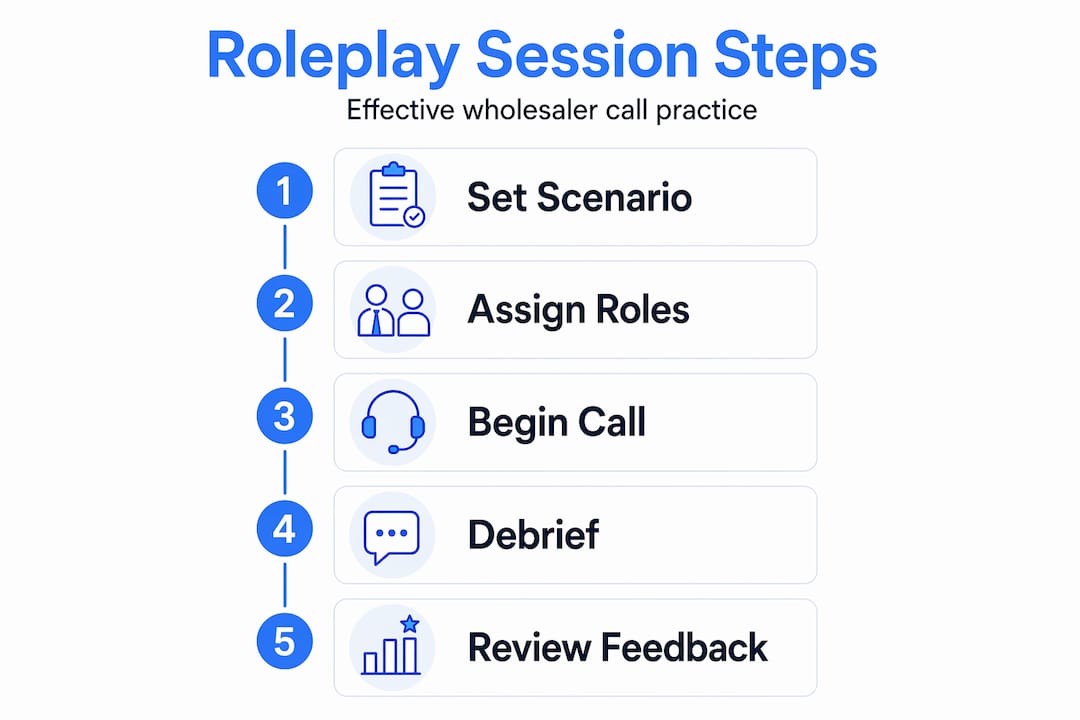
A common mistake is running roleplay sessions that are too comfortable. Real sellers are unpredictable, emotional, and sometimes hostile. Your sessions should mirror that reality. Scenario-based practice with timed simulations, observer debrief, and role reversal is the evidence-aligned structure proven to improve objection handling and negotiation skills fastest.
Follow this structure for every session:
- Select the scenario. Pull a scenario card that matches a real lead type in your pipeline. If you’re working pre-foreclosure leads this week, build sessions around that seller type.
- Assign roles. One person plays the wholesaler, one plays the seller using the scenario card as their guide, and one acts as a silent observer. Solo investors can record themselves and self-debrief.
- Set the timer. Run the simulation for three to five minutes. Short constraints force focus and mirror the real-world window you have to earn a seller’s trust.
- Debrief immediately. The observer shares one specific strength and one specific improvement opportunity. Keep feedback concrete, not vague. “Your tonality shifted well after the objection” beats “you did good.”
- Reverse the roles. The wholesaler becomes the seller. This forces you to think from the seller’s perspective, which makes you far more empathetic and strategically flexible on live calls.
- Scale up the difficulty. Add an unexpected edge case mid-call. Have the seller hang up. Have them ask for proof of funds on the second exchange. Have them demand an offer before you’ve asked a single question.
Here’s how basic sessions compare to advanced sessions:
| Element | Basic session | Advanced session |
|---|---|---|
| Scenario type | Single objection, cooperative seller | Hostile seller, multiple stacked objections |
| Timing | Open-ended | Strict 3 to 5 minutes |
| Role reversal | Optional | Required every session |
| Observer feedback | General notes | Structured rubric with scoring |
| Complexity scaling | Same scenario repeated | New edge case added mid-simulation |
Pro Tip: Use real cold calling tips from your most recent live calls to design scenarios. The objections you struggled with last week are exactly the ones to drill this week.
Breakthrough objections: Advanced scenarios and edge case mastery
Once you have the basics down, leveling up means drilling tough objections and edge scenarios until you’re comfortable under pressure.
Most wholesalers can handle “not interested” on a good day. But what about “just give me an offer right now” before you’ve asked a single discovery question? Or a seller who immediately asks how long you’ve been in business and whether you can actually close? These edge cases cause good wholesalers to freeze, and they’re where deals are won or lost. Discovery and objection handling loops are the core skill to drill because the call structure separates motivation, timeline, and property condition before any offer discussion happens.
Here are the edge case scenarios every wholesaler must roleplay repeatedly:
- “Just give me a number.” The seller wants an offer before you know anything. Practice slowing this down with a curiosity pivot: “I want to make sure any number I give you is actually fair. Can I ask a couple quick questions first?”
- “We’re not really interested in selling.” This is an early objection that hides real motivation. Practice leaning in with empathy: “That makes total sense. Can I ask what would need to change for it to make sense?”
- “How do I know you can actually close?” A proof-of-funds or credibility challenge. Practice responding with confidence and a brief, specific track record statement rather than over-explaining.
- The timeline surprise. Seller says they need to close in two weeks. Practice pivoting quickly into next-step logistics without losing rapport.
- The emotional pivot. A probate seller starts crying or venting about the deceased. Practice holding space, slowing down, and re-entering discovery gently after the emotional moment passes.
“The hardest part for most wholesalers is the pivot: when sellers ask unexpected questions, pattern interrupt moments, discovery anchors, and price expectation probes require real-time adaptability, not a rehearsed line.”
The standard to judge your roleplay performance is not whether you hit every script point. It’s whether you stayed curious, kept the conversation moving, and built enough trust for the seller to agree to a next step. Mastering objections in wholesaling is a repeatable skill, but only if you practice the right scenarios under realistic conditions.
Pro Tip: Build a dedicated edge case library. After every live call that surprised you, write a one-sentence description of what happened and turn it into a new roleplay scenario within 24 hours. Your library will become your biggest competitive advantage over time.
Measuring roleplay results: How to verify progress and improve fast
Finally, all that practice means little unless you can measure and accelerate your progress. Here’s how.
Most investors practice but never track. That’s like going to the gym every day without measuring anything. Progress happens faster when you have a feedback loop. Scenario-based practice with observer debrief and role reversal is not just a training structure. It’s also a measurement system when you use it consistently.
After every session, run through this debrief checklist:
- What went well? Name one specific moment where the wholesaler adapted naturally.
- What needs work? Identify one concrete skill gap, such as rushing past discovery or weak tonality on objections.
- What is the follow-up scenario? Based on the weakness identified, design the next session to address it directly.
- Did you close for a next step? Yes or no. If not, what stopped you and how do you fix it?
- How did your energy feel throughout? Flat energy on practice calls translates directly to flat energy on live calls.
Beyond session-level tracking, winning more wholesale deals becomes measurable when you track whether your roleplay improvements show up in real call outcomes. Monitor these real-world indicators weekly:
- Number of calls that get past the 60-second mark
- Number of discovery questions you successfully asked per call
- Number of callbacks or appointments set
- Number of calls where you handled an objection and kept the conversation going
Stat to remember: Sales training research shows that role reversal and debrief within a structured session significantly accelerates skill retention compared to observation alone. Doing the work on both sides of the call forces cognitive engagement at a deeper level.
The pattern you’ll notice after four to six weeks of consistent, structured practice is that your live calls start to feel slower. You’ll catch yourself thinking clearly mid-objection rather than reacting. That mental space is where deals are made.
What most real estate training gets wrong about roleplaying
Even with best practices in mind, breaking through to true mastery means seeing roleplaying differently than most.
Here’s the uncomfortable truth: most real estate training programs treat roleplaying as a warm-up, not the main event. They hand you a script, run one or two practice rounds, and send you to the phones. That approach produces wholesalers who freeze the moment a real conversation diverges from the page.
The real leverage in roleplaying is not script coverage. It’s scenario variety and feedback quality. A wholesaler who has drilled 30 different seller personalities and objection stacks will outperform someone who has memorized the perfect script every single time. Real sellers do not follow your script. They follow their own pain, fear, and timeline.
There’s also a missed opportunity in how wholesalers treat failure during practice. Most people feel embarrassed when a roleplay goes poorly and rush past the debrief. That awkward moment when you froze, said the wrong thing, or lost the thread is where your actual growth lives. The discomfort is the signal. Lean into it, not away from it.
We also see too many wholesalers practicing only the easy scenarios. They run friendly seller simulations, nail the framework, and feel good. But their prospecting process insights never improve because the hard scenarios, hostile sellers, emotionally volatile probate conversations, and aggressive “just give me an offer” pushbacks, never get drilled.
The wholesalers who convert the most distressed seller leads are not the most polished. They’re the most adaptable. That adaptability is a direct product of uncomfortable, varied, well-debriefed roleplay sessions done consistently over weeks and months.
Take your wholesaler roleplaying to the next level
After mastering these techniques, using purpose-built AI tools will supercharge your results even further.
If you’re serious about converting more distressed seller calls into appointments and deals, you need more than theory. You need reps. Hundreds of them, across every seller type and scenario that shows up in your pipeline.
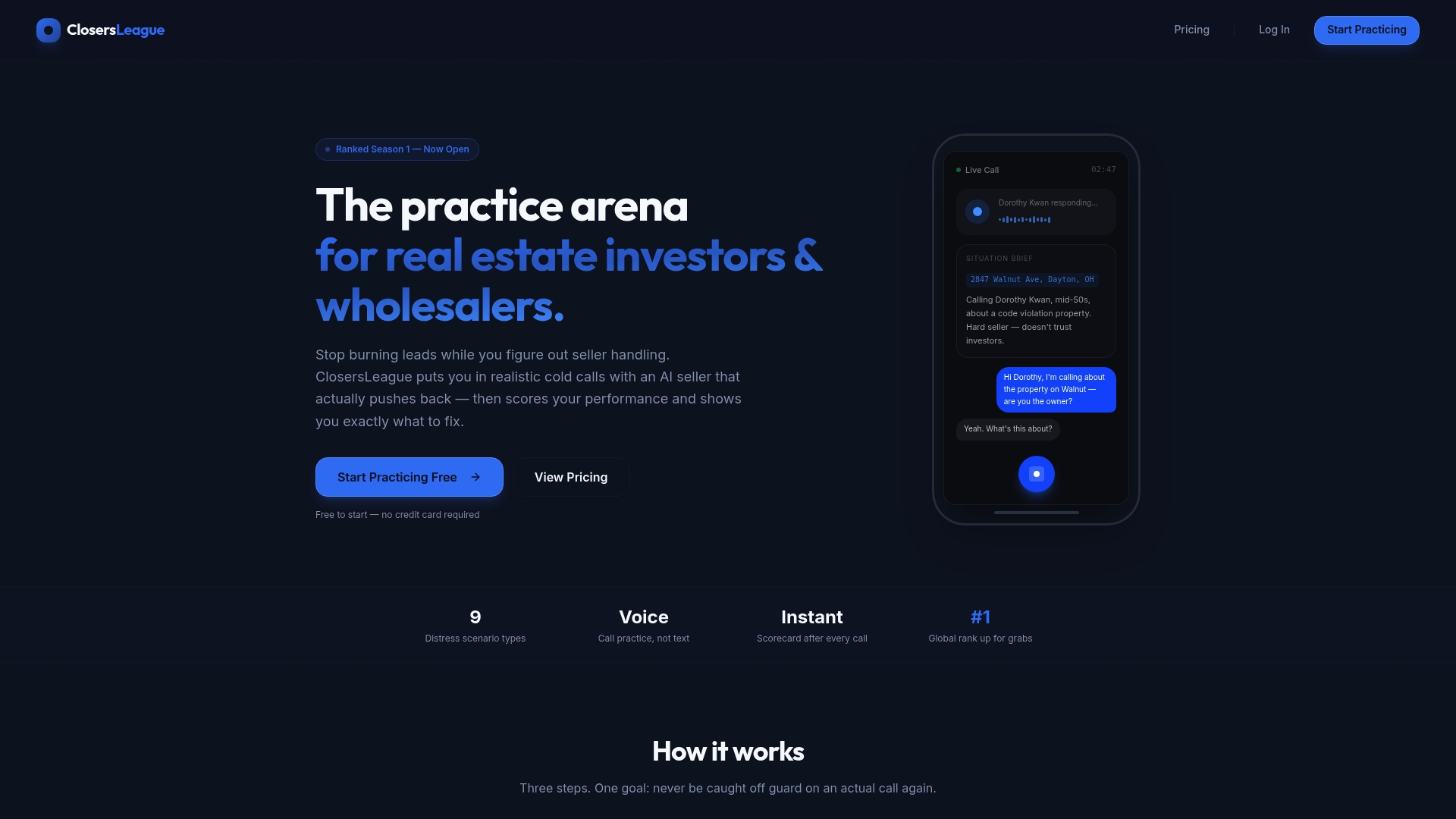
ClosersLeague is an AI-powered cold calling training platform built specifically for real estate investors and wholesalers. You can practice AI roleplay sessions for every major distressed seller type, including foreclosure, probate, divorce, tax delinquent, and more. Need to sharpen your responses to code violation scenarios? We have that. Want dedicated reps on inherited property roleplaying? We cover that too. Every session gives you immediate feedback so you improve call by call, not quarter by quarter. Stop waiting for your next live call to practice. Build your skills before they cost you a deal.
Frequently asked questions
What’s the most important moment to roleplay when cold calling distressed sellers?
The pivot moment, when a seller asks an unexpected or challenging question, tests your real adaptability and should be roleplayed frequently. Structured diagnostics like pattern interrupts and discovery anchors prepare you to navigate those moments without losing momentum.
How can I prevent sounding too scripted during roleplaying?
Focus on scenario-based roleplay and active listening instead of repeating memorized lines. Conversational naturalness and listening behavior are the real benchmarks for a strong practice call, not word-for-word script coverage.
What’s a simple framework for structuring wholesaler cold call roleplays?
Start with a permission-based opener, state the property-specific reason for calling, ask discovery questions, and finish with a concrete next step. This four-stage conversational framework applies to every distressed seller type and gives your sessions a clear structure to evaluate.
How often should wholesalers run roleplay sessions to stay sharp?
Aim for two to three focused sessions per week, cycling through different scenarios and objections each time. Timed simulations with observer debrief and role reversal in each session will compound your improvement quickly across weeks.
Recommended
- Pre-Foreclosure Cold Calling Practice — AI Roleplay for Real Estate Investors & Wholesalers
- Foreclosure Cold Calling Practice — AI Roleplay for Real Estate Investors & Wholesalers
- Vacant Property Cold Calling Practice — AI Roleplay for Real Estate Investors & Wholesalers
- Real Estate Cold Calling Practice — AI Roleplay for Every Seller Type | ClosersLeague