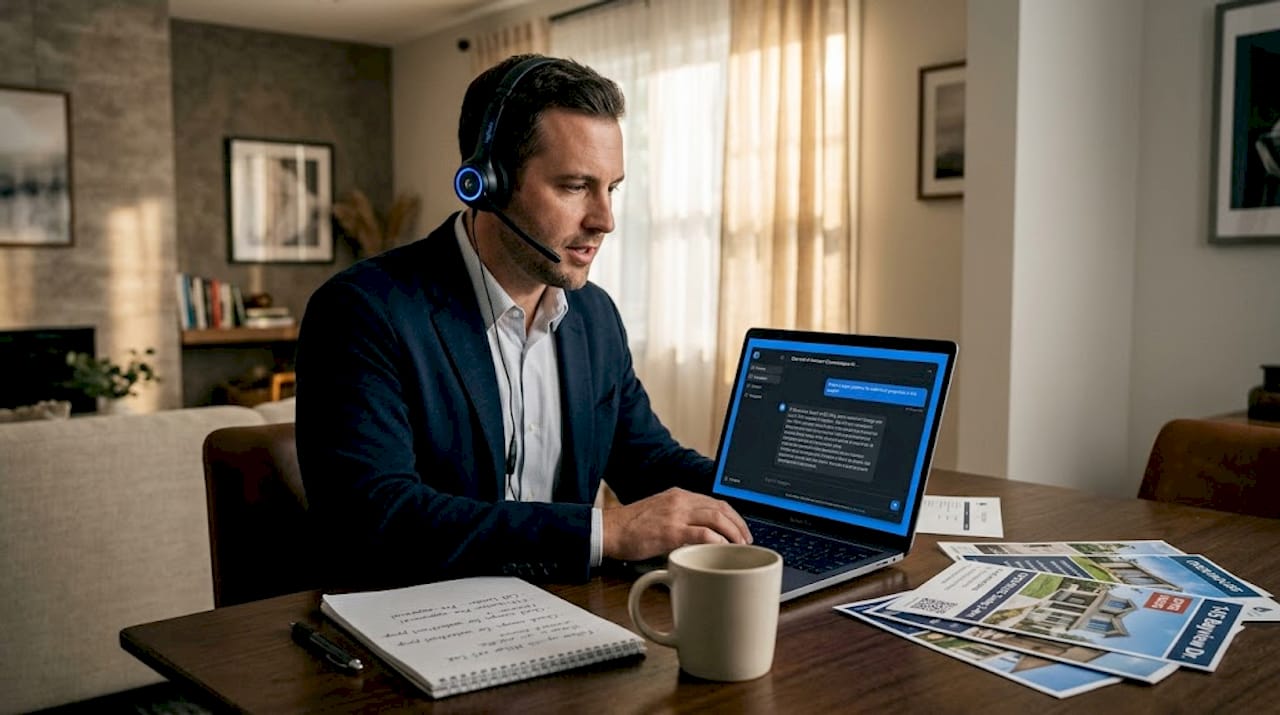
Most wholesalers lose deals not because they lack leads, but because they freeze up on the call. AI roleplay real estate wholesaling is changing that. Instead of learning through burned leads and missed opportunities, you can now practice seller conversations, objection handling, and negotiation scenarios on demand, without any real-world consequences. This guide breaks down exactly how AI roleplay works, why it outperforms traditional training, and how to put it to work in your wholesaling business starting today.
Table of Contents
- Key takeaways
- What AI roleplay in real estate wholesaling actually is
- Why AI roleplay beats traditional wholesaling training
- Comparing AI roleplay platforms for wholesalers
- How to integrate AI roleplay into your wholesaling workflow
- Future trends in AI roleplay and wholesaling
- My take on AI roleplay and wholesaling success
- Practice smarter with Closersleague
- FAQ
Key takeaways
| Point | Details |
|---|---|
| AI roleplay replaces risky live practice | Rehearse seller calls and objections without burning real leads or damaging relationships. |
| Personalized feedback accelerates growth | AI coaching adapts to your communication style, helping you fix specific weaknesses faster. |
| Consistency is the key driver | Wholesaling teams that commit to two sessions weekly see measurable performance improvements over time. |
| Compliance is built into good platforms | Top AI tools include TCPA and state-level legal frameworks to keep your outreach protected. |
| AI assists, it does not replace you | The wholesaler who builds real trust still closes the deal. AI prepares you to do that better. |
What AI roleplay in real estate wholesaling actually is
AI roleplay is a virtual simulation of real estate calls and negotiations powered by artificial intelligence. You speak or type as yourself, and the AI responds as a homeowner, motivated seller, or cash buyer, reacting in real time based on what you say. The conversation feels like a live call because the AI is trained on thousands of real interactions.
For wholesalers, the typical scenarios include:
- Cold calls to distressed sellers (foreclosure, probate, divorce, tax delinquent)
- Objection handling practice (“I’m not interested,” “I already have an agent,” “Your offer is too low”)
- Negotiation simulations where the AI pushes back on price or terms
- Script testing to see which openings and closes actually land
The technology behind it involves natural language processing and machine learning models trained specifically on real estate conversations. The AI does not just follow a script tree. It adapts. If you pivot your approach mid-call, the AI adjusts its responses accordingly, which is what makes it genuinely useful for real estate negotiation AI practice.
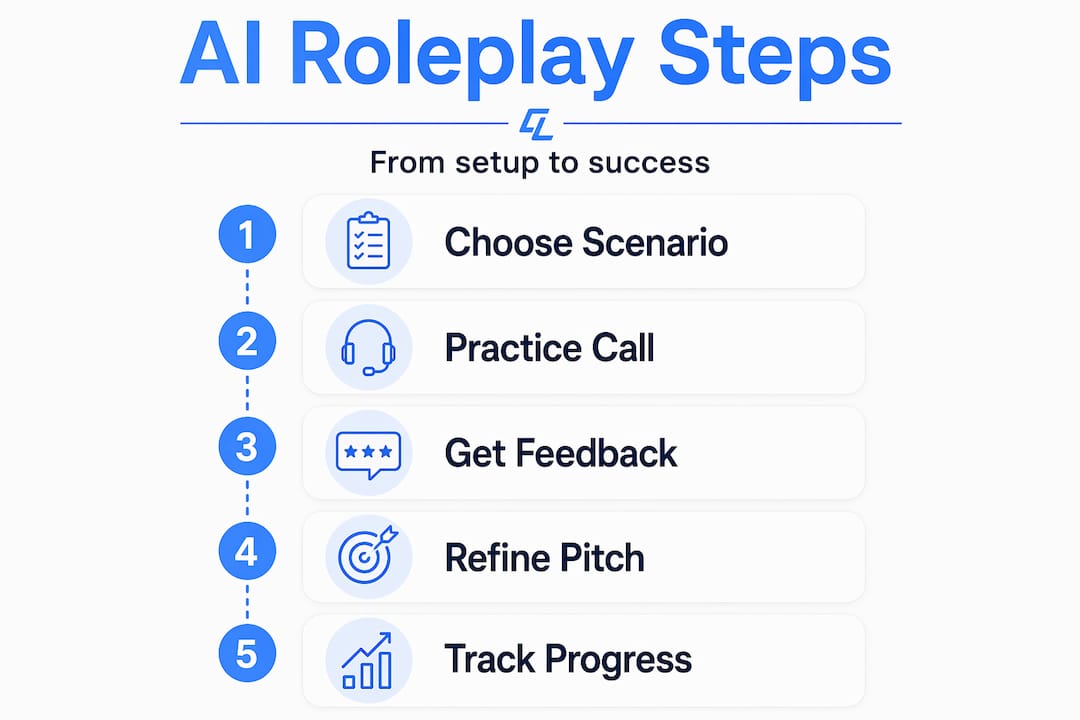
One of the most practical features is on-demand availability. You do not need to schedule a coach or wait for a team meeting. You can run five practice calls before your first real call of the morning. After each session, the platform gives you feedback on tone, pacing, objection responses, and areas where you lost momentum.
Pro Tip: Record your AI roleplay sessions and listen back. You will catch verbal habits, filler words, and hesitation patterns you never noticed in real calls.
Why AI roleplay beats traditional wholesaling training
Traditional training methods have a ceiling. You can shadow a mentor, attend a workshop, or read scripts all day, but none of that replicates the pressure of a live call with a grieving homeowner in probate or a frustrated landlord ready to walk away. AI roleplay removes that ceiling.
Here is why wholesalers who adopt it consistently outperform those who do not:
-
No scheduling conflicts. Your AI coach is available at 6 AM or midnight. There is no calendar to book, no mentor to track down. AI assistants reduce lead response time to seconds and stay available around the clock, which mirrors how AI roleplay tools operate for training purposes.
-
Zero risk to your pipeline. Every wholesaler has fumbled a call with a hot lead and lost the deal. With AI roleplay, you can mess up, restart, and try again without any real-world cost. AI roleplay’s greatest value is exactly this: constant, pressure-free rehearsal that lets you fine-tune skills without burning leads.
-
Feedback that is actually personalized. Generic coaching tells you to “sound more confident.” AI coaching tells you that your pacing slows down after an objection and your close lacks specificity. AI-driven coaching platforms analyze personality signals and adjust feedback to your specific communication style and motivators.
-
Data you can track. You can measure your objection response rate, call completion rate, and improvement over time. That data tells you exactly where to focus your next session.
-
Confidence that compounds. Repetition builds muscle memory. Wholesalers who practice regularly walk into real calls with a different energy. They have already heard every objection dozens of times. Nothing surprises them.
-
Reviving cold leads. AI simulations can help you prepare for re-engagement calls on leads that went cold months ago. You practice the exact conversation before you dial, which dramatically improves your chances of reactivating that lead.
“AI is like a refrigerator. It’s always on. It handles what needs to be handled so you can focus on the relationships that actually close deals.” — Alex Gustafson, serial entrepreneur, as quoted here
Comparing AI roleplay platforms for wholesalers
Not all AI roleplay tools are built the same. Some are general-purpose sales trainers with a real estate skin. Others are purpose-built for wholesaling workflows. Here is what to look for and how the major approaches stack up.
Pro Tip: Before committing to any platform, run a free trial with a scenario that matches your most common seller type. If the AI’s responses feel scripted or shallow, the training value will be limited.
| Platform type | Script sophistication | CRM integration | Compliance tools | Best for |
|---|---|---|---|---|
| Closersleague modules | High, seller-type specific | Moderate | Built-in guidance | Wholesalers and investors |
| Multi-agent open source (e.g., Wholesaile) | Very high, 6 specialized agents | Advanced | TCPA and state law built in | Tech-savvy teams |
| General sales AI trainers | Moderate, not RE-specific | Low | Minimal | Broad sales teams |
| Proprietary brokerage AI | High within brokerage context | High | Varies by brokerage | Traditional agents |
The Wholesaile system is a notable open-source example. It uses six specialized AI agents with a 113-file knowledge base to handle everything from lead scouting to negotiation and transaction management. That level of depth is impressive, but it requires technical setup and ongoing maintenance that most solo wholesalers cannot support.
Closersleague takes a different approach. The platform focuses specifically on cold calling practice for distressed seller scenarios, which is where most wholesalers actually need the reps. The modules are organized by seller type, so you practice foreclosure calls separately from probate calls, inherited property calls, and out-of-state owner scenarios. That specificity matters because each seller type carries different emotional dynamics and objections.
Compliance is a non-negotiable factor. The best platforms embed TCPA requirements and state-specific regulations directly into their training frameworks, so you are not just getting better at calls. You are getting better at calls that stay within legal boundaries.
How to integrate AI roleplay into your wholesaling workflow
Knowing the tool exists is not enough. The wholesalers who see real results are the ones who build AI roleplay into their daily routine the same way a professional athlete builds film study into practice.
Here is how to do it effectively:
-
Set a minimum practice schedule. The data is clear. Wholesaling teams that mandate at least two AI roleplay sessions per week see consistent performance improvements. Two sessions is the floor, not the ceiling.
-
Match your practice to your pipeline. If you are working a batch of pre-foreclosure leads this week, run pre-foreclosure scenarios in your AI sessions. Do not practice generic cold calls when your real calls will be emotionally charged distressed seller conversations.
-
Use AI feedback to rewrite your scripts. After each session, review the feedback and make one specific change to your script or approach. Small, deliberate adjustments compound fast. You can find script refinement strategies that pair well with AI practice.
-
Combine AI practice with live call debriefs. Run your AI session in the morning. Make your real calls. Then compare how the live calls felt versus the practice. Where did you freeze? Where did you nail it? That comparison is where the real learning happens.
-
Track your scores over time. Most AI platforms give you a performance score after each session. Log those scores. If your objection handling score is flat after three weeks, that tells you something specific needs to change in your approach.
-
Do not skip the uncomfortable scenarios. The seller types that make you nervous are exactly the ones you need to practice most. Probate calls, divorce situations, angry landlords. Run those scenarios until they feel routine.
Future trends in AI roleplay and wholesaling
The tools available today are impressive. What is coming in the next two to three years will be a different level entirely.
-
More realistic conversations. Natural language processing is advancing fast. Future AI roleplay tools will handle interruptions, emotional escalation, and long pauses the way a real person would, making practice sessions nearly indistinguishable from live calls.
-
Voice AI and real-time call assistance. Imagine having an AI coach listening to your live call and feeding you suggested responses in real time through an earpiece. That technology is already in early development stages for real estate applications.
-
Full pipeline management through multi-agent AI. Systems like Wholesaile point toward a future where AI manages the full deal lifecycle, from initial lead contact through negotiation and closing documentation. Wholesalers will focus on relationship decisions while AI handles the operational layer.
-
Hyper-personalized coaching. AI will eventually pull in your local market data, your historical call performance, and even your personality profile to create training scenarios tailored specifically to your market and your weaknesses.
-
Compliance automation. As regulations around cold calling tighten, AI platforms will automatically update their compliance frameworks, so your training always reflects current TCPA requirements and state laws.
-
Human oversight remains non-negotiable. No matter how advanced the AI becomes, the wholesaler who reads the room, builds genuine trust, and makes judgment calls in real time will always be the one who closes. AI augments that ability. It does not replace it.
My take on AI roleplay and wholesaling success
I have watched a lot of wholesalers get excited about new tools and then use them wrong. They run a few AI sessions, feel good about it, and go back to winging their calls. That is not how this works.
What I have seen actually move the needle is consistent, deliberate practice tied to real call outcomes. The wholesalers who treat AI roleplay like a gym membership and show up twice a week, every week, are the ones whose close rates climb. Not because the AI is magic, but because repetition removes hesitation. And hesitation is what kills deals.
I have also seen wholesalers overcorrect the other way. They get so polished in AI sessions that their live calls sound rehearsed. Sellers can feel that. The goal is not to memorize a script. The goal is to internalize the logic of a conversation so you can respond naturally when a seller goes off script.
One thing that surprises most wholesalers when they start using AI roleplay is how quickly it exposes their actual weaknesses. Not the ones they thought they had, but the real ones. One investor I know was convinced his problem was his opening line. Three sessions in, the AI feedback showed his opening was fine. His problem was how he handled the first “I’m not interested.” He had never noticed because he was too busy reacting in the moment on live calls.
My honest take: AI is the best practice partner you have ever had. It is patient, available, and brutally honest. But it only works if you treat it seriously. Stop winging it. Start drilling.
— Dave
Practice smarter with Closersleague
If you are ready to put AI roleplay to work in your wholesaling business, Closersleague is built specifically for this. The platform offers targeted practice modules for every major seller type you will encounter: inherited property calls, code violation scenarios, out-of-state owners, foreclosure, pre-foreclosure, and more.
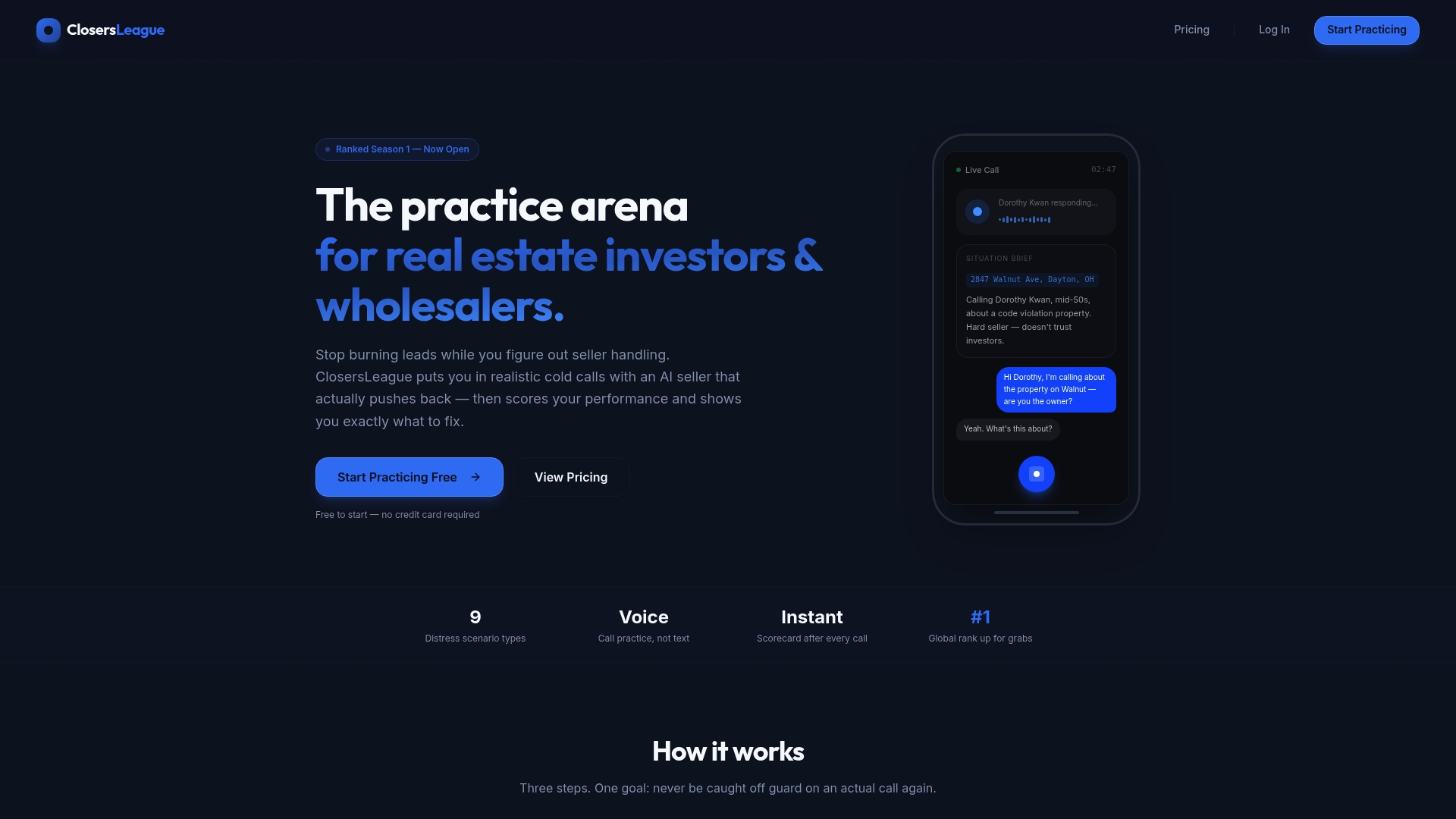
Each module simulates the specific emotional dynamics and objections tied to that seller type. You get scored after every session, with feedback that tells you exactly what to fix. There is no scheduling, no waiting, and no burned leads. Just reps that make you sharper. Whether you are new to wholesaling or a seasoned investor looking to tighten your close rate, start practicing today and see the difference deliberate AI practice makes on your next real call.
FAQ
What is AI roleplay in real estate wholesaling?
AI roleplay in real estate wholesaling is a virtual simulation where an AI acts as a seller or buyer so wholesalers can practice cold calls, objection handling, and negotiation in a risk-free environment. The AI responds dynamically based on what you say, making each session feel like a real conversation.
How often should wholesalers practice with AI roleplay?
Wholesaling teams that mandate a minimum of two AI roleplay sessions per week see consistent, measurable performance improvements. Two sessions weekly is the recommended baseline for building real skill.
Can AI roleplay actually improve my negotiation skills?
Yes. AI platforms provide personalized feedback on tone, pacing, and objection responses, which directly improves negotiation outcomes. Data-driven AI tools in real estate have shown conversion rate improvements of up to fivefold when used consistently.
Is AI roleplay compliant with TCPA and cold calling laws?
The best platforms build compliance directly into their training frameworks. Tools like Wholesaile incorporate state-by-state legal requirements and TCPA guidelines, so your practice sessions reflect legally sound outreach strategies.
Does AI roleplay replace the need for a human coach?
No. AI roleplay handles repetition, availability, and data-driven feedback, but a human coach provides context, intuition, and relationship insight that AI cannot fully replicate. Think of AI as your practice partner and a human coach as your strategist.