
Cold calling for investors: why direct outreach still wins
Most real estate investors assume cold calling is a numbers game where you burn through lists and hope for the occasional lucky break. That assumption is costing them deals. The truth is that contact rates average 10-15% for real estate investors, and top performers close at over 5% — numbers that rival many digital marketing channels at a fraction of the cost. Cold calling, done with intention and skill, is one of the most direct paths to motivated sellers who are not listed anywhere online. This article will show you why investors prioritize the phone, what results you can realistically expect, and how to sharpen your approach so every call counts.
Table of Contents
- The strategic purpose behind investor cold calling
- Benchmarks and results: What cold calling actually delivers
- How investors maximize success through cold calling techniques
- Comparing cold calling to other real estate lead generation methods
- The real difference: What most investors get wrong about cold calling
- Practice smarter cold calling to boost your lead success rate
- Frequently asked questions
Key Takeaways
| Point | Details |
|---|---|
| Why investors cold call | Cold calling provides direct access to motivated sellers and uncovers deals competitors often miss. |
| Success benchmarks | Top investors convert at rates up to 5.2%, with long-term ROI climbing steeply after six months of consistent effort. |
| Best practices matter | Scripts, follow-ups, and continuous practice dramatically improve cold calling results for real estate investors. |
| Cold calling vs. alternatives | Direct phone outreach stands apart for speed and lead quality, especially with niche property types or urgent seller challenges. |
The strategic purpose behind investor cold calling
Digital ads and direct mail have their place, but they both share a critical weakness: they wait for the seller to act. A motivated homeowner facing foreclosure or managing an inherited property out of state may never click your ad or respond to a postcard. A phone call, though, creates an immediate moment of real human connection. That gap between passive marketing and real-time conversation is exactly where cold calling earns its value.
Investors who understand cold calling basics know that the phone reaches sellers at the moment a problem feels most urgent. The most responsive groups typically include:
- Pre-foreclosure homeowners who are anxious, overwhelmed, and looking for options
- Out-of-state landlords dealing with vacancy or tenant problems from a distance
- Probate property owners navigating legal complexity alongside grief
- Code violation owners facing fines they cannot afford to fix
- Tax-delinquent property owners who risk losing their home and need a fast solution
These sellers are not browsing Zillow. They need a conversation, not a landing page. Cold calling removes the competition because most investors are not willing to pick up the phone consistently.
“The phone is the fastest way to find out if a seller is truly motivated. No form, no email, no ad can replicate the clarity of a direct conversation.”
Beyond access, cold calling creates real-time qualification. In two minutes, you can determine whether a seller has equity, decision-making authority, and a timeline that matches your buying criteria. That instant feedback loop is something no passive channel can match. Empirical benchmarks confirm that consistent cold calling generates qualified leads and contracts at measurable, repeatable rates. Following strong cold calling tips from the start keeps your pipeline moving even when other marketing channels slow down.
The strategic edge is simple: cold calling puts you in front of motivated sellers before anyone else does. That early access, combined with skilled rapport-building, is what separates investors who wait on deals from those who create them.

Benchmarks and results: What cold calling actually delivers
Knowing the why behind investor outreach, let’s look at what results you can realistically expect from dedicated cold calling. Numbers anchor your expectations and help you build a sustainable routine instead of quitting after a tough week.
Here is what the data shows:
| Metric | Industry average | Top performers |
|---|---|---|
| Contact rate per list | 10-15% | 18-22% |
| Leads per day (250-300 calls) | 1-2 qualified leads | 2-3 qualified leads |
| Lead-to-appointment rate | 20-30% | 35-50% |
| Close rate overall | 2.5% | 5.2% |
The 250-300 conversations daily benchmark reveals that high-volume calling paired with strong scripting yields 1-3 qualified leads per day, with top performers closing deals at a 5.2% rate. For context, that outperforms the average email marketing close rate by a wide margin.
New investors often expect one deal per week and quit when reality hits differently. The smarter mindset is to treat cold calling as a compounding skill. Your first month is slower. Your third month is noticeably better. By month six, your ability to read a seller’s emotional state, handle objections, and pivot your script becomes almost automatic.
ROI is real, but it is not instant. Persistence combined with skill development is what creates the return. Tracking your metrics from day one, including calls made, contacts reached, leads generated, and appointments set, gives you a feedback loop that shows exactly where to improve.
Pro Tip: Track your script performance by section. If you are reaching sellers but losing them before you qualify the lead, the problem is likely your rapport-building or your opening questions. Refining that specific section can double your conversion at that stage without changing anything else. Use cold calling success tips to guide your tracking process.
How investors maximize success through cold calling techniques
With realistic goals in mind, it’s time to focus on how top investors turn those phone calls into deals with proven methods. Technique is where your average caller becomes a deal-closing machine.
Here is the call structure that consistently produces results:
- Open with curiosity, not a pitch. Start with the seller’s name, a brief reference to their property, and an open-ended question about their situation. “I came across your property on [Street Name]. Are you open to a conversation about it?” keeps the door open.
- Identify motivation early. Ask simple, direct questions about how long they have owned the property, what their plans are, and whether anything has changed recently. The answers tell you everything.
- Confirm decision authority. Ask directly whether they are the sole decision-maker or whether others are involved. Skipping this step wastes time on calls that require more stakeholders.
- Qualify the numbers. Determine equity position, outstanding loans, and urgency without making it feel like an interrogation. Use empathy: “Is there a timeframe that works best for you?”
- Set the next step. Every call should end with a clear action, an appointment, a callback time, or a referral. Never leave a call open-ended.
Following a consistent investor script workflow is what separates structured closers from improvised callers. Scheduling appointments from qualified leads succeeds at a 30-50% rate, which means your follow-up technique is just as important as your opening.
Rejections and hang-ups are not failures. They are data. Log the objection, review your response, and adjust. Sequencing follow-ups matters too. A seller who says “not yet” in January may be ready by March. A systematic follow-up plan keeps those opportunities alive through better lead generation methods.
Pro Tip: Roleplay practice is the fastest accelerator for cold calling skill. Record yourself, then listen back. You will immediately hear where you rush, where you sound uncertain, and where sellers disengage. Fix one thing per session and your improvement will compound quickly.
Comparing cold calling to other real estate lead generation methods
To round out your strategy, it’s important to see how cold calling stacks up against other common ways investors source leads.
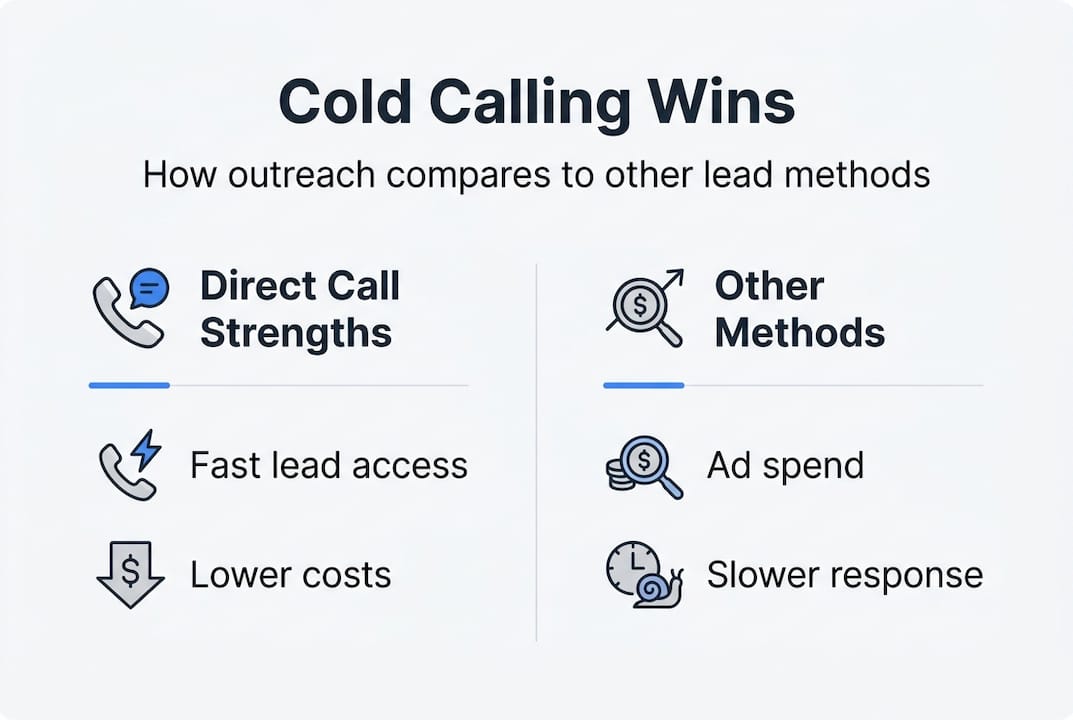
| Method | Avg. cost per lead | Speed to contact | Lead quality | Best for |
|---|---|---|---|---|
| Cold calling | Low | Immediate | High (direct) | Motivated sellers, distressed properties |
| Direct mail | Medium | Days to weeks | Medium | Broader list reach |
| Online ads (PPC) | High | Hours to days | Variable | General seller inquiries |
| Inbound/SEO | Very low (long-term) | Weeks to months | Medium-high | Brand-building, passive leads |
| Driving for dollars | Low | Immediate | High (visual) | Vacant/distressed properties |
Each method has a role, but cold calling wins on speed and lead quality for distressed sellers. Top performers achieve up to a 5.2% close rate with targeted cold calling over several months, a benchmark that paid ads rarely match at comparable cost.
Here is when to prioritize the phone over other channels:
- The property has a known distress signal, such as foreclosure notice, code violation, or tax lien
- The seller is out of state and unlikely to see local mail or ads
- You need a quick answer on whether a deal is worth pursuing
- Your list is small and targeted rather than broad and cold
- You want to test a new market before committing to a larger paid campaign
Direct mail works well as a supplement, reinforcing your phone outreach for sellers who did not pick up. PPC and SEO build long-term brand presence but rarely produce the urgency-driven conversations that investors need with distressed sellers. Cold calling is still your most direct path to a motivated seller’s decision. Explore lead generation strategies that blend these methods once your phone skills are sharp.
The real difference: What most investors get wrong about cold calling
Most investors quit cold calling within the first 60 days. They make 200 calls, get a handful of hang-ups and a few rude rejections, and decide it doesn’t work. What they miss is that cold calling has a learning curve, and the ROI is back-loaded, not front-loaded.
Cold calling ROI climbs dramatically once your skill matures past the six-month mark. That return is not accidental. It reflects the compounding value of a refined script, a warmer follow-up sequence, and the ability to read a seller’s emotional state in real time.
The bigger trap is treating cold calling as transactional rather than relational. Many investors call a list once, get no response, and move on. Experienced closers understand that a seller who says “no” in February may say “yes” in April when their situation worsens. Staying in consistent, respectful contact over time, without pressure, builds the kind of trust that leads to off-market deals. Use script refinement insights to keep sharpening your approach as your confidence grows. Stop winging it. Start drilling.
Practice smarter cold calling to boost your lead success rate
Ready to turn insights into action? Knowing the stats and techniques is only the beginning. The gap between knowing and closing comes down to deliberate, structured practice.
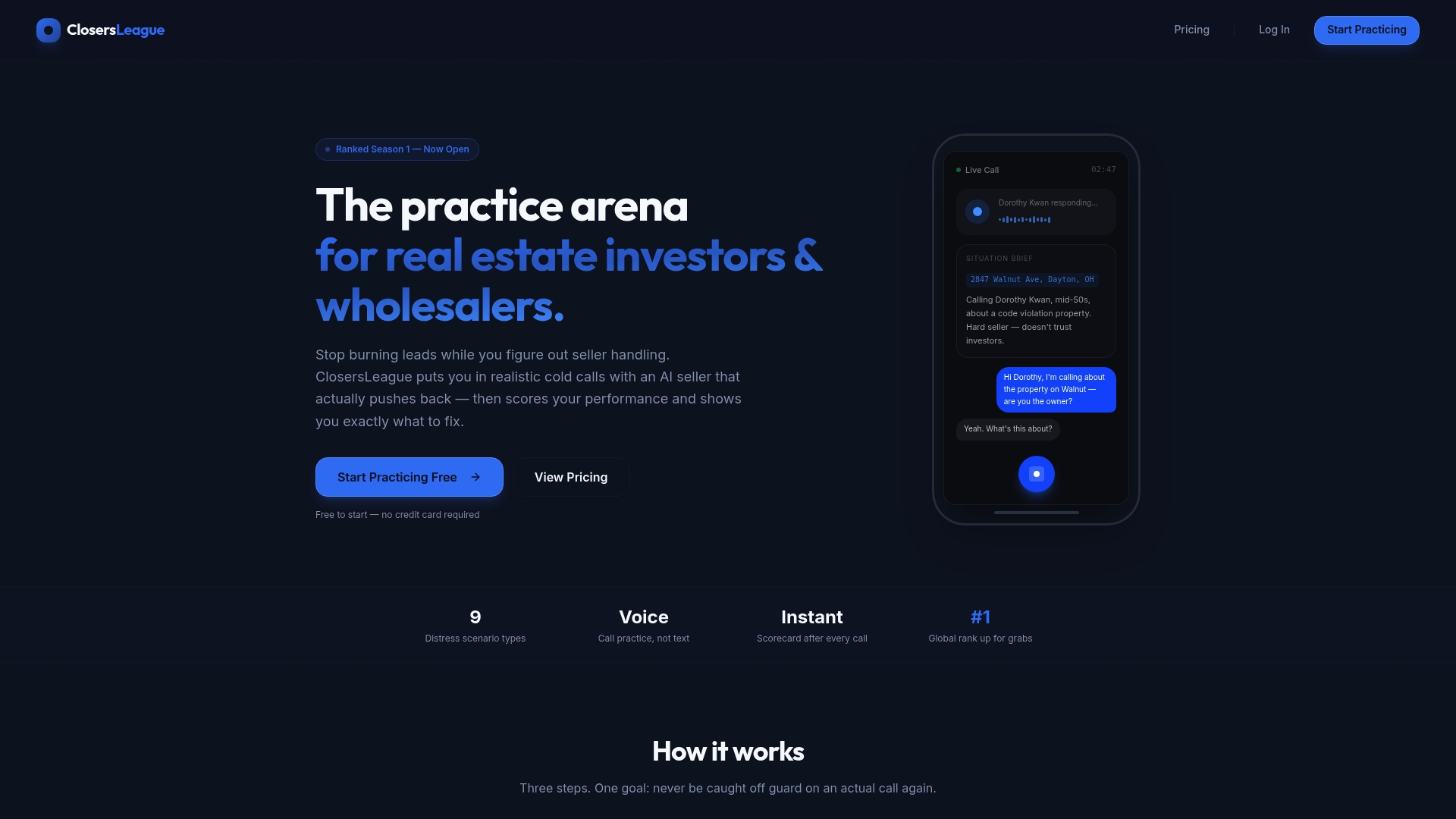
ClosersLeague is an AI-powered cold calling training platform built specifically for real estate investors and wholesalers. You can practice cold calling roleplay scenarios that mirror real seller situations, including pre-foreclosure, probate, tax delinquent, and divorce. Need to sharpen your approach for a specific niche? Our code violation call training puts you in the exact conversations that trip up most investors. Get feedback, track your improvement, and build the confidence that turns cold calls into contracts. Sign up today and make your next call your best one.
Frequently asked questions
How many cold calls do investors typically need to make to get a deal?
On average, 5,500 calls can yield 8 contracts in a targeted scenario, but stronger list quality and improved scripting can significantly reduce that number over time.
What is a good contact rate for real estate cold calling?
A contact rate of 10-15% is the standard industry benchmark, and better targeting combined with skip-tracing tools can push that figure higher.
Is cold calling still effective for real estate investing in 2026?
Yes. Industry data shows a sustained ROI of 4x or higher after six months of consistent effort, making it one of the most reliable tools in an investor’s lead generation arsenal.
What types of sellers respond best to investor cold calls?
Motivated sellers in distress, including those facing foreclosure, probate situations, code violations, or tax delinquency, consistently produce the highest-quality leads for investors who call with empathy and purpose.
Recommended
- 10 proven cold calling tips for real estate investors – ClosersLeague Blog
- Real Estate Cold Calling Practice — AI Roleplay for Every Seller Type | ClosersLeague
- Master Real Estate Lead Generation: Cold Calling Basics – ClosersLeague Blog
- Boost Real Estate Deals with a Proven Investor Script Workflow – ClosersLeague Blog