
10 proven cold calling tips for real estate investors
Cold calling distressed property owners is one of the hardest skills in real estate investing to master, and also one of the most rewarding. The gap between investors who consistently book appointments and those who burn through lists without results often comes down to a handful of specific, repeatable habits. Timing, persistence, and the right words at the right moment can turn a reluctant homeowner into a motivated seller. This article breaks down proven cold calling tips built specifically for investors and wholesalers working foreclosure, probate, and divorce leads, so you can stop guessing and start converting.
Table of Contents
- Understand the numbers: Cold calling benchmarks that matter
- Call at the right time: Timing strategies for higher response rates
- Persistence, follow-up, and script mastery: Skills top closers use
- Overcoming objections: How to handle tough conversations with distressed sellers
- Comparing cold call approaches: Which strategy fits each seller situation?
- Why authentic connection—more than scripts—wins over distressed sellers
- Take your cold calling from theory to action with ClosersLeague
- Frequently asked questions
Key Takeaways
| Point | Details |
|---|---|
| Know your numbers | Track your call conversion and deal benchmarks to set smart goals. |
| Time calls strategically | Maximize your reach by calling during proven high-response windows. |
| Persistence pays off | Follow up at least six times to dramatically lift your contact rates. |
| Personalize your pitch | Scenario-specific scripts and empathy drive higher appointment rates. |
| Practice makes perfect | Refining your approach with real-world simulations increases close rates. |
Understand the numbers: Cold calling benchmarks that matter
Before you can improve your cold calling results, you need to know what good actually looks like. Setting realistic expectations keeps you from quitting too soon and helps you identify exactly where your process is breaking down.
Industry data gives us a clear picture. The cold calling statistics show that the average cold call to appointment rate lands between 1.7% and 2.3%, with a close rate around 2.5%. Top performers push that close rate to 5.2%. Investors making 100 or more calls per day can realistically generate around 18 deals per year. REsimpli users alone closed 802 deals through cold calling in 2024, generating $15 million in revenue.
Those numbers matter because they reframe effort. If you make 50 calls and book zero appointments, that is not failure. That is math. You need volume and consistency to make the averages work in your favor.
Here is a quick benchmark table to keep on your desk:
| Metric | Average performer | Top performer |
|---|---|---|
| Call to appointment rate | 1.7% to 2.3% | 3.5%+ |
| Close rate | 2.5% | 5.2% |
| Daily call volume | 50 to 75 | 100+ |
| Deals per year (100 calls/day) | ~10 to 12 | ~18 |
“Volume without skill is noise. Skill without volume is wasted potential. You need both.”
To build that skill foundation, invest time in real estate cold calling practice before you dial live leads. Tracking these metrics weekly will show you exactly which lever to pull next. Monitor your contact rate, appointment rate, and follow-up attempts per lead as your core performance indicators. Reviewing your cold calling basics regularly keeps your fundamentals sharp as your volume scales.
Call at the right time: Timing strategies for higher response rates
Once you are tracking your metrics, the next critical lever is optimizing when you are actually picking up the phone. Calling at the wrong time is one of the most common and most fixable mistakes investors make.
Research on calling schedules consistently shows that the best windows for reaching distressed homeowners are weekdays between 9 and 11 AM and again from 4 to 6 PM. Saturdays from 10 AM to 1 PM also perform well, especially for owners who are harder to reach during the workweek. Evening calls between 6 and 8 PM can work for specific lists, particularly absentee owners or landlords.
Times to avoid include the lunch hour, early mornings before 9 AM, and Mondays and Fridays. People are either mentally checked out or too rushed to engage meaningfully.
Here is a comparison table for quick reference:
| Time slot | Day | Performance | Notes |
|---|---|---|---|
| 9 to 11 AM | Weekdays | High | Peak focus, open to conversation |
| 4 to 6 PM | Weekdays | High | Post-work, more relaxed |
| 10 AM to 1 PM | Saturday | Strong | Owners home, less guarded |
| 6 to 8 PM | Weekdays | Moderate | Works for absentee lists |
| 12 to 1 PM | Any | Low | Lunch distraction |
| Monday/Friday | Any | Low | Start/end of week resistance |
Here is a simple process for structuring your call blocks:
- Block your morning session from 9 to 11 AM for your hottest leads.
- Use midday for skip tracing, list building, and CRM updates.
- Run your afternoon session from 4 to 6 PM for your follow-up calls.
- Reserve Saturday mornings for vacant property cold call scripts and absentee owner outreach.
- Review your contact rate by time slot weekly and adjust accordingly.
Pro Tip: Rotate your calling windows across different lists. If your foreclosure list gets low contact rates in the morning, try the same list in the late afternoon for two weeks and compare results.
Persistence, follow-up, and script mastery: Skills top closers use
Optimizing your call schedule is only half of the equation. Next, let’s hone the skills and habits that move the numbers up.
Persistence is the single most underrated skill in cold calling. 6+ follow-ups can boost your contact rate by 70%, yet most investors give up after two or three attempts. That means the majority of your competition is leaving deals on the table by quitting too early.

Scripts matter too. Investors who use structured scripts book 22% more appointments and come across as more credible. Personalization takes it further, lifting response rates by 28%. The catch is call length. Calls that stretch past five minutes see a 61% drop in success rate, so you need to get to the point and earn the appointment quickly.
Here are the core habits top closers build:
- Follow up at least 6 times before removing a lead from your active list.
- Use a script as a guide, not a word-for-word recitation. Flexibility matters.
- Personalize every opening by referencing something specific, such as the property address or the seller’s situation.
- Keep calls under five minutes. Your goal is the appointment, not the full conversation.
- Log every call in your CRM immediately after hanging up.
- Review your landlord call scripting and inherited property scripts regularly to stay sharp.
Pro Tip: Build three script variations for your most common scenarios: foreclosure, probate, and divorce. Practice switching between them fluidly so you can adapt the moment you learn what situation the seller is in.
Overcoming objections: How to handle tough conversations with distressed sellers
You have learned how to follow up and script effectively. Now let’s tackle what to say when the conversation gets tough.
Distressed sellers often push back hard, not because they are not interested, but because they are scared, overwhelmed, or guarded. Scripts and personalization lift appointments by 22% and response rates by 28%, but the real skill is handling objections with empathy rather than pressure.
The most common objections you will hear include:
- “I’m not interested.” This usually means “I don’t trust you yet.” Respond with curiosity, not a counter-pitch.
- “I’m already working with someone.” Acknowledge it, then ask if they are open to a second opinion or a backup offer.
- “I’m not ready to sell.” This is a timing objection. Ask when they think they might be ready and schedule a follow-up.
- “How did you get my number?” Be transparent. Explain you work with homeowners in their area and found their information through public records.
- “I need to think about it.” Agree, then offer to call back at a specific time to keep the door open.
For pre-foreclosure script samples, the tone needs to be especially calm and solution-focused. Sellers facing foreclosure are often embarrassed. For divorce script roleplay, lead with neutrality and avoid taking sides. For probate call approaches, acknowledge the loss first before discussing the property.
Pro Tip: Use mirroring and open-ended questions to reduce resistance. Repeat the last two or three words the seller says as a question, then stay quiet. It signals you are listening and invites them to keep talking.
Comparing cold call approaches: Which strategy fits each seller situation?
Not all distressed sellers are in the same emotional or financial position. Matching your approach to the situation can be the difference between dead air and a booked meeting.
Personalization and scenario-appropriate scripts consistently boost both response and appointment rates. Here is how the approach should shift depending on the seller type:
| Seller type | Tone | Key offer | Call length | Follow-up cadence |
|---|---|---|---|---|
| Foreclosure | Calm, solution-focused | Fast close, cash offer | Under 4 minutes | Every 3 to 5 days |
| Probate | Empathetic, patient | Hassle-free sale, as-is | Under 5 minutes | Weekly |
| Divorce | Neutral, efficient | Quick resolution, fair price | Under 4 minutes | Every 5 to 7 days |
| Absentee/out-of-state | Direct, informative | Remote closing, simple process | Under 4 minutes | Bi-weekly |
Key adjustments by scenario:
- Foreclosure: Lead with urgency without creating panic. Acknowledge the timeline and position yourself as a resource.
- Probate: Never rush. These sellers are grieving. Ask questions about the property and the family’s goals before making any offer.
- Divorce: Stay neutral. Both parties may be involved. Focus on speed and simplicity as the shared benefit.
- Out-of-state owners: The out-of-state owner approach works best when you emphasize remote convenience and your ability to handle everything locally.
Do not use the same script across all four situations. The words that comfort a probate seller will feel tone-deaf to someone racing against a foreclosure auction date.
Why authentic connection—more than scripts—wins over distressed sellers
Here is something most cold calling guides will not tell you: scripts are a floor, not a ceiling. They give you structure, but the investors who consistently close deals are not the ones reading the most polished lines. They are the ones who actually listen.
Distressed sellers are not just homeowners. They are people in crisis. Foreclosure, divorce, and probate are among the most stressful life events a person can face. When you call them, they can tell within seconds whether you are running a pitch or having a conversation. The mechanical caller gets hung up on. The human one gets invited to come see the house.
The real edge comes from active listening and adapting in real time. That means pausing when the seller shares something emotional, asking a follow-up question instead of jumping to your next talking point, and being honest when you do not have an immediate answer. Reviewing cold calling basics is a great start, but the next level is developing genuine responsiveness that no script can fully teach.
Challenge yourself: after your next ten calls, ask how many times you actually changed direction based on what the seller said. If the answer is zero, you are reading, not connecting.
Take your cold calling from theory to action with ClosersLeague
Ready to put these winning cold calling tips to work for your investing business? Knowing the strategies is one thing. Building the muscle memory to execute them under pressure is another.
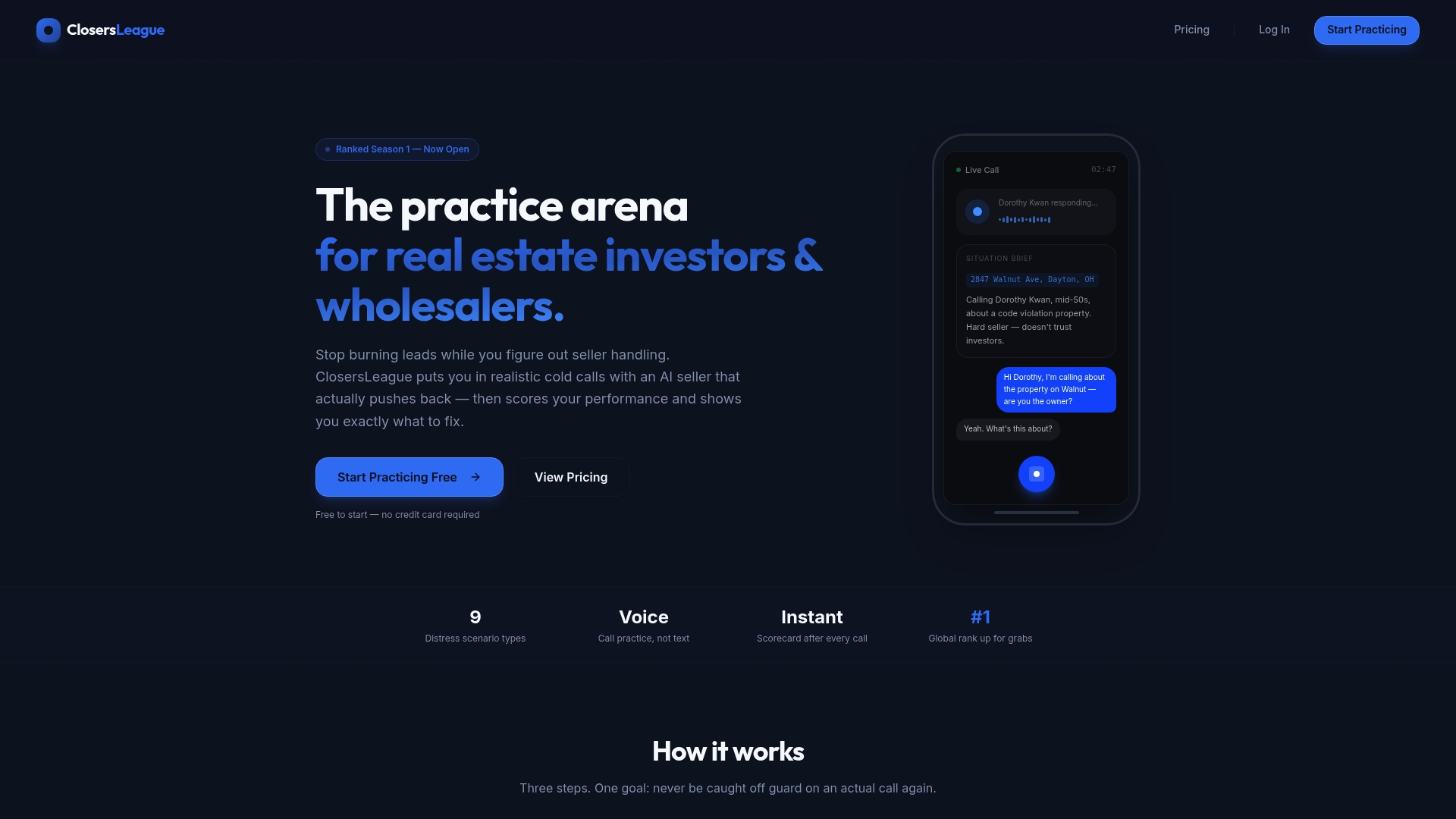
ClosersLeague is an AI-powered cold calling practice platform built specifically for real estate investors and wholesalers. You can run realistic roleplay sessions for foreclosure, probate, divorce, and more, and get scored on your objection handling, tone, and pacing. Start with pre-foreclosure AI roleplay and work through the toughest scenarios before you dial a real lead. Stop winging it. Start drilling.
Frequently asked questions
What is the best day and time to cold call real estate leads?
Weekdays between 9 to 11 AM and 4 to 6 PM, plus Saturdays 10 AM to 1 PM, consistently produce the highest contact rates. Avoid lunchtime and Mondays or Fridays when possible.
How many follow-ups should I make when cold calling sellers?
Make at least 6 follow-up attempts before moving a lead to inactive status. 6+ follow-ups can increase your contact rate by up to 70% compared to stopping after one or two calls.
Do scripts actually improve cold calling results?
Yes. Using a structured script can increase appointments by 22% and makes your delivery sound more confident and credible to sellers.
What is a realistic success rate for cold calling in real estate?
Most investors see a 1.7% to 2.3% appointment rate and a close rate around 2.5%. Top performers push close rates above 5%, which is achievable with consistent volume and deliberate practice.
Should I change my script for different seller situations?
Absolutely. Personalized scripts for foreclosure, probate, and divorce situations boost response rates by 28% and appointment rates by 22% compared to using a one-size-fits-all approach.
Recommended
- Real Estate Cold Calling Practice — AI Roleplay for Every Seller Type | ClosersLeague
- Master Real Estate Lead Generation: Cold Calling Basics – ClosersLeague Blog
- Vacant Property Cold Calling Practice — AI Roleplay for Real Estate Investors & Wholesalers
- Pre-Foreclosure Cold Calling Practice — AI Roleplay for Real Estate Investors & Wholesalers
- 7 Esempi di Strategie di Vendita Immobili di Successo