
Cold calling distressed homeowners is one of the hardest skills in real estate investing. You’re calling people who may be facing foreclosure, probate, divorce, or tax delinquency, and they’re often stressed, suspicious, and not expecting your call. Even experienced wholesalers freeze on tough objections, stumble over their words, or lose rapport at the worst moment. Roleplay training is the fastest, most direct way to fix that. This guide walks you through exactly how to set up and run roleplay sessions that build real confidence, sharpen your objection handling, and translate directly into more closed deals.
Table of Contents
- What you need before real estate roleplay training
- Step-by-step guide: Setting up your real estate roleplay training
- How to handle objections and adapt: Active listening and discovery in roleplay
- Measuring success: Improving outcomes through review and real-world results
- What most real estate roleplay training misses: Adaptability over memorization
- Take your roleplay training to the next level
- Frequently asked questions
Key Takeaways
| Point | Details |
|---|---|
| Frameworks beat fixed scripts | Conversation frameworks build natural conversations and adapt to each seller for higher success rates. |
| Practice objections, not just pitches | Roleplaying common and tough objections prepares you for real conversations with distressed sellers. |
| Track and adapt | Review real outcomes and refine your practice using feedback from live cold calls. |
| Adaptability wins deals | Investors who adjust to each call’s reality outperform those who stick to memorized scripts. |
What you need before real estate roleplay training
Before diving into actual roleplay, set yourself up for maximum efficiency with the right tools and approach.
Most investors make the mistake of jumping straight into calls without any structure behind their practice. They memorize a script word for word, then fall apart the moment a homeowner goes off script. The solution is to treat every call like a conversation, not a performance. Your prospecting process steps should reflect this, starting with preparation that prioritizes flexibility over rigidity.
Scripts are recommended as conversation frameworks (not word-for-word) that emphasize empathy, active listening, and a clear call to action. That distinction matters enormously. A framework gives you guardrails without boxing you in. You know where you’re headed, but you can adapt to what the homeowner says in real time.
Here are the core materials every investor and wholesaler needs before starting roleplay practice:
- Customizable conversation frameworks built around each lead type: pre-foreclosure, probate, divorce, code violation, and tax delinquent
- Lead sheets with realistic homeowner profiles, including property address, situation details, and emotional state
- An objections bank listing the 15 to 20 most common responses distressed sellers give, from “I’m not interested” to “How did you get my number?”
- A CRM or tracking sheet to log what scenarios you practiced, what worked, and what needs improvement
- A practice partner or AI roleplay system that can play the homeowner and respond dynamically
- Dedicated time blocks for practice sessions, not ad hoc or when you “have a few minutes”
Here’s a quick comparison of how materials differ depending on your practice setup:
| Material needed | Solo practice | Team or partner practice | AI-powered practice |
|---|---|---|---|
| Conversation framework | Required | Required | Required |
| Lead sheet | Self-created | Shared between partners | Pre-loaded by scenario |
| Objections bank | Self-reviewed | Partner delivers objections | AI delivers dynamically |
| Performance feedback | Self-assessed | Partner gives notes | Instant scored feedback |
| Session scheduling | Flexible | Requires coordination | On-demand, anytime |
| Variety of scenarios | Limited | Moderate | High, repeatable |
AI-powered practice has a significant advantage in consistency. Your partner might go easy on you or repeat the same objections. An AI system can play a hostile, skeptical pre-foreclosure homeowner every single time, no matter what hour you log in.
Check out these cold calling tips to build out your preparation even further before your first session.
Pro Tip: Use short, flexible prompts rather than word-for-word scripts. Try starting with something like “I work with homeowners in difficult situations, and I wanted to see if there’s anything I could help you with.” That opens a conversation rather than launching a pitch.
Step-by-step guide: Setting up your real estate roleplay training
Once you’ve gathered your resources, you’re ready to design and execute your first roleplay session.
Practicing roleplay specifically to handle objections and improve delivery in a low-pressure setting before speaking to homeowners is what separates consistent closers from investors who rely on luck. Here is a clear, repeatable process to follow:
-
Choose a specific scenario. Pick one lead type per session. Pre-foreclosure calls feel different from probate calls. Divorce situations require different empathy cues than code violations. Focusing on one scenario keeps the practice targeted and the learning sharp.
-
Draft your conversation framework. Write out 5 to 7 key beats: your opener, a brief statement of purpose, your first discovery question, 2 to 3 follow-up questions, your value proposition, and your call to action. Keep each beat flexible enough to adapt mid-call.
-
Assign roles clearly. One person is the investor or wholesaler making the call. The other, whether a partner, teammate, or AI system, plays the homeowner. The homeowner role should be played with realistic resistance, not passive agreement. For AI roleplay practice, the system handles this automatically with scenario-specific personas.
-
Run a timed session. Set a timer for 5 to 7 minutes per call simulation. Real calls rarely go beyond that window. Short, focused sessions train you to communicate efficiently under mild pressure. Do 3 to 5 rounds per session.
-
Review performance immediately after each round. Don’t wait until the end of the session. Debrief right after each call. What did you do well? Where did you lose momentum? Did you ask open-ended discovery questions or resort to yes or no prompts?
-
Log your takeaways and update your frameworks. Write down what objection caught you off guard. Update your objections bank. Adjust the conversation framework if something didn’t flow naturally. Treat every session as a data point.
Here’s a reference table for session structure based on best practices from top-performing wholesalers:
| Session element | Recommended approach | Why it matters |
|---|---|---|
| Session frequency | 2 to 3 times per week | Builds retention and momentum |
| Session length | 20 to 40 minutes total | Focused, not draining |
| Calls per session | 3 to 5 rounds | Repetition with reflection |
| Scenario variety | 1 to 2 per session | Deep practice beats scattered practice |
| Feedback method | Immediate debrief or scored AI review | Real-time correction sticks better |
For pre-foreclosure cold calling specifically, practice the emotional range of the homeowner. Some are angry. Some are relieved someone called. Some are in denial. Your framework needs to flex across all of those emotional states.

Pro Tip: Rotate practice partners or use an AI system regularly. If you only practice with one person, you start to predict their responses and your adaptability shrinks. Real homeowners are unpredictable. Your training should be too.
How to handle objections and adapt: Active listening and discovery in roleplay
Beyond first-round simulation, the real skill-builder is tackling real-world resistance, questions, and emotional triggers.
There is a critical difference between training for objection handling and training for memorized responses. Memorized responses feel scripted. Homeowners can hear it in your voice. True objection handling is about listening to what the homeowner actually said, identifying the emotion underneath it, and responding to the real concern, not just the surface statement.
Here are the most common objections you should build into your roleplay sessions:
- “I’m not interested.” (Surface objection, often means “I don’t know if I can trust you yet.”)
- “How did you get my number?” (Privacy concern, requires calm transparency.)
- “I’m not ready to sell.” (Timing concern, not a hard no. Explore what “ready” means to them.)
- “I already have an agent.” (Informational objection. Understand if the listing is active or expired.)
- “I owe more than it’s worth.” (Financial concern. This is often where the real conversation begins.)
- “My spouse handles this.” (Gatekeeping. Find out who the decision-maker is and how to reach them.)
- “Just send me something in writing.” (Deflection. Keep the conversation alive without losing control.)
The forum community at BiggerPockets reflects an important tension in the wholesaling world:
“There is no proven script… [some investors are] fiercely against scripts.”
That opinion isn’t wrong. Rigid scripts turn callers into telemarketers. But it doesn’t mean you go in unprepared. It means your preparation should be conversational and framework-based, not line-by-line memorization. Use roleplay to practice your thinking, not just your talking.
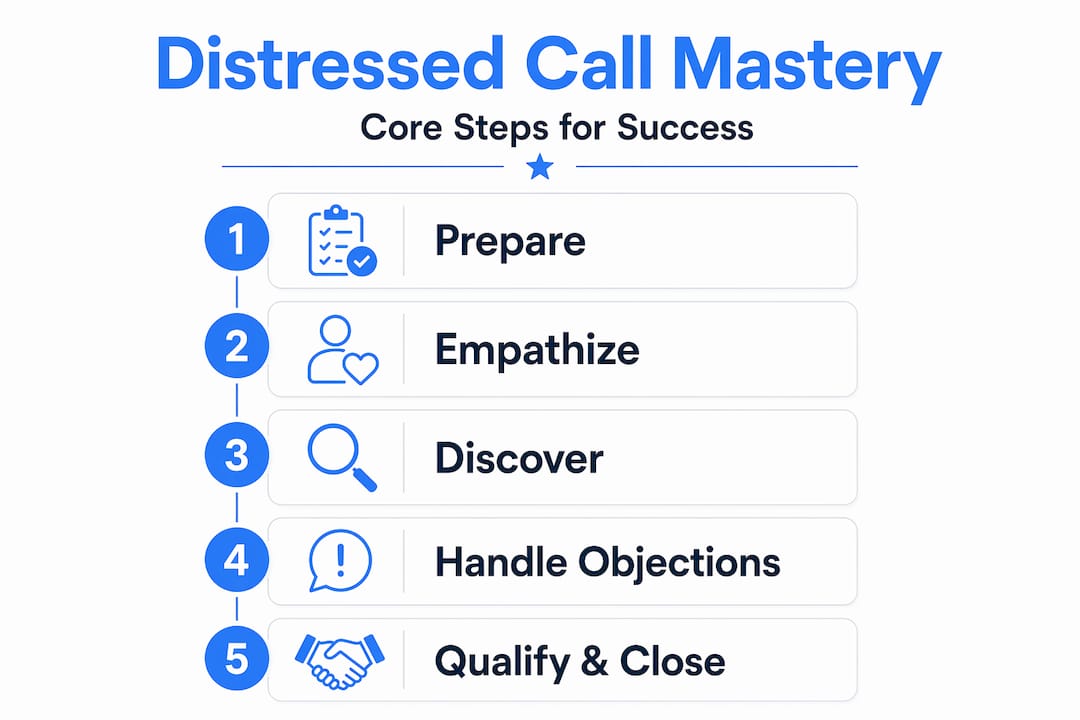
The mechanics of great distressed seller conversations come down to four things. First, empathy before pitch. Acknowledge their situation before asking anything about the property. Second, discovery questions that open up the homeowner’s actual motivations. Ask what their ideal outcome looks like, not just whether they want to sell. Third, avoid the high-energy telemarketer opener. Keep your voice calm, measured, and human. Fourth, plan for multi-contact timelines. Most distressed sellers don’t say yes on the first call. Roleplay for follow-up calls, not just first contacts.
Practicing qualifying questions in cold calling through roleplay helps you identify seller motivation faster, which improves your conversion rate without adding more call volume.
Measuring success: Improving outcomes through review and real-world results
All the practice pays off only if you measure the impact, make adjustments, and bring lessons learned back into your roleplay.
Here’s how to close the feedback loop effectively:
-
Listen to call replays after every live calling session. Pull recordings from your CRM or dialer. Listen for where you lost the homeowner’s interest, where you spoke too fast, or where an objection caught you off guard. This is gold for your next roleplay session.
-
Debrief with your team or practice partner weekly. What patterns are showing up? Are multiple callers struggling with the same objection? That objection needs to be drilled in the next session.
-
Track your core KPIs consistently. These include total calls made, contacts reached, qualified leads generated, appointments set, and contracts signed. Improvement across these numbers signals that your roleplay training is actually working.
-
Compare your metrics before and after structured practice starts. Most investors see a measurable improvement in qualified lead rate within 30 days of consistent roleplay training.
-
Feed real call scenarios back into roleplay. If a homeowner said something unexpected and threw you off, recreate that exact scenario in your next practice session. Train for the curveball, not just the standard pitch.
The data backs up the value of system-building around your calls. 15,000 cold calls led to contracts after consistent lead filtering and rapid follow-up. That’s not a volume problem. That’s a systems and refinement problem. Roleplay training is how you build the system.
Training systems that combine a strong conversation framework with qualifying questions, CRM handoffs, and structured follow-up consistently produce closed deals. Roleplay is what ties all those pieces together at the skill level.
Explore our lead generation basics guide to understand how your call training connects to the larger pipeline you’re building.
Statistic to know: In one documented cold calling case study, 5,500 calls produced 32 qualified leads and 8 contracts in progress. That ratio improves dramatically when callers are trained on objection handling and discovery, not just dialing volume.
What most real estate roleplay training misses: Adaptability over memorization
With all methods covered, it’s time to step back and look at what actually separates top-performing investors from the rest.
Most roleplay programs teach you to practice until you feel comfortable. But comfortable is not the same as effective. We’ve seen investors who can recite their frameworks flawlessly in practice, then freeze the moment a homeowner says something unexpected on a live call. The gap is adaptability.
Top-performing investors treat every call as a living conversation. They’re not running a script. They’re following a homeowner’s emotional cues, adjusting their tone, and finding the real motivation beneath the surface objection. That skill does not come from memorization. It comes from training specifically for uncertainty.
The guidance from pre-foreclosure cold calling experts reinforces this directly: callers should avoid “telemarketer” or high-energy openings, allow homeowners to explain their situation fully, and plan for multi-contact strategies rather than assuming one call closes the deal. That last point is critical. Most roleplay training simulates a single call. Real deals require 3, 5, sometimes 8 touchpoints. Practice should reflect that reality.
The investors who convert distressed seller leads at the highest rates are the ones who build emotional intelligence alongside their conversation frameworks. They practice what to say when the homeowner cries. They practice what to say when a homeowner is angry and insulting. They practice silence. Knowing when to stop talking and let the homeowner fill the space is one of the most powerful skills in cold calling, and almost nobody drills it.
Pro Tip: Use every rejected or surprising call outcome as a scenario for your next roleplay. If a homeowner hung up after your opener, rebuild the opener and practice it 10 more times. Train for the exceptions. That’s where the real improvement lives.
The real estate cold calling mastery principles you internalize through repetition are what produce reliable results, not just lucky calls.
Take your roleplay training to the next level
You now have a complete framework for building roleplay training that actually moves the needle. But knowing the process and drilling it consistently are two different things.
ClosersLeague is built specifically for real estate investors and wholesalers who want to practice smarter, not just more. Our AI roleplay for real estate platform lets you run realistic distressed seller simulations on demand, with instant performance feedback scored across key categories like empathy, discovery, objection handling, and call to action. No scheduling, no easy partners, no repetitive scenarios. Whether you’re working code violation roleplay scenarios or sharpening your approach with inherited property scripts, you get targeted practice built around the exact situations you face. Stop winging it. Start drilling.
Frequently asked questions
What’s the best type of script for cold calling distressed property leads?
Use a flexible conversation framework built around empathy, active listening, and a clear call to action. Rigid word-for-word scripts limit your ability to adapt when homeowners respond in unexpected ways.
How often should I roleplay cold calling with my team or partner?
Aim for at least two dedicated sessions per week. Short, frequent practice sessions build retention and confidence far more effectively than long, infrequent workshops.
Can you train using objections from real calls?
Absolutely. Using actual objections and unexpected responses from live calls in your roleplay is one of the most effective ways to build confidence. BatchDialer’s guidance specifically recommends role-playing different scripts and scenarios to anticipate objections before they happen on live calls.
How do I know if my roleplay training is actually working?
Track your real-world call outcomes, including qualified leads generated, appointments set, and contracts signed. 15,000 cold calls producing contracts shows what systematic training and follow-up can produce. If your numbers are trending up over 30 to 60 days, your training is working.
Recommended
- Foreclosure Cold Calling Practice — AI Roleplay for Real Estate Investors & Wholesalers
- Pre-Foreclosure Cold Calling Practice — AI Roleplay for Real Estate Investors & Wholesalers
- Tired Landlord Cold Calling Practice — AI Roleplay for Real Estate Investors & Wholesalers
- Vacant Property Cold Calling Practice — AI Roleplay for Real Estate Investors & Wholesalers