Most investors spend weeks building the perfect list and hours rehearsing their opening pitch. Then a homeowner says, “I’m not interested,” and the call falls apart. Here’s the truth: your list and your script get you in the door, but your ability to handle objections is what closes deals. Objections are not a sign the conversation is over. They’re a signal the homeowner is still processing. When you learn to read them, respond to them, and work through them with genuine empathy, your conversion rates go up, your appointments increase, and your pipeline grows faster.
Table of Contents
- What are real estate objections?
- Types of objections and why they arise
- The impact of effective objection handling
- Essential skills for handling real estate objections
- Why mastering objections is the real superpower in real estate investing
- Take your objection handling to the next level
- Frequently asked questions
Key Takeaways
| Point | Details |
|---|---|
| Objections are normal | Nearly every real estate call involves objections, but they are predictable and manageable. |
| Handling lifts conversions | Proactive objection management can increase conversion rates by up to 19%. |
| Empathy is essential | Top investors use empathy and listening as their main tools to overcome seller hesitations. |
| Practice pays off | Roleplay and review are key to improving objection handling and closing more deals. |
| Follow-up boosts results | Persistent follow-up after handling objections can nearly double close rates. |
What are real estate objections?
A real estate objection is any hesitation, concern, or resistance a property owner voices during a cold call. It’s not a final answer. It’s a reaction, often emotional, to something they don’t yet understand or trust. Objections show up early, in the middle of conversations, and sometimes right before a homeowner agrees to meet with you.
Most investors misread objections as rejection. That’s the single most costly mistake you can make on a cold call. When a homeowner says, “I don’t want to sell below market value,” they’re not hanging up. They’re telling you they have a concern about price. That concern is workable. Objection handling lifts conversion rates by 19% compared to calls where objections go unaddressed. That number alone should reframe how you view every pushback you hear.
Here are the most common objections investors and wholesalers encounter:
- “I’m not interested in selling right now.”
- “I already have a real estate agent.”
- “I know what my home is worth and your offer will be too low.”
- “I need time to think about it.”
- “My kids/family need to be involved in this decision.”
- “How do I know you’re a legitimate buyer?”
- “I’ve heard about these ‘we buy houses’ scams.”
Each of these sounds like a dead end. But each one is actually a conversation starter if you know what to say next. For a solid foundation on cold calling basics, understanding objections is step one. Good cold calling tips always begin with objection awareness.
“An objection is not a rejection. It’s a request for more information, delivered with emotion.”
That mindset shift alone will change how you show up on every single call.
Types of objections and why they arise
Having defined objections, let’s break down the main types you’ll face and what they reveal about a seller’s motivations.

Objections don’t appear randomly. They cluster around specific fears and uncertainties. When you recognize the type, you can match your response to what the homeowner actually needs to hear. Top callers convert up to 5.2% of their contacts to contract by skillfully navigating these exact patterns.
The five main categories of real estate objections:
- Price objections: “Your offer will be too low” or “I know what my house is worth.” These come from homeowners who fear being taken advantage of or who have unrealistic market expectations.
- Timing objections: “Now isn’t a good time” or “I’m not ready to sell yet.” These often signal life situations in flux, such as a pending divorce, a family illness, or uncertainty about where they’ll move next.
- Trust objections: “How do I know you’re legitimate?” or “I’ve heard bad things about investors.” These come from fear of scams, past negative experiences, or general distrust of unsolicited calls.
- Process objections: “I don’t understand how this works” or “I’d rather use a traditional realtor.” These arise from a lack of knowledge about how wholesaling or direct buying actually works.
- Influence objections: “I need to talk to my spouse” or “My attorney handles these things.” These aren’t stalls; they reflect real decision-making dynamics that you need to work with, not around.
Here’s a quick breakdown of objection types and what they typically signal:
| Objection type | What it usually means | What the seller needs |
|---|---|---|
| Price | Fear of being lowballed | Transparency and a clear explanation of your process |
| Timing | Uncertainty or life transition | Patience and a follow-up plan |
| Trust | Past bad experience or fear | Credibility, references, and consistency |
| Process | Confusion about how it works | Education and simple next steps |
| Influence | Multiple decision-makers involved | Inclusion and time to consult others |
Knowing the root cause of an objection changes everything about how you respond. You wouldn’t use the same script for a homeowner who fears scams as you would for someone who just hasn’t thought about selling yet. Practicing these distinctions through cold calling practice roleplay is one of the fastest ways to build this recognition. The more you practice with varied scenarios, the faster you’ll identify which category you’re dealing with within the first 30 seconds.
Every objection has an emotional driver underneath it. Identifying that driver is your job on the call. Not selling. Not convincing. Listening and understanding.
The impact of effective objection handling
Understanding the types and sources of objections, let’s see why it’s worth investing real effort in mastering the response.
The data is clear and it should motivate you. Effective objection handling lifts conversion rates by 19%, close rates can rise from 1.7% to 3.4% with disciplined follow-up, and the median lead-to-close time for cold call-generated deals sits at 73 days. These are not small gains. That 19% lift compounded across a year of calling means significantly more contracts signed.
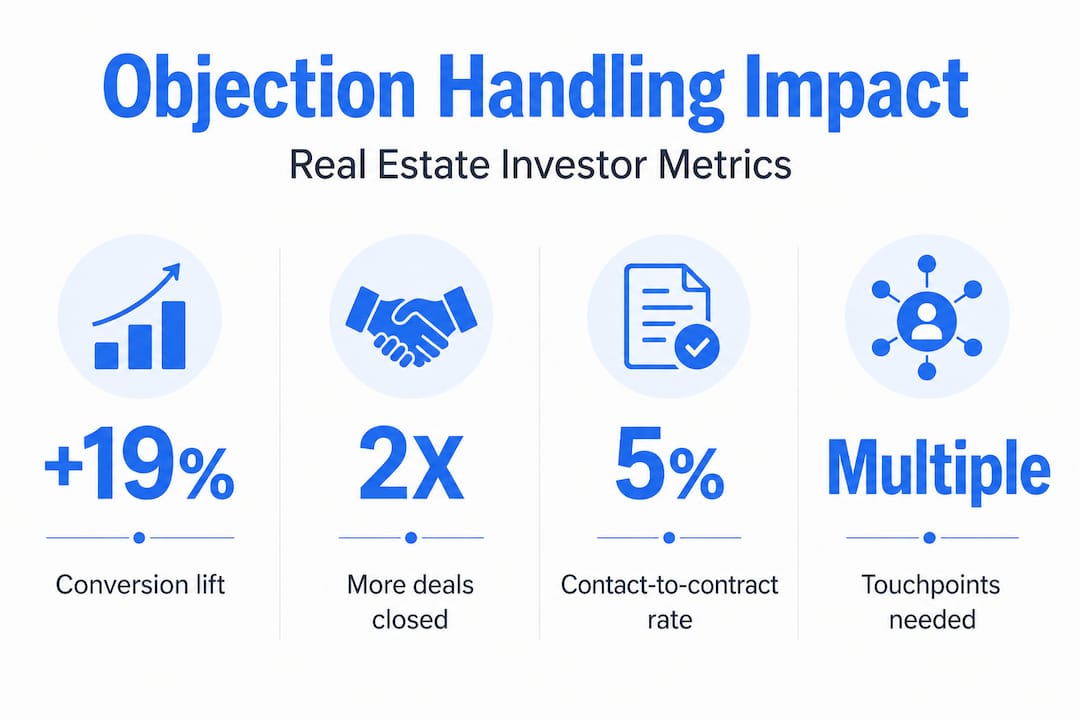
Here’s how the numbers stack up in real terms:
| Metric | Without objection handling | With objection handling |
|---|---|---|
| Conversion lift | Baseline | +19% |
| Close rate (cold calls) | ~1.7% | Up to 3.4% with follow-up |
| Lead-to-close time | 73 days average | Potentially shorter with strong follow-up |
| Contact-to-contract rate | 1 to 2% | Up to 5.2% for top callers |
That contact-to-contract rate gap, from 1% to over 5%, represents the real cost of ignoring objection handling. It also shows what’s possible when you treat every objection as a skill to build rather than a wall to avoid.
Follow-up plays a massive role in these results. Most homeowners need multiple touchpoints before they feel ready to commit, especially in distressed situations like foreclosure or probate where the emotional stakes are high. Pairing strong objection handling with a smart follow-up strategy is what separates a good caller from a great one.
Pro Tip: Keep a simple call log where you note the objection type, how you responded, and the outcome. After 30 calls, review the patterns. You’ll quickly see which responses are working and which ones cost you deals.
The investors who treat every call as a data point accelerate their improvement dramatically. Each lost deal is a lesson. Each objection handled well is a skill rep. Over time, the patterns become obvious and your instincts sharpen.
Essential skills for handling real estate objections
So how do top-performing investors actually defuse objections in real time? Here’s what the data and the pros say works best.
The foundation is not a script. It’s active listening. When a homeowner raises an objection, most inexperienced callers rush to counter it. Top callers do the opposite. They slow down, acknowledge what was said, and ask a clarifying question before offering any response. Not preparing for objections can reduce your success rate by as much as 40%. That’s not a minor performance gap, it’s the difference between building a pipeline and burning through a list.
Here’s a practical framework for handling any objection in real time:
- Listen without interrupting. Let the homeowner finish their thought completely. Rushing in early signals you’re not really listening.
- Acknowledge their concern directly. Say something like, “That makes total sense” or “I hear you, and I’d feel the same way.” Validation lowers defensiveness immediately.
- Ask a clarifying question. “Can you tell me a little more about what’s holding you back right now?” often surfaces the real concern beneath the surface-level objection.
- Respond to the root cause, not the surface statement. If someone says they’re not ready to sell, but your clarifying question reveals they’re waiting on a probate ruling, your response should address that specific situation.
- Reframe the offer or next step. Instead of pushing for a contract, suggest a low-pressure next step like a quick walkthrough or a follow-up call in two weeks.
- Confirm understanding before moving on. Ask, “Does that make sense?” or “Is there anything else you’d want to know before we take a next step together?”
“The best real estate callers are the best listeners. They ask more questions than they answer.”
Preparation matters just as much as in-call skill. Spending time before your session reviewing the five objection types and rehearsing two to three responses for each means you’re never caught off guard. Your tone stays calm, your language stays grounded, and you project confidence even when a homeowner pushes back hard.
Connecting your real estate lead generation efforts to strong objection handling creates a complete system. Good leads and strong conversation skills together produce results.
Pro Tip: Record your calls and listen back to your objection responses. You’ll catch filler language, defensive tones, and missed clarifying questions you didn’t notice in the moment. Reviewing two or three calls per week builds self-awareness faster than any script.
The empathy piece is not soft advice. It’s a proven performance lever. Homeowners in distress, whether facing foreclosure, going through a divorce, or dealing with probate, are emotionally activated. They don’t need a fast-talking buyer. They need someone who sounds like they actually care about helping them find the right solution.
Why mastering objections is the real superpower in real estate investing
Here’s an uncomfortable truth most training programs skip: scripts are the floor, not the ceiling. Every serious investor eventually gets a decent script together. They learn how to introduce themselves, ask about the property, and make an offer. But scripts without objection handling are like a car with no steering wheel. You can accelerate, but you can’t navigate.
We’ve seen investors with average lists and average budgets consistently outperform competitors with bigger operations simply because they stayed on the phone longer, listened better, and responded to objections with genuine curiosity rather than scripted rebuttals. That’s not talent. That’s practiced skill.
The investors who grow fastest are the ones who treat every lost deal as a workshop. They ask: “What objection did I hear that I didn’t handle well?” Then they practice that specific scenario until it becomes automatic. This kind of deliberate repetition is exactly what separates the callers converting at 5% from those stuck at 1%.
Here’s what we also know from observing thousands of calls: canned responses hurt you. When a homeowner senses you’re running through a checklist, trust evaporates. The script might get the words right but the tone gets it wrong. Genuine objection handling sounds like a conversation, not a presentation. It requires you to actually process what the homeowner said and respond to that specific statement, not a memorized version of it.
Real estate objections aren’t barriers. They’re entry points. Every concern a homeowner raises is a window into what matters to them. If they’re worried about price, that tells you they care about getting fair value. If they need time, that tells you the decision is significant to them. If they ask about your credibility, that tells you they’re actually considering the possibility. These are all buying signals wrapped in resistance.
The investors who internalize this perspective become callers homeowners actually enjoy talking to. And homeowners who enjoy talking to you call you back. Good real world cold calling tips always return to this foundation: build trust through the conversation, not around it.
Stop winging it. Start drilling. The practice you do before the call determines the results you get on it.
Take your objection handling to the next level
If you’re serious about mastering objections and shortening your deal cycle, it’s time to move from theory to practice. Reading about objection handling builds awareness. Drilling it builds skill.

At ClosersLeague, we’ve built an AI-powered platform specifically for real estate investors and wholesalers who want to sharpen their cold calling skills. Our roleplay scenarios drop you into real conversations with distressed seller types, including foreclosure, probate, divorce, and tax delinquent homeowners, so you can practice handling their specific objections on demand. You get immediate feedback on your tone, empathy, and response accuracy. No more learning on live calls. No more burning through your best leads while you figure out what to say. Practice the hard scenarios, build real confidence, and hit your next call ready to convert. Start practicing today and see what deliberate objection training does for your close rate.
Frequently asked questions
What is an objection in real estate wholesaling?
An objection is any concern, hesitation, or resistance expressed by a property owner during a wholesale deal call, commonly about price, timing, or trust. Seller concerns during investor outreach are a normal and expected part of every call.
How many objections does the average real estate caller face?
Most cold calls result in one to three objections, with top callers anticipating multiple pushbacks per conversation. Preparing for at least three common objections before each session dramatically improves your confidence and response quality.
Does handling objections really improve closing rates?
Yes. Effective objection handling is shown to lift conversions by 19% and can nearly double the number of deals closed from cold calls when combined with consistent follow-up.
What’s the best way to prepare for objections?
Review common objection scenarios before each calling session, practice your responses out loud, and focus on empathetic listening first. AI-powered roleplay tools let you drill specific seller types and objection categories so preparation becomes part of your routine.
How long does it usually take to close after handling objections successfully?
The median lead-to-close time is approximately 73 days for cold call-generated real estate deals. Strong objection handling combined with consistent follow-up can tighten that timeline by keeping motivated sellers engaged and moving toward a decision.
Recommended
- 10 proven cold calling tips for real estate investors – ClosersLeague Blog
- Master Real Estate Negotiation Tactics for Better Deals – ClosersLeague Blog
- Real Estate Cold Calling Practice — AI Roleplay for Every Seller Type | ClosersLeague
- Cold calling for investors: why direct outreach still wins – ClosersLeague Blog