
Many of the most lucrative distressed property deals sitting in your market right now are locked inside probate estates. Yet most investors either ignore them entirely or approach them without understanding how court supervision, executor authority, and sale timelines shape every step of the transaction. Probate real estate is real property that becomes part of a deceased owner’s estate, often overlooked yet creating unique buying opportunities. This guide breaks down exactly what probate real estate is, how the process works, and what you need to know to build a smart acquisition strategy around it.
Table of Contents
- What is probate real estate?
- How the probate process works for real estate
- Court confirmation and investor implications
- Investor strategies for finding and underwriting probate deals
- What most investors miss about probate real estate deals
- Next steps: How to practice and master probate investment strategies
- Frequently asked questions
Key Takeaways
| Point | Details |
|---|---|
| Probate real estate defined | Probate real estate includes properties managed by a court after an owner’s death and not already held in trust or joint tenancy. |
| Investor process is unique | Investors must understand court authority, sale timelines, and bidding requirements to navigate probate deals successfully. |
| Strategies for success | Cold calling, professional scripts, and careful underwriting help investors source and win valuable probate deals. |
| Pitfalls to avoid | Ignoring court confirmation, holding costs, or multistate issues often leads to failed probate investments. |
What is probate real estate?
Probate real estate is any property that passes through the legal process of estate administration after an owner dies. When someone dies holding real property solely in their own name, that property typically cannot transfer to heirs or be sold without court involvement. The probate court supervises the process to ensure debts are paid and assets are distributed legally.
Probate real estate is handled under court supervision after an owner’s death, which immediately distinguishes it from a standard seller-to-buyer transaction. Not every property ends up in probate, though. Asset structure determines whether a property goes through probate at all. Properties held in a living trust, under joint tenancy with right of survivorship, or with a transfer on death (TOD) deed bypass probate entirely.
Here is a quick comparison of probate versus conventional sales:
| Feature | Probate Sale | Conventional Sale |
|---|---|---|
| Seller authority | Executor or administrator | Individual owner |
| Court involvement | Required (sometimes) | None |
| Timeline | Months to over a year | Weeks to months |
| Property condition | Typically as-is | Variable |
| Pricing | Often below market | Market-driven |
| Negotiation flexibility | Limited by court/estate | Flexible |
Some common misconceptions worth clearing up:
- Probate always means foreclosure. It does not. Probate means the estate is in administration, not necessarily in financial distress.
- Probate sales are always discounted. Often true, but not guaranteed. Discounts depend on estate needs, condition, and jurisdiction.
- You can close fast on probate deals. Sometimes, but court confirmation requirements can stretch timelines significantly.
- Heirs make the decisions. Not always. The executor holds legal authority, and heirs may have competing interests.
Understanding these distinctions is step one. If you are already working on probate cold calling strategies to reach executors and heirs, knowing these nuances will sharpen every conversation you have. For context on how probate fits into your broader acquisition pipeline, revisit your real estate wholesaling overview to see where these deals sit in the deal flow.
“The as-is condition of probate properties can create real value for investors who know how to price repairs accurately and negotiate from a position of knowledge.”
Now that we have defined the space, let us look at how probate real estate sales actually unfold.
How the probate process works for real estate
Understanding what probate real estate is sets the stage for exploring how its sales process actually unfolds. The sequence is predictable, but the timeline varies widely by jurisdiction and estate complexity.
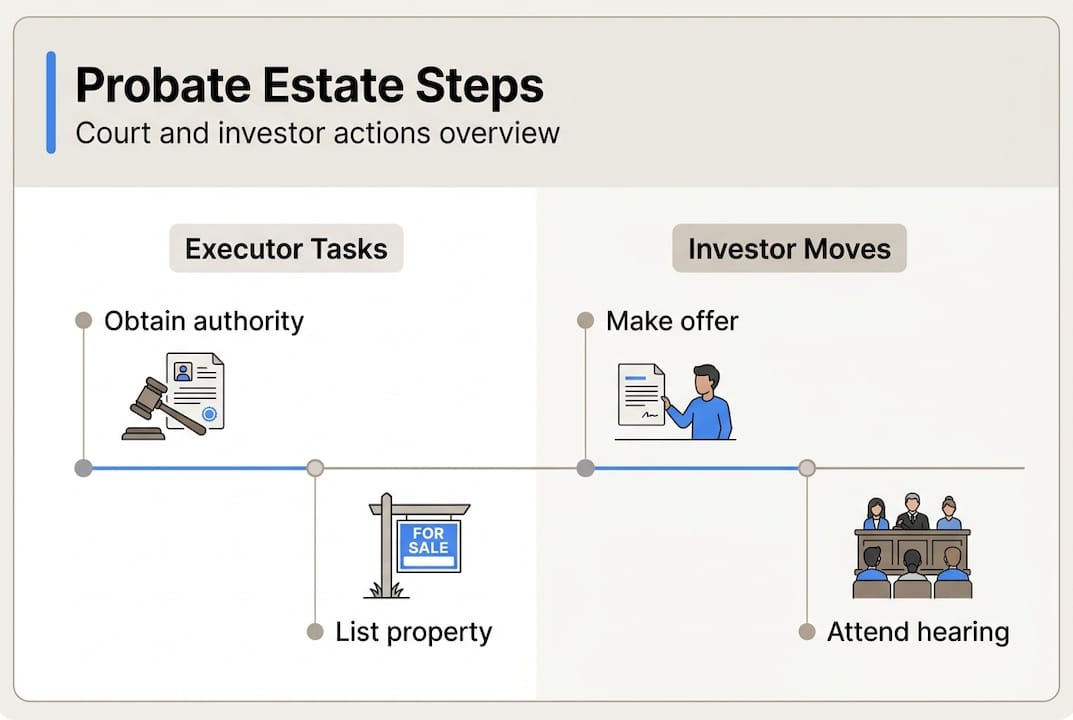
Here are the major steps in order:
- File a petition with the probate court. A family member or named executor files to open the estate.
- Receive letters testamentary or letters of administration. The court grants the executor legal authority to manage estate assets.
- Secure and appraise the property. The executor must protect the property and obtain a court-ordered appraisal.
- Post notice to creditors. Creditors are given a window to make claims against the estate.
- Clear debts and liabilities. Outstanding debts, taxes, and claims are resolved before any sale.
- List and market the property. The executor can begin the sale process, typically through a licensed real estate agent.
- Accept an offer and seek court confirmation (if required). Depending on the authority granted, the sale may need court approval before closing.
- Close the transaction. Once approved, proceeds flow to the estate and are distributed to heirs.
Here is how timelines typically look depending on estate complexity:
| Estate Type | Estimated Timeline |
|---|---|
| Simple, independent administration | 4 to 6 months |
| Court-confirmed sale required | 9 to 12 months |
| Contested or complex estate | 12 to 24+ months |
The executor must obtain legal authority and may need court confirmation to sell a probate property, which is the single biggest factor driving timeline uncertainty. As an investor, those delays translate directly into holding costs if you are under contract and waiting on court dates.

Pro Tip: Before making an offer, always ask whether the estate is operating under independent administration or full court supervision. That one question shapes your entire offer structure, from price to contingency terms.
You can get ahead of these conversations by practicing with a probate investor script workflow so you already know what to ask and when. Use real estate cold calling for probate to rehearse these exact scenarios before you are on the phone with a real executor.
Court confirmation and investor implications
Now that we have covered the mechanics, let us look at how investor experience changes based on the need for court confirmation.
Court confirmation may be required for probate sales depending on the authority granted to the executor. This single variable changes your entire approach as a buyer.
Here is how the two paths compare:
| Sale Type | Timeline | Bidding Risk | Investor Control |
|---|---|---|---|
| Independent administration | Shorter | Low | Higher |
| Court-confirmed sale | Longer | Overbidding possible | Lower |
Under independent administration, the executor can accept your offer and close without bringing it back to the court for approval. This is the cleaner path. You negotiate directly, agree on terms, and move toward closing on a relatively predictable schedule.
Under court confirmation, the process gets more complicated. Here is what happens:
- You submit an offer, and the estate accepts it as the lead bid.
- The court schedules a confirmation hearing, often 30 to 45 days out.
- At the hearing, other buyers can submit overbids, typically starting at a statutory minimum above your offer.
- If someone overbids you, you lose the deal and all the time you invested in due diligence.
- If no one overbids, the court confirms your sale and you move to closing.
The overbidding risk is real. Many investors show up at confirmation hearings unprepared and get outbid on deals they spent weeks underwriting. The smart move is to price your initial offer to leave room for overbidding while still hitting your numbers.
Pro Tip: In court-confirmed sales, factor in the cost of lost deals. You may win one out of three confirmation hearings. Build that loss rate into your acquisition strategy so each deal you do win still delivers your target return.
Refining your negotiation tactics with probate sellers and executors is what separates investors who close consistently from those who burn time on deals that fall through.
Investor strategies for finding and underwriting probate deals
With those legal differences in mind, let us focus on practical strategies investors can use to unlock value from probate deals.
Sourcing probate leads is the first challenge. Here are the most reliable methods:
- Courthouse records: Probate filings are public record. Check your county probate court regularly for newly opened estates with real property.
- Probate lead services: Several data providers compile and sell probate lead lists, saving you hours of manual research.
- Direct mail campaigns: Letters sent to executors are often well-received because many want to resolve the estate quickly.
- Attorney referrals: Build relationships with probate attorneys. They talk to executors daily and can refer motivated sellers to you.
- Cold calling: Direct outreach to executors and heirs, when done professionally, remains one of the fastest ways to get in front of motivated sellers early.
Underwriting probate deals requires a different framework than standard acquisitions. Offers must account for holding costs, lengthy timelines, and unpredictability in probate deals. That means your numbers need to work even if closing takes 12 months.
Key underwriting factors:
- As-is property condition and estimated repair costs
- Sale timeline based on administration type
- Risk of overbidding at confirmation hearings
- Carrying costs including taxes, insurance, and utilities during escrow
- Negotiation leverage based on estate liquidity needs
One major pitfall investors overlook is multistate complexity. Ancillary probate may be required for real estate in multiple states, meaning a separate legal proceeding must open in each state where the deceased owned property. This adds time, legal costs, and administrative burden to the deal.
Pro Tip: When you find an executor who needs to move fast, that urgency is your leverage. Use your cold calling tips for probate deals to build rapport quickly and position yourself as a reliable, low-hassle buyer. Executors often choose the investor who communicates clearly and closes predictably over the one who offers the highest price.
What most investors miss about probate real estate deals
Here is the uncomfortable truth most articles skip: probate is not a shortcut to cheap deals. It is a specialty. And most investors underestimate how badly a misread probate deal can hurt their business.
The biggest blind spot is timeline overconfidence. Investors assume they can lock up a probate property and close in 60 to 90 days. Then the court confirmation hearing gets delayed, the estate attorney hits a snag, and suddenly they are carrying a deal for eight months with no certainty of closing.
Offers must account for holding costs, lengthy timelines, and unpredictability in probate deals, and yet most investors build their offers as if probate is a standard transaction with extra paperwork.
The investors who consistently profit from probate deals are the ones who specialize. They know which jurisdictions run efficient courts and which ones drag. They have refined effective probate deal scripts that help them build trust with executors fast. They understand that winning in probate is about preparation, not luck. If you are treating probate like just another lead source, you are leaving money on the table and exposing yourself to deal risk you have not priced in.
Next steps: How to practice and master probate investment strategies
Knowing the process is one thing. Executing it confidently on a live call with an executor is another challenge entirely.

ClosersLeague is built specifically for real estate investors and wholesalers who want to stop winging it and start closing. With AI-powered probate cold calling practice modules, you can rehearse real executor conversations, handle objections, and sharpen your offer framing before you ever pick up the phone. Our real estate cold calling practice platform scores your performance and gives you instant feedback so every rep makes you sharper. If probate deals are part of your strategy in 2026, the best competitive edge you can build is deliberate, targeted practice.
Frequently asked questions
What types of properties are considered probate real estate?
Any property titled solely in the decedent’s name and not held in a trust or via joint tenancy is considered probate real estate. Shared ownership structures and trusts generally bypass the probate court entirely.
How long does the probate process take for real estate sales?
Sale timeline depends on executor authority and court confirmation requirements, with most probate sales taking several months to over a year. Complex or contested estates can push that timeline well beyond 18 months.
Do probate real estate sales always require court confirmation?
No. Independent administration often allows sales without court confirmation, which speeds up the transaction considerably and reduces overbidding risk for investors.
Can probate real estate deals involve property in multiple states?
Yes. Ancillary probate may be required for real estate in multiple states, meaning each state where the deceased owned property may require its own separate probate proceeding.
Are probate sales good opportunities for real estate investors?
Absolutely, when approached with the right knowledge. Probate real estate can offer undervalued deals for investors who understand process risks, timelines, and how to build trust with executors and heirs.
Recommended
- Real estate CRM: Benefits, features, and best practices – ClosersLeague Blog
- Boost Real Estate Deals with a Proven Investor Script Workflow – ClosersLeague Blog
- What is a real estate wholesaler? Process, profits, risks – ClosersLeague Blog
- Probate Cold Calling Practice — AI Roleplay for Real Estate Investors & Wholesalers