
Proven real estate script templates: boost close rates 22%
Picking the wrong cold calling script does more than slow you down. It can shut a conversation before you even reach your pitch, especially when you’re talking to homeowners facing foreclosure, probate, or divorce. Scripts boost conversion rates by up to 22%, yet most investors and wholesalers still rely on generic templates they found on a forum years ago. AI tools are now changing how scripts get built and tested, adding a new layer of complexity to an already high-stakes process. This guide cuts through the noise, giving you a clear framework for evaluating, selecting, and using cold calling script templates that actually convert.
Table of Contents
- What makes a real estate script template effective?
- Essential script templates for real estate investors and wholesalers
- Comparing traditional and AI-driven script approaches
- Situational recommendations: picking the right template for your lead
- A fresh perspective: Why script flexibility and human insight still matter most
- Practice and perfect your real estate scripts with ClosersLeague
- Frequently asked questions
Key Takeaways
| Point | Details |
|---|---|
| Templates increase conversion | Cold calling scripts improve close rates significantly compared to ad hoc conversations. |
| AI amplifies but cannot replace humans | AI tools help with prompts and analysis but human insight is crucial for outbound calls. |
| Empathy and adaptability win | Customizing scripts for the homeowner’s situation delivers the best engagement and results. |
| Fast follow-up is critical | Calling back the same day maximizes your chances of converting leads. |
What makes a real estate script template effective?
Not all script templates are built the same. A script that works for a FSBO (for sale by owner) lead will fall flat with a pre-foreclosure homeowner who is scared and already defensive. Understanding what separates a high-performing template from a mediocre one is the first step toward stronger results.
Every effective script shares four core elements:
- Empathy-first opening: Acknowledge the homeowner’s situation before you mention price or intent.
- Compliance language: Stay within TCPA (Telephone Consumer Protection Act) and Do Not Call (DNC) regulations from the first sentence.
- Targeted phrasing: Language should match the seller’s specific pain point, whether that’s looming foreclosure, low equity, or an inherited property they don’t want.
- A clear call to action: Every script needs a natural next step, whether that’s scheduling a walkthrough or a follow-up call.
The data backs this up. Top cold callers close 5.2% of leads compared to the 2.5% industry average. That gap does not come from luck. It comes from using scripts that are matched to the situation and refined through practice.
Context-specific scripts outperform generic ones because homeowners in distress do not respond to standard sales pitches. A pre-foreclosure seller needs to feel heard. An out-of-state owner needs reassurance that you can handle logistics without hassle. A low-equity homeowner needs a creative solution explained clearly. If you’re still learning the cold calling basics, building that context awareness is one of the fastest ways to lift your numbers.
The bottom line: the best script templates are empathetic, legally sound, and built around a specific seller type. Generic does not close deals.
Essential script templates for real estate investors and wholesalers
Now that we’ve defined effective criteria, let’s apply them by examining script templates tailored for investor needs. Here are the four core templates every serious investor and wholesaler should have ready.
Pre-foreclosure script: Lead with empathy and problem-solving. Open by referencing the situation without shaming the homeowner. Offer a clear way out. Pre-foreclosure scripts should focus on empathy and avoid offering legal advice, which keeps you protected and the homeowner comfortable.
Tired landlord script: Focus on relief. These sellers are exhausted by tenants, maintenance, and cash flow problems. Your opening should validate their frustration and pivot quickly to the simplicity of your offer.

Inherited property script: Lead with condolences when appropriate and frame your offer as a service that removes complexity from a difficult time. Practice this one carefully because tone missteps here are costly. Repetition with inherited property cold calling scenarios builds the sensitivity needed for these calls.
Out-of-state owner script: Emphasize remote convenience. These sellers often want the problem gone quickly. Highlight your ability to close without requiring their physical presence.
AI-enhanced versions of these scripts now integrate real-time prompts and sentiment analysis, flagging when a caller’s tone shifts or when the homeowner shows signs of hesitation. That kind of live feedback used to be available only to top-performing teams. Now, tools built for investors can simulate these scenarios before you ever make a live call. Consistent drilling with a tired landlord script in a simulated environment sharpens your instincts before real money is on the line.
Pro Tip: On sensitive calls involving inherited properties or pre-foreclosure, slow down your delivery. A rushed pitch signals that you’re after a deal, not a solution. Pace yourself to signal genuine interest.
Empathy trumps hard-selling in distressed scenarios. Homeowners in financial pain are not looking for an investor. They’re looking for someone who understands their situation and can offer a real way forward.
Also, brush up on your cold calling tips specific to investor scenarios so your empathy feels natural, not rehearsed.
Comparing traditional and AI-driven script approaches
Understanding your options means knowing how AI can boost but not entirely replace traditional methods. Here is a direct comparison of both approaches.
| Factor | Traditional (human-only) | AI-assisted | |
|---|---|---|---|
| Personalization | High, based on caller skill | Moderate, based on data inputs | |
| Compliance risk | Caller-dependent | Lower with built-in guardrails | |
| Scalability | Limited by headcount | High, can run parallel campaigns | |
| Nuance handling | Strong with experienced callers | Weaker in edge cases | |
| Cost per contact | Higher | Lower at scale | |
| Conversion on sensitive leads | Often higher | Often lower without human touch |
AI tools can triple contact rates, but expert practitioners warn that outbound calling still benefits from human callers, especially in nuanced wholesaling situations.
Common pitfalls when going all-in on AI include:
- DNC and TCPA compliance gaps: AI dialers move fast. Without proper list scrubbing and compliance settings, you can face serious fines.
- Local nuance failures: An AI script does not pick up on regional speech patterns or know that a specific neighborhood is dealing with a recent factory closure affecting property values.
- Distressed homeowner tone mismatch: AI can sound clinical during emotionally charged conversations, which kills rapport instantly.
Hybrid strategies often outperform either method alone. Use AI to identify and prioritize warm leads, then deploy human callers for the actual conversation. You can refine your live calling skills through AI roleplay practice before switching to real calls. For niche leads like vacant properties, combining AI-driven list building with a human caller using a tailored vacant property script tends to outperform either approach on its own.
Situational recommendations: picking the right template for your lead
With core template knowledge and AI versus traditional tradeoffs covered, here is how to select the best approach for every lead type you encounter.
Follow this decision flow before each call:
- Identify the lead type. Pre-foreclosure, code violation, probate, low equity, out-of-state, or tired landlord?
- Assess the emotional state. Is this a panic seller, a reluctant seller, or a motivated but cautious seller?
- Choose your script framework. Match empathy level, pacing, and opening to the seller’s situation.
- Decide on delivery method. Human caller for sensitive leads, hybrid or AI for initial contact on higher-volume campaigns.
- Plan your follow-up before you dial. Fast follow-up within the same day closes more real estate deals, so have your callback scheduled before you hang up.
Here is a quick reference table to match lead type to template:
| Lead type | Recommended template | Priority tone | Follow-up timing |
|---|---|---|---|
| Pre-foreclosure | Empathy-forward, solution-focused | Calm, reassuring | Same day |
| Code violation | Problem-removal framing | Practical, direct | Within 24 hours |
| Inherited property | Condolence-led, low pressure | Warm, patient | Within 24-48 hours |
| Tired landlord | Relief-focused, fast offer | Confident, efficient | Same day |
| Out-of-state owner | Convenience-centered | Professional, clear | Same day |
| Low equity | Creative solution framing | Educational, honest | Within 24 hours |
Pro Tip: Speed matters more than perfection on the follow-up. A good callback the same day beats a perfect script two days later. Set a timer the moment you hang up and treat same-day follow-up as a non-negotiable part of your process. Follow-up strategies built around speed consistently outperform those focused on messaging alone.
For specific practice with code violation or pre-foreclosure leads, focused drilling with a code violation script and a dedicated pre-foreclosure practice session will sharpen your instincts faster than reading alone.
A fresh perspective: Why script flexibility and human insight still matter most
Here is something most template guides won’t tell you. The script is not the closer. You are.
The best templates in the world only set a foundation. Top closers read the conversation in real time and adapt. They hear hesitation and slow down. They catch an opening and lean in. That instinct does not come from memorizing a script. It comes from thousands of reps, honest self-assessment, and the willingness to be uncomfortable on calls.
AI can support that process. It can score your calls, surface patterns, and flag where you lose momentum. But it cannot replace the judgment call you make when a homeowner breaks down mid-conversation or reveals information that changes everything.
Reddit wholesale experts strongly prefer local human callers for nuanced wholesaling because real conversations require real people. The investors who consistently close deals use a blended approach: scripts as a starting point, AI as a training and analysis tool, and their own emotional intelligence as the final variable.
If you want to see how adaptable your current approach really is, review your investor script workflow and look for the moments where you defaulted to the script instead of the conversation.
Practice and perfect your real estate scripts with ClosersLeague
Ready to put these script templates into action? Knowing the right template is only half the battle. Executing it under pressure is where most investors lose deals.
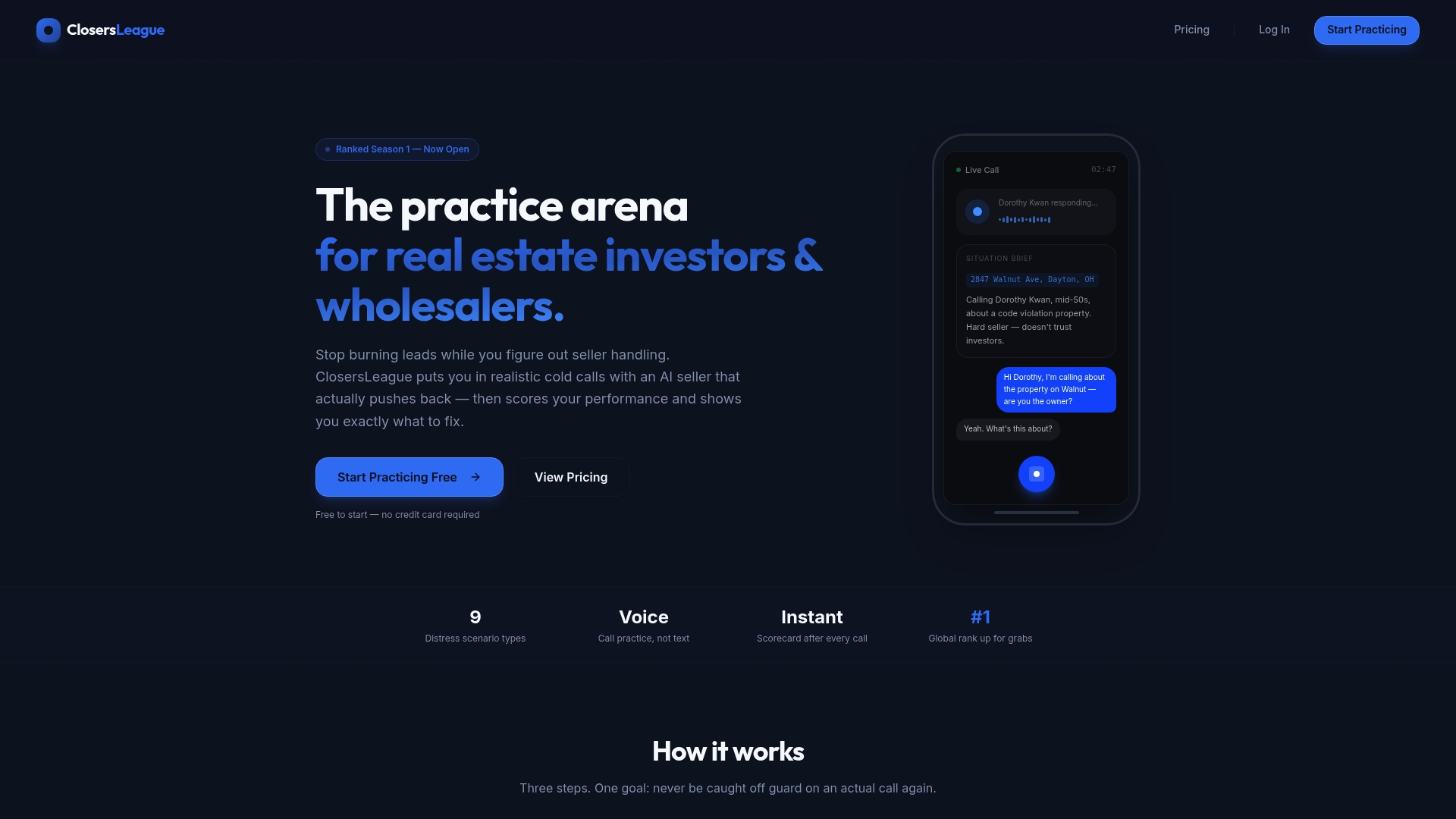
ClosersLeague is an AI powered cold calling training platform built specifically for real estate investors and wholesalers. You can practice live scenarios for every lead type, from inherited property cold calling to tax delinquent script practice, with real-time feedback that scores your empathy, pacing, and objection handling. Stop winging it on live calls. Start drilling in a safe environment where mistakes make you better. Explore all the AI cold calling tools available on ClosersLeague and start building the consistency that separates top closers from everyone else.
Frequently asked questions
What is the average cold calling success rate with script templates?
Using proven script templates can boost close rates by up to 22%, with top cold callers closing 5.2% of leads compared to the 2.5% industry average.
Are AI-powered scripts effective for outbound cold calling in real estate?
AI tools increase contact rates up to three to five times, but most experts still recommend human callers for outbound due to nuance, emotional complexity, and compliance requirements.
How should script templates differ for financially distressed homeowners?
Distressed homeowners need empathy-centered scripts that avoid offering legal advice and are customized to their specific situation, whether that is foreclosure, probate, or divorce.
How quickly should you follow up after a cold call?
Same-day follow-up dramatically increases your odds of closing a deal, making callback speed one of the most underrated factors in real estate wholesaling success.
Recommended
- Boost Real Estate Deals with a Proven Investor Script Workflow – ClosersLeague Blog
- Real Estate Follow Up: Close More Deals in 2026 – ClosersLeague Blog
- 10 proven cold calling tips for real estate investors – ClosersLeague Blog
- Real estate pitch: Win more wholesale deals in 2026 – ClosersLeague Blog