
Cold calling is dead. You’ve probably heard that at least a dozen times. It’s wrong. While most investors chase Facebook ads and direct mail campaigns, the ones quietly closing the most off-market deals are picking up the phone. Real estate telemarketing remains one of the highest-ROI outreach strategies available to wholesalers and investors today, particularly when you’re targeting distressed homeowners facing foreclosure, probate, or divorce. This guide breaks down exactly what real estate telemarketing is, how the process works, and how to apply it to find motivated sellers faster and more consistently.
Table of Contents
- What is real estate telemarketing?
- How real estate telemarketing works: The process step-by-step
- Modern telemarketing techniques vs. old-school cold calling
- Mistakes to avoid in real estate telemarketing
- Tools and resources for effective real estate telemarketing
- Why most investors misunderstand telemarketing (and how to get ahead)
- Take your real estate telemarketing to the next level
- Frequently asked questions
Key Takeaways
| Point | Details |
|---|---|
| Telemarketing’s unique value | Proactive calls let you reach motivated sellers that online marketing often misses. |
| Process is critical | Success depends on building targeted lists, using proven scripts, and following up consistently. |
| Modern tools drive results | Leveraging AI roleplay and dynamic scripts makes you more effective in every conversation. |
| Avoid common mistakes | Research your leads, use compliant scripts, and track every call to protect and grow your business. |
| Practice makes perfect | Regular practice, especially with AI or peer feedback, transforms your skills and results. |
What is real estate telemarketing?
Real estate telemarketing is the practice of making proactive, outbound phone calls to property owners to identify potential selling opportunities. It’s not random dialing. It’s strategic, research-driven outreach aimed at homeowners who are likely experiencing a financial or personal situation that makes selling attractive.
Think of it this way: a standard sales call tries to push a product. Real estate telemarketing is about connecting with a person at the right moment and starting a genuine conversation about their options. That distinction matters enormously.

As outlined in proven cold calling tips for real estate investors, the most effective telemarketers treat every call as an information-gathering session, not a pitch.
The homeowner situations most commonly targeted include:
- Foreclosure: Owners behind on mortgage payments who need a fast solution
- Probate: Heirs managing inherited property they often don’t want or can’t maintain
- Divorce: Couples splitting assets and needing a quick, clean sale
- Tax delinquency: Owners who owe back taxes and face government action
- Code violations: Properties with unresolved city violations that create financial pressure
- Tired landlords: Rental property owners exhausted by tenant issues or maintenance costs
Each of these scenarios creates genuine motivation to sell. Your job on the call is to identify that motivation and position yourself as a solution. That’s fundamentally different from cold calling a random homeowner to ask if they want to sell.
The connection between lead generation cold calling and telemarketing is tight. When done right, telemarketing generates a steady pipeline of qualified, motivated leads that no algorithm or ad budget can reliably replicate.
“The best real estate calls don’t feel like sales calls. They feel like a conversation between two people solving a problem together.”
Pro Tip: Before you dial a single number, research the property and the owner’s situation. Knowing whether someone is 90 days past due on their mortgage versus just listed for probate changes how you open the conversation entirely.
How real estate telemarketing works: The process step-by-step
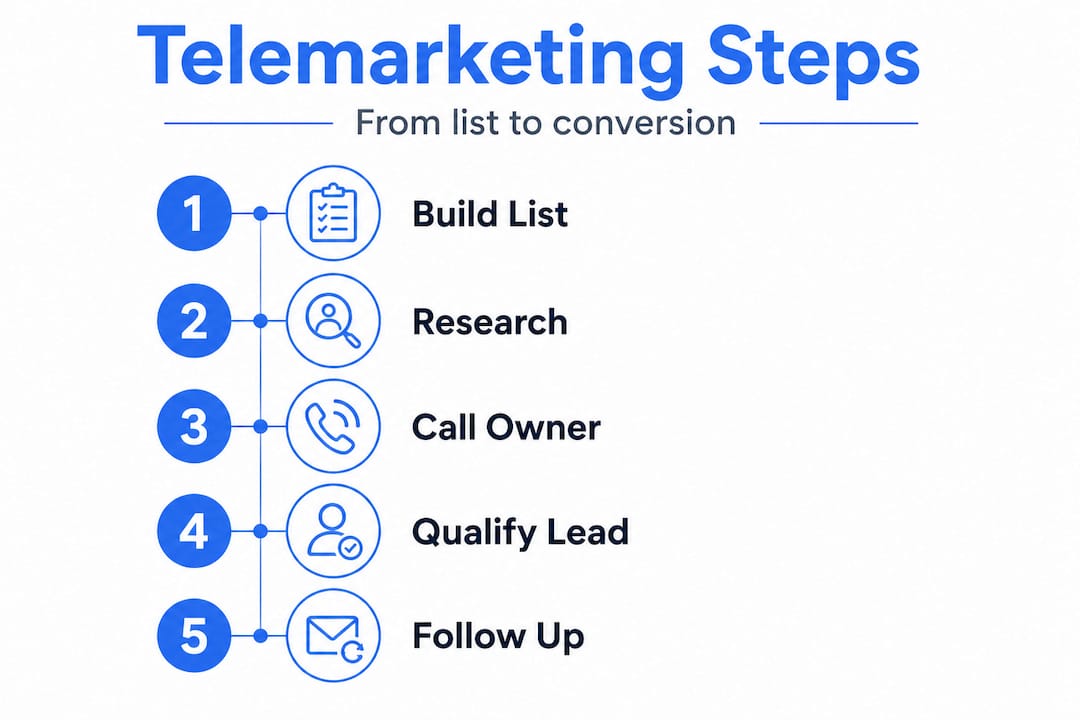
Understanding the definition is one thing. Knowing how to execute is another. Here’s the standard telemarketing workflow that successful investors and wholesalers follow:
- Build and scrub your list. Pull targeted leads from public records, probate court filings, foreclosure notices, or data providers. Scrub the list against the National Do Not Call (DNC) registry before calling. A clean, targeted list saves hours of wasted effort.
- Research each lead. Check the property’s estimated value, the owner’s name, any liens or lis pendens filings, and length of ownership. The more you know before you call, the more natural and confident you sound.
- Prepare your script. Your script isn’t a word-for-word monologue. It’s a conversation guide with key questions, transition phrases, and objection responses mapped out in advance.
- Make the initial call. Open with a clear, calm introduction. State why you’re calling without being evasive. Get to your qualifying questions quickly without feeling like an interrogation.
- Qualify the homeowner. Assess motivation level, property condition, timeline, and whether they have decision-making authority. The goal is to determine if there’s a real opportunity worth pursuing.
- Track and follow up. Most deals don’t close on the first call. Log every interaction in your CRM, set follow-up reminders, and stay consistent. Lead generation basics consistently show that 70% of leads require multiple touches before they’re ready to talk seriously.
| Phase | Focus area | Key action |
|---|---|---|
| List building | Data quality | Scrub against DNC, verify contact info |
| Script prep | Conversation flow | Map objections, prepare opening lines |
| Initial call | Connection and trust | Listen more than you talk |
| Qualification | Motivation and fit | Ask about timeline, condition, and urgency |
| Follow-up | Relationship building | Track every call, set reminders |
Consider two scenarios: calling a foreclosure lead versus a probate lead. On a foreclosure call, urgency is already present. The homeowner knows the clock is ticking. Your tone should be calm and solution-focused, acknowledging the pressure without piling on. On a probate call, the emotional weight is grief and family complexity. You lead with patience, empathy, and respect for what they’re going through before ever getting to numbers.
Same core process. Completely different emotional approach. That flexibility is what separates skilled telemarketers from average ones.
Pro Tip: Within the first two minutes of a call, ask one open-ended question about the homeowner’s situation. “What’s your ideal timeline for making a decision on the property?” gives you more intelligence than five yes/no questions combined.
Modern telemarketing techniques vs. old-school cold calling
Old-school cold calling was a numbers game. Dial 200 numbers, hope 10 people answer, and pitch the same script to everyone. It worked, barely, because there wasn’t much competition. Today, that approach gets you hangups, angry callbacks, and a burned reputation.
Modern real estate telemarketing looks completely different. As why direct outreach wins explains, direct phone outreach consistently outperforms mass marketing channels when paired with smart targeting and personalized conversation.
| Factor | Traditional cold calling | Modern telemarketing |
|---|---|---|
| List quality | General property owner lists | Segmented, distressed-specific lists |
| Script style | Generic, one-size-fits-all pitch | Dynamic, scenario-based conversations |
| Dialing method | Manual, slow, inconsistent | Auto-dialers, power dialers |
| Follow-up | Often nonexistent | CRM-tracked, sequenced |
| Practice method | On-the-job learning | AI roleplay and scenario drilling |
| Compliance | Often overlooked | TCPA and DNC scrubbing built in |
The tools shaping modern telemarketing for real estate investors include:
- Auto-dialers and power dialers: These tools dramatically increase the number of quality conversations per hour. You skip answering machines and disconnected numbers automatically.
- CRM platforms: Tools like REsimpli, Podio, and Salesforce help you track every lead, every call, and every follow-up sequence without anything falling through the cracks.
- AI roleplay platforms: Cold calling practice platforms simulate real seller conversations so you can rehearse objections and refine your tone before you’re in a live call situation.
- Lead scoring systems: These rank your leads by likelihood to sell based on factors like days delinquent, equity position, and time in probate, so you prioritize the hottest opportunities first.
- Dynamic scripts: Unlike static scripts, these branch based on homeowner responses. If the seller says they have a realtor, your script branches to an objection-handling path. If they express urgency, it moves to qualification questions faster.
The result is a measurable improvement in contact rates, conversion rates, and deal quality. Investors who upgrade from old-school dialing to modern systems typically see their qualified lead rate improve dramatically within the first month.
Mistakes to avoid in real estate telemarketing
Even investors who understand the modern approach still make costly mistakes. These errors don’t just lose deals. They can damage your reputation and expose you to legal liability.
Not complying with TCPA and DNC laws. The Telephone Consumer Protection Act (TCPA) and the National Do Not Call Registry have strict rules about who you can call and how. Fines can reach $500 to $1,500 per violation. Before you dial, scrub your list. Every time. No exceptions.
Using pushy or generic scripts. Nothing kills a promising conversation faster than a seller feeling like they’re being worked over. Scripted lines like “I can close in 7 days, cash, any condition” delivered robotically before you even know the seller’s situation signal that you don’t actually care about their problem. As covered in the investor script workflow framework, effective scripts are structured around questions and listening, not rapid-fire pitching.
Skipping follow-up. This is the single most common mistake among new investors. They make one call, get a soft “not interested,” and move on. In reality, a homeowner in pre-foreclosure who says “not right now” in January may be desperate for help in March. Consistent, respectful follow-up over weeks and months is where most deals actually get made.
Failing to track calls and results. If you’re not logging every call, you’re flying blind. You can’t improve what you’re not measuring. Track call duration, outcome, objections raised, and follow-up dates for every contact.
Calling without researching the lead. Calling someone about their property and not knowing whether it’s a condo or a single-family home, or mispronouncing their name, instantly destroys credibility. Thirty seconds of research before each call pays off every time.
“One unethical call or compliance mistake can permanently close doors with entire neighborhoods and data providers. Your reputation is your pipeline.”
Common mistakes summarized:
- Skipping DNC scrubbing before dialing
- Using one generic script for all seller types
- Never following up after an initial soft rejection
- Failing to log calls and outcomes in a CRM
- Calling without knowing basic property or owner details
Tools and resources for effective real estate telemarketing
Theory without practice is just information. Here’s how to actually build your telemarketing skills and systems so they perform consistently.
- Use scenario-specific script templates. A probate script looks different from a tax delinquent script. Download or build templates for each distressed seller type you target. Then customize them with local language and your natural speaking style.
- A/B test your openings. Run two different opening lines for 50 calls each. Track which one keeps people on the phone longer. Small wording changes can produce big differences in engagement.
- Drill objections weekly. The most common objections, “I’m not interested,” “I already have an agent,” “I need to think about it,” can be rehearsed until your responses are calm, confident, and natural.
- Use AI roleplay tools. Platforms like those built around pre-foreclosure roleplay and the script workflow for deals let you simulate real conversations with AI-driven homeowners before you risk a live lead.
- Review your recorded calls. Many dialers allow call recording. Listening back to your own calls is uncomfortable but incredibly valuable. You’ll catch filler words, missed follow-up questions, and moments where your tone shifts under pressure.
- Practice with distressed-specific scenarios. The tired landlord practice environment is one example of how targeted roleplay helps you prepare for the emotional nuances of specific seller types rather than generic homeowner conversations.
Pro Tip: Set aside 20 minutes three times a week specifically for objection drilling with an AI roleplay tool. Investors who practice this consistently report feeling noticeably more confident within two to three weeks, and that confidence comes through clearly on live calls.
Building a telemarketing practice routine is just as important as building a dialing schedule. The investors who close the most deals aren’t necessarily the ones making the most calls. They’re the ones who are best prepared for the conversations those calls produce.
Why most investors misunderstand telemarketing (and how to get ahead)
Here’s the uncomfortable truth: most investors approach telemarketing as a volume play. Dial more, close more. That logic made some sense 15 years ago. Today, it produces mediocre results and burned-out callers.
The investors actually winning with telemarketing in 2026 have shifted their mental model. They’re not trying to “get through” a list. They’re trying to connect with people. That shift changes everything, from how they open calls to how they handle rejection.
The conventional advice focuses on scripts, dialers, and lists. Those things matter. But what really separates top performers is their ability to read emotional state on a call and adjust in real time. A homeowner in probate who’s grieving doesn’t need a closing technique. They need to feel heard first.
Tone carries more weight than most investors realize. You can have a perfect script and lose the call in the first 10 seconds because you sound rushed, robotic, or rehearsed. The sellers who become deals almost always say later that they agreed to meet because the investor “seemed like a real person” or “actually listened.”
The contrarian insight here is this: slow down your calls. Most investors rush because they’re chasing volume. But a 6-minute call where you build genuine rapport will outperform ten 90-second calls every single time when it comes to actual conversions.
As investor cold calling insights reinforce, the highest-converting callers ask more questions than they answer. They practice active listening. They pause after the homeowner speaks instead of jumping in. These aren’t sales tricks. They’re human communication skills applied deliberately.
Stop treating telemarketing like a task to get through. Start treating it like a skill to master. That mindset shift alone puts you ahead of most of your competition.
Take your real estate telemarketing to the next level
You now understand what real estate telemarketing is, how it works, and what separates good callers from great ones. The next step is practice, specifically the kind that builds real skills fast.

ClosersLeague is an AI-powered cold calling training platform built for real estate investors and wholesalers. We give you realistic practice environments for every major distressed seller scenario. Start with inherited property roleplay to sharpen your probate conversations, or work through code violation cold calling to get comfortable with some of the most emotionally complex calls in the business. Every session gives you scored feedback so you know exactly where to improve. Stop winging it. Start drilling with AI cold calling practice built specifically for investors like you.
Frequently asked questions
What types of leads benefit most from real estate telemarketing?
Distressed homeowners facing foreclosure, probate, or divorce are most responsive to targeted telemarketing, along with owners dealing with tax delinquency or code violations.
Is cold calling still effective for real estate in 2026?
Yes, direct phone outreach remains one of the highest-ROI strategies for sourcing off-market deals and building genuine seller rapport.
How do I stay compliant with telemarketing laws?
Always scrub your call lists against the DNC registry and follow TCPA guidelines to avoid costly fines and protect your reputation with data providers.
What’s the best way to practice real estate telemarketing?
Use AI roleplay tools and distressed-seller-specific script templates to rehearse real investor scenarios and sharpen your objection handling before live calls.
Recommended
- Master Real Estate Lead Generation: Cold Calling Basics – ClosersLeague Blog
- 10 proven cold calling tips for real estate investors – ClosersLeague Blog
- Cold calling for investors: why direct outreach still wins – ClosersLeague Blog
- Real Estate Cold Calling Practice — AI Roleplay for Every Seller Type | ClosersLeague