Most real estate investors make cold calls. Far fewer convert them into actual deals. If you’ve been grinding through lists of distressed sellers only to hear hang-ups, angry rejections, and dead ends, you’re not alone. The gap between dialing and closing isn’t luck. It’s a system. Investors who consistently win in foreclosure, probate, and divorce niches follow a precise process: they build quality lists, execute structured calls, stay compliant, and follow up relentlessly. This guide walks you through every step so you can stop spinning your wheels and start building a real pipeline.
Table of Contents
- Prepare for success: Building and qualifying your lead list
- Step-by-step system: Effective cold calling that connects and qualifies
- Avoid common mistakes: Compliance and conversation pitfalls
- From connection to close: Maximizing conversions and building your pipeline
- Why top performers still win with cold calls (when others quit)
- Practice and scale your cold calling with proven tools
- Frequently asked questions
Key Takeaways
| Point | Details |
|---|---|
| High-quality lead lists | Success starts with verified, niche-specific distressed seller lists. |
| Organized calling systems | Top investors triple their results by standardizing scripts and tracking metrics. |
| Compliance is critical | Scrubbing for DNC and following solicitation laws protects you and boosts call quality. |
| Follow-up wins deals | The fortune is in consistent, structured follow-up sequences with motivated sellers. |
| Practice makes perfect | Ongoing roleplay and system refinement increase conversions and confidence on calls. |
Prepare for success: Building and qualifying your lead list
Now that you know what you’ll gain, let’s start by focusing on your foundation: targeting the right sellers.
Your results are only as good as your list. Calling random homeowners wastes time and money. Calling the right distressed sellers, at the right moment, with verified contact info, is where deals actually start.
What are distressed stacks and why do they matter?
Top investors don’t just pull a generic list of homeowners. They build what are called distressed stacks, combinations of overlapping data signals that dramatically increase the chance a seller is motivated. According to the Guide: Finding & Attracting Motivated Sellers, the most effective targeting stacks include:
- Pre-foreclosure + tax delinquency + low equity: Sellers facing multiple financial pressures who urgently need an exit
- Absentee + 10+ years of ownership + eviction records: Landlords who are tired and burned out, ready to sell without going to market
- Probate + vacant properties: Inherited properties where heirs want a fast, clean sale
Each additional filter narrows your list and sharpens your targeting. You’re not looking for volume. You’re looking for motivation.
The critical role of verified data and skip tracing
Bad data is expensive. Calling wrong numbers, disconnected lines, and unverified contacts kills your momentum. Skip tracing, the process of locating current contact information for property owners, is essential before you pick up the phone. Quality skip trace services cross-reference multiple databases to find mobile numbers, updated mailing addresses, and email contacts.
Pro Tip: Never skip the skip trace step. Investing $0.10 to $0.25 per record to get verified contact info will save you hours of wasted calling time and significantly improve your connect rate.
DNC compliance: The rule you can’t ignore
The Do Not Call registry, along with TCPA (Telephone Consumer Protection Act) regulations, sets strict rules about who you can call and how. Violating these laws can result in fines up to $1,500 per call. Before you dial a single number, scrub your list against the national DNC registry and any state-specific registries that apply.
Understanding cold calling basics includes knowing your legal boundaries as well as your scripts. Always keep documentation of your scrubbing process.
| Lead source | Motivation level | Skip trace priority | DNC risk |
|---|---|---|---|
| Pre-foreclosure | Very high | Critical | Medium |
| Tax delinquent | High | Critical | Medium |
| Probate | High | Essential | Low |
| Absentee landlord | Medium to high | Essential | Medium |
| Vacant properties | Medium | Recommended | Low |
“The investors who win at cold calling don’t just dial more. They dial smarter, with cleaner data and tighter targeting than their competition.”
When you know how to qualify real estate leads before the call even happens, you increase your close rate without increasing your dial count.
Step-by-step system: Effective cold calling that connects and qualifies
With your list ready, it’s time to execute a calling system that consistently delivers real conversations with motivated sellers.

A great list without a structured process is just a spreadsheet. Execution is everything. Here’s the workflow top performers use to turn contacts into conversations.
The proven cold calling process
- Block your calling time. Dedicate specific hours daily, typically between 9 a.m. and 12 p.m. and again from 4 p.m. to 6 p.m. local time, when homeowners are most reachable.
- Load your list into a dialer. Use a power dialer or multi-line dialer to increase call volume without sacrificing quality. Tools like Mojo Dialer or Call Tools are popular among investors.
- Follow your script structure. Open with your name and a clear, simple reason for calling. Transition quickly to a qualifying question about their situation. Never jump to your offer before you understand their pain point.
- Identify motivation signals. Listen for cues like “I’ve been meaning to deal with this,” “it’s been vacant for a while,” or “we’re trying to settle the estate quickly.” These tell you the seller is ready to talk.
- Handle objections with empathy, not pressure. When a seller says “I’m not interested,” respond with curiosity, not a sales pitch. Ask “What would need to change for this to make sense?” rather than pushing harder.
- Log every call in your CRM immediately. Record the outcome, follow-up date, and any personal details the seller shared. This data powers your follow-up sequence.
- Set a clear next step before you hang up. Whether it’s a callback, a property walk-through, or sending information, always close each call with a specific action item.
Investors who follow a structured investor script workflow consistently outperform those who improvise. The data backs this up.
Systematized vs. random calling: What the numbers say
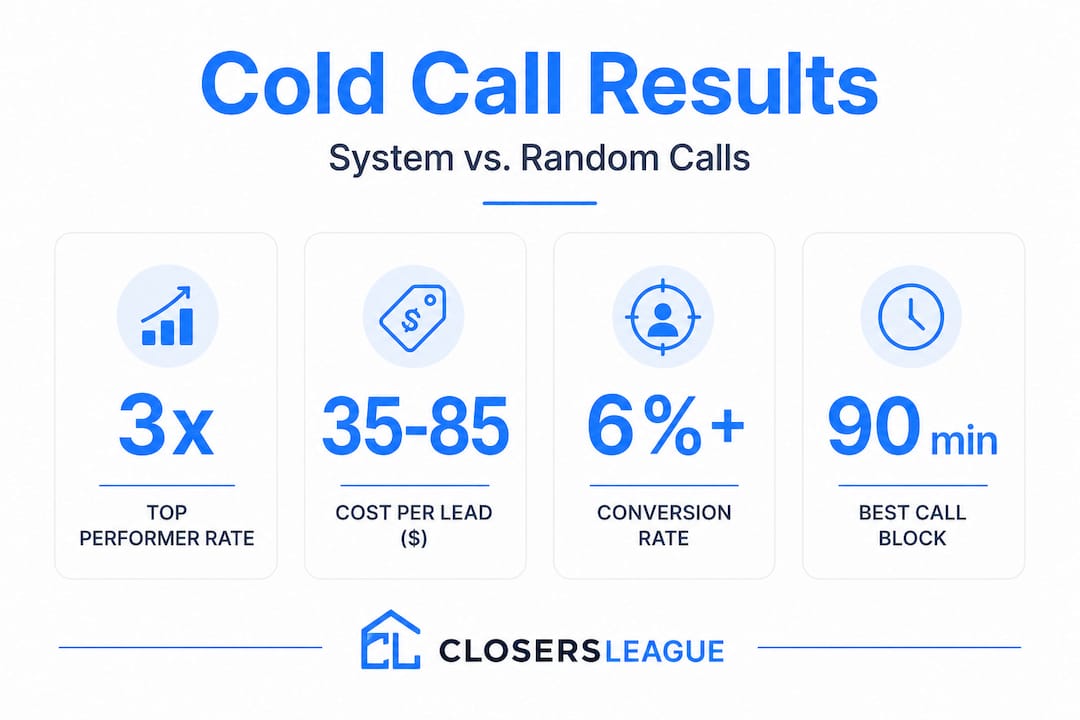
Some voices in the industry claim cold calling is dead. They’re wrong, and the numbers prove it. According to real estate cold calling statistics, top performers using organized systems achieve 3x the average connection and deal rates compared to investors who call without structure. Cost-wise, cold calling generates leads at $35 to $85 per lead versus $212 or more for digital marketing channels.
| Approach | Avg. connect rate | Cost per lead | Deal conversion |
|---|---|---|---|
| Random calling (no system) | 3% to 5% | $150 to $200 | Low |
| Systematized cold calling | 9% to 15% | $35 to $85 | Significantly higher |
| Digital marketing (PPC/social) | Variable | $150 to $212+ | Moderate |
Understanding why direct outreach wins comes down to one simple fact: you’re reaching motivated sellers before anyone else does. Your competitors are waiting for sellers to come to them. You’re showing up first.
Pro Tip: Batch your calls in 90-minute focused blocks. This keeps your energy high, your delivery sharp, and your outcomes consistent. Momentum matters when you’re cold calling.
For specific techniques that sharpen your approach, explore these cold calling tips designed specifically for real estate investors working distressed niches.
Avoid common mistakes: Compliance and conversation pitfalls
Equipped with a repeatable system, you must avoid costly mistakes that separate real closers from amateurs.
Knowing what to do is half the battle. Knowing what NOT to do is where most investors stumble. Let’s cover the most damaging errors and how to stay clear of them.
Legal and compliance red flags
The distressed seller targeting process carries real legal responsibility. Here’s what you absolutely must do:
- Scrub your list against federal and state DNC registries before every campaign
- Never use auto-dialers to call cell phones without prior written consent under TCPA rules
- Keep records of your scrub dates, data sources, and list versions
- Follow state-specific solicitation laws, which vary significantly by jurisdiction
- If you’re calling for a business, identify yourself and your company within the first few seconds of the call
Failing to follow these steps can expose you to serious legal and financial liability. One settlement can wipe out months of deal profits.
Script and tone errors that kill deals
Even with a solid list and legal compliance in place, poor delivery destroys conversions. The most common conversation mistakes include:
- Talking too much. Sellers don’t want a monologue. They want to feel heard. Aim for a 60/40 listening-to-talking ratio.
- Jumping to price too early. Asking “what’s the lowest you’d take?” before building even minimal rapport signals that you only care about the deal, not the person.
- Using robotic or rehearsed-sounding language. Scripts are guides, not scripts to read word for word. Practice until your delivery sounds natural.
- Failing to acknowledge emotion. Sellers in foreclosure, probate, and divorce situations are often under enormous stress. Ignoring that emotional reality makes sellers shut down immediately.
“The call isn’t about your offer. It’s about their situation. The investor who listens best usually wins the deal.”
The follow-up failure most investors share
Research consistently shows that the majority of deals close after the fifth or sixth contact, yet most investors give up after one or two attempts. This is one of the most costly errors in cold calling. Implementing structured follow up strategies is not optional. It’s what separates closers from collectors of cold leads.
A seller who doesn’t respond today may be ready in 30 days when their situation gets worse or a deadline approaches. Your follow-up system is what keeps you in position when that moment arrives.
From connection to close: Maximizing conversions and building your pipeline
To capitalize on initial conversations, converting leads means ongoing qualification and structured follow-up.
Getting a seller to talk is the beginning. Turning that conversation into a signed agreement requires a disciplined pipeline process.
How to quickly qualify motivated sellers
Not every distressed seller is ready to sell at an investor’s price. Fast qualification saves you from investing hours into unmotivated leads. Use these key questions within the first three to five minutes of every call:
- “How long have you owned the property?”
- “Are you currently living there, or is it vacant?”
- “What’s driving your interest in selling right now?”
- “Have you talked with any other buyers or agents?”
- “If you received a fair cash offer this week, how quickly could you move forward?”
These questions reveal timeline, motivation, and urgency. A seller who says “we need to close within 60 days, my brother and I can’t agree on what to do with the estate” is far more actionable than one who says “we might sell in a year or two.”
Effective lead qualification methods applied in the first call dramatically reduce wasted follow-up time and focus your energy on real opportunities.
Best follow-up sequence for distressed leads
Once you’ve had an initial conversation and identified motivation, follow this sequence to stay top of mind without becoming a pest:
- Day 1: Send a brief text or voicemail summarizing your offer and expressing genuine interest in helping
- Day 3: Follow up with a personal call referencing specific details from your first conversation
- Day 7: Send a handwritten note or a direct mail piece reinforcing your credibility
- Day 14: Call again, sharing a relevant success story or example of how you helped a similar seller
- Day 30: Reconnect with a “just checking in” call and ask if anything has changed in their situation
Pro Tip: Always reference something personal from your last conversation. Saying “I remember you mentioned the property has been vacant since your father passed” shows you were listening and builds trust faster than any script.
Using a CRM to manage your pipeline
Tracking every lead in a reliable system is non-negotiable if you want to scale. A CRM (Customer Relationship Management) tool lets you set follow-up reminders, log call notes, and see your full pipeline at a glance. Without it, leads fall through the cracks. With it, you systematically work every opportunity until it closes or dies.
Learn the real estate CRM best practices that experienced wholesalers use to manage hundreds of active leads simultaneously. The investors doing 10 to 20 deals a year are not smarter than you. They’re just better organized.
According to motivated seller targeting data, the best-performing investors combine verified distressed stacks with consistent follow-up to dramatically improve their deal conversion rates.
Why top performers still win with cold calls (when others quit)
Let’s reconsider what separates the top closers in this industry from those who never break through.
Every few months, someone publishes a piece declaring cold calling dead. They point to lower connect rates, rising DNC lists, and seller resistance as proof that the phone no longer works. But here’s the reality: those claims miss what’s actually happening at the top of the industry.
According to real estate cold calling statistics, top-performing investors achieve three times the connection and conversion rates of their peers. The difference isn’t the phone. It’s the system behind the call. Investors who track their metrics, practice their scripts, handle objections with precision, and follow up relentlessly are seeing results that average dabblers simply won’t experience.
We’ve seen this pattern repeatedly: the investors who quit cold calling after a rough week are the same ones who called without a structured script, pulled unverified lists, and never followed up more than twice. Of course it didn’t work. They weren’t really doing it.
Contrast that with the investor who treats cold calling like a skill to be developed. They practice objection handling daily, they review call recordings to spot what they missed, and they iterate their approach based on real feedback. That investor gets better every single week. And after 90 days of focused effort, their pipeline looks nothing like it did when they started.
The real competitive advantage in cold calling is this: you reach motivated sellers through direct investor outreach before a single competitor even knows those sellers exist. While other investors wait for inbound leads from expensive digital campaigns, you’re already building rapport with a probate heir who just needs someone to call them back one more time.
Stop winging it. Start drilling. The investors who commit to the system are the ones still closing deals while everyone else debates whether cold calling is worth it.
Practice and scale your cold calling with proven tools
Ready to put these strategies into practice and accelerate your learning curve?
Reading about cold calling and actually executing it under pressure are two very different things. That’s exactly why we built ClosersLeague, an AI-powered cold calling training platform designed specifically for real estate investors and wholesalers working distressed niches.

You can practice real seller conversations before you ever pick up the phone on a live call. Sharpen your approach with inherited property cold calling practice that simulates probate and estate situations with realistic objections. Work your confidence in high-pressure scenarios with tax delinquent cold calling practice that mirrors real seller emotions. And drill the specific language of urgency and empathy with pre-foreclosure cold calling practice tailored to sellers facing the clock. Score your calls, track your improvement, and build the skills that convert distressed sellers into signed deals.
Frequently asked questions
What are the best lists to target for real estate lead conversions today?
Pre-foreclosure, tax delinquency, absentee with long ownership or eviction records, probate, and vacant properties are consistently the top-performing lead lists for motivated seller outreach.
Is cold calling still effective for real estate lead conversion in 2026?
Yes. Top investors using systems achieve three times the average connect and deal rates at a cost of $35 to $85 per lead, compared to $212 or more for digital channels.
How can I stay compliant when cold calling distressed sellers?
Always scrub your list against DNC registries before every campaign, use verified skip tracing to confirm contact info, and follow TCPA rules and any state-specific solicitation laws that apply.
What should be included in a real estate cold call script?
The most effective scripts open with a clear, brief introduction, move quickly into qualifying questions about the seller’s situation, and offer a specific, empathetic solution before closing with a defined next step.
What’s the fastest way to move a cold lead to an appointment?
Build rapport by referencing details from your first conversation, qualify motivation within the first few minutes, and commit to an immediate, structured follow-up sequence so you’re always the investor who calls when it counts.
Recommended
- Master Real Estate Lead Generation: Cold Calling Basics – ClosersLeague Blog
- Cold calling for investors: why direct outreach still wins – ClosersLeague Blog
- 10 proven cold calling tips for real estate investors – ClosersLeague Blog
- Inherited Property Cold Calling Practice — AI Roleplay for Real Estate Investors & Wholesalers