
Cold calling distressed property owners is one of the hardest skills to build in real estate wholesaling. You dial, you get voicemails, you get hung up on, and you wonder if the whole approach is even working. The reality is that most wholesalers fail at cold calling not because they lack hustle, but because they lack a system. They wing the script, skip the data, and never track what’s actually converting. This guide covers everything: how to prepare your lists and tools, how to execute calls that qualify sellers fast, how to track your performance, and how to follow up until deals close.
Table of Contents
- What you need before you start cold calling
- Step-by-step cold calling process for wholesalers
- Tracking performance metrics and improving your results
- Follow-up strategies and lead recycling for more deals
- What most wholesale training misses: The funnel-first mindset
- Sharpen your skills with ClosersLeague’s AI roleplay training
- Frequently asked questions
Key Takeaways
| Point | Details |
|---|---|
| Target distressed sellers | Pull lead lists using indicators like pre-foreclosure and code violations to boost motivated-seller contact rates. |
| Use flexible scripts | Treat scripts as adaptable frameworks to qualify motivation and set clear next steps without sounding robotic. |
| Measure every call | Track KPIs such as connect and appointment rates to identify and improve weak points in your funnel. |
| Follow up consistently | Repeat calls and automate follow-ups in your CRM to unlock deals from leads that didn’t answer initially. |
| Prioritize funnel discipline | Focus on managing full-funnel metrics from contact to contract for true cold-calling mastery. |
What you need before you start cold calling
Most investors jump straight to dialing without laying the right groundwork. That’s where wasted hours and empty pipelines come from. Before you make a single call, you need three things locked in: quality leads, the right tools, and the right mindset.
Start with targeted lists
Not all lists are created equal. Pulling random homeowner data gives you low-quality conversations. You want leads built around distress signals. The most effective cold calling basics start with filtering for owners who actually have a reason to sell. Distress and motivation indicators like pre-foreclosure, tax delinquency, code violations, inherited properties, vacant homes, and absentee owners are the foundation of every productive list. These aren’t just names. They’re people under pressure, and that pressure creates motivation.
Here are the most common list types and what makes them valuable:
| List type | Distress indicator | Typical motivation |
|---|---|---|
| Pre-foreclosure | Missed mortgage payments | Avoid foreclosure damage |
| Tax delinquent | Unpaid property taxes | Avoid lien or tax sale |
| Probate/inherited | Recent inheritance | Liquidate estate quickly |
| Vacant/absentee | No occupant, out-of-area owner | Simplify management burden |
| Code violation | Property citations pending | Avoid fines or legal action |
Set up your tools properly
You need three core tools before your first call session: a power dialer, a CRM (customer relationship management system), and a flexible script framework. A power dialer lets you move through lists efficiently without manual redialing. A CRM tracks every touchpoint so no lead falls through the cracks. The script framework keeps your conversations on track without making you sound robotic.
- Power dialer: Automates call sequences and records conversations
- CRM: Logs call outcomes, schedules follow-ups, tracks deal stages
- Script framework: Covers your opening, qualifying questions, objection responses, and next steps
Pro Tip: Don’t try to memorize a word-for-word script. Build a framework with key questions and practice adapting it in real time. That flexibility is what separates closers from callers.
Prepare your mindset
Rejection is constant in this business. You will reach sellers who are angry, defensive, or simply not ready. That’s normal. Go into each session with curiosity instead of desperation. Your goal on any single call isn’t to close a deal. It’s to qualify or disqualify a lead as efficiently as possible. That shift in thinking reduces pressure and makes your conversations more natural.
Step-by-step cold calling process for wholesalers
With your prerequisites set, here’s how to execute calls that convert.
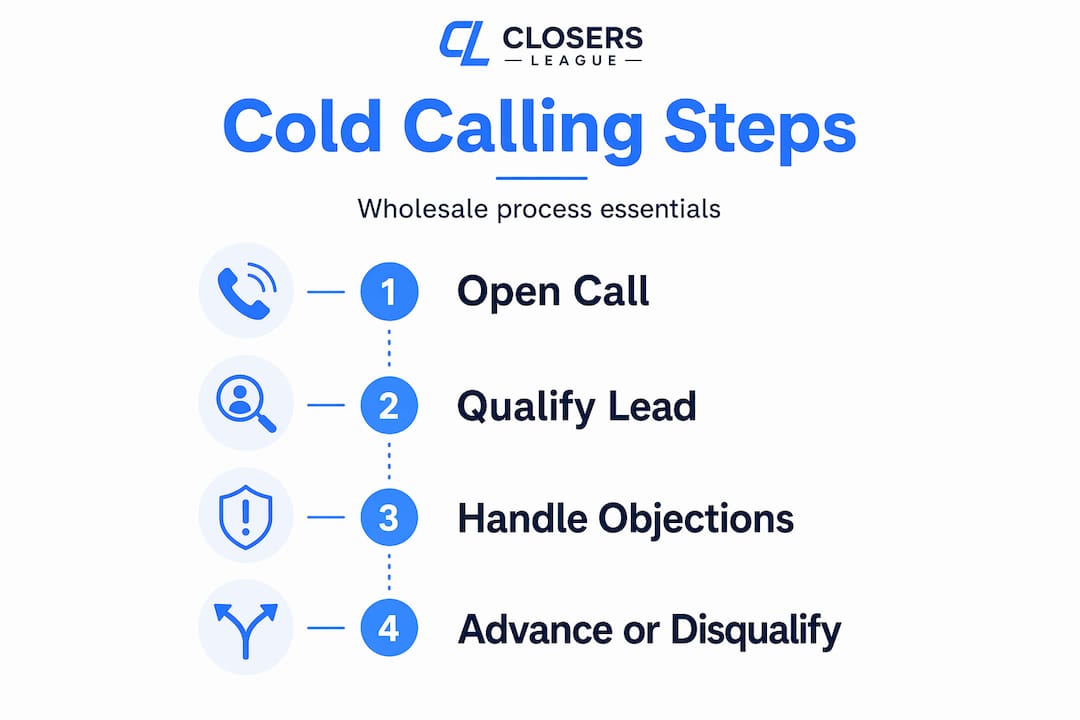
Step 1: Open with confidence and a clear purpose
Your first five seconds matter more than anything else you say. State your name, that you’re a local investor, and that you’re calling about their property. Keep it simple. Don’t pitch. Don’t over-explain. The goal is to earn thirty more seconds of their time.
Step 2: Qualify with open-ended questions
Wholesaling cold calling scripts work best as flexible frameworks, not rigid word-for-word scripts. Once you’ve established who you are, shift immediately into qualifying. Ask open-ended questions that give sellers room to talk. The more they share, the more you learn.
Core qualifying questions to cover early:
- Is the property currently occupied, or is it vacant?
- What condition would you say the property is in right now?
- Have you thought about what you’d want for it if the right offer came along?
- Is there a timeline you’re working with, or are you flexible on that?
- What’s making you consider selling at this point?
These five questions tell you almost everything you need to know. Occupancy status affects your offer. Condition affects your repair estimate. Motivation and timeline tell you how urgent the deal is. Price expectations tell you whether there’s a gap to bridge.
Step 3: Handle objections with empathy
Objection handling is largely about conversation management, not argument. When a seller pushes back, don’t defend your position. Acknowledge what they said, then ask a permission-based question to continue. “I totally understand, and I’m not here to pressure you at all. Would it be okay if I asked just one more question?” That structure keeps conversations alive.
Here’s how objections compare in terms of approach:
| Objection type | Weak response | Strong response |
|---|---|---|
| “I’m not interested” | “Are you sure?” | “Completely fair. Is it okay if I ask what changed your mind?” |
| “My property isn’t for sale” | Hang up | “I understand. Have you thought about it at all recently?” |
| “I already have an agent” | Apologize and hang up | “Got it. If something changed, would you be open to a quick conversation?” |
Step 4: Advance or disqualify the lead
Every call should end with a clear outcome. Either you’re booking a callback or an appointment, or you’re disqualifying the lead and updating your CRM. Study the full investor script workflow to understand how to move from opening to close efficiently. There’s no value in leaving calls open-ended or letting leads sit in limbo.
Pro Tip: If a seller isn’t ready to sell but isn’t saying no, add them to a long-term nurture sequence. Many deals come from leads that needed six months to make up their minds. The approach to winning wholesale deals often comes down to patience combined with consistent follow-through.
Tracking performance metrics and improving your results
Once you’ve mastered the process, you’ll need to start tracking what works and what doesn’t.

Feelings are not data. Thinking a session “went okay” is not the same as knowing your connect rate climbed from 8% to 14% over four weeks. Real improvement requires real numbers.
The KPIs that matter most
Performance measurement and KPI benchmarking are emphasized in top training resources. The metrics you should track on every single session include:
- Dials made: Total outbound attempts
- Connect rate: Percentage of dials that reach a live person
- Conversation rate: Percentage of connects that become real conversations
- Interest rate: Percentage of conversations where the seller shows genuine motivation
- Appointment rate: Percentage of conversations that turn into scheduled appointments
- Cost per qualified appointment: Total time and dollar cost divided by appointments set
Industry benchmarks to use as targets
| KPI | Beginner benchmark | Experienced benchmark |
|---|---|---|
| Dials per hour | 20 to 30 | 40 to 60 |
| Connect rate | 5% to 8% | 10% to 15% |
| Conversation rate | 40% to 50% | 60% to 70% |
| Appointment rate | 2% to 4% of dials | 5% to 8% of dials |
These benchmarks give you targets to chase. If your connect rate is sitting at 4%, the fix might be list quality or call timing, not your script. If your conversation rate is solid but appointments are low, your qualifying questions or objection handling needs work. Metrics tell you exactly where to focus.
Data point: According to KPI tracking resources for investors, tracking cost per qualified appointment gives wholesalers a clear view of ROI across different list types and calling times, helping allocate time and budget more effectively.
Build this tracking into your daily routine. Study your prospecting process steps to identify where leads drop off. Use the data to adjust your approach weekly, not monthly. Small weekly improvements compound fast. Also review cold calling tips and proven acquisitions strategies to supplement your data review with updated techniques.
How to act on your data
Low connect rate? Adjust your calling hours. Try 8 to 10 a.m. and 5 to 7 p.m. when more people pick up. Low conversation rate? Review your opening ten seconds. Are you triggering hang-ups by sounding like a telemarketer? Low appointment rate? Work on your qualifying questions and objection scripts. Every KPI problem has a specific fix.
Follow-up strategies and lead recycling for more deals
Tracking helps spot missed opportunities, but follow-up and recycling are where many deals are won.
Here’s a truth most new wholesalers learn too slowly: the deal rarely closes on the first call. Sellers are cautious. They need time to trust you, process their situation, and feel ready to move. That means your follow-up cadence is just as important as your initial conversation.
Build a multi-touch follow-up system
Follow-up cadence and lead recycling are emphasized by experts as critical to increasing answer and engagement rates over time. Calling the same lead multiple times across different days dramatically improves your chances of connecting. A basic follow-up cadence might look like this:
- Day 1: First call attempt, leave voicemail if no answer
- Day 3: Second call attempt, no voicemail this time
- Day 7: Third call attempt, paired with a direct mail piece
- Day 14: Fourth attempt, optional text message
- Day 30: Add to long-term nurture list if no response
The key is consistency without harassment. Space your attempts out. Combine phone with mail. Use your CRM to automate reminders so nothing slips.
Lead recycling: Don’t delete, recycle
A lead that says “not right now” in March might be desperate by August. Circumstances change fast, especially in distressed situations. Study the best follow-up strategies to see how top investors build recycling workflows that keep old leads warm. Build a long-term nurture bucket in your CRM and revisit it every 60 to 90 days.
Pro Tip: When you recycle a lead, don’t call it a “follow-up.” Open with something fresh. Reference a market update or a recent sale in their neighborhood. It restarts the conversation without reminding them they already said no.
Combine channels for better results
Calls alone leave money on the table. The wholesalers who consistently boost deal closures layer their outreach. Pair calls with direct mail, SMS, or even simple handwritten notes for high-priority leads. When a seller sees your name in multiple places, you move from “random caller” to “serious buyer.” That perception shift makes your next call far easier.
Use your CRM to qualify real estate leads accurately so you know which leads deserve multi-channel follow-up and which should stay in a simple email drip. Prioritizing your energy correctly is what keeps your pipeline full without burning you out.
What most wholesale training misses: The funnel-first mindset
With the guide steps covered, let’s look at what genuinely separates top performers from the rest.
Here’s an uncomfortable observation after watching hundreds of wholesalers train: most programs spend 80% of their time on scripts and almost no time on funnel management. That’s backwards. Cold call performance is driven by the full funnel, from contact to conversation to interest to appointment to show to contract, not just by how polished your opening sounds.
Scripts matter. But data quality, call timing, and disciplined KPI tracking matter more. We’ve seen investors with average scripts and exceptional systems outperform callers with perfect scripts and zero tracking. Every time. The script is the car. The system is the road.
The other thing most training skips is edge-case management. What do you do when a seller sounds interested but is mid-probate dispute? What do you say to a code violation owner who’s convinced the city is targeting them unfairly? These scenarios require modular call frameworks built for QA and measurement, not rigid templates. Programs that teach you to adapt in real time, and then measure whether your adaptations are working, produce investors who actually improve.
The funnel-first mindset means asking a different question after every session. Instead of “did I sound good?” ask “where did leads drop off, and what can I change?” That shift is where real growth in winning wholesale deals happens. Stop optimizing for comfort. Start optimizing for conversion.
Sharpen your skills with ClosersLeague’s AI roleplay training
Ready to apply these strategies? ClosersLeague is built specifically for real estate investors and wholesalers who want to improve their cold calling through deliberate, structured practice. Our AI-powered roleplay platform lets you practice live conversations with simulated motivated sellers, including pre-foreclosure owners, probate heirs, and code violation properties, before you ever dial a real number.
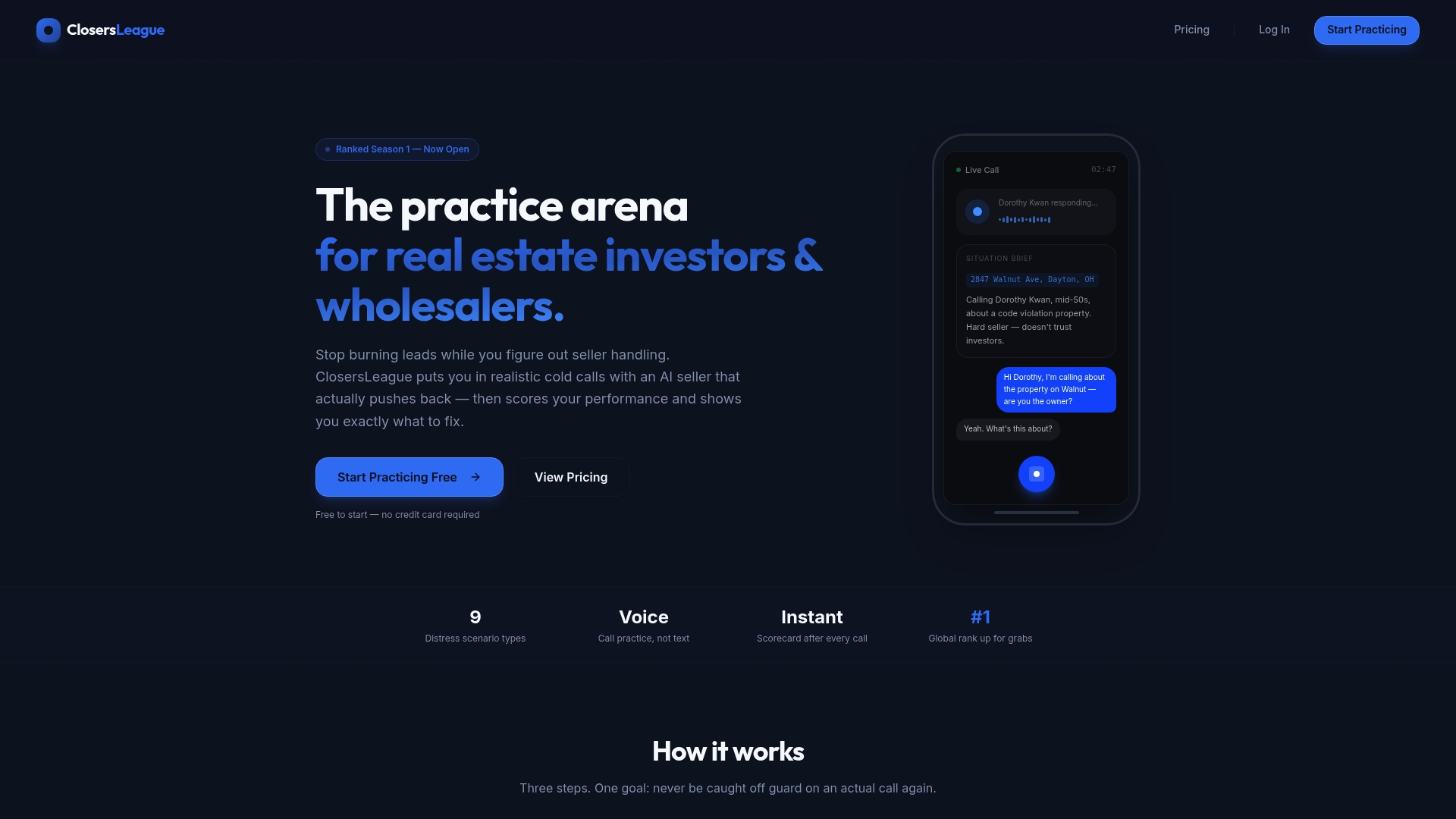
You can practice calling a distressed seller in a tax delinquency scenario, get instant feedback on your qualifying questions, and track your improvement across sessions. Every rep you take inside ClosersLeague is scored against real conversion criteria so you know exactly what to fix. Stop winging it. Start drilling. Visit ClosersLeague and start your first AI roleplay session today to build the consistency and confidence that turns cold lists into closed deals.
Frequently asked questions
How do I find the best cold calling lists for distressed properties?
The most effective lists are built using distress and motivation indicators such as pre-foreclosure status, tax delinquency, code violations, inherited ownership, vacant properties, and absentee owners. These signals identify sellers with real urgency.
What questions should I ask on a wholesale cold call?
Focus your qualifying questions on occupancy status, property condition, seller motivation, expected timeline, and price expectations. Training materials consistently emphasize covering these five areas early in the call to frame qualification and determine next steps efficiently.
How many follow-up attempts should I make when a lead doesn’t answer?
Most experts recommend multiple attempts across several days because many sellers only pick up after repeated contact. A structured cadence of four to five attempts spaced over 30 days, paired with direct mail, significantly improves your connection rate.
What KPIs should I track to improve my cold calling results?
Track dials made, connect rate, conversation rate, interest rate, appointment rate, and cost per qualified appointment. These cold calling KPI benchmarks give you clear, actionable data to diagnose exactly where your funnel is leaking and what to fix next.
Recommended
- Turn Cold Calls Into Deals: A Lead Conversion Guide – ClosersLeague Blog
- Real Estate Cold Calling Practice — AI Roleplay for Every Seller Type | ClosersLeague
- Master Real Estate Lead Generation: Cold Calling Basics – ClosersLeague Blog
- Cold calling for investors: why direct outreach still wins – ClosersLeague Blog