
ClosersLeague is the top pick for U.S. real estate investors and wholesalers who need distressed-seller AI roleplay training. It covers probate, pre-foreclosure, divorce, vacant, tax-delinquent, and tired-landlord scenarios with voice-first practice, real-time scoring, and leaderboards. For solo investors starting out, ClosersLeague’s free trial is the fastest path to measurable improvement in Appointment Ask Rate. Teams scaling dial volume may also evaluate VA plus predictive dialer managed services as a complementary layer. Entry-level text simulators exist but lack the TCPA-aware, scenario-specific depth that distressed-seller outreach demands.
Table of Contents
- How the top closers.app alternatives compare
- How to choose the right AI cold-calling trainer for your operation
- Features that actually move your call-to-appointment rate
- Pricing models and what a real trial should include
- How these platforms fit into your calling stack
- TCPA, DNC, and compliance checks before you scale
- How we evaluated these platforms
- Key Takeaways
- Why ClosersLeague stands out for distressed-seller outreach
- ClosersLeague: practice distressed-seller calls before they cost you deals
- Useful sources
- FAQ
How the top closers.app alternatives compare
| Category | Best For | Pricing & Trial | AI Roleplay Type & Fidelity | Scenario Coverage | Analytics & Scorecards | Practice Capacity | CRM/Dialer Integration | Support & Onboarding | US Compliance |
|---|---|---|---|---|---|---|---|---|---|
| ClosersLeague | Solo investors & wholesaler teams drilling distressed-seller calls | Subscription by calls/month; free trial included | Voice-first; high fidelity with emotional-state simulation | Probate, pre-foreclosure, divorce, vacant, tax-delinquent, inherited, tired landlord, code violation | Call scoring, leaderboards, objection-behavior scorecards | Tiered by plan; scales with team size | CRM export, webhook support | Fast onboarding; dedicated support | TCPA/DNC guidance; encrypted recordings |
| Entry-level text/voice simulators | Agents new to roleplay wanting low-cost practice | Low monthly fee or freemium; limited trial calls | Text-first or basic voice; lower fidelity | Generic buyer/seller; limited distressed-seller personas | Basic pass/fail feedback | Low call limits | Minimal or no CRM hooks | Self-serve only | Varies; often no compliance guidance |
| VA + predictive-dialer managed services | Teams needing raw dial volume with outsourced callers | Per-lead or monthly retainer; no free trial typical | No AI roleplay; human VA execution | All seller types via human script | Dial volume reports; no call scoring | 800–1,000 dials per shift possible | Dialer-native; CRM varies by vendor | Onboarding takes weeks | Depends on vendor; DNC scrubbing varies |
| Hybrid coaching platforms | Brokerages or teams wanting live coach + AI blend | Higher price point; demo required | Mixed voice/text; moderate fidelity | Broader real estate; some distressed coverage | Aggregate KPIs; less granular behavior scoring | Moderate; seat-based | Moderate integration depth | Longer ramp; coach scheduling required | Partial; check vendor-by-vendor |
Pick ClosersLeague if your priority is distressed-seller scenario depth and measurable call improvement. Entry-level simulators work for basic objection familiarity but fall short on probate or pre-foreclosure persona realism. VA-plus-dialer bundles add volume but do not train your callers.
Pro Tip: During any trial, run a probate roleplay first. If the AI persona does not simulate grief, resistance to price, or executor-authority objections, the platform is not built for your actual calls.
Pro Tip: Ask every vendor how their scorecard defines “objection handled.” A platform that only logs whether you moved past an objection misses the behavioral detail that actually improves your Appointment Ask Rate.
How to choose the right AI cold-calling trainer for your operation
The single most important criterion is scenario fidelity for distressed sellers. A platform that cannot simulate a grieving probate heir or a pre-foreclosure homeowner deflecting with denial will not prepare you for the calls that matter.
Use this checklist during every vendor demo:
- Scenario relevance: Does the platform include probate, pre-foreclosure, divorce, vacant, and tired-landlord personas with distinct objection flows?
- Voice vs. text roleplay: Is the practice voice-based, or text-only? Voice fidelity is non-negotiable for cold-call muscle memory.
- Practice call volume: How many AI practice calls are included per month? Does the plan scale with your team?
- Scorecard granularity: Does scoring break down specific behaviors (opening strength, rapport, objection handling, Appointment Ask Rate) or just give an overall grade?
- Analytics export: Can you pull call recordings and scorecard data into your CRM or share with a VA manager?
- Trial transparency: Is there a real free trial with actual voice roleplay, or only a recorded demo?
- TCPA/DNC guidance: Does the vendor address U.S. compliance requirements, or ignore them entirely?
Red flags to disqualify a platform immediately: no voice roleplay in the trial, opaque per-call pricing, no call recording or export, and zero mention of TCPA or DNC considerations.
Features that actually move your call-to-appointment rate
AI roleplay fidelity is where most platforms diverge. Voice tone, pacing, and emotional-state simulation determine whether practice transfers to live calls. A probate seller sounds different from a tired landlord. A pre-foreclosure homeowner carries urgency and shame simultaneously. Platforms that flatten these into a generic “motivated seller” persona train you for calls you will never actually make.
Scenario coverage matters because each distressed-seller type has a distinct objection flow:
- Probate/inherited: Executor authority questions, emotional resistance, family disagreement objections
- Pre-foreclosure: Denial, lender-solution deflection, timeline urgency
- Divorce: Dual-decision-maker complexity, emotional volatility, speed-versus-price tension
- Vacant/out-of-state: Absentee owner skepticism, property condition uncertainty
- Tired landlord: Tenant-problem fatigue, repair-cost anchoring, “I’ll just list it” deflection
- Tax-delinquent: Fear of judgment, confusion about options, urgency around deadlines
Scorecards built around specific behaviors outperform aggregate KPIs. Tracking Appointment Ask Rate, Appointment Set Rate, and Show-Up Rate tells you whether training is producing real results, not just call volume. Research confirms that impact-based metrics like these are the right lens for judging cold-calling ROI.
Practice capacity matters differently for solo operators versus teams. A solo investor drilling 20 calls per week needs a different plan tier than a team of five callers running 150 dials per day each. Exportable call recordings and CRM webhooks let managers review sessions and tag improvement areas without manual note-taking.
Pro Tip: Use call-scoring data to identify the one behavior costing you the most appointments. Rushing the opening is the most common culprit. Fix that single behavior before moving to objection handling.
Pricing models and what a real trial should include
Focus on calls-per-month and analytics access, not just seat price. A cheap seat with a 10-call monthly cap will not produce measurable improvement.
| Pricing Shape | What’s Typically Included | Trial Offer | Best For |
|---|---|---|---|
| Subscription by calls/month | Set number of AI practice calls; scorecard access; scenario library | Free trial with limited calls | Solo investors; small teams |
| Seats + unlimited calls | Per-seat fee; unlimited practice; full analytics | Demo or short trial | Larger teams with daily callers |
| Pay-as-you-go practice calls | Credits per call; no monthly commitment | Credits included at signup | Occasional users; testing phase |
| VA + dialer bundle | Human VAs; predictive dialer; lead management | No free trial; onboarding fee typical | Teams outsourcing all calling |
Top performers typically make a high volume of calls per day, so your practice plan should include enough calls to simulate several days of live volume before you scale. During your trial, test voice roleplay on a probate or pre-foreclosure scenario, review the scorecard detail, and attempt a CRM data export. If any of those three steps fail, the platform is not ready for your operation.
Realistic onboarding: most AI roleplay platforms take one to two days to set up. Measurable improvement in Appointment Ask Rate typically appears within two to four weeks of consistent daily practice.
How these platforms fit into your calling stack
The most valuable integrations are CRM webhooks for call metadata and dialer compatibility that lets you tag practice sessions and export recordings.
Integration checklist before committing to any platform:
- CRM export via CSV or API (confirm field mapping for your CRM)
- Dialer webhook or native integration (Readymode and similar dialers have seat minimums; confirm compatibility)
- Calendar or appointment export for tracking Set Rate against practice volume
- Call-recording storage policy (retention period, encryption, download access)
Workflow by operator type:
Solo investor: Connect AI trainer directly to your CRM. Practice daily before live dial sessions. Export scorecards weekly to track Appointment Ask Rate trends.
Small team with in-house callers: Assign each caller a weekly practice-call quota. Use leaderboard data in team huddles. Manager reviews flagged recordings for coaching.
Team using outsourced VAs with a predictive dialer: Trained VAs using a predictive dialer can reach 800–1,000 dials per shift, but volume without skill training produces diminishing returns. Pair AI roleplay training with VA onboarding to close that gap.
TCPA, DNC, and compliance checks before you scale
TCPA and DNC diligence is a gating factor, not an afterthought. DNC violations can significantly reduce campaign success, and fines for violations may be costly. Skipping list scrubbing is one of the fastest ways to destroy a cold-calling campaign.
Compliance checklist for any platform you evaluate:
- Does the vendor provide TCPA/DNC guidance or resources?
- Are practice calls conducted with anonymized or synthetic numbers?
- Does the platform support opt-out handling and call-logging for audit purposes?
- Are call recordings encrypted, with configurable retention controls?
- Does the vendor provide a data-processing agreement for lead data?
Pro Tip: Build compliance roleplay into your training. Practice handling opt-out requests and consent verification in the AI simulator before your callers face them live. One mishandled opt-out on a live call can cost more than a month of platform fees.
How we evaluated these platforms
We ranked platforms by five weighted criteria: scenario fidelity for distressed sellers, measurable practice capacity, scorecard and analytics quality, compliance features, and trial transparency. Voice roleplay fidelity carried the most weight because it most directly predicts live-call improvement.
Evaluation principle: A platform that scores well on price but cannot simulate a probate heir’s emotional resistance or a pre-foreclosure homeowner’s denial pattern will not move your Appointment Ask Rate. Fidelity to the actual call is the only metric that matters in training.
Live trial checks included running at least one distressed-seller scenario per platform, reviewing scorecard breakdown, testing CRM export, and timing onboarding from signup to first practice call. Platforms were also assessed on whether they addressed TCPA/DNC compliance in their documentation or onboarding.
Key Takeaways
ClosersLeague leads the category for distressed-seller AI roleplay training because it combines voice-first scenario depth, behavioral scorecards, and TCPA-aware features that generic simulators and VA-dialer bundles cannot match.
| Point | Details |
|---|---|
| Scenario fidelity is the top criterion | Choose a platform that simulates probate, pre-foreclosure, divorce, and vacant-seller personas with distinct objection flows. |
| Track impact-based KPIs | Measure Appointment Ask Rate, Appointment Set Rate, and Show-Up Rate, not raw dial counts. |
| Trial must include voice roleplay | A demo without live voice practice tells you nothing about how the platform will train your callers. |
| Compliance is non-negotiable | DNC violations can significantly reduce campaign success; confirm TCPA/DNC guidance before committing. |
| ClosersLeague is the recommended starting point | Start a free trial, run a probate scenario, review the scorecard, and test CRM export within your first session. |
Why ClosersLeague stands out for distressed-seller outreach
Most AI training platforms are built for general sales, not for the specific emotional and situational complexity of distressed-seller cold calling. A probate call is not a sales call in the conventional sense. It is a conversation with someone navigating grief, legal confusion, and financial pressure simultaneously. Generic roleplay tools do not prepare you for that.
ClosersLeague was built specifically for real estate investors and wholesalers working these exact scenarios. The scenario library, scoring categories, and objection flows reflect the actual calls you make every day, not abstract sales frameworks. That specificity is what separates deliberate practice from wasted repetition.
One honest caveat: if your operation is purely volume-focused and you are outsourcing all calling to a VA team with a managed dialer, a VA-plus-dialer bundle may be the right primary tool. ClosersLeague is the right layer on top of that, training your VAs before they touch live leads.
ClosersLeague: practice distressed-seller calls before they cost you deals
Cold callers convert roughly 1.7% of cold calls to appointments on average. Top 10% of performers reach about 5.2% conversion to sale, while the overall average close rate for cold callers is near 2.5%, according to industry statistics. The gap between average and top performers comes down to preparation, not personality. ClosersLeague gives you the practice environment to close that gap on probate, pre-foreclosure, divorce, and vacant-property calls before a single live lead is at risk.
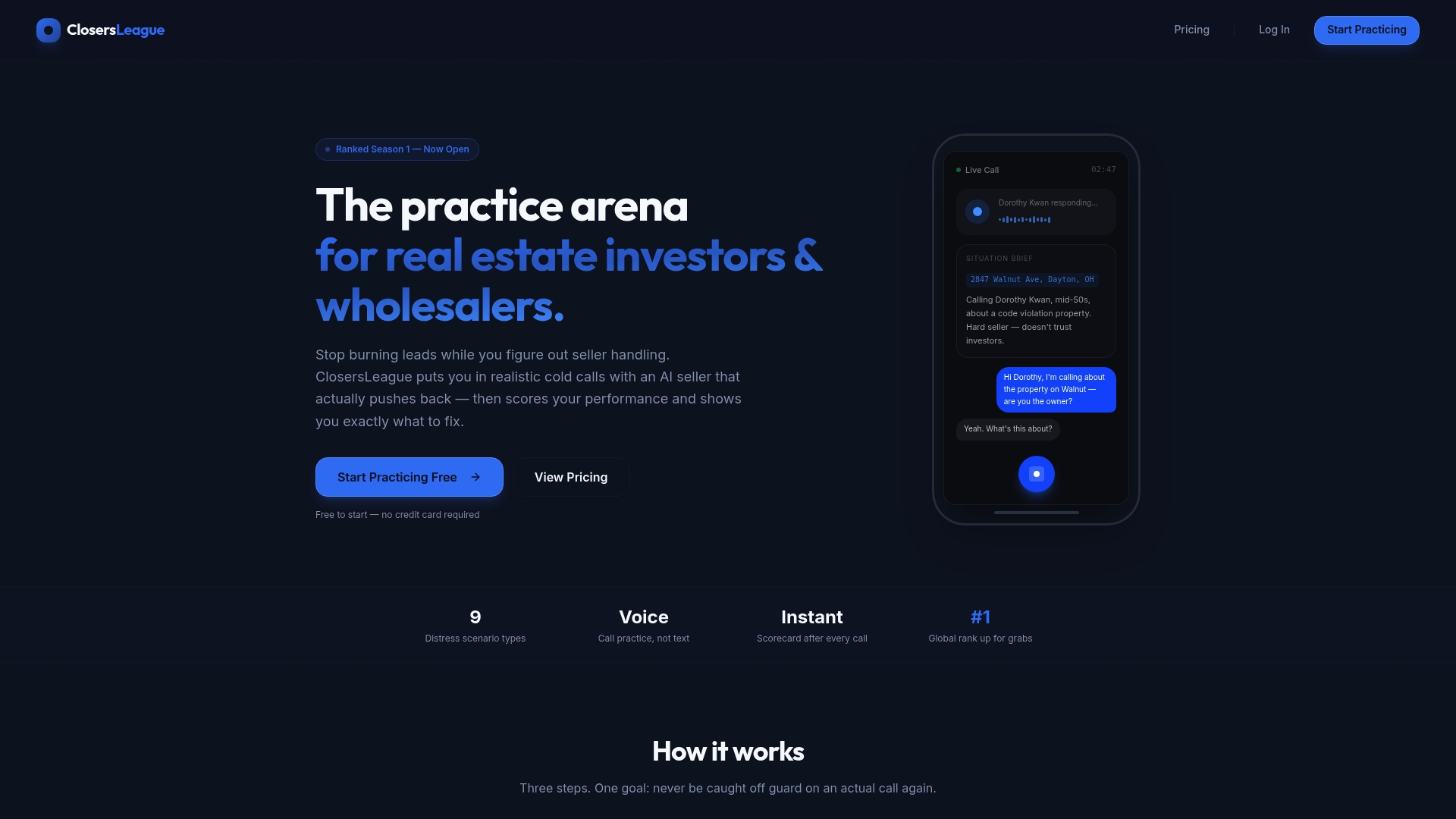
Start your free trial at ClosersLeague and run your first probate or inherited property scenario in your first session. Review the scorecard, test the CRM export, and see exactly where your Appointment Ask Rate is leaking. The free trial includes a limited set of practice calls; converting to a paid plan unlocks the full scenario library and team leaderboards. Most investors complete onboarding in under a day and see measurable improvement in Appointment Ask Rate within two to four weeks of consistent daily practice.
If you primarily need raw dial volume through outsourced VAs, a managed VA-plus-dialer service may fit that layer of your stack. ClosersLeague is the training layer that makes every caller, in-house or outsourced, more effective before they dial a live lead.
Useful sources
- How to Practice Cold Calling in Real Estate Without Losing Leads — MaverickRE
- AI Roleplay for Real Estate Agents — SalesArmor
- FCC TCPA Consumer Guide — Federal Communications Commission
- National Do Not Call Registry — FTC
FAQ
What makes a closers.app alternative worth using for distressed-seller calls?
The platform must offer voice-based AI roleplay with scenario-specific personas for probate, pre-foreclosure, divorce, and vacant sellers, plus behavioral scorecards that track Appointment Ask Rate, not just call volume.
How many practice calls per month do I actually need?
Top performers average 150 live dials per day, so your practice plan should cover at least a week of simulated volume before scaling. For most solo investors, a moderate number of AI practice calls per month is a meaningful starting point.
Does ClosersLeague cover TCPA and DNC compliance?
ClosersLeague includes TCPA/DNC guidance and uses encrypted call recordings with configurable retention, making it one of the few platforms in this category that addresses U.S. compliance requirements directly.
Can I integrate AI roleplay training with my existing dialer and CRM?
Yes. Look for platforms that offer CRM export via CSV or API and dialer webhook support. ClosersLeague supports CRM export and call-recording download so managers can review sessions and tag improvement areas.
How long before I see improvement in my appointment rate?
Most investors using daily AI roleplay practice see measurable improvement in Appointment Ask Rate within two to four weeks, with onboarding typically completed in one to two days.