
Building seller trust is the single most reliable predictor of whether a deal closes or dies. Sellers don’t just evaluate your offer. They evaluate you: your credibility, your preparation, and whether you’ll actually follow through. The core elements that drive that evaluation are transparency, demonstrated competence, dependability, and a genuine focus on the seller’s needs rather than your own urgency.
Here’s what that looks like in practice:
- Prepare with data. Know the seller’s situation before you call. Proof of funds, realistic timelines, and a clear buy box signal you’re serious.
- Ask discovery questions. Uncover what the seller actually needs, not what you assume they need.
- Undersell timelines. If you say six weeks and close in four, you’ve earned trust. Reverse that, and you’ve lost it.
- Admit limitations honestly. Sellers can tell when you’re overpromising. Candor builds credibility faster than a polished pitch.
- Follow through on every small commitment. Trust accumulates through consistency, but a single broken promise can undo weeks of goodwill.
Trust builds slowly and breaks fast. Every interaction either adds to the account or draws it down.
How do you build seller trust step by step?
Earning seller trust isn’t a single moment. It’s a sequence of deliberate actions, each one reinforcing the last. Here’s the order that works.
-
Prepare before you make contact. Research the seller’s property, neighborhood comps, and likely motivation. When you open with specific knowledge rather than a generic script, sellers notice immediately. Knowing a seller’s situation before they tell you signals competence.
-
Lead with discovery, not your pitch. Ask what’s driving their decision to sell. What timeline works for them? What matters most: speed, certainty, or price? Discovery questions that address seller triggers shift the dynamic from interrogation to conversation, moving sellers from fear toward openness before you ever discuss numbers.
-
Present proof of funds and a clear buy box upfront. For wholesalers especially, presenting proof of funds and a realistic closing timeline before the seller asks builds credibility before skepticism has a chance to form.
-
Answer candidly about what you can and can’t do. Admitting limitations builds trust faster than overstating your capabilities. A confident “we don’t handle that well, but here’s how we work around it” scores higher on competence than deflecting or over-promising.
-
Use specific, genuine compliments. Flattery reads as scripted. A real compliment tied to a concrete detail, a decision the seller made, a condition they maintained, tells them you’re paying attention.
-
Set expectations clearly and early. Surprises kill deals. Walk sellers through exactly what happens next, when they’ll hear from you, and what could cause a delay. Clarity reduces anxiety.
-
Follow up on schedule, every time. If you say you’ll call Tuesday, call Tuesday. Reliability is how sellers measure whether your word means anything. Consistent follow-through on small commitments builds the foundation for bigger ones.
-
Use third-party validation when you have it. Buyers often trust coworker recommendations and third-party reviews more than vendor claims. A reference from a title company, a past seller testimonial, or a documented closed deal carries more weight than anything you say about yourself.
Why do sellers hesitate, and how do you overcome it?
Seller hesitation is almost always rooted in one of three fears: the deal won’t close, the buyer isn’t legitimate, or the process will be confusing and painful. Understanding which fear you’re dealing with tells you exactly how to respond.
-
Fear of no close. This is the most common one, especially with wholesalers. Sellers have often heard promises that evaporated. Counter it with documented proof of funds, a named title company you work with, and a realistic timeline you can actually hit. Don’t promise a seven-day close if you haven’t found your end buyer yet. That kind of over-promise destroys trust the moment it slips.
-
Doubt about your legitimacy. A professional business identity matters more than most new investors realize. An LLC, a business phone number, a clean email address, and a simple website all signal that you’re operating a real business. Sellers do their homework. If they search your name and find nothing, their guard goes up.
-
Uncertainty about the process. Walk sellers through each step before they ask. Explain what happens after they sign, who handles closing, and what the timeline looks like. Sellers facing foreclosure, probate, or divorce are already under stress. Clarity is a form of respect.
The ethical dimension here matters too. If a deal genuinely isn’t a good fit for the seller, say so. Willingness to say no signals independence and integrity. Neediness, pushing every deal forward regardless of fit, erodes trust instantly. Sellers can feel when you’re working them rather than working for them. Honest admission of deal fit, or lack of it, is one of the fastest ways to build long-term credibility, even if it costs you the immediate transaction.
For sellers dealing with expired listings or FSBO situations, the hesitation often runs even deeper. Building trust with expired listings requires addressing the specific frustration of a deal that already failed, which means leading with empathy and proof before you ever discuss your offer.

What does neuroscience tell us about how trust actually forms?
Trust and distrust aren’t opposite ends of the same dial. Neuroscience research shows they operate on distinct neurological pathways. Distrust activates the amygdala and insula, regions tied to fear and threat detection. Trust activates reward prediction and social bonding circuits. That distinction has a direct implication for sellers: you can’t simply reduce distrust by adding more proof points. You have to actively generate positive signals that engage the trust pathway.
Oxytocin plays a central role here. Positive social interactions, characterized by consistency, empathy, and genuine engagement, are associated with oxytocin release, which reduces perceived social threat and increases cooperative behavior. This is the biological basis for why relationship-based sales strategies work so durably in high-stakes environments like real estate.

| Trust Type | Driver | What It Looks Like in a Call |
|---|---|---|
| Cognitive trust | Competence, data, reliability | Accurate comps, proof of funds, clear timeline |
| Affective trust | Emotional safety, shared values | Empathy, active listening, honest admissions |
The practical takeaway: cognitive trust gets you in the door, but affective trust is what closes the deal and keeps the relationship alive. Most sales professionals invest almost exclusively in cognitive trust, the ROI slide, the proof points, the reference list. That’s necessary but not sufficient. Sellers also need to feel genuinely understood.
Trust also builds slowly through reinforcement and can be undone in a single interaction. A broken promise, a missed callback, or an inflated ARV on a deal package resets the clock. Recovery is possible, but it requires a sustained pattern of consistent positive interactions over time, not a single apology.
What communication frameworks help you maintain seller trust?
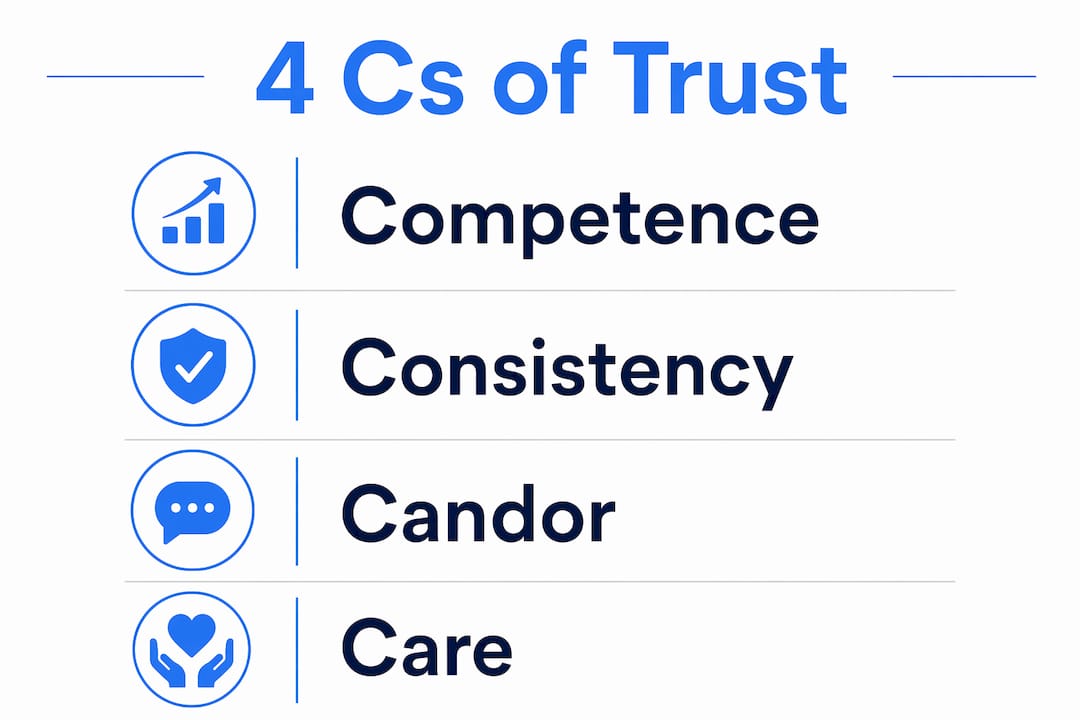
The 4 Cs of trust give you a practical framework to audit your communication at every stage: competence (you know what you’re doing), consistency (you show up the same way every time), candor (you tell the truth, including the uncomfortable parts), and care (you prioritize the seller’s outcome, not just your own). When any one of these breaks down, trust follows.
Timing and organization of information matter as much as the content itself. Sellers don’t need everything at once. They need the right information at the right moment. Early in the conversation, focus on understanding their situation. Mid-conversation, present your offer with supporting data. At the close, confirm next steps clearly and set a specific follow-up time.
| Seller Concern | Communication Tactic |
|---|---|
| “Will this actually close?” | Share proof of funds and a named title company reference |
| “Is your timeline realistic?” | Undersell by a week; explain what could cause a delay |
| “Do you understand my situation?” | Reflect their stated priorities back before presenting your offer |
| “What happens after I sign?” | Walk through each step of the closing process proactively |
| “Can I trust your numbers?” | Show comparable sales data, not just your offer price |
Underselling timelines is one of the most underused trust tactics in real estate sales. Realistic closing timelines set expectations sellers can rely on. If you say six weeks and close in four, you’ve exceeded expectations. If you say four weeks and it takes six, you’ve damaged the relationship before the seller has seen any value.
Pro Tip: Match your affective communication to the seller’s emotional state. A seller in foreclosure needs empathy before data. A seller in probate needs clarity before urgency. Read the room, then adjust your approach. Cognitive trust alone won’t move a seller who doesn’t feel heard.
For distressed sellers specifically, the sequence matters: empathy first, competence second, urgency never. Sellers facing distressed situations are already in a high-stress state. Pushing too hard, too fast, triggers the exact fear response that shuts down trust.
Key Takeaways
Building seller trust requires consistent proof of competence, honest communication, and genuine focus on the seller’s needs at every stage of the sales process.
| Point | Details |
|---|---|
| Prepare with specifics | Proof of funds, accurate comps, and a clear buy box build credibility before the first question. |
| Undersell timelines | Promise conservatively and close early; exceeding expectations compounds trust faster than any pitch. |
| Cognitive plus affective trust | Data and credentials open the door; emotional safety and empathy close the deal. |
| Saying no builds credibility | Willingness to walk away from a bad fit signals independence and integrity, not weakness. |
| Trust breaks fast | A single broken promise can undo weeks of consistent positive interactions. |
FAQ
How do you build trust when selling to a distressed homeowner?
Lead with empathy and discovery before presenting any offer. Ask what matters most to the seller, reflect their priorities back, and present proof of funds and a realistic timeline before they have to ask.
What are the 4 Cs of trust in sales?
The 4 Cs are competence, consistency, candor, and care. Together they cover both cognitive trust (what you know and deliver) and affective trust (how the seller feels working with you).
What is the difference between cognitive and affective trust?
Cognitive trust is built on data, credentials, and reliability. Affective trust is built on emotional safety and feeling genuinely understood. Both are required for a seller to commit long-term.
Why does saying no build seller trust?
Willingness to say no signals that you’re not desperate, which makes every yes you give more credible. Sellers trust someone who can walk away from a bad deal over someone who pushes every transaction forward regardless of fit.
How do you recover from a trust breach with a seller?
Acknowledge the failure directly and without excuses, then rebuild through a sustained pattern of small, kept promises. Trust breaks quickly but repairs slowly, through consistent positive interactions over time, not a single apology.
Stop Winging It. Start Drilling.
Every trust-building principle in this guide comes down to one thing: practice. Knowing what to say is different from being able to say it under pressure, when a seller is skeptical, emotional, or pushing back hard.

ClosersLeague gives real estate investors and wholesalers an AI-powered environment to practice exactly these conversations before they happen live. Work through inherited property cold calling scenarios where trust is fragile from the first word, get scored on your discovery questions, your empathy, and your ability to set realistic expectations. Stop losing deals to sellers who didn’t trust you. Build the reps that make trust your default.
Start training on ClosersLeague and turn these principles into instinct.