
You’ve found the motivated seller, locked in a great price, and shaken hands on a deal. Then it falls apart at the finish line. Sound familiar? Closing deals with distressed sellers, whether they’re facing foreclosure, going through a divorce, or dealing with an inherited property, is a completely different skill set than standard real estate transactions. The pressure is real, the timelines are tight, and the emotional stakes are high on both sides. This guide walks you through every step of the process, from preparation to closing table, so you stop leaving money behind.
Table of Contents
- Get prepared: What you need before you close
- Step-by-step: The closing process for wholesalers
- Choosing your closing method: Assignment vs double close
- Troubleshooting: Common reasons deals fall through (and how to prevent them)
- A seasoned investor’s take: What really closes deals (and what doesn’t)
- Level up your closing skills with ClosersLeague
- Frequently asked questions
Key Takeaways
| Point | Details |
|---|---|
| Know your seller | Distressed and motivated sellers require a transparent, fast approach for results. |
| Choose the right method | Assignment offers speed; double close offers privacy and higher profits. |
| Build your buyer list | Solid cash buyer contacts are essential to closing quickly and reliably. |
| Prevent common pitfalls | Mitigate deal failures with buffers, strong communication, and pre-vetted buyers. |
Get prepared: What you need before you close
Preparation isn’t glamorous, but it’s where most deals are won or lost before they ever reach the closing table. If you walk into a negotiation without the right tools in place, you’re setting yourself up to scramble at the worst possible moment.
Know your seller types first. Motivated distressed sellers include people in pre-foreclosure, inherited property situations, divorce proceedings, and burned-out landlords. These sellers typically accept contracts at 60 to 70% of after-repair value (ARV) minus estimated repairs. That spread is your profit margin, so understanding the seller’s situation shapes every offer you make.
Here’s a quick breakdown of common distressed seller types and what drives them:
| Seller type | Primary motivation | Typical timeline |
|---|---|---|
| Pre-foreclosure | Avoid credit damage | 30 to 90 days |
| Divorce | Quick resolution | Varies, often urgent |
| Inherited property | Avoid maintenance burden | Flexible |
| Tired landlord | Cash out and move on | 30 to 60 days |
Essential contract elements you cannot skip. Every wholesale contract needs four non-negotiable components:
- Assignment clause: Write in “buyer or assigns” to protect your right to transfer the contract
- Earnest money deposit (EMD): Keep it between $500 and $2,000 to show good faith without overcommitting
- Inspection period: Allow 10 to 14 days to conduct due diligence without penalty
- Closing timeline: Target 21 to 30 days to keep deals moving and sellers confident
Build your cash buyers list before you need it. The worst time to look for a buyer is after you’ve signed a contract. Build your list through REIA meetups, Facebook investor groups, county purchase records, and connections through local title companies. A strong buyers list means you can move fast when the deal is live, which matters enormously to distressed sellers who need certainty.
Pro Tip: Always work with investor-friendly title companies. They understand assignment contracts, double closings, and the urgency that comes with distressed situations. A traditional title company can stall or kill your deal simply from lack of experience.
Finalizing your negotiation tactics for better deals before you sit across from a stressed homeowner will give you the composure and leverage to actually close.
Step-by-step: The closing process for wholesalers
Now that you’re prepared, let’s walk through each step required to take your deal to closing, fast and effectively.
Wholesaling closing methods primarily come down to two approaches: contract assignment and double closing. Knowing when to use each is a skill in itself.
-
Locate and pre-qualify your motivated seller. Before you invest time, confirm the seller has equity, motivation, and the authority to sell. Verify ownership through county records. Assess their urgency and emotional state. This filters out deals that look good on paper but have no real exit.
-
Negotiate and secure the contract. Your offer should reflect ARV minus repairs minus your fee. Get the contract signed with your inspection period, EMD, and assignment clause locked in. Use your winning wholesale pitches to handle seller objections calmly and keep the conversation moving forward.
-
Assign or double close. Once the contract is in hand, you have two paths. See the comparison below.
| Method | Best for | Key consideration |
|---|---|---|
| Assignment | Fees under $20k, simple deals | Fee visible to both parties |
| Double close | Fees over $20k, restricted contracts | Requires transactional funding |
- Close with your cash buyer and collect your fee. Once your buyer is lined up and the title work is clear, both sides show up to close. In an assignment, one closing handles it all. In a double close, you execute two back-to-back transactions the same day.
Understanding the full wholesaler process and profits picture helps you set realistic expectations and protect your margin at every step.
Pro Tip: Use assignment for fees under $20k. Move to a double close when privacy matters, your fee is larger, or the contract restricts assignment. Don’t let ego or habit push you toward the wrong method.
Choosing your closing method: Assignment vs double close
With the main closing pathways outlined, it’s vital to decide which method fits your deal and your risk tolerance.
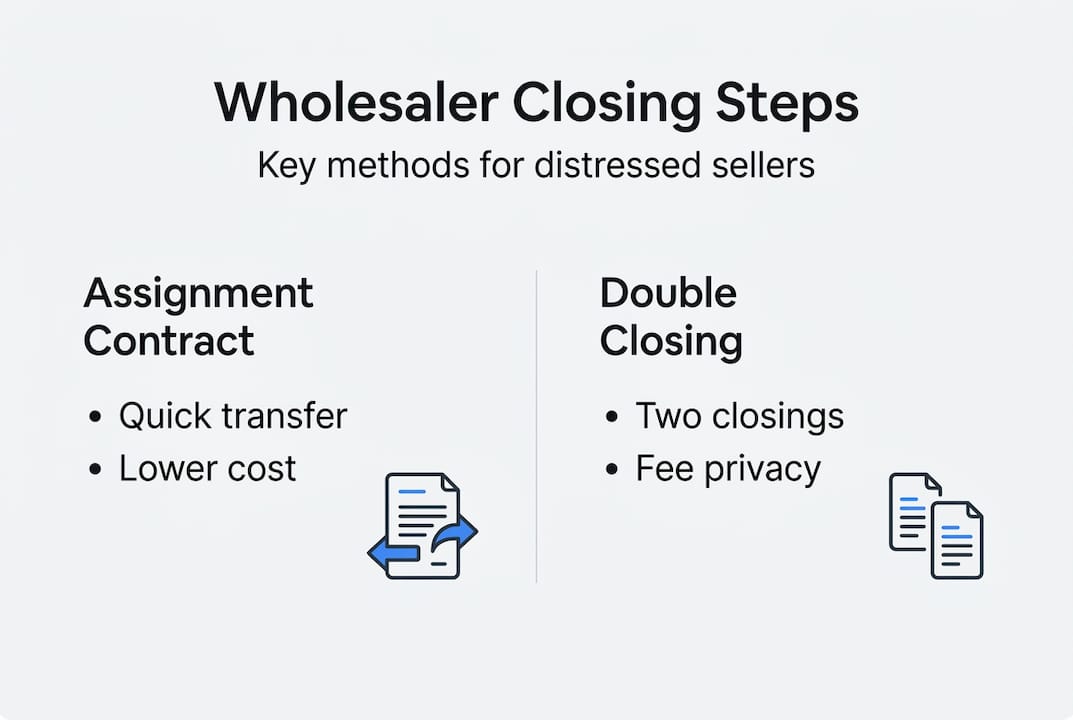
Assignment of contract is the faster, cheaper option. You transfer your purchase rights to the end buyer for a fee. The downside? Assignment is simpler but fee-visible, meaning the seller and buyer can both see what you’re making. For some sellers, that transparency is fine. For others, it creates friction.

Double closing involves two separate transactions. You buy from the seller, then immediately resell to your end buyer. It costs an extra $2,000 to $5,000 in transactional funding and closing fees, but it keeps your profit completely private. Double closing is preferred for larger fees over $20k or when the original contract prohibits assignments.
Here’s a side-by-side breakdown:
| Factor | Assignment | Double close |
|---|---|---|
| Speed | Fast, one closing | Slower, two closings |
| Cost | Low, minimal fees | $2k to $5k extra |
| Fee visibility | Visible to all parties | Private |
| Best scenario | Simple deals, small fees | Large fees, restricted contracts |
Practical risks worth knowing:
- Some lenders restrict assignment contracts on REO or bank-owned properties
- State laws vary on assignment disclosures, so verify your local rules
- Not every title company handles double closings, so ask upfront
- Transactional lenders (also called flash funders) are needed for same-day double closes
The method you choose isn’t just a financial decision. It’s a relationship decision. Picking the right approach for your specific seller situation builds trust and makes future deals more likely.
If you’re unsure about industry terms for investors like transactional funding or EMD, get clear on those before your next call. And build your follow-up strategies early so sellers don’t go cold between contract signing and close.
Troubleshooting: Common reasons deals fall through (and how to prevent them)
Even with the right strategy, deals can fall apart. Let’s prevent that with proven troubleshooting tips.
The numbers are sobering. Buyer financing accounts for 22% of failed deals, while appraisal and inspection issues cause 25% of closings to collapse. That’s nearly half of all deal failures coming from two very preventable problems.
Top deal killers and how to neutralize them:
- Financing fall-through: Only work with pre-approved cash buyers or verified proof of funds. No pre-approval, no contract assignment
- Inspection surprises: Walk the property yourself before locking in your price. Build repair buffers into your offer so unexpected findings don’t blow up the deal
- Communication breakdowns: Keep all parties updated every two to three days, even when there’s no news. Silence kills confidence
- Missed deadlines: Track every contract date in your calendar with 48-hour advance alerts. Extensions are easier to get when you ask early
- Title issues: Order title work immediately after contract signing, not the week before closing
Special note for foreclosure deals. Short sales add complexity because the lender, not the homeowner, must approve the sale. Short sales require a hardship letter, financial documentation, and lender approval, which can extend your timeline significantly. Factor that into your closing window and communicate it clearly to your buyer.
Pro Tip: Always have two or three backup buyers ready. If your primary buyer backs out, a backup list turns a disaster into a minor delay. Your proven investor script workflow should include language for managing seller expectations during delays so anxiety doesn’t push them to cancel.
A seasoned investor’s take: What really closes deals (and what doesn’t)
Here’s the straight talk from someone who’s worked through dozens of closings with distressed sellers. Most guides tell you to master your script and nail your numbers. That’s not wrong, but it’s incomplete.
The investors who close consistently aren’t the slickest talkers. They’re the most transparent. Telling a seller upfront that you’re a wholesaler and that you make a fee for connecting them with a cash buyer sounds risky. In practice, it eliminates the skepticism that kills deals later. Sellers who feel deceived slow things down or walk. Sellers who feel respected move forward.
Scripts are a starting point, not a crutch. Real closing happens when you adapt in real time, respond to what the seller is actually saying, and pivot when the conversation shifts. The investors who practice pitching for wholesale deals consistently outperform those who wing it, because practice builds genuine flexibility, not just memorized lines.
The biggest long-term profit doesn’t come from squeezing every dollar from one transaction. It comes from the seller who calls you six months later with another property because you treated them fairly. One relationship built on honesty can generate more revenue than ten one-time deals built on pressure.
Level up your closing skills with ClosersLeague
If you want a proven environment to practice these skills without real risk, here’s your next step.
Knowing the steps is one thing. Executing them under pressure with a distressed seller on the line is another. ClosersLeague is an AI-powered real estate cold calling practice platform built specifically for investors and wholesalers. You can practice live closing scenarios with motivated seller simulations before your next real call.

We offer dedicated pre-foreclosure cold calling practice modules so you’re never caught off guard by an emotional seller or a complex situation. Whether you’re new to wholesaling or want to sharpen your edge, ClosersLeague gives you the reps you need to close with confidence. Stop winging it. Start drilling.
Frequently asked questions
What’s the fastest way to close a wholesale real estate deal?
Assignment of contract is typically the fastest method because it requires only one closing and minimal extra costs, making it ideal for straightforward deals with smaller fees.
How do you build a strong cash buyers list?
Attend REIA meetups, network in Facebook investor groups, pull county purchase records, and build relationships with local title companies who see active buyers regularly.
What is a double closing and when should I use it?
A double closing splits your deal into two back-to-back transactions to keep your fee private. Use it when your profit exceeds $20k or when the seller’s contract prohibits assignment.
What’s the biggest reason deals with distressed sellers fall apart?
Financing issues at 22% and inspection surprises at 25% are the top two deal killers. Pre-screen your buyers and walk properties early to prevent both.
How can I keep my assignment fee private from the seller?
A double close keeps your profit hidden from both the original seller and the end buyer by executing two separate purchase transactions.
Recommended
- Master Real Estate Negotiation Tactics for Better Deals – ClosersLeague Blog
- Real Estate Cold Calling Practice — AI Roleplay for Every Seller Type | ClosersLeague
- Boost Real Estate Deals with a Proven Investor Script Workflow – ClosersLeague Blog
- 10 proven cold calling tips for real estate investors – ClosersLeague Blog