
You’re on a call with a motivated seller and they ask, “So what’s your ARV on this?” You freeze. That one moment of hesitation can cost you the deal. Real estate investors and wholesalers who stumble over core industry terms lose credibility fast, and credibility is currency in this business. The good news? You don’t need a finance degree to speak the language. You need a focused, practical breakdown of the terms that actually come up in deals. This guide gives you exactly that: clear definitions, real formulas, and context for how to use each term with confidence on your next call or negotiation.
Table of Contents
- Why industry terms matter for investors and wholesalers
- Core industry terms every real estate investor should know
- Deal evaluation terms: The 70% rule, MAO, and negotiating leverage
- Contract, assignment, and closing terms for wholesalers
- The uncomfortable truth about real estate jargon: Words can make or break deals
- Put your industry knowledge into action with ClosersLeague
- Frequently asked questions
Key Takeaways
| Point | Details |
|---|---|
| Speak like a pro | Understanding industry terms sharpens your credibility and builds trust with sellers. |
| Crunch numbers fast | Core formulas like ARV and MAO let you analyze deals and make confident offers. |
| Close with confidence | Mastering contract terms and assignment strategies helps you negotiate and complete more deals. |
| Apply with practice | Use roleplay and real scenarios to turn vocabulary knowledge into action that wins deals. |
Why industry terms matter for investors and wholesalers
Every profession has its language, and real estate investing is no different. When you understand the wholesaler process, you quickly realize that the vocabulary you use shapes how sellers, buyers, and agents perceive you. One misused term can make you sound like an amateur. One well-placed definition can earn instant trust.
Think about what happens when you walk into a seller conversation cold. The seller has likely spoken to other investors. They’re evaluating whether you know your stuff. If you stumble over terms like ARV (After Repair Value), MAO (Maximum Allowable Offer), or EMD (Earnest Money Deposit), you signal inexperience. That’s a deal-killer.
Here’s why command of industry language is a real competitive advantage:
- Credibility: Sellers and buyers take you more seriously when you speak fluently about deal mechanics.
- Clarity: Precise terms reduce miscommunication and prevent costly misunderstandings in contracts.
- Speed: Knowing your numbers and vocabulary means faster negotiations and quicker closes.
- Trust: Explaining terms clearly to sellers, rather than hiding behind them, builds rapport.
One of the most common pitfalls investors fall into is either overloading sellers with jargon or avoiding terms entirely out of fear. Neither works. The sweet spot is using terms confidently and then briefly explaining them in plain English.
“The best investors I’ve coached don’t just know the terms. They know when to use them and when to translate them for the person across the table.”
For example, key real estate investing terms like ARV are essential for determining deal viability. But if you throw “ARV” at a distressed homeowner without context, you’ll lose them. Say it, then explain it. That’s the move.
Practicing these conversations through cold calling roleplay is one of the fastest ways to get comfortable using terms naturally. The goal is fluency, not recitation. You want these words to feel like second nature, not a script.
Sellers of off-market properties are especially sensitive to how investors communicate. They’re often in distress and need to feel understood, not overwhelmed.
Pro Tip: Always define terms with sellers in plain English right after you use them. It shows expertise without making them feel talked down to.
Core industry terms every real estate investor should know
Let’s decode the vocabulary that drives deals. These are the terms you’ll use on calls, in offers, and at the closing table.
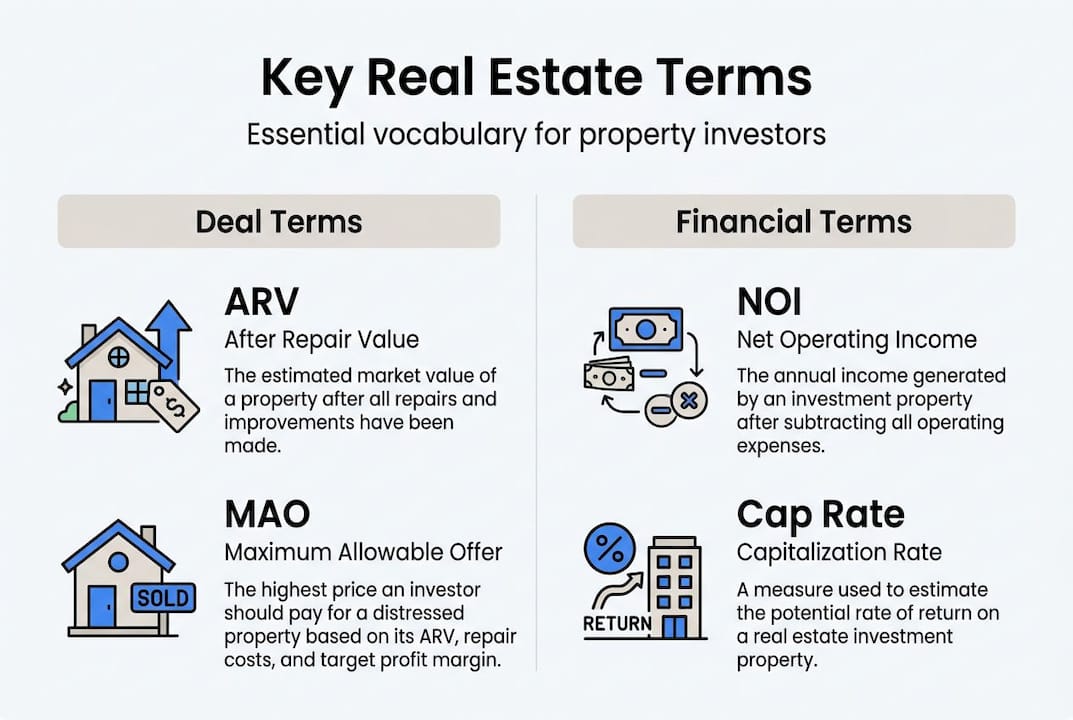
ARV (After Repair Value): The estimated market value of a property after all renovations are complete. This is your north star for every deal. The MAO formula and ARV work together to tell you exactly how much you can offer.
MAO (Maximum Allowable Offer): The highest price you can pay and still make a profit. Formula: (ARV × 0.70) minus repair costs minus your wholesale fee.

EMD (Earnest Money Deposit): A good-faith deposit you put down when signing a purchase contract. Typically ranges from $500 to $5,000 in wholesaling.
NOI (Net Operating Income): Annual rental income minus operating expenses, not including mortgage payments. NOI and Cap Rate are the core metrics for evaluating cash-flow properties.
Cap Rate (Capitalization Rate): NOI divided by the property’s current market value, expressed as a percentage. A higher cap rate generally signals higher risk and higher potential return.
Here’s a quick-reference table to keep handy:
| Term | Definition | When you use it |
|---|---|---|
| ARV | Estimated value post-renovation | Setting your max offer |
| MAO | Max price you can pay profitably | Making offers to sellers |
| EMD | Good-faith deposit at contract signing | Securing deals |
| NOI | Income minus operating expenses | Evaluating rentals |
| Cap Rate | NOI divided by property value | Comparing investment properties |
These real estate metrics are used by serious investors every day. Knowing them puts you in the same conversation as experienced buyers.
For wholesalers, the most critical terms are ARV and MAO. Understanding wholesaler profits starts with getting these two right every single time. Your cash buyers will expect you to know them cold.
When you’re talking to motivated sellers, you won’t always need to use every term. Read the room. But you should always know them.
Pro Tip: Save this table as a screenshot on your phone. Before a call, do a 30-second review. It keeps your mind sharp and your confidence up.
Deal evaluation terms: The 70% rule, MAO, and negotiating leverage
Knowing the terms is step one. Knowing how to run the numbers in real time is what separates closers from tire-kickers.
The 70% rule is the foundation of fast deal analysis. It states that you should pay no more than 70% of a property’s ARV minus repair costs. That 30% margin covers your profit, holding costs, and unexpected expenses. The 70% rule and MAO together form the risk buffer that keeps your deals profitable even when things go sideways.
Here’s a step-by-step sample calculation:
- Estimate ARV: Comparable homes in the area sell for $200,000 after renovation.
- Apply 70% rule: $200,000 × 0.70 = $140,000.
- Subtract repair costs: Estimated repairs are $30,000. $140,000 minus $30,000 = $110,000.
- Subtract wholesale fee: Your fee is $10,000. $110,000 minus $10,000 = $100,000.
- Your MAO: $100,000. That’s the most you can offer the seller.
Here’s how those numbers look in a simple table:
| Step | Amount |
|---|---|
| ARV | $200,000 |
| × 70% | $140,000 |
| Minus repairs | $110,000 |
| Minus wholesale fee | $100,000 |
| MAO | $100,000 |
Wholesale fees typically range from $5,000 to $30,000 depending on the deal size and your market. Don’t be shy about your fee. It’s built into the math for a reason.
The deal analysis process becomes second nature once you’ve run these numbers enough times. Speed matters. The faster you can evaluate a deal on a call, the more confident you sound.
When you’re talking to sellers, you don’t need to walk them through every step. But knowing your MAO cold means you can negotiate from a position of strength. You know your floor. That’s leverage.
Pro Tip: In hot markets, experienced investors sometimes adjust to a 75% or even 80% rule. Know your local competition before tightening your margins. Always protect your profit first.
Practice running these numbers before your calls. Use the opening line with sellers to get the conversation started, then move into deal analysis naturally.
Contract, assignment, and closing terms for wholesalers
Once you know your max offer, the next step is locking up the deal. That means understanding the contract terms that govern how you buy, assign, or close.
Here are the core contract types and terms you need to know:
- Purchase contract: A standard agreement between you and the seller to buy the property at a set price and terms. This is always the first document you sign.
- Assignment contract: A separate agreement that transfers your rights under the purchase contract to a cash buyer for a fee. This is how most wholesalers get paid.
- Double close: You actually buy the property and then immediately resell it to your end buyer. More complex and costly, but it hides your fee from both parties.
- “And/or assigns” clause: Language in the purchase contract that gives you the right to assign the deal. Without this, you can’t wholesale the property legally.
- EMD (Earnest Money Deposit): Typically $500 to $2,000 in wholesaling. It’s refundable during the inspection period if you back out for a covered reason.
The assignment contract process is preferred by most wholesalers because it’s faster, cheaper, and simpler than a double close. You never actually take title to the property. You just sell your contractual right to buy it.
“Assignable contracts are the engine of wholesaling. They let you move fast, keep costs low, and collect your fee without ever owning the property.”
Double closes make sense when your buyer doesn’t want to see your assignment fee, or when the deal structure requires it. But they come with added closing costs and complexity.
Understanding wholesaler contracts thoroughly protects you legally and financially. Always work with a real estate attorney familiar with wholesaling in your state.
For sellers in distress, such as those facing pre-foreclosure, the contract process can feel overwhelming. Your job is to make it simple and clear. Walk them through each step without drowning them in terms.
The uncomfortable truth about real estate jargon: Words can make or break deals
Here’s something most training programs won’t tell you: knowing every term in this article is not enough. In fact, investors who lead with jargon often lose deals that less technical investors close.
Why? Because sellers, especially distressed homeowners facing foreclosure, probate, or divorce, are not impressed by vocabulary. They’re scared, overwhelmed, and looking for someone they can trust. When you drop “MAO” and “cap rate” without explanation, you can come across as cold and transactional.
The best closers we’ve seen do something different. They use industry terms internally to make sharp decisions, but they translate everything into plain English for the seller. They say “the most I can offer” instead of “my MAO.” They say “what the house would be worth fixed up” instead of “ARV.”
This is the real skill. It’s not just vocabulary. It’s code-switching between investor language and human language depending on who you’re talking to.
Knowing the motivated sellers opening line is a start, but reading the room on every call is what builds the trust that closes deals. Terms give you a framework. Empathy gives you the deal.
The investors who win long-term are the ones who master both sides of the language equation.
Put your industry knowledge into action with ClosersLeague
You now have the vocabulary, the formulas, and the frameworks. The next step is putting them to work in real conversations.

ClosersLeague is an AI-powered cold calling practice platform built specifically for real estate investors and wholesalers. You can rehearse using these exact terms in simulated seller conversations, get scored on your delivery, and sharpen your scripts before you ever dial a real lead. Whether you’re working pre-foreclosure lists, probate leads, or code violation calling, our roleplay tools help you build the kind of confident, fluent communication that closes deals. Stop winging it. Start drilling. Your next deal depends on how well you show up on that call.
Frequently asked questions
What does ARV mean in real estate investing?
ARV stands for After Repair Value, which is the estimated value post-repairs of a property once all renovations are complete. It’s the starting point for every deal analysis and offer calculation.
How is MAO calculated?
MAO is calculated using the formula: ARV × 70% minus repair costs minus your wholesale fee. It tells you the maximum you can pay a seller and still profit.
What is an assignment contract?
An assignment contract transfers your purchase rights under a purchase agreement to a cash buyer in exchange for an assignment fee, without you ever taking title to the property.
Why is the 70% rule important to investors?
The 70% rule creates a margin that accounts for repair costs, holding costs, and profit, acting as a built-in risk buffer so investors don’t overpay on deals.
What does EMD stand for in real estate wholesaling?
EMD means Earnest Money Deposit, a good-faith deposit made when signing a purchase contract to show the seller you’re serious about closing the deal.
Recommended
- Master Real Estate Lead Generation: Cold Calling Basics – ClosersLeague Blog
- AI Cold Calling Practice for Real Estate Investors & Wholesalers | ClosersLeague
- Cold Calling Tips & Real Estate Wholesaling Blog — ClosersLeague
- The Exact Opening Line to Keep Motivated Sellers Talking — ClosersLeague
- Understanding Off-Market Properties: A Guide to Success – Living on the Côte d’Azur