The fastest way to fix language barrier cold calling is a short, memorized script paired with three or four repair phrases, daily rehearsal out loud, and live transcription used as a backup, not a crutch. Do these three things on your next call: shorten your opening to one sentence, pause after every question to let the answer land, and use one repair line the moment you sense confusion instead of over-apologizing.
TL;DR:
- Using short, memorized scripts and a small set of repair phrases consistently improves comprehension and reduces hesitation during language barrier cold calls.
- Rehearsing key phrases daily, especially in realistic scenarios, helps callers deliver responses automatically under pressure, reducing cognitive load.
- Live transcription tools assist with understanding fast speech, but they should be combined with simple language and confirmation questions for best results.
- Recognizing cultural differences in tone, formality, and silence enhances rapport with prospects from diverse backgrounds.
- Tracking call comprehension incidents and confidence levels over time enables continuous improvement of scripts and speaking fluency.
Table of Contents
- What Is Language Barrier Cold Calling, and Why Does It Trip Up Even Skilled Callers?
- Pre-Call Preparation: Build Your Script and Phrase Bank Before You Dial
- During the Call: Pace, Pause, Paraphrase, and Repair
- Tools That Actually Help (and Where They Fall Short)
- When to Bring in Bilingual Reps or Interpreters
- Build a Practice Routine That Sticks
- Ready-to-Use Phrases for Common Call Moments
- Cultural Sensitivity Matters as Much as Vocabulary
- Where Language Barrier Calls Usually Go Wrong
- Building Rapport When You Don’t Share a First Language
- Measuring Whether Your Approach Is Actually Working
- Why Rehearsal Beats Talent Every Time
- Practice the Exact Calls That Trip You Up
- Sources
- FAQ
What Is Language Barrier Cold Calling, and Why Does It Trip Up Even Skilled Callers?
Language barrier cold calling refers to outbound sales calls where the caller, the prospect, or both struggle to fully understand each other because of accent, vocabulary gaps, idiom, or processing speed. It’s a subset of the broader challenge sales teams call “cross-cultural communication,” and it shows up constantly in real estate cold calling, where you’re often reaching homeowners from different backgrounds about sensitive topics like probate, foreclosure, or divorce.
Cold calling is hard enough without a language gap. You get one shot to earn eight seconds of attention, and any hesitation reads as unpreparedness. Add a language barrier and the caller now has to translate meaning in real time, choose words carefully, and manage tone, all while the prospect on the other end may already be primed to hang up on a stranger. That’s not a vocabulary problem. It’s a cognitive load problem, and the fix looks a lot more like athletic training rather than grammar homework.
Business leaders increasingly recognize the stakes. Roughly 72% of business leaders view language barriers as a real impediment to growth, which tells you this isn’t a niche annoyance limited to a few callers. It’s a structural issue in outbound sales, and it responds well to structure.
Pre-Call Preparation: Build Your Script and Phrase Bank Before You Dial
Every second you spend improvising mid-call is a second the prospect uses to decide you’re not worth their time. The fix starts before you pick up the phone.
- Research the prospect and pick one value line. Know the property situation (pre-foreclosure, inherited, tax delinquent, whatever applies) and write one sentence that states why you’re calling. Skip the rest.
- Write three openings that fit in 30 to 45 seconds. Test them out loud with a timer. If you stumble on a word, replace it. Complicated vocabulary is not more persuasive, it’s just riskier.
- Build a small phrase bank you can reuse every call. Include confirmation lines (“So the property is at 4th Street, is that right?”), paraphrase starters (“What I’m hearing is…”), buy-time lines (“Give me one second”), and repair phrases for when you lose the thread.
- Rehearse under mild pressure. Set a timer, record yourself, or run a scripted roleplay with a partner who interrupts you. Selling in a second language adds real cognitive load, and the only proven way to reduce it is repetition until the response is automatic, not composed on the fly.
Pro Tip: Keep your opening under 20 words. If you need a breath to finish the sentence, it’s too long for a first impression.
Cultural adaptation matters here too. Simplified, direct phrasing tends to translate better across backgrounds than idiom-heavy scripts, and it’s one reason cultural adaptation strategies consistently outperform generic scripts in international telemarketing.
During the Call: Pace, Pause, Paraphrase, and Repair
Preparation gets you to the call. What happens in the next 90 seconds decides whether you keep it going.
Slow down your rate of speech, but don’t stretch every word. Use plain subject-verb-object sentences instead of stacked clauses. “I’m calling about your property on Elm Street” beats “I wanted to reach out because I came across some information suggesting that you might be the owner of a property that could potentially be of interest to us.” One of those sentences a distracted homeowner can follow. The other loses them by word twelve.
The single most useful live technique is pause, paraphrase, respond. Ask a short question, stop talking, and let the answer arrive without filling the silence. Then paraphrase what you heard before responding, which confirms understanding on both sides and buys you a second to plan your next line.
When you make a mistake or lose a word, own it fast:
- “Let me say that a different way.”
- “English is my second language, give me a second to rephrase.”
- “I want to make sure I say this clearly. One moment.”
None of these apologize excessively, and all of them keep momentum. Over-apologizing signals weakness; a brief, direct acknowledgment signals control.
If the prospect uses slang or speaks fast, redirect gently: “Can you say that again, a little slower?” or “Just to confirm, do you mean…?” works far better than pretending you followed along.

Pro Tip: Keep two fallback lines memorized for total comprehension breakdowns: “Let me get that exactly right, can you repeat the last part?” and “I want to be precise here, one more time please.” Both sound competent, not confused.
Tools That Actually Help (and Where They Fall Short)
Technology closes some of the gap, but it doesn’t close all of it. Know which tool does which job.
- Live captions and in-call subtitles on platforms like Zoom or Google Meet help you follow fast speech in real time, particularly useful on video-based intake calls.
- Post-call transcription tools such as Otter let you review exactly what was said, spot where comprehension broke down, and rewrite your script around those failure points, a tactic sales reps swap regularly in community forums.
- AI call summarizers turn a messy 12-minute conversation into three clean bullet points for your CRM notes, which matters when you’re juggling dozens of leads a day.
- Auto-translation apps can help with comprehension in a pinch, but they routinely flatten tone, miss idiom, and strip out the warmth that builds trust.
Live captioning and translation tools cut down on comprehension friction meaningfully, but they were never built to replace human clarification. Combine them with simple language and direct confirmation questions instead of leaning on them as your entire strategy.
One legal note before you record anything: U.S. call recording law varies by state, some require consent from only one party, others require both. Ask permission naturally, something like “Do you mind if I take some notes as we talk?” works and keeps you compliant without sounding like a disclaimer.
When to Bring in Bilingual Reps or Interpreters
Adapting your own scripts only goes so far. At some point, the math favors adding bilingual capacity instead.
Watch for these triggers:
- You’re getting the same non-English-speaking prospect type repeatedly, not as a one-off.
- Your conversion rate on those specific calls sits well below your average.
- Compliance or documentation requirements make miscommunication a real liability, not just an inconvenience.
Your options scale with need. A bilingual voicemail or IVR greeting handles low volume cheaply. On-demand interpreter services work for occasional high-stakes calls. A dedicated bilingual hire makes sense once volume justifies a salary.
Onboarding a bilingual rep fast means giving them the same phrase bank and scripts you built for yourself, then running two or three roleplays before their first live call. Check their calls against a simple scorecard for the first week. The red flag to watch for: a rep who’s fluent conversationally but hasn’t practiced the specific distressed-seller vocabulary (probate, lien, tax delinquent) that your calls actually require.
Build a Practice Routine That Sticks
Fluency under pressure comes from repetition, not from reading a script once and hoping. Structure this like a training program.
- Run daily short drills. Ten to twenty spoken repetitions of your opening and top three objection responses, out loud, every day.
- Record, review, iterate. Listen back for hesitation points, mispronounced words, and moments you slowed down unnaturally. Fix the script, then re-record.
- Rotate roleplay formats. Practice with a peer, a coach, or AI roleplay tools built around real seller scenarios, each format exposes different gaps.
- Track two numbers: comprehension breakdowns per call and your own confidence rating after each session. Fold anything that trips you up back into your phrase bank.
Sales communication training built for international teams consistently points to the same conclusion: rehearsing key phrases out loud until they’re automatic closes the gap between what you know and what you can actually say under pressure. Reading a script silently doesn’t build that same muscle. ClosersLeague’s AI roleplay modules are built around this exact loop, scenario-specific practice with instant scoring, so you can see where language friction is costing you calls.
Pro Tip: Score your own calls out of 10 for “comprehension incidents,” moments where either side clearly misunderstood the other. If you’re above two per call, your script needs shortening, not more vocabulary.
Ready-to-Use Phrases for Common Call Moments
Keep this list next to your dialer.
- Openings: “Hi, this is [Name] calling about your property on [Street]. Do you have 60 seconds?”
- Clarification: “Just to confirm, you said [X], is that right?”
- Paraphrase starter: “So what I’m hearing is…”
- Buy-time line: “Good question, give me one second.”
- Repair line: “Let me rephrase that so it’s clearer.”
- Objection response: “I understand. A lot of homeowners feel that way at first.”
Cultural Sensitivity Matters as Much as Vocabulary
Language and culture travel together, and treating them as separate problems is a common mistake. A homeowner from a culture where direct questions about money feel intrusive won’t respond to your script the same way one from a more transactional background will, even if both speak English fluently.
Pay attention to formality norms. Some prospects expect a title and last name before any first-name familiarity; jumping straight to casual language can read as disrespectful rather than friendly. Pace matters too. In some cultures, silence during a call signals thoughtfulness, not disengagement, so resist the urge to fill every pause with more talking.
Directness also varies widely. A prospect who says “maybe” or “I’ll think about it” isn’t always leaving the door open, in some cultural contexts, that’s a polite way of saying no. Learning to read the actual signal instead of the literal words takes exposure, and it’s worth building into your post-call notes: what did this prospect’s hesitation actually mean?
None of this requires becoming an expert in every culture you might call. It requires slowing down, listening for tone as much as content, and adjusting your script’s formality and pacing to match what the prospect gives you. That single habit, matching rather than pushing your own default style, does more for rapport than any clever line ever will.
Where Language Barrier Calls Usually Go Wrong
Most breakdowns aren’t dramatic. They’re small, and they compound.
The most common mistake is assuming silence means confusion when it often means processing. Callers jump in to “help” a pause and end up talking over the exact moment the prospect was about to answer. A second common error is over-explaining after a misunderstanding, adding three more sentences of context when the prospect just needed the same sentence repeated slower.
Idioms cause more trouble than complex vocabulary. A phrase like “let’s circle back” or “ballpark figure” can stop a non-native speaker cold, even when they’d have understood a more technical but literal phrase without issue. Tone mismatches cause a subtler problem: a caller trying to sound warm through exaggerated enthusiasm can come across as insincere or even mocking to a prospect from a more reserved cultural background.
The final trap is treating one bad call as proof the whole approach doesn’t work. A single miscommunication, even an awkward one, rarely costs you the deal. What costs you the deal is panicking, rushing the rest of the call, and abandoning your prepared script mid-conversation. Stick to your repair phrases and keep moving.
Building Rapport When You Don’t Share a First Language
Rapport doesn’t depend on shared vocabulary as much as most callers assume. It depends on the prospect feeling heard, and you can signal that in ways that don’t require perfect grammar.
Use the prospect’s own words back to them. If they describe the property as “a mess since my mom passed,” repeat that phrasing rather than translating it into your own clinical language. It shows you were actually listening, not running a script on autopilot.
Tone of voice carries more weight than word choice in the first thirty seconds. A warm, steady pace communicates confidence even through an accent or occasional grammar slip. Rushing to prove fluency often backfires, it reads as nervous rather than competent.
Brief, honest acknowledgment of a language gap can actually build trust rather than undermine it. Saying “I want to make sure I understand you fully, can you say that again?” positions you as careful and respectful, not incapable. Prospects generally respond better to a caller who admits a gap and closes it than one who bluffs through confusion and gets details wrong.
Measuring Whether Your Approach Is Actually Working
You can’t improve what you don’t track, and language friction is easy to feel but hard to quantify without a system.
Track comprehension breakdowns per call, moments where you had to repeat, rephrase, or ask “can you say that again.” A dropping trend over a few weeks is real progress. Track call duration relative to your average; calls that run unusually short may indicate the prospect disengaged early due to confusion, not disinterest.
Conversion rate by call type matters more than overall conversion. If your rate on calls involving a language gap sits meaningfully below your baseline, that’s your clearest signal something in the script or delivery needs adjustment. Post-call transcription, reviewed weekly, lets you spot the exact sentence or phrase that consistently causes hesitation on the prospect’s end, then you rewrite around it.
Self-rated confidence after each call is a softer metric, but it correlates strongly with performance over time. If your confidence score climbs while comprehension incidents drop, your rehearsal routine is working.
Why Rehearsal Beats Talent Every Time
Most advice on this topic treats language barriers as a fixed trait, something you either have or don’t. That framing is wrong, and it’s a big reason so many capable callers stay stuck. Fluency under sales pressure is a trained skill, not an inherited one. The callers who improve fastest aren’t the ones who study more grammar, they’re the ones who repeat the same fifteen phrases out loud until the words stop requiring thought.
ClosersLeague was built around that exact principle: scenario-based voice practice against realistic seller psychology, scored instantly, drilled repeatedly. The gap between a caller who “knows” a script and one who can deliver it fluently under real pressure only closes through repetition, and that gap is where most deals are lost or won.
— Dave
Practice the Exact Calls That Trip You Up
Generic sales training and roleplay with a coworker can’t consistently recreate the pressure of a real seller conversation, and they definitely can’t score you objectively on it. ClosersLeague built its platform specifically to close that gap: AI roleplay across nine distressed seller types, from probate to tax delinquent to divorce, with instant scorecards that show exactly where language friction or hesitation is costing you the call.
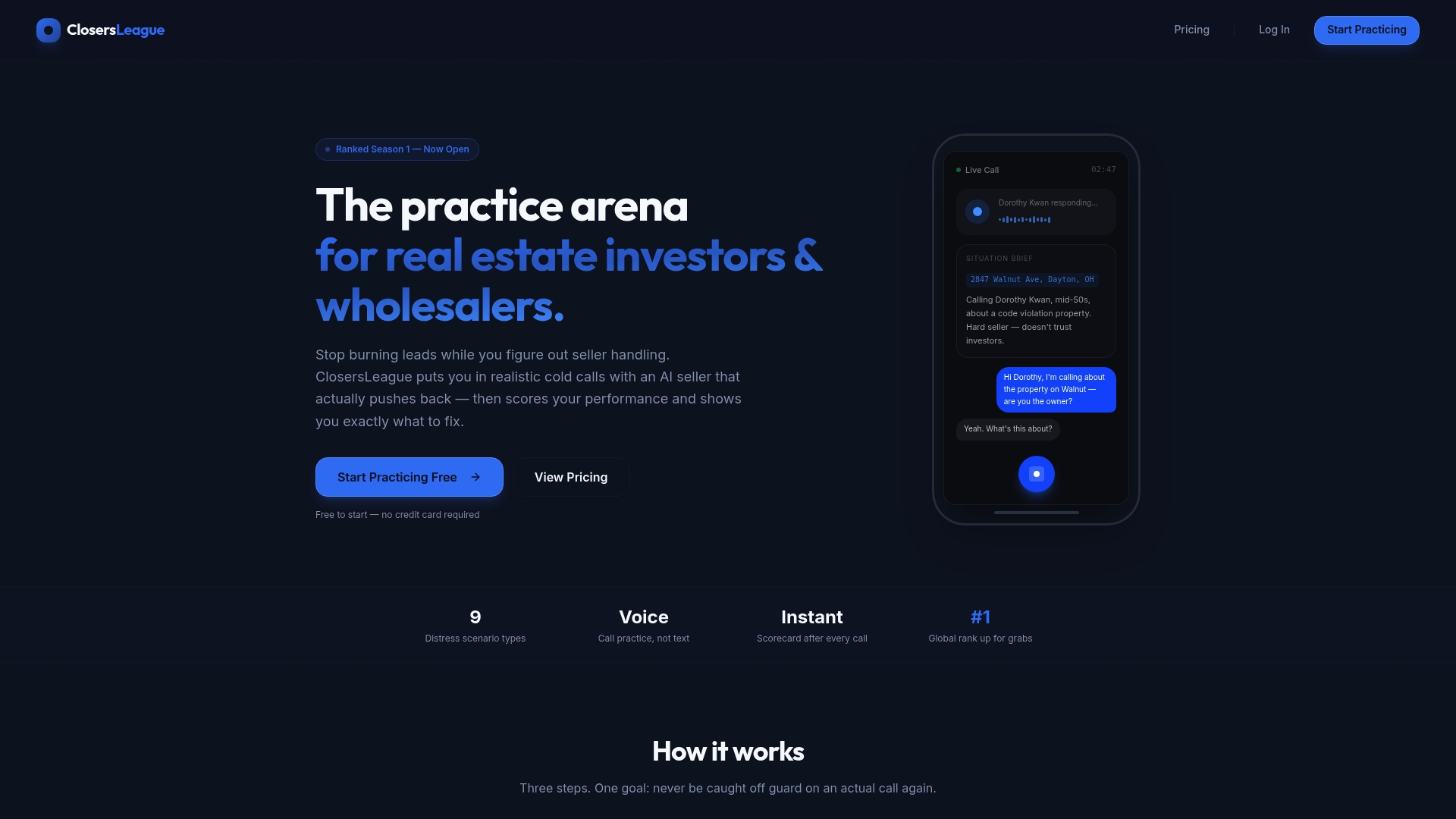
If a script feels shaky the moment a real homeowner starts talking fast or off-script, that’s a rehearsal gap, not a talent gap. Start with the Starter plan and run a few scenario drills built around the seller types you call most, including inherited property conversations, where hesitation shows up fastest. Score your first session, then run it again tomorrow and watch the number move.
Sources
- Overcome Language Barriers at Work: 8 Proven Strategies
- Cultural Adaptation Strategies for Successful International B2B Telemarketing – B2B Appointment Setting
- Dealing with Language Barriers : r/sales
FAQ
What Is an Example of a Language Barrier in Cold Calling?
A common example is a caller mispronouncing a street name or a prospect’s own name, which triggers immediate distrust even when the rest of the pitch is solid. Idioms like “ballpark figure” or “circle back” also frequently stall comprehension for non-native speakers on either end of the call.
Why Is Cold Calling So Difficult With a Language Barrier?
Cold calling already demands quick thinking under rejection pressure, and a language gap adds real-time translation and word selection on top of that. This raises cognitive load significantly, which is why structured rehearsal that makes responses automatic matters more than vocabulary size.
How Do You Overcome Language Barriers on Sales Calls?
Short, rehearsed scripts, a small set of repair and paraphrase phrases, and consistent pause-and-confirm habits solve most comprehension issues. Live captioning or post-call transcription tools add a useful safety net, but they work best alongside human clarification, not instead of it.
What Are Language Barriers in Communication?
Language barriers are any obstacle, accent, vocabulary gap, idiom, pace, or cultural framing, that prevents two people from fully understanding each other’s intended meaning. In cold calling specifically, they show up as misheard details, misread tone, or a prospect disengaging because the pace or phrasing felt inaccessible.
Does ClosersLeague Help With Language Barrier Cold Calling Specifically?
ClosersLeague’s AI roleplay drills let callers rehearse real distressed-seller conversations repeatedly with instant scorecards, which directly targets the confidence-competence gap that language barriers create. Current pricing details are available on ClosersLeague’s pricing page.