
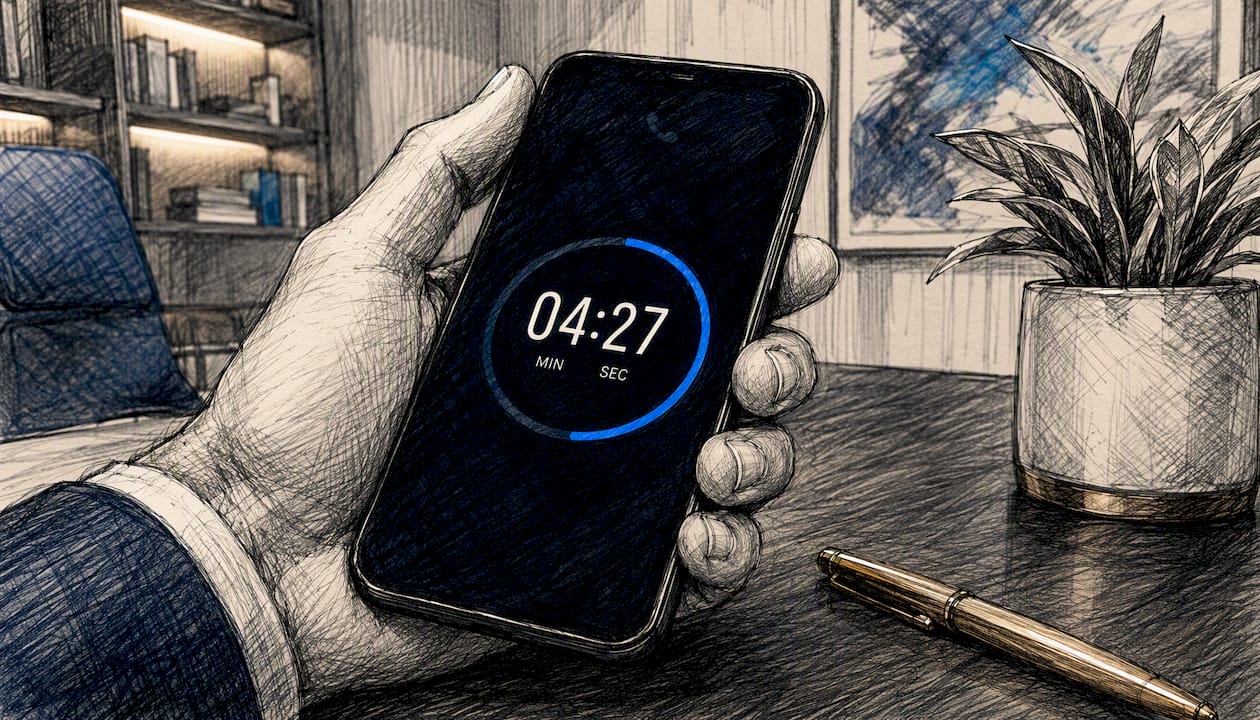
Keep your first outbound call to a distressed homeowner at 3–5 minutes. That window is enough to introduce yourself, confirm the seller’s situation, qualify the lead, and book a next step. It is not enough time to negotiate. That distinction matters for every call you make.
A few situations justify going shorter or longer:
- Shorter (under 2 minutes): Seller is hostile, clearly not the owner, or asks you to call back. End politely and log the follow-up.
- Longer (up to 8 minutes): Seller volunteers an urgent event unprompted, such as a foreclosure date within 30 days, an estate with multiple heirs, or an immediate relocation; let them talk.
- Language barrier: Add 1–2 minutes for clarification. Never rush a seller who is working through a second language.
Voicemail: Keep it to 15–20 seconds. State your name, that you are a local investor interested in their property, and one callback number. Example: “Hi, this is [Name] with [Company]. I’m a local investor and I’d love to learn more about your property on [Street]. Call me back at [Number].” Always send a follow-up text within 5 minutes of leaving a voicemail.
Key Takeaways
| Point | Details |
|---|---|
| Target call duration | Keep initial outbound calls to 3–5 minutes: opener, situation questions, qualification, and close. |
| Seller talk-time | Experienced callers speak less than 30% of the time; open-ended questions drive seller disclosure. |
| Voicemail length | Leave a 15–20 second message with your name, property reference, and one callback number. |
| When to extend | Only extend past 5 minutes when the seller volunteers a clear urgency signal unprompted. |
| ClosersLeague practice | AI roleplay with timed drills and scorecards helps you internalize the 3–5 minute structure across every distressed seller type. |
Table of Contents
- Why call length changes outcomes with distressed sellers
- How to structure every minute of a 3–5 minute call
- When should you extend a call vs. book a follow-up?
- Pre-call and on-call tactics that keep you inside the target window
- How to practice the timing until it feels natural
- What backs these recommendations
- The 3–5 minute rule works. Here is the challenge.
- Practice your timing with ClosersLeague AI roleplay
- Sources
- FAQ
Why call length changes outcomes with distressed sellers
Short, focused calls preserve seller willingness to keep talking. Distressed homeowners, whether facing pre-foreclosure, probate, divorce, or code violations, are often skeptical and emotionally guarded. A call that drags past 7 minutes without a clear purpose signals that you are not organized, and sellers disengage.

Research on motivated seller scripts confirms the 3–5 minute structure specifically because it maps each minute to a conversion task: opener, situation questions, qualification, and close. When you run over, you are almost always filling time with negotiation that belongs in a property visit, not a cold call.
Speed matters too, as explained in Real Estate Leads Singapore: A Practical Guide for Property Agents. Responsiveness preserves seller willingness to engage far more than perfect scripting does. A seller who just listed a property or missed a payment is emotionally activated. Reaching them quickly, with a tight, confident call, captures that window.
Pro Tip: Before you dial, pull up the property address, estimated equity, and any known distress signal (tax lien, lis pendens, probate filing). Having those facts in front of you cuts dead air and keeps the call inside the target window. Good list data is your best time-management tool.
How to structure every minute of a 3–5 minute call
Here is the stage-by-stage timing plan with micro-scripts you can use today.
| Stage | Time | Goal | Sample Script |
|---|---|---|---|
| Opener | 15–20 seconds | Identify yourself, disarm skepticism | “Hi [Name], this is [Your Name]. I’m a local investor. I know you probably get a lot of calls — I’ll be quick.” |
| Situation questions | Short (under 2 minutes) | Get the seller talking about the property | “Can you tell me a little about the property? Is it currently occupied?” |
| Qualification | 3–5 minutes | Confirm motivation, timeline, title, condition | “If the price worked for you, how soon would you want to move?” |
| Close / next step | 3–5 minutes | Book a property visit or follow-up call | “I’d love to come take a quick look. Would Tuesday or Thursday work better for you?” |
Prospects form an impression in the first 7–10 seconds, so your opener carries disproportionate weight. Acknowledge that they receive repeated calls. It lowers their guard faster than any pitch.
Your qualifying questions should cover four things without turning the call into an interrogation:
- Property condition: “Is the home move-in ready, or does it need some work?”
- Timeline: “Are you in a hurry to sell, or are you flexible on timing?”
- Motivation: “What’s making you consider selling now?”
- Title and ownership: “Are you the sole owner, or are there others on the title?”
Pro Tip: Top wholesalers speak less than 30% of the time on a first call. After each question, stay quiet. Silence prompts sellers to fill the gap, and what they say next usually reveals the real motivation.
When should you extend a call vs. book a follow-up?
Extend only when the seller gives you a clear, unprompted urgency signal. These are the ones worth staying on the line for:
- Seller mentions a specific foreclosure auction date.
- Seller says they need to be out of the property within 60 days or less.
- Seller discloses a major financial event (job loss, medical bills, estate dispute).
- Seller asks you directly about your buying process or timeline.
Any one of those signals justifies 2–3 extra minutes to gather detail. None of them justify negotiating a price on call one.
Trying to close a deal on the first call almost always burns the lead. The seller hasn’t seen you, hasn’t trusted you, and hasn’t had time to process. Your job on call one is to qualify and book the visit. The deal happens at the property.
When you hit a red flag, end the call cleanly and schedule the follow-up. Red flags include:
- Hostile or dismissive tone after two attempts to engage.
- Seller cannot confirm they own the property.
- Seller is evasive about timeline and motivation after direct questions.
- Seller asks you to call back “in a few months.”
That last one is not a dead lead. Log it with a note on their timeline and trigger. Capturing the seller’s preferred contact method and best callback time during intake turns low-motivation leads into future deals when circumstances change.
Pre-call and on-call tactics that keep you inside the target window
Before you dial, confirm these five things:
- Correct owner name and spelling.
- Property address and any known distress indicator.
- Estimated equity or mortgage balance.
- Your note template is open and ready.
- Your two-option close is memorized.
On the call, set a soft agenda in your opener: “I just have a couple of quick questions.” That phrase signals brevity and reduces seller resistance. Use calibrated, open-ended questions rather than yes/no questions. “Tell me about the property” generates more useful information than “Is the property vacant?”
For closing the call, two-option closes convert without pressure:
- “Would Tuesday afternoon or Wednesday morning work better for a quick walkthrough?”
- “Would it be easier to chat again this week, or would next Monday give you more time?”
Pro Tip: Batch your calls in 90-minute blocks. Dial, leave voicemails, send follow-up texts, then review your last three calls for 5 minutes before the next block. That scheduling discipline keeps your energy consistent and your timing sharp across a full session.
How to practice the timing until it feels natural
Internalize the structure before you rely on instinct. Here is a practical routine:
Daily warm-up (10 minutes before your first dial):
- Read your opener aloud three times at a natural pace.
- Time yourself delivering the full 3–5 minute structure with a practice partner or into a voice recorder.
- Review one recorded call from the previous session and note where you talked too long.
Milestone targets:
- Calls 1–50: Use a written script. Focus on staying inside the time window, not on sounding perfect.
- Calls 51–150: Drop the script for the opener and close. Keep qualifying questions on a reference card.
- Calls 150–300: Full conversation from memory. Script becomes a fallback, not a crutch.
Scripts are training wheels. You need them for the first 300–500 calls. After that, the structure lives in your muscle memory and the script becomes a reference you rarely touch. — Coaching guidance from ClosersLeague practitioners
Reading scripts aloud before dialing, recording calls, and using call-scoring to identify high-motivation patterns are the three practices that accelerate skill development fastest. Recording is legal in most U.S. states with one-party consent, but confirm your state’s rules before you start.
Pro Tip: After each session, pick your two worst calls and your two best calls. Write one sentence about what made each one go the way it did. That 5-minute review compounds faster than any amount of additional dialing without reflection.
What backs these recommendations
The timing guidance in this article draws from several sources:
- The 3–5 minute first-call structure and seller talk-time targets come from practitioner-tested motivated seller scripting guidance.
- Cold calling benchmarks for investors, including contact rates of 10–15% and lead rates near 1–2%, set realistic expectations for volume and practice targets.
- The 7–10 second first-impression window supports the emphasis on opener psychology.
- ClosersLeague’s cold calling guides align the minute-by-minute structure to investor and wholesaler use cases specifically.
Call length varies by seller type. A pre-foreclosure call with a homeowner 10 days from auction may run longer than a cold call to a tired landlord with no urgency. The 3–5 minute rule holds for most initial outbound prospecting calls. Adjust at the margins based on the signals the seller gives you, not on your own comfort with silence.
The 3–5 minute rule works. Here is the challenge.
Most investors know the call should be short. Few actually time themselves. They drift past 6 minutes because the seller is talking, or they rush past 2 minutes because they are nervous. Neither produces a booked appointment.
Here is a concrete challenge: run 50 calls this week with a timer running. After each call, log the duration and whether you booked a next step. You will see the pattern within 20 calls. The 3–5 minute calls with high seller talk-time will produce the most appointments. The outliers will teach you exactly where your timing breaks down.
That data is more useful than any script.
Practice your timing with ClosersLeague AI roleplay
Knowing the structure and executing it under pressure are two different skills. ClosersLeague gives you a place to close that gap before it costs you a live lead.
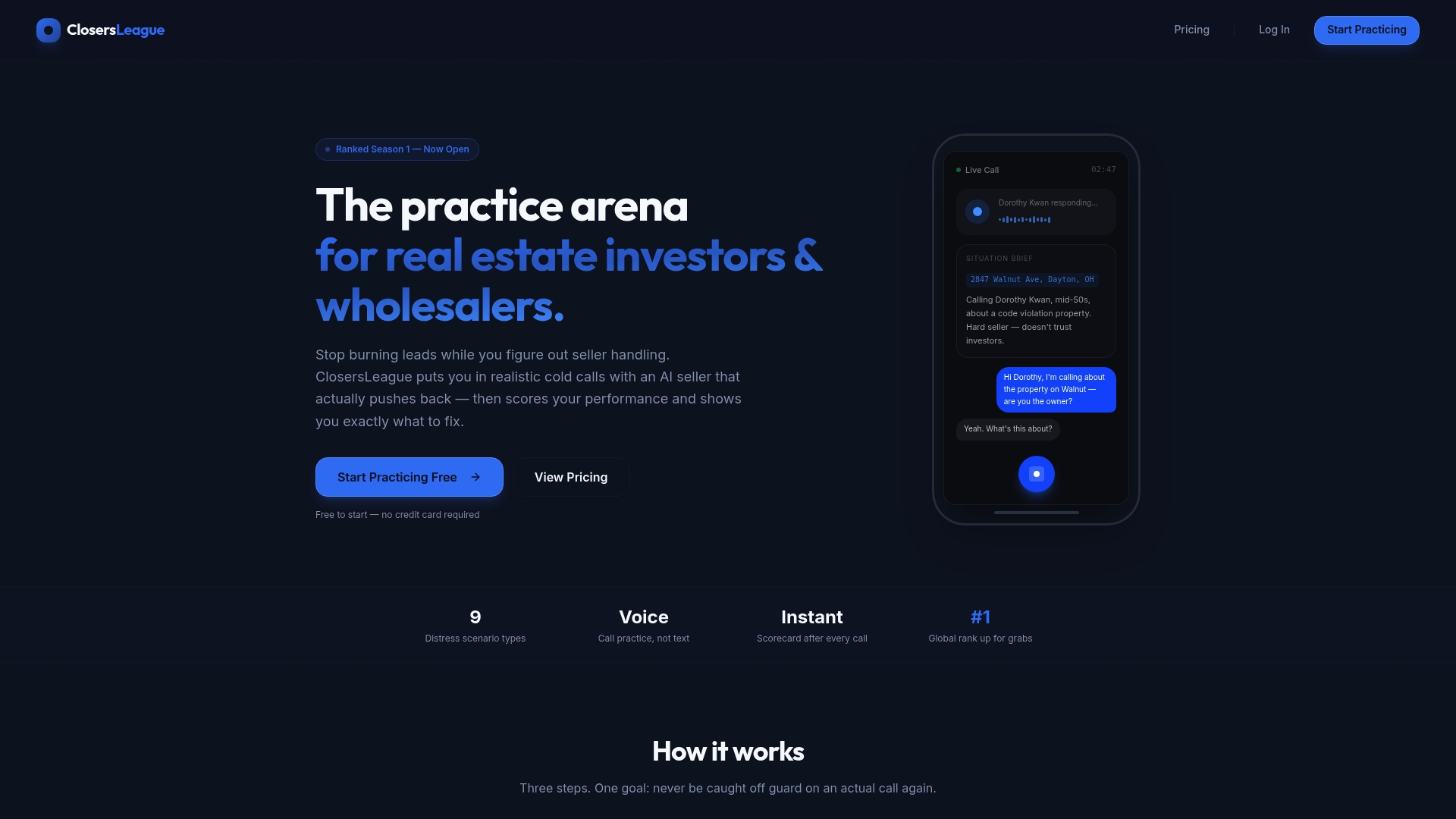
The platform’s AI roleplay scenarios cover the distressed seller types you call every day: probate, pre-foreclosure, inherited property, tax delinquent, divorce, and more.
Two drills to start with: a timed 3-minute qualification call on an inherited property scenario, and a 20-second voicemail drill. Run each one three times before your next live session. Your scorecard will show the improvement.
Start your free trial at ClosersLeague and run your first timed drill today.
Sources
- Motivated Seller Scripts: Timing Beats Wording Every Time
- The Motivated Seller Intake Call: What to Capture Before You Ever See the Property – Call Porter
- Cold Calling for Real Estate Investors: The Complete 2026 Guide | Televista Blog
- 2026 Real Estate Cold Calling Scripts Guide – 14.3% Success | Televista Blog
FAQ
What is the ideal call length for a cold call to a motivated seller?
The ideal call length is 3–5 minutes for an initial outbound call. That window covers your opener, situation questions, qualification, and a close to book a property visit.
How long should a voicemail be when calling distressed homeowners?
Keep voicemails to 15–20 seconds. State your name, reference the property, and leave one callback number. Follow up with a text within 5 minutes.
How much should I talk vs. listen on a first call?
Ask open-ended questions and let the seller fill the silence. That talk-time ratio reveals motivation faster than any script.
When is it okay to extend a call past 5 minutes?
Extend when the seller volunteers an urgent, unprompted signal: a foreclosure date, an immediate relocation need, or a direct question about your buying process. Do not extend to negotiate price on call one.
How many practice calls does it take before the timing feels natural?
Most callers need 300–500 calls before the structure becomes conversational. Use a written script for the first 50 calls, then gradually drop it section by section as each stage becomes fluent.