
Real estate CRM: Benefits, features, and best practices
Investors using a CRM convert leads at 9.1% compared to the industry average of 2.41%, a nearly threefold difference. Yet most investors still treat their CRM like a glorified spreadsheet. They log contacts, maybe add a note or two, and wonder why their pipeline stays thin. The truth is a real estate CRM is an active deal-generating system when used correctly. This guide breaks down exactly what makes a real estate CRM unique, which features matter most for distressed property outreach, how to calculate your return on investment, and how to choose the right platform for your investing strategy.
Table of Contents
- Defining real estate CRM: More than a database
- How real estate CRMs improve lead management and deal flow
- Core features of investor-focused CRMs
- Calculating ROI: The business case for real estate CRM
- Why most investors underestimate CRM—and what actually works
- Level up your real estate deals with hands-on CRM training
- Frequently asked questions
Key Takeaways
| Point | Details |
|---|---|
| Triple your conversions | Investors using real estate CRMs convert three times as many leads as those without. |
| Workflows boost efficiency | Automated follow-up and lead tracking save time while preventing deals from being lost. |
| Investor-specific features | Skip tracing, list stacking, and deal analyzers are must-haves for distressed property strategies. |
| Quantifiable ROI | CRM investment can yield up to 500 percent returns for high-volume real estate campaigns. |
Defining real estate CRM: More than a database
CRM stands for Customer Relationship Management. At its core, a CRM is software that helps you organize, track, and communicate with your leads and contacts. But a real estate CRM built for investors goes far beyond storing phone numbers.
Generic CRMs like Salesforce or HubSpot are designed for broad sales teams. They track deals and emails just fine. What they cannot do is pull a motivated seller’s contact info from a public record, stack multiple distressed lists to find the highest-priority leads, or calculate whether a deal makes financial sense before you even pick up the phone.
Investor-focused CRMs are purpose-built for that exact workflow. Platforms like REsimpli, Left Main REI, and InvestorFuse include skip tracing, list stacking, driving for dollars (D4D) integration, and deal analyzers. Agent-focused platforms like Follow Up Boss or Wise Agent are built around traditional client pipelines, open house follow-ups, and referral tracking. They serve a different purpose entirely.
Here is what separates an investor CRM from everything else:
- Skip tracing: Automatically finds phone numbers and emails for property owners using public records
- List stacking: Overlaps multiple distressed lists (foreclosure, probate, tax delinquent) to identify the most motivated sellers
- Driving for dollars (D4D) integration: Lets you pin distressed properties while driving and pull them directly into your pipeline
- Deal analyzers: Run quick ARV (after repair value) and profit calculations inside the platform
- Automated follow-up sequences: Send texts, emails, and task reminders without manual effort
A real estate investor CRM is not a contact list. It is a full outreach system that finds sellers, prioritizes them, and keeps you in front of them until they are ready to sell.
Understanding these distinctions matters before you spend a dollar on any platform. If you are still building your foundation, reviewing lead generation basics will help you see where CRM fits into your overall strategy. And if terms like list stacking or ARV are new to you, brushing up on industry terms for investors is a smart first step.
How real estate CRMs improve lead management and deal flow
Once you understand what real estate CRM platforms offer, the next question is how they directly improve your process as an investor.
The workflow starts the moment a lead enters your system. You import a list, skip trace it to get contact info, and the CRM automatically assigns follow-up tasks. From there, each lead moves through defined pipeline stages.
A typical motivated seller lead moves through these stages:
- New lead: Imported from a list or inbound inquiry
- Contacted: First call or text attempt logged
- Conversation had: Seller picked up, initial details captured
- Appointment set: Walkthrough or virtual meeting scheduled
- Offer made: Deal terms submitted to the seller
- Under contract: Signed purchase agreement in place
- Closed: Deal funded and completed
Without a CRM, leads stall between steps two and three. You forget to call back. The seller moves on. With a CRM, automated sequences fire off follow-up texts and reminders so no lead goes cold by accident.

The numbers back this up. CRM users convert at 9.1% versus the 2.41% industry average, and one documented case showed a 73% conversion increase, jumping from 22% to 38%, with an added $2,400 per lead in value.
| Factor | Manual tracking | CRM-based workflow |
|---|---|---|
| Lead conversion rate | ~2.4% | ~9.1% |
| Follow-up consistency | Inconsistent | Automated, scheduled |
| Data entry errors | High | Low |
| Time per lead | High | Reduced significantly |
| Pipeline visibility | Limited | Full, real-time |
Pro Tip: Set your CRM to trigger a follow-up sequence the moment a lead goes 72 hours without contact. Most deals are won in follow-up attempts four through eight, not on the first call. Pair this with a solid cold calling lead generation strategy and you will see your pipeline fill faster.
If you want to see how CRM stages align with your actual conversations, studying an investor script workflow will show you how each pipeline step maps to a real call.
Core features of investor-focused CRMs
Understanding the improved workflow, you will want to know which features matter most for investor success.
Not all CRMs are created equal. Investor-specific platforms include skip tracing, list stacking, D4D integration, and deal analyzers, while generic CRMs lack these native real estate investor workflows entirely.
Here are the must-have features for any investor working distressed property lists:
- Skip tracing: Pulls owner contact info directly inside the platform, no third-party tool required
- List stacking: Identifies sellers who appear on multiple distressed lists, signaling higher motivation
- D4D integration: Captures properties while you drive, instantly adding them to your pipeline
- Deal analyzers: Calculates ARV, repair costs, and profit margins before you make an offer
- Automated follow-up: Sends timed texts, emails, and voicemail drops without manual input
- Pipeline management: Visualizes every lead’s stage so nothing gets lost
- Call tracking and recording: Logs every conversation for review and team coaching
| CRM platform | Skip tracing | List stacking | D4D integration | Deal analyzer | Automation |
|---|---|---|---|---|---|
| REsimpli | Yes | Yes | Yes | Yes | Yes |
| InvestorFuse | Yes | Yes | No | No | Yes |
| Left Main REI | Yes | Yes | Yes | Yes | Yes |
| Follow Up Boss | No | No | No | No | Partial |
| Wise Agent | No | No | No | No | Partial |
Each feature directly supports distressed seller outreach. Skip tracing means you can go from a foreclosure list to a live phone call in minutes. List stacking helps you prioritize your highest-probability leads so you spend your time on sellers most likely to move. Automation keeps you consistent even on your busiest days.
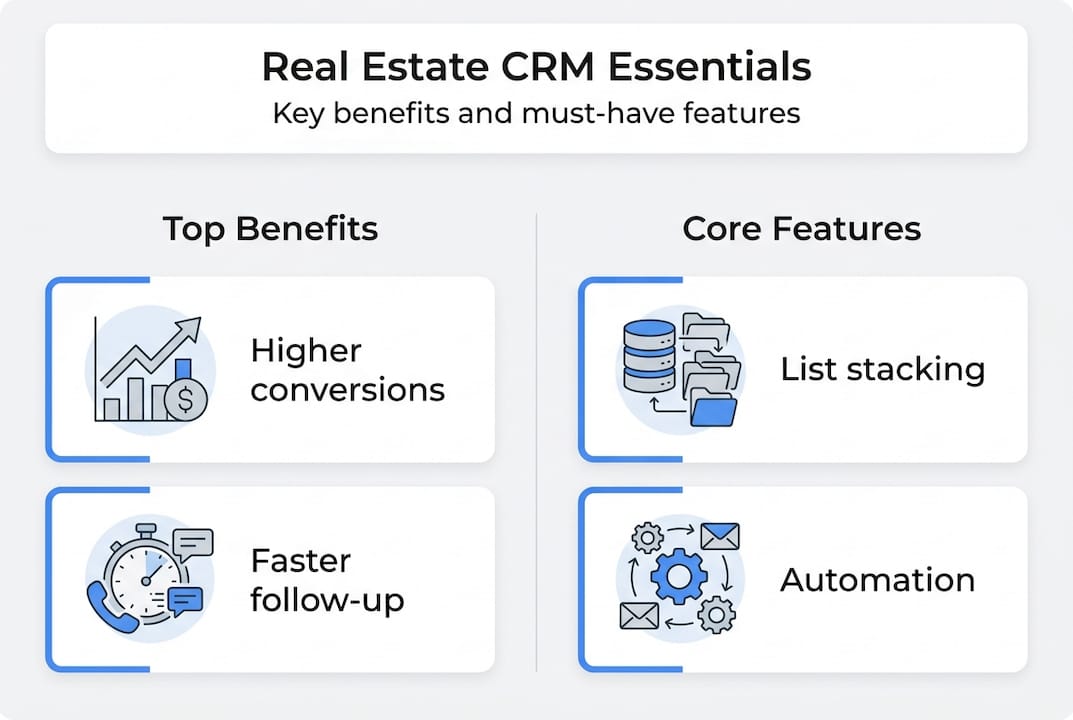
Getting comfortable with these tools also means sharpening your actual calling skills. Review these cold calling tips to make sure your conversations match the quality of your CRM setup. Your system can deliver the right lead at the right time, but you still have to close the conversation.
Calculating ROI: The business case for real estate CRM
With features and workflows in mind, investors must justify any software investment. Let’s break down the real-world returns.
The math is straightforward when you look at what a CRM actually does to your numbers. Automation saves 11 hours per week and lifts conversion rates by 28%, with reported ROI reaching as high as 500%, or $8.71 returned for every $1 spent.
Here is how to calculate CRM ROI for your own business:
- Count your monthly leads: How many distressed property leads do you work each month?
- Apply your current conversion rate: If you close 2 out of 100 leads, that is 2%.
- Apply the CRM-boosted rate: A 28% lift on a 2% rate gets you to roughly 2.56%. At scale, that is meaningful.
- Multiply by your average deal margin: If each deal nets $8,000, one extra deal per 100 leads adds $8,000 monthly.
- Subtract CRM cost: Most investor CRMs run $100 to $300 per month. The math almost always favors the tool.
- Factor in time savings: 11 hours per week freed up means more calls, more offers, more deals.
The ROI case is especially strong for outbound campaigns targeting pre-foreclosure or probate lists, where follow-up timing is critical. A missed callback on a pre-foreclosure lead can mean a lost deal entirely. Practicing your approach with pre-foreclosure cold calling techniques ensures you make the most of every CRM-generated opportunity.
Pro Tip: Spend two hours upfront building your CRM automation sequences before you import a single lead. That setup investment pays off across every campaign you run from that point forward. The investors who skip setup are the ones who say CRMs do not work.
Why most investors underestimate CRM—and what actually works
Having explored the numbers, let’s cut through the hype with a real-world perspective.
Here is the uncomfortable truth: the CRM does not close deals. You do. The CRM just makes sure you show up consistently enough to get the chance.
Most investors underestimate their CRM because they treat it as a personal reminder tool rather than a team playbook. The real power comes when your entire process lives inside the system. Every script, every follow-up stage, every objection response is documented and repeatable. That is when a CRM becomes a business asset instead of a monthly expense.
The most costly mistake we see is letting leads sit in a “contacted” stage for weeks with no automation firing. Those leads are not dead. They are just waiting for someone persistent enough to follow up. The investors who win are the ones who build script-driven workflows that run whether they feel motivated that day or not.
After the learning curve, which typically takes two to four weeks of consistent use, the CRM stops feeling like extra work and starts feeling like your most reliable team member. That shift is where the real results live.
Level up your real estate deals with hands-on CRM training
Ready to go beyond theory? Here is how to implement CRM mastery in your day-to-day investing.
Knowing how a CRM works is only half the equation. The other half is being sharp enough on the phone to convert the leads your system delivers. That is where we come in.
At ClosersLeague, our AI cold calling platform gives you a realistic environment to practice your scripts against motivated seller scenarios before you ever dial a real lead. Whether you are working tax delinquent lists, probate leads, or pre-foreclosure contacts, you can sharpen your skills with tax delinquent cold calling practice and full real estate cold calling practice sessions. Stop winging it. Start drilling. Your CRM will fill your pipeline. We will make sure you are ready to close it.
Frequently asked questions
What is the difference between an agent CRM and an investor CRM?
Investor CRMs like REsimpli offer skip tracing, list stacking, and deal analyzers, while agent CRMs focus on traditional client pipelines and referral tracking.
Can a real estate CRM improve my conversion rates?
Yes. CRM users convert at 9.1% compared to the 2.41% industry average, with some investors reporting a 73% increase in conversion after adopting a CRM.
How does automation in a CRM save time for investors?
Automation saves 11 hours per week and lifts conversion rates by 28%, freeing you to focus on making offers instead of chasing follow-ups manually.
What features should I prioritize in a real estate investor CRM?
Prioritize skip tracing, list stacking, driving for dollars integration, and automated follow-up sequences. Investor-specific platforms include these natively while generic CRMs do not.
Can a CRM help manage leads from multiple marketing channels?
Absolutely. A CRM centralizes leads from cold calling, direct mail, and online sources into one pipeline, so automation lifts conversion across every channel and reduces missed follow-ups.
Recommended
- Master Real Estate Lead Generation: Cold Calling Basics – ClosersLeague Blog
- Boost Real Estate Deals with a Proven Investor Script Workflow – ClosersLeague Blog
- 10 proven cold calling tips for real estate investors – ClosersLeague Blog
- Real Estate Cold Calling Practice — AI Roleplay for Every Seller Type | ClosersLeague