
More leads do not automatically mean more deals. That is the uncomfortable truth most new investors discover after burning through phone lists with nothing to show for it. The real differentiator is how you manage and move opportunities once they enter your world. A real estate pipeline is the organized system that tracks potential deals from first contact to closing, acting like a funnel that helps you prioritize the right opportunities at the right time. This guide will show you exactly how to build, manage, and accelerate that pipeline using AI-powered cold calling and smart automation.
Table of Contents
- Understanding the real estate pipeline
- Pipeline stages for real estate investors and wholesalers
- Common pitfalls and expert tips for pipeline management
- Applying AI and automation to your pipeline
- A smarter approach to scaling your deal flow
- Level up your pipeline with ClosersLeague AI practice tools
- Frequently asked questions
Key Takeaways
| Point | Details |
|---|---|
| Pipeline clarity drives results | Tracking leads through clear, actionable stages keeps you organized and maximizes deal conversions. |
| Leverage AI for scale | AI-powered cold calling and automation boost efficiency in sourcing and nurturing seller leads. |
| Prioritize quality over quantity | A smaller, hot pipeline beats a giant list by focusing on motivated sellers ready to move. |
| Expert discipline wins | Morning reviews, follow-up discipline, and strategic use of automation separate top investors from the rest. |
Understanding the real estate pipeline
Many investors treat their deal flow like a pile of sticky notes. Leads come in from cold calls, direct mail, and data lists, then get scattered across spreadsheets, phone apps, and memory. That approach kills deals quietly. Opportunities go cold not because sellers were not motivated, but because there was no system to follow up consistently and intentionally.
A real estate pipeline solves that problem by giving every lead a defined home and a clear next action.
“A real estate pipeline, for investors and wholesalers, is an organized system tracking potential deals from initial leads through stages to closing, functioning like a funnel to prioritize high-potential opportunities.”
Think of it this way: your pipeline is not a list. It is a living workflow. At any given moment, you should know exactly how many leads are at each stage, what action moves them forward, and which ones deserve your attention today.
This structure is especially critical if you are running AI-powered cold calling campaigns. AI can dial hundreds of distressed property owners in the time it would take a human to call ten. But volume without a pipeline to receive and process those leads creates chaos. Understanding the wholesaler roles and process makes it clear: the money is not in the calls themselves. It is in the disciplined follow-through after those calls.
Here is why a structured pipeline matters for investors and wholesalers specifically:
- Prevents lead leakage. Without defined stages, promising leads get forgotten after the first call, especially when you are juggling a hundred contacts at once.
- Improves conversion rates. Organized pipelines help you identify where leads stall and fix the specific problem, rather than blaming the whole strategy.
- Enables smarter prioritization. You stop chasing every new lead and start focusing on the ones most likely to close this week.
- Supports team scaling. If you ever bring on a transaction coordinator or virtual assistant, a clear pipeline makes handoffs effortless.
- Creates data you can use. Tracking stage-by-stage conversion rates tells you whether your cold calling script needs work, your follow-up timing is off, or your offer formula is weak.
The power of automation for real estate investors comes into full effect when there is a pipeline structure to plug it into. Automation without a pipeline is just noise. Automation inside a clean pipeline is leverage.

Pipeline stages for real estate investors and wholesalers
Understanding the pipeline concept is one thing. Knowing exactly what to do at each stage is where most investors start gaining a real edge. Let’s break it down step by step.
Standard pipeline stages for residential investors and wholesalers typically follow this progression:
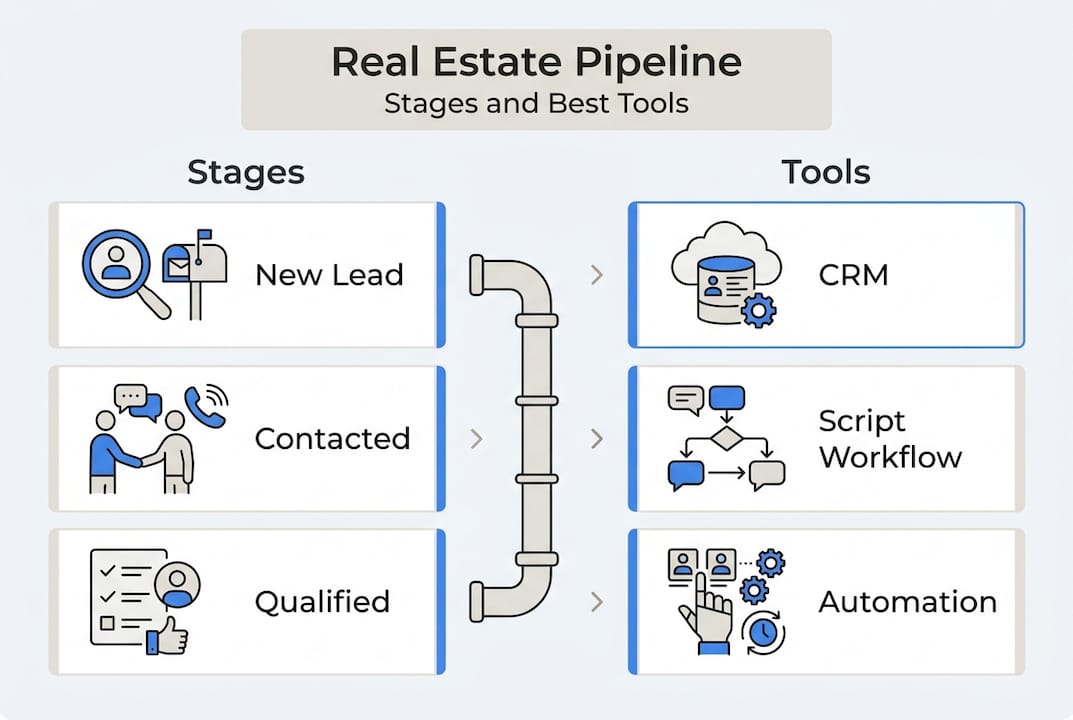
- New Lead. The lead enters your system from a cold call, direct mail piece, driving for dollars, or a data list. At this point, you only know the basic property and owner information. Your job is to log it immediately in your CRM before it gets lost.
- Contacted. You have made first contact with the property owner. The conversation was brief, but the line is open. The key action here is logging the call outcome and scheduling your next touchpoint within 24 to 48 hours.
- Qualified. This is where deals start separating from dead ends. You verify whether the seller has real motivation, such as facing foreclosure, going through probate, dealing with divorce, or carrying a tax delinquent property. You also confirm their timeline. Sellers with a timeline under 90 days deserve priority attention. Those with no urgency can sit in a nurture sequence.
- Follow-up and nurture. Not every motivated seller is ready to act today. Some need two weeks. Some need two months. A strong nurture sequence keeps you top of mind through automated texts, emails, and scheduled callbacks. Miss this stage and you hand deals to the next investor who stayed consistent.
- Offer made. Based on your after-repair value (ARV) analysis and estimated repair costs, you present a written or verbal offer. This stage requires human skill, empathy, and negotiation finesse. No AI closes this moment alone.
- Under contract. The seller accepted your offer. Now it is about due diligence, title work, and lining up your end buyer if you are wholesaling. Speed matters here. Time kills deals.
- Closed. The deal is done. Log the outcome, note what worked, and move on to the next cycle. Every closing teaches you something about where your pipeline is strongest.
Here is how each stage maps to your key actions and tools:
| Pipeline stage | Primary action | Best tool |
|---|---|---|
| New Lead | Log contact and property details | CRM with auto-import |
| Contacted | Record call outcome and set next step | AI cold calling platform |
| Qualified | Score motivation, timeline, and distress type | Call script with qualifying questions |
| Nurture | Send automated follow-up sequence | Email or SMS automation |
| Offer Made | Present offer based on ARV formula | Human negotiation |
| Under Contract | Manage paperwork and buyer pipeline | Transaction management software |
| Closed | Analyze deal data and update KPIs | CRM reporting |
Using a proven script workflow at the qualification stage is one of the highest-leverage moves you can make. Inconsistent questioning leads to inconsistent data, which makes it impossible to know if a lead is genuinely hot or just politely interested. Following solid CRM best practices ensures every stage is tracked, every task has an owner, and nothing falls through the cracks.
Common pitfalls and expert tips for pipeline management
Knowing the stages is the blueprint. Actually managing your pipeline well is where most investors struggle. Here are the biggest mistakes we see, and how to avoid them.
Mistake 1: Treating all leads equally. Not every lead deserves the same urgency. A homeowner in active foreclosure with a court date in 30 days is not the same as someone casually considering selling in a year. When you treat both the same, you waste energy on low-probability deals and miss the ones that need your attention right now.
Mistake 2: Letting pipeline value get too thin. Pipeline value should be 3 to 6 times your monthly deal goal. If you want to close two deals per month, your pipeline needs enough active opportunities to support six to twelve potential closings at any given time. Most investors keep pipelines too small and then wonder why their closing rate feels inconsistent.
Mistake 3: Skipping the morning pipeline review. Start each day by reviewing your highest-impact actions. Focus on hot leads first, meaning those who responded to a call, replied to a text, or are approaching a critical timeline. Do not start your day generating new leads when you have warm opportunities sitting untouched.
Mistake 4: Giving up after one or two contacts. Research consistently shows that most real estate deals require five or more touchpoints before a seller commits. Giving up after the second call is like leaving money on the table and handing it directly to your competition. Use real estate follow-up strategies to stay consistent without burning yourself out.
Mistake 5: Using AI where humans are needed. AI is a powerful first-touch tool for high-volume cold calling. But when a seller is emotionally distressed, confused about their options, or ready to negotiate, you need a real person on the line. Misusing AI at the wrong stage of the pipeline erodes trust fast.
Pro Tip: Set a weekly pipeline audit on your calendar. Spend 20 minutes reviewing every active lead. Ask yourself: What is the next action? When is it scheduled? If a lead has no next action logged, create one or move it to your cold list. An unmaintained pipeline is just a list with extra steps.
Here is a quick checklist for smarter pipeline management:
- Score every lead at qualification with a simple 1 to 3 rating based on motivation, timeline, and property condition.
- Set automated reminders for every follow-up so nothing relies on memory.
- Review pipeline metrics weekly: total leads by stage, conversion rate between stages, and average days per stage.
- Identify your “stuck” stage, the one where leads consistently stall, and fix it with a targeted script or process change.
- Keep a separate nurture list for sellers who are not ready now but showed genuine interest.
Applying AI and automation to your pipeline
Once your pipeline structure is solid, AI and automation become force multipliers. Without structure, they just generate more chaos faster. With structure, they can transform your capacity to close deals.
AI-powered cold calling handles the highest-volume, most time-consuming part of your pipeline: initial outreach. Learning the fundamentals of AI cold calling basics shows you how to reach distressed homeowners at scale without burning out your team or yourself. AI can dial through hundreds of leads daily, identify which numbers are live, and flag contacts who expressed interest for human follow-up.
Here is a comparison of doing this manually versus using AI-assisted tools:
| Task | Manual approach | AI-assisted approach |
|---|---|---|
| Daily dials | 50 to 80 calls | 300 to 500+ contacts |
| Lead qualification | Inconsistent, caller-dependent | Standardized script scoring |
| Follow-up reminders | Relies on memory or calendar | Automated trigger-based sequences |
| Data capture | Manual note-taking during calls | Auto-logging in CRM |
| Cost per contact | High (time-intensive) | Significantly lower at scale |
| Best stage to use | Offer, negotiation, closing | First touch, initial qualification |
Real estate automation handles the follow-up stage reliably. The moment a lead is flagged as “contacted but not yet qualified,” automation kicks in with a sequence of texts and emails designed to re-engage. You set the sequence once. It runs while you focus on closing the deals that are already warm.
Pro Tip: Practice your AI-assisted cold calling conversations before you go live with a real list. Use AI cold calling roleplay to rehearse objection handling, qualification questions, and transitions to appointment setting. Sellers can tell the difference between a practiced investor and someone stumbling through their first call.
The key principle that experts consistently reinforce is this: use AI for first-touch cold calls, and bring in humans for negotiation and closing. AI handles scale. Humans handle nuance. Your pipeline should reflect exactly when each one is needed.
A well-structured pipeline with AI feeding the top and skilled humans managing the middle and bottom stages gives you the best of both worlds: volume and conversion. That combination is what separates the investors closing two to three deals per month from those who are still waiting for their first one.
A smarter approach to scaling your deal flow
Here is the perspective we want you to internalize: chasing more leads is a beginner’s strategy. Optimizing your pipeline is how experienced investors scale.
We have seen investors doubling their cold calling volume, spending more on lists and data, and still closing the same number of deals. The problem was never the top of the funnel. It was that leads were entering a broken or nonexistent pipeline and leaking out at every stage.
The investors who consistently win in 2026 are not necessarily the ones making the most calls. They are the ones with the cleanest pipelines, the most disciplined follow-up systems, and the sharpest sense of which deals deserve their time today. They understand wholesale pitching strategies and apply them at exactly the right pipeline moment, not randomly, but with intention.
AI solves the scale problem. It removes the ceiling on how many homeowners you can reach in a day. But focus and pipeline discipline are what turn that reach into revenue. Reviewing your pipeline every morning, scoring your leads honestly, and cutting dead weight early are habits that compound over time. The investors who build those habits outpace everyone chasing sheer volume.
Level up your pipeline with ClosersLeague AI practice tools
Ready to put these insights into practice? ClosersLeague equips real estate investors and wholesalers with the AI-powered tools you need to sharpen every stage of your pipeline, starting with the calls that open the door.
Practice realistic cold calling scenarios before you touch a live lead list. Our AI roleplay simulations cover the exact seller types you will encounter, from inherited properties to code violations. Work through inherited property AI practice sessions to nail your qualifying questions, or sharpen your objection handling with code violation AI roleplay. Every scenario is designed to build the confidence and consistency that turn pipeline contacts into contracts. Visit ClosersLeague to start practicing smarter today.
Frequently asked questions
What is a real estate pipeline for investors?
A real estate pipeline is a system that tracks leads through stages from initial contact to closed deal, helping investors stay organized and focused on the highest-potential opportunities.
Which stages belong in a standard real estate pipeline?
Typical stages include: New Lead, Contacted, Qualified, Follow-Up/Nurture, Offer Made, Under Contract, and Closed, each with a defined action and next step to keep deals moving forward.
How can AI help improve my real estate pipeline?
AI streamlines high-volume lead generation, handles first-touch call outreach, and automates follow-up, letting you focus on negotiating and closing the best deals. The core rule is to use AI for first-touch and humans for negotiation.
How big should my pipeline be?
Experts recommend your active pipeline value be 3 to 6 times your monthly deal goal, giving you enough opportunities in play to ensure consistent closings even when some deals fall through.
Recommended
- Real estate pitch: Win more wholesale deals in 2026 – ClosersLeague Blog
- Real Estate Cold Calling Practice — AI Roleplay for Every Seller Type | ClosersLeague
- What is a real estate wholesaler? Process, profits, risks – ClosersLeague Blog
- Boost Real Estate Deals with a Proven Investor Script Workflow – ClosersLeague Blog