
Real estate pitch: Win more wholesale deals in 2026
Most investors walk into their first call with a distressed homeowner armed with a rigid script and leave empty-handed. The reason isn’t lack of effort. It’s a fundamental misunderstanding of what a real estate pitch actually is. A real estate pitch in wholesaling is a structured conversation used to engage distressed homeowners, not a canned sales monologue. This guide breaks down the core components, practical frameworks, common mistakes, and objection-handling tactics you need to qualify sellers, build real rapport, and secure more contracts.
Table of Contents
- What is a real estate pitch in wholesaling?
- Core steps of a high-converting real estate pitch
- Breaking down the script: Key components and real examples
- Handling objections and uncovering true seller motivation
- Why genuine conversations, not scripts, close the best deals
- Sharpen your pitch: Practice with AI roleplay platforms
- Frequently asked questions
Key Takeaways
| Point | Details |
|---|---|
| Empathy matters most | Successful real estate pitches for wholesalers focus on empathy and flexible conversation, not memorized scripts. |
| Follow a proven structure | Use a step-by-step framework to qualify, build rapport, and secure contracts with distressed sellers. |
| Expect realistic results | For every 100 cold calls, expect roughly 1 closed wholesale deal following industry benchmarks. |
| Tackle objections smartly | Learning to handle seller objections and uncover real motivation separates average investors from top closers. |
| Practice is essential | Sharpening your pitch with AI roleplay tools builds skill and confidence for real-world results. |
What is a real estate pitch in wholesaling?
Now that you know why this matters, let’s break down what a real estate pitch truly is and how it fits within wholesaling.
A real estate pitch isn’t a rehearsed speech. It’s a purposeful conversation designed to connect with a distressed homeowner, understand their situation, and create a solution that works for both parties. Think of it as a structured dialogue, not a performance.
Understanding the wholesaler process and profits helps clarify the goal: you’re not trying to con anyone. You’re identifying homeowners who have a problem you can solve. Your pitch is the tool that opens that door.
Here’s who your pitch is designed for:
- Homeowners facing foreclosure who need a fast exit before the bank takes over
- Probate sellers managing an inherited property they don’t want or can’t maintain
- Divorcing couples who need to liquidate assets quickly and cleanly
- Owners with code violations who face mounting fines and selling a house with code violations can feel overwhelming without guidance
- Absentee landlords dealing with problem tenants or neglected properties
Each of these situations carries real emotional weight. The pitch that works acknowledges that weight before it ever mentions price.
“A real estate pitch in wholesaling is a structured conversation or script used by investors to engage distressed homeowners.”
What does a successful pitch accomplish? Three things: it builds trust quickly, uncovers the seller’s true motivation, and moves toward a signed contract. That’s it. If your pitch is doing anything else, it’s probably getting in its own way.
Following a proven investor script workflow gives you the structure to stay on track without sounding robotic. The best investors adapt their tone and questions based on what the seller reveals. Empathy and flexibility aren’t soft skills. They’re your most powerful closing tools.
Core steps of a high-converting real estate pitch
So what are the actual steps? Let’s lay out the structure that gets real results.
A strong pitch follows a logical sequence, but the order matters less than the intent behind each step. Here’s the framework:
- Icebreaker. Start warm and human. Comment on something specific: the neighborhood, a recent event, or simply acknowledge that you know this might be unexpected. You want them talking, not guarded.
- Situation discovery. Ask open-ended questions. “Can you tell me a little about the property?” or “How long have you owned it?” You’re listening for context, not filling a form.
- Motivation probing. This is where most investors rush. Slow down. Ask why they might consider selling. Let them fill the silence. People reveal a lot when given space.
- Rapport building. Reflect back what they share. Use their words. Show you heard them. This creates psychological safety and keeps the conversation open.
- Identifying real needs. Move from surface answers to core concerns. Are they worried about speed, privacy, debt, or family pressure? Each seller has a primary driver.
- Offer framing. Connect your solution to their specific need. Don’t lead with price. Lead with outcome: “What if you could close in two weeks with no repairs and no agent fees?”
- Commitment ask. Make it low-pressure and specific. “Can I run some numbers and follow up Thursday?” is far more effective than a vague close.
Learning negotiation tactics for deals will help you sharpen each step, especially the framing and commitment stages. For making a profitable house sale, aligning your offer to the seller’s timeline is often more persuasive than the dollar amount alone.
Pro Tip: Record your practice calls. You’ll catch filler phrases, missed pauses, and moments where you talked over a seller’s hesitation. Those gaps are where deals are lost.
Remember: no rigid scripts work in every situation. Conversational rapport consistently outperforms formula-based pitches.
Breaking down the script: Key components and real examples
With the steps in mind, let’s get tactical. What should the pitch actually sound like? Here are the components and examples.
Every effective pitch has four structural parts: the greeting, discovery questions, empathy statements, and the closing ask. Each part plays a specific role.
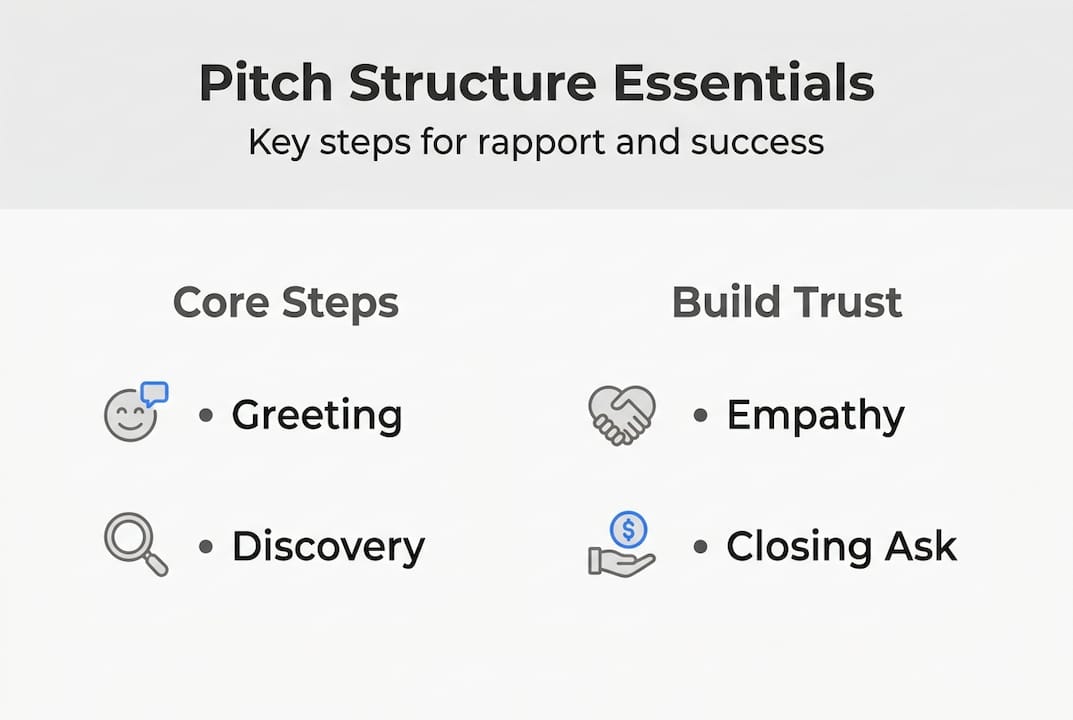
Greeting: Keep it brief and non-threatening. “Hi, my name is [Name], I work with homeowners in [City] looking to sell quickly. Is this something you’d want to hear more about?”
Discovery questions: Open-ended and curious. “What’s going on with the property right now?” or “Have you looked into any options yet?”
Empathy statements: Mirror the seller’s emotional tone. “That sounds like a really stressful situation” or “I’ve worked with a lot of families going through something similar.”
Closing ask: Specific and soft. “Would it be okay if I came by to see the property this week?”
Here’s a comparison of phrases that work versus phrases that kill momentum:
| Winning phrase | Phrase to avoid | Why it matters |
|---|---|---|
| “What would a good outcome look like for you?” | “We buy houses fast for cash!” | Seller-focused vs. investor-focused |
| “Tell me more about that” | “So the price you want is…” | Builds trust vs. creates resistance |
| “I understand this is tough” | “Here’s what I can offer” | Empathy first vs. transaction first |
| “No repairs, no fees, flexible close” | “My formula gives you X” | Outcome-focused vs. jargon-heavy |
Knowing your cold calling tips and mastering real estate lead generation through cold calling will help you set realistic expectations. The empirical benchmarks are clear: 100 calls typically yield 10 to 20 conversations, 3 to 5 leads, and 1 closed deal. That means your pitch doesn’t need to be perfect every time. It needs to be consistent.
Pro Tip: Adjust your empathy statement based on the distress type. A probate seller needs acknowledgment of grief. A foreclosure seller needs acknowledgment of stress and urgency. One statement doesn’t fit all.
Handling objections and uncovering true seller motivation
Now that you have the building blocks for a pitch, it’s critical to handle pushback and spot the truly interested sellers.

Objections are normal. They don’t mean no. They usually mean “I’m not convinced yet” or “I need to feel safe first.” Your job is to understand what’s underneath the surface response.
Here’s how to read and respond to the most common objections:
| Objection | What it usually means | Best response |
|---|---|---|
| “I’m not ready to sell” | Fear of making the wrong move | “That’s fine. Can I just ask a few questions so I understand your situation?” |
| “I’m just curious about prices” | Gathering info, not yet committed | “That’s exactly where most sellers start. Let me share what I’ve seen in your area.” |
| “I already have an agent” | Loyalty or uncertainty about alternatives | “Totally understand. If the listing doesn’t work out, I’m here as a backup option.” |
| “I need full market value” | Price anchor not yet shifted | “Let’s talk about what factors are affecting value. You might be surprised.” |
Now let’s talk about distress stacks. A distress stack means a seller is dealing with more than one problem at once. For example, absentee ownership combined with probate, or a code violation on top of a pending foreclosure. Distress stacks yield hotter leads because the motivation to sell fast is compounded.
When you practice vacant property cold calling or pre-foreclosure outreach, you’ll start recognizing the signals quickly. Hesitation followed by urgency, vague answers about the property’s condition, or reluctance to mention family members are all signals worth exploring.
Here’s a simple framework for uncovering true motivation:
- Ask the surface question: “Are you thinking about selling?”
- Probe deeper: “What’s making you consider that now?”
- Confirm the core need: “So if I could solve [X], that would make this easier for you?”
Motivation is rarely what sellers say first. It’s what they say after you give them space to say more.
Why genuine conversations, not scripts, close the best deals
Understanding the practical steps is powerful, but there’s a bigger truth most guides don’t tell you.
Here’s the uncomfortable reality: most investors who fail at pitching aren’t failing because they lack knowledge. They’re failing because they’re hiding behind a script instead of having a real conversation. A script feels safe. But sellers can hear it. They know when someone is reading from a mental checklist instead of actually listening.
Top closers don’t abandon structure. They internalize it so deeply that it disappears. What remains is genuine curiosity and focused listening. They speak less and hear more. They adapt mid-conversation when a seller mentions something unexpected. That flexibility is what creates trust in emotionally charged situations like divorce, foreclosure, or probate.
As conversational rapport consistently outperforms rigid formulas, the goal isn’t to memorize lines. It’s to build a mental framework so solid that you can respond naturally to anything. Strong negotiation tactics start with listening before they end in agreements.
The investors who close the most deals aren’t the smoothest talkers. They’re the best listeners.
Sharpen your pitch: Practice with AI roleplay platforms
If you’re ready to take your real estate pitch to the next level, don’t just read. Practice smarter.
Reading about pitch frameworks is a solid starting point. Mastery only comes through repetition in realistic scenarios. That’s exactly what ClosersLeague is built for.

Our AI-powered real estate cold calling practice platform puts you in live roleplay scenarios with simulated distressed sellers. You practice handling objections, building rapport, and closing contracts across every major seller type. From code violation cold call training to probate, pre-foreclosure, and inherited properties, every session sharpens your instincts and builds real confidence. Stop winging it. Start drilling the conversations that actually matter.
Frequently asked questions
What is the main purpose of a real estate pitch in wholesaling?
The main purpose is to qualify a distressed seller’s motivation, build rapport, and secure a discounted contract for assignment. A structured wholesale pitch focuses on connecting with the homeowner before presenting any offer.
How long does it typically take to secure the first wholesale deal using real estate pitches?
For most beginners, closing the first deal takes approximately 2 to 3 months of consistent outreach and pitching practice.
What’s a realistic expectation for call-to-deal conversions when pitching to distressed sellers?
Expect that 100 calls yield roughly 10 to 20 conversations, 3 to 5 qualified leads, and 1 closed deal on average.
Why do distress stacks matter in wholesaling?
When a seller faces multiple overlapping problems, their urgency increases significantly. Stacked distress signals like absentee ownership combined with probate create highly motivated sellers who are more likely to accept a below-market offer.
Should I use the same script for every seller type?
No. Each distress scenario carries unique emotional and logistical pressures. Rigid scripts fail in complex situations. Adapt your framework to the seller’s specific circumstances every time.
Recommended
- Real Estate Cold Calling Practice — AI Roleplay for Every Seller Type | ClosersLeague
- Boost Real Estate Deals with a Proven Investor Script Workflow – ClosersLeague Blog
- What is a real estate wholesaler? Process, profits, risks – ClosersLeague Blog
- AI Cold Calling Practice for Real Estate Investors & Wholesalers | ClosersLeague
- Nebraska distressed property solutions & 2026 outlook