The seller emotion cues worth acting on are specificity, a stated deadline, clear decision authority, and a willingness to agree to a next step especially when paired with vocal arousal like a faster pace or tighter pauses. The moment you hear two or more together, stop talking and ask one operational verification question. Emotion tells you someone is activated. It never proves they will sell. Facts and voluntary next steps do.
TL;DR:
- Vocal cues like rising pitch, jitter, shimmer, faster speech, clipped words, and longer pauses often signal stress or arousal, but do not confirm seller motivation.
- Specific verbal statements, especially those with clear deadlines or legal triggers, outweigh tone and reveal actionable selling signals.
- Asking three verification questions about decision authority, timelines, and willingness for next steps quickly qualifies distressed leads.
- Legal and trust considerations require recording factual language and avoiding pressure to prevent violations and preserve trust.
- Recognizing emotional indicators improves with practice, use of AI tools, and focused roleplay, enhancing qualification accuracy.
Table of Contents
- Priority Vocal Cues: What Pitch, Speed, Pauses, and Volume Changes Usually Mean
- Verbal Cues and Word Patterns That Signal Readiness to Sell
- How to Verify Intent Fast on a Distressed Seller Call
- What to Avoid: Compliance and Trust Risks With Distressed Homeowners
- Short Scripts and Micro-Phrases to Probe Motivation
- Practice and Training to Sharpen Recognition
- Reading Non-Verbal Cues on Video and In-Person Follow-Ups
- Coach Dave’s Perspective: What Changes When You Stop Guessing
- Practice These Exact Cues Before Your Next Call
- Sources
- FAQ
Priority Vocal Cues: What Pitch, Speed, Pauses, and Volume Changes Usually Mean
Stress changes the way a voice sounds before it changes what a seller says. That is the entire reason vocal cues matter on a cold call: you often hear motivation before you hear a decision.
The clearest acoustic markers to train your ear on:
- Rising pitch or fundamental frequency — a voice that climbs higher than the seller’s opening tone
- Jitter and shimmer — small, rapid instabilities that make a voice sound rough or shaky
- Faster speaking rate — words compressing together, sentences arriving quicker than the opening exchange
- Clipped words — syllables cut short, as if the seller is rushing to get a thought out
- Longer or more frequent pauses — silence that signals the seller is calculating, not just thinking
Voice research on stress and cognitive load has documented these exact patterns for decades. Acoustic analysis of induced vocal stress found measurable increases in pitch, jitter, and shimmer under stress conditions, and more recent work on separating arousal from intent confirms the same markers show up reliably. Neither study says a stressed voice equals a motivated seller; arousal and intent are different variables, and treating them as the same thing is how callers waste time chasing anxious homeowners who have no plan to sell.
Pro Tip: Keep a mental baseline from the first 15 seconds of the call. A shift from that baseline, not the absolute pitch or speed, is what actually signals something changed.
The practical rule: vocal arousal is a trigger for a verification question, never a signal to move toward closing language. If a seller’s voice tightens right as you mention foreclosure, that is your cue to ask, not to assume.
Verbal Cues and Word Patterns That Signal Readiness to Sell
Words beat tone every time they conflict. A seller who sounds completely calm but says “we have to close by the 15th because of the auction date” is a stronger lead than one who sounds shaky but never gives you anything concrete.
Listen for language that carries specificity and operational weight:
- Explicit dates or deadlines (“by the end of the month,” “before the sale date”)
- References to legal or financial triggers: foreclosure notices, liens, tax bills, code citations
- Ownership and authority language: “executor,” “power of attorney,” “my sister and I both have to agree”
- Urgency phrases tied to a real constraint: “we can’t keep up with the payments,” “we need this handled”
The pattern to internalize is that specificity beats intensity. “I’m overwhelmed” tells you almost nothing actionable. “We need to sell by May because the bank already sent a notice” tells you the timeline, the pressure source, and the next question to ask. One is a feeling. The other is a lead.
Pro Tip: When you hear a phrase with real specificity, repeat it back almost verbatim before your next question. “So you’re saying the notice came already, and you’re targeting May?” This confirms you heard correctly and keeps the seller in logistics mode.
Log calls the same disciplined way. Write the seller’s exact words and the specific action they requested, not your read on their emotional state. A CRM note like “said foreclosure notice received, asked for callback Thursday” holds up. A note like “sounded desperate” does not, and it can bias how the next caller treats that seller.
How to Verify Intent Fast on a Distressed Seller Call
Emotion gets you attention. Verification gets you a qualified lead. The fastest way to convert one into the other is three questions you can ask in almost any distressed scenario, regardless of whether the trigger is foreclosure, probate, or a landlord who has simply had enough.
- Who is authorized to decide? If a seller cannot answer this cleanly, you are not talking to the person who can sign anything yet.
- What timeline are you working to? A real deadline is specific: a court date, a foreclosure sale date, a closing on a new place. A vague answer (“soon, I guess”) is a soft lead, not a hot one.
- Would you be open to a written offer or a quick visit? This is the behavioral test. Agreeing to a concrete next step is worth more than any amount of emotional language.
Watch for confirming behaviors alongside the answers: the seller offers a callback time without you asking twice, volunteers a decision-maker’s contact information, or asks what paperwork comes next. Those are voluntary moves, and voluntary moves are the strongest signal you will get on a first call.
Pro Tip: If the seller sounds like they are grieving, overwhelmed, or asks for time, stop the verification sequence. Offer a specific callback window and document their preferred day and time. Pushing past that moment costs you the lead and, frankly, it is not how you want to treat someone in crisis.
What to Avoid: Compliance and Trust Risks With Distressed Homeowners
Distressed sellers are already dealing with pressure from banks, courts, or family. Adding pressure from you is how you lose the lead and possibly invite a complaint.
Start with the legal baseline. The Telemarketing Sales Rule requires you to identify yourself and your purpose early in the call, respect National Do Not Call Registry requests, and keep suppression records. Calls to numbers on that registry are only allowed under narrow exceptions, such as an established business relationship or specific written permission. The FTC’s own safe-harbor guidance lays out what protects you if a mistake slips through: written procedures, staff training, call monitoring, and registry checks refreshed within 31 days.
Beyond the legal floor, a few habits protect trust:
- Never manufacture urgency the seller has not volunteered themselves
- Match your pace to theirs; speed up only when they do
- Avoid emotional labels in your notes. Record facts: “said foreclosure notice received; asked for callback Thursday” is defensible. A guess about their mental state is not.
Short Scripts and Micro-Phrases to Probe Motivation
The best scripts do two things in one breath: acknowledge the seller’s situation, then ask one operational question. No stacking, no pressure, one thing at a time.
Foreclosure: “I know a foreclosure notice is stressful to deal with. Can I ask what date the sale is currently set for?”
Probate: “I’m sorry about the loss of your [relative]. Whenever you’re ready, are you the one handling the estate, or is someone else involved in that decision?”
Overwhelmed owner: “It sounds like this property has been a lot to manage. If it’s helpful, would you be open to a quick visit sometime in the next couple weeks?”
Each template ends on exactly one verification question and a low-friction next step, never a hard close. Add the empathy line first, always. It costs you five seconds and buys you a seller who feels heard instead of processed.
The micro-rules that make these work in practice:
- Ask one question, then stop talking.
- Summarize what you heard before moving to the next point.
- Offer to follow up on the seller’s timeline, not yours.
Pro Tip: Practice these three templates out loud until the empathy line feels automatic. A script that sounds read is worse than no script at all.
Practice and Training to Sharpen Recognition
Recognizing seller emotional intelligence signals is a skill, and skills improve with repetition, not with more theory. A few drills work especially well for cold callers:
- Five-minute listening drills using recorded calls to spot pitch and pace shifts without the pressure of live conversation
- One-question verification roleplays where the only goal is asking the right follow-up cleanly
- Scored callbacks reviewed against a rubric, not gut feel
AI emotion-detection tools can speed this up by flagging arousal patterns in real time, similar to what ClosersLeague’s AI roleplay training is built to surface. The tool spots the pattern. You still have to run the verification question yourself.
| What to measure | Why it matters |
|---|---|
| Correct cue identification | Confirms you noticed the right vocal or verbal signal |
| Correct verification question asked | Confirms you converted the cue into a qualifying action |
| Next-step behavior recorded | Confirms the lead is real, not just emotionally loud |
Reading Non-Verbal Cues on Video and In-Person Follow-Ups
Cold calls are audio-only, but plenty of distressed-seller conversations move to video or an in-person visit fast, especially with probate and inherited properties. That is where recognizing seller body language becomes just as important as reading a voice.
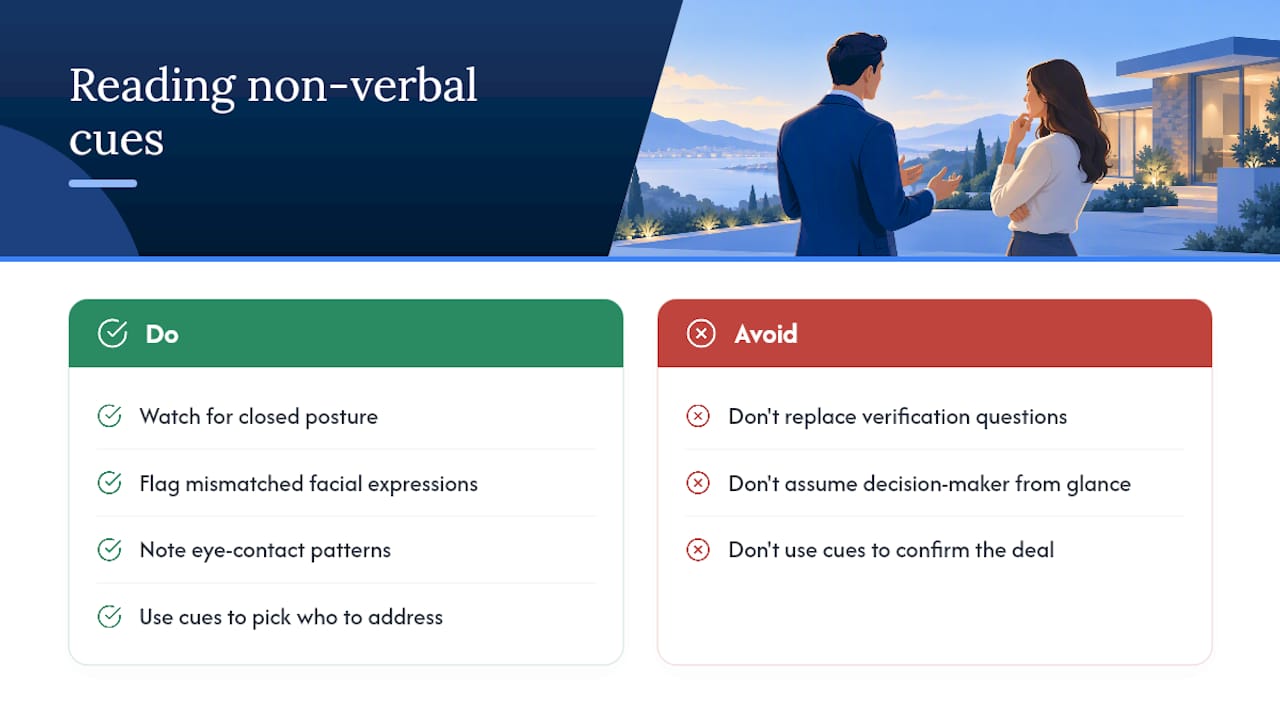
Watch for closed posture: crossed arms, a body turned slightly away from the camera or from you, which often signals guardedness rather than outright refusal. Facial expressions that do not match the words are worth flagging quietly. A seller saying “I’m fine with this” while their brow stays tense is telling you two different things at once, and the face is usually the more honest one.
Eye contact patterns matter too, though context matters more than the pattern itself. Sustained eye contact while discussing a deadline usually signals confidence in the decision. Eyes that dart toward another person in the room, especially during a probate visit with multiple heirs present, often mean the real decision-maker is not who is currently talking.
None of these replace the verification questions from earlier. They are supporting evidence, the same way vocal arousal is supporting evidence. Use them to decide who in the room to address next, not to decide whether the deal is real.
Coach Dave’s Perspective: What Changes When You Stop Guessing
The biggest mistake I see is callers treating a shaky voice as a green light. It is not. It is a flag. The best week I have watched a caller run started with a probate seller who sounded calm the entire call. Only after asking “who’s handling the estate?” did the real motivation surface. Try 15 minutes a week: five minutes of listening drills, five minutes of scripted verification roleplay, five minutes reviewing your own CRM notes for emotion labels you should replace with facts.
— Dave
Practice These Exact Cues Before Your Next Call
This platform is designed to help users recognize seller emotion cues in real time and turn them into qualifying questions instead of guesses. It offers scenario-based AI roleplay across multiple distressed property types, with AI emotion detection that flags vocal arousal as described above, plus instant scorecards that grade whether the right verification question was asked.

Run a five-call test against the real estate cold calling practice scenario library and see where your verification habits actually stand. If probate is your focus, the probate cold calling practice pack drills the exact empathy-then-logistics sequence from this article. Plans start with the Starter tier at $5 per month, with Growth at $10 and Pro at $18, all listed on the ClosersLeague pricing page. Pick a tier, run your first scored call, and see your scorecard before you dial a real seller again.
Sources
Compliance guidance comes from the FTC’s Telemarketing Sales Rule and its safe-harbor recordkeeping rules. Probate nuance draws on NAR’s real estate after life guidance and its estate cleanout practice guide. Voice-acoustics claims cite research separating arousal from intent. For gathering property logistics without pressure, the property information hub setup guide offers a useful companion framework.
- Complying with the Telemarketing Sales Rule
FAQ
What Is the Single Strongest Seller Emotion Cue?
No single cue works alone, but specificity paired with a stated deadline is the strongest combination. A seller who names a real date and a real reason is far more actionable than one who only sounds upset.
Can Vocal Stress Alone Confirm a Seller Is Ready to Sell?
No. Vocal stress markers like rising pitch and jitter show arousal, not intent. Always follow a vocal cue with an operational verification question before treating the lead as qualified.
How Should I Handle a Grieving Executor on a Probate Call?
Slow down, acknowledge the loss briefly, and ask who is authorized to make the decision before asking about timelines. NAR’s guidance on real estate after loss recommends patient, operational engagement over pushing for speed.
What Should I Write in My CRM Instead of Emotion Labels?
Record exact phrases and requested actions, such as “said foreclosure notice received, asked for callback Thursday,” rather than subjective labels like “sounded desperate.” This keeps your notes factual and protects you legally.
How Can I Practice Recognizing These Cues Before Real Calls?
Scenario-based roleplay with scored feedback is the fastest way, which is exactly what ClosersLeague’s AI roleplay platform is built for across probate, foreclosure, and other distressed seller types. Plans start at $5 per month on the pricing page.