
Owner motivation is the combination of internal desires and external pressures that drives a property owner to sell, hold, or act on their real estate. For investors and wholesalers, understanding seller motivation, the recognized industry term for this concept, is the difference between closing deals and collecting hang-ups. The two core categories are pull factors (autonomy, financial growth, passion) and push factors (foreclosure, probate, divorce, burnout). According to U.S. Census Business Survey data, wanting autonomy and income rank as the top two reasons owners make major asset decisions. Recognizing which force is driving a seller lets you tailor your pitch, your offer, and your timing with precision.
What is owner motivation, and why does it matter to investors?
Owner motivation is defined as the blend of pull and push forces that shape a property owner’s readiness and urgency to sell. Pull factors are intrinsic. They include the desire for autonomy, financial gain, or a personal connection to the asset. Push factors are external. They include financial hardship, code violations, pre-foreclosure notices, inherited property burdens, or simple burnout from managing a difficult asset.
The distinction matters because pull versus push factors directly shape how a seller responds to your offer. A pull-motivated owner has options and knows it. They are weighing your offer against alternatives. A push-motivated owner is under pressure and often needs relief more than top dollar. Treating both the same way is the fastest route to a dead conversation.

The importance of owner motivation also shows up in what sellers actually say versus what they mean. A seller who says “I just want a fair price” may actually mean “I need this resolved before my court date.” Reading that subtext requires you to understand the forces behind the words.
Pro Tip: Before you make any offer, ask yourself: is this owner running toward something or running away from something? That single question reframes your entire approach.
What are the primary types of seller motivation?
Pull and push factors are not equal in frequency or intensity. U.S. Census data from 2023 shows that 62.3% of business owners cite wanting to be their own boss as a top motivator, and 62.1% cite greater income. These are pull factors. Only 7.4% cited inability to find a job as a reason, which is a classic push factor. That gap tells you most owners start from a position of choice, not desperation.
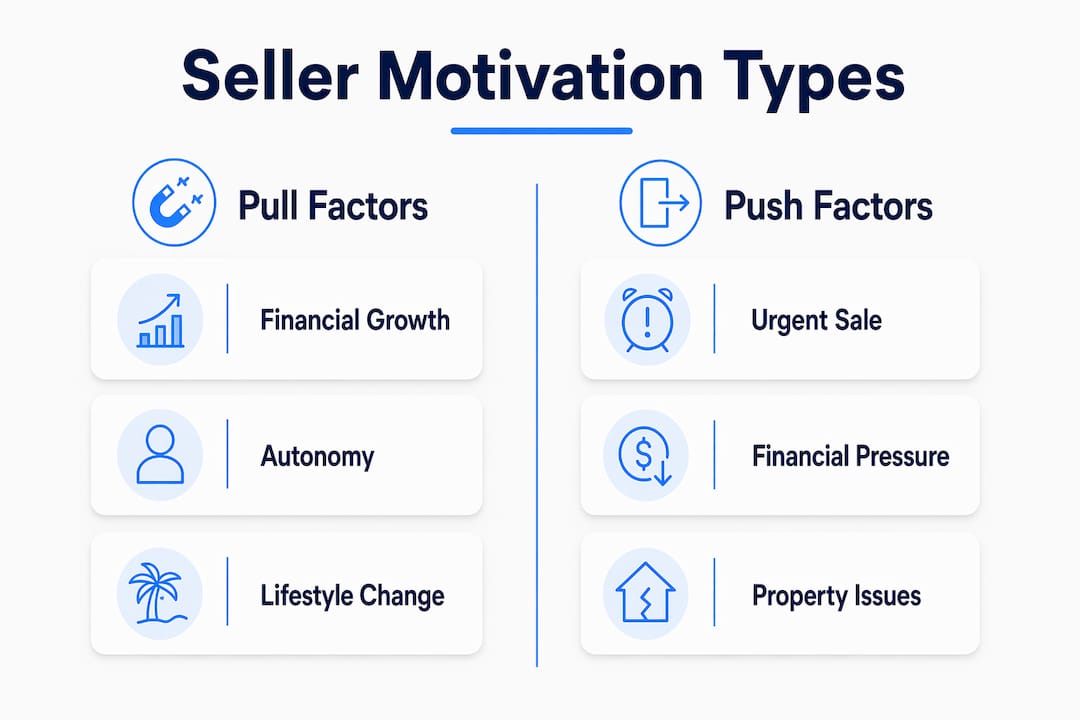
Pull-motivated property owners tend to be deliberate. They set timelines, compare offers, and respond well to respect and professionalism. Push-motivated owners, by contrast, are reactive. They respond to speed, simplicity, and empathy. Here is how the two categories break down in practice:
Pull factors:
- Desire to free up capital for a new investment
- Retirement planning or portfolio rebalancing
- Passion project pivot (selling a rental to fund a business)
- Desire for less management responsibility on their own terms
Push factors:
- Pre-foreclosure or tax delinquency notices
- Probate proceedings and inherited property disputes
- Code violations creating financial and legal pressure
- Divorce forcing a forced sale timeline
- Physical or emotional burnout from property management
Understanding pull and push motivation lets you match your language to the seller’s reality. With a pull-motivated owner, lead with opportunity. With a push-motivated owner, lead with relief.
How does seller motivation shift over time?
Motivation is not fixed. Entrepreneurial motivations evolve along four pathways: financial ambition, social impact, family tradition, and necessity-driven survival. A landlord who bought a rental property 20 years ago out of financial ambition may now be holding it out of family tradition or legacy. That shift changes everything about how you approach the conversation.
The table below maps common owner types to their dominant motivation pattern and what that means for your outreach:
| Owner type | Dominant motivation | What they need from you |
|---|---|---|
| New investor seller | Financial ambition (pull) | Data, speed, and a clean offer |
| Legacy or inherited owner | Family tradition or obligation | Respect, patience, and context |
| Distressed seller | Necessity-driven (push) | Empathy, simplicity, and fast resolution |
| Burned-out landlord | Burnout and complexity fatigue | Relief from process, not just price |
Demographic factors also shape motivation patterns. Younger owners tend to be more driven by wealth and status than by social or environmental goals, while established owners often shift toward legacy and impact. Family tradition motivation is also shaped by media narratives and community norms, which means a seller in a tight-knit neighborhood may resist selling even under financial pressure because of what it signals to others.
Recognizing these shifts helps you time your follow-up correctly. An owner who is not ready today because of family tradition may be ready in six months after a life event. Strong follow-up systems keep you in position when that moment arrives.
What practical methods help investors identify seller motivation?
The most reliable way to uncover motivation is to ask open-ended questions and then listen without rushing to fill silence. Most investors talk too much. The sellers who reveal their real situation do so when they feel heard, not when they feel sold to.
Here is a repeatable process for identifying and responding to owner motivation:
- Open with a neutral question. Ask “What’s got you thinking about selling right now?” rather than “Are you ready to sell?” The first invites a story. The second invites a yes or no.
- Listen for time pressure. Words like “soon,” “before,” “by the time,” and “already” signal push motivation. Note them.
- Ask about the property’s history. “How long have you owned it?” and “What’s been your experience managing it?” reveal emotional attachment and fatigue levels.
- Probe the outcome, not the price. “What would a successful sale look like for you?” surfaces what the owner actually needs, which is often not the highest number.
- Confirm the motivation before making an offer. Restate what you heard: “It sounds like the main thing for you is getting this resolved before the probate deadline. Is that right?” Confirmation builds trust and prevents misaligned offers.
Authentic motivation surfaces only after rapport and acknowledgment of the owner’s challenge. Skipping rapport to get to the offer is the single most common mistake investors make on cold calls.
Pro Tip: If a seller mentions a deadline, write it down and reference it in your follow-up. Showing you remembered signals that you listened, and that alone separates you from every other caller they heard that week.
For a deeper look at reading seller signals, the ClosersLeague guide on uncovering seller motivation breaks down the exact questions that work across different seller types.
What challenges do investors face with owner motivation?
The biggest challenge is misreading low motivation as a dead lead. Low motivation is often temporary, caused by decision fatigue and the feeling that the process is too complex to start. Owners in this state are not uninterested. They are overwhelmed.
Signs that an owner’s motivation has faded rather than disappeared:
- They agreed to talk but keep rescheduling
- They say “I’m just not sure yet” without a specific objection
- They respond to messages but never initiate next steps
- They mention the property frequently but avoid committing to a timeline
The wrong response is to increase financial pressure. Owners experiencing burnout respond better to simplification than to bigger numbers. Break the process into the smallest possible steps. Instead of “Let’s schedule a walkthrough and get you an offer,” try “Can I just ask you two quick questions this week?” That reduction in perceived effort restores engagement.
Small, measurable wins rebuild an owner’s confidence that a sale is actually possible. Owners who feel the process is manageable move forward. Owners who feel buried in complexity go silent.
Vacant property owners face a specific version of this challenge. The property is a financial drain, but the emotional weight of deciding what to do keeps them stuck. Resources on vacant property decisions show that framing the conversation around relief and simplicity, rather than profit, moves these sellers forward faster.
Key Takeaways
Understanding seller motivation as a dynamic mix of pull and push factors is the foundation of every successful investor conversation.
| Point | Details |
|---|---|
| Pull vs. push factors | Pull factors signal choice; push factors signal urgency. Match your approach to the type. |
| Motivation shifts over time | Legacy, burnout, and life events change a seller’s readiness. Time your follow-up accordingly. |
| Rapport unlocks real motivation | Sellers disclose true reasons only after they feel heard and respected. |
| Low motivation is not a dead lead | Decision fatigue causes silence. Simplify the next step to restore engagement. |
| Small wins close deals | Breaking the process into tiny steps rebuilds seller confidence and moves conversations forward. |
Why I think most investors read motivation completely wrong
Most investors treat motivation like a light switch. Either the seller is motivated or they are not. That framing kills deals before they start.
What I have seen, working with investors and wholesalers across hundreds of cold call scenarios, is that motivation is a dial, not a switch. It moves. A seller who was cold in January can be ready in March after a missed mortgage payment or a family conversation. The investors who close the most deals are not the ones with the best scripts. They are the ones who understand where a seller is on that dial and adjust accordingly.
The other mistake I see constantly is leading with price. Price is a factor, but it is rarely the primary one. Authentic owner motivation almost always comes down to something more personal: relief from stress, a clean exit, protecting a family member, or simply not wanting to deal with the property anymore. When you ask “what would a successful sale look like for you?” and actually wait for the answer, you learn things no comparable sales report will ever tell you.
The investors I respect most treat every call as a listening exercise first and a sales conversation second. That shift in mindset is what separates a 10% close rate from a 30% one.
— Dave
How ClosersLeague helps you read and respond to owner motivation
Knowing the theory behind seller motivation is one thing. Executing it under pressure on a live call is another.

ClosersLeague is an AI-powered cold calling training platform built for real estate investors and wholesalers. The platform puts you in realistic roleplay scenarios with sellers facing inherited property situations, code violations, and pre-foreclosure pressure. You practice reading motivation signals, building rapport, and adjusting your approach in real time, without the cost of a real deal going sideways. Start with inherited property roleplay to sharpen your ability to handle legacy and obligation-driven sellers. Add pre-foreclosure practice to build confidence with high-pressure, push-motivated conversations. Stop winging it. Start drilling.
FAQ
What is owner motivation in real estate?
Owner motivation is the combination of internal desires and external pressures that drives a property owner to sell or hold their real estate. Investors use this concept to tailor their offers and communication to match the seller’s actual needs.
What are the two main types of seller motivation?
The two main types are pull factors, which are intrinsic motivations like financial growth and autonomy, and push factors, which are external pressures like foreclosure, probate, or burnout. Identifying which type applies shapes every part of your negotiation approach.
How can I uncover a seller’s true motivation on a cold call?
Ask open-ended questions like “What’s got you thinking about selling right now?” and listen for time pressure, emotional attachment, or fatigue signals. True motivation surfaces only after the seller feels heard and respected.
Why does seller motivation change over time?
Motivation shifts as life circumstances change, including financial events, family dynamics, and property management fatigue. An owner who was not ready six months ago may be highly motivated today after a missed payment or a family decision.
What should I do when a seller seems unmotivated?
Reduce the complexity of the next step rather than increasing your offer. Decision fatigue is the most common cause of seller silence, and simplifying the process restores engagement faster than financial pressure does.