Property ownership research is the process of identifying the legal owner of a parcel, locating their contact information, and verifying that data before making outreach. For real estate investors and wholesalers, knowing how to research property owners is the difference between chasing listed deals and building a pipeline of off-market opportunities. The process starts at your county tax assessor’s website, extends to the county recorder’s office, and often requires Secretary of State business databases and skip tracing to reach the actual person behind an LLC or trust. Get this right, and you gain access to motivated sellers before anyone else does.
How to research property owners: essential tools and resources
The county tax assessor website is your starting point. It provides the legal owner name, mailing address, parcel number, and tax status for any property in the county. Most assessor portals are free, updated regularly, and searchable by address or Assessor Parcel Number (APN). The county assessor and recorder are authoritative sources because they reflect the most current ownership on file with local government.
Beyond the assessor, you need the county recorder or register of deeds. This office holds the actual deed documents, which show the legal transfer of ownership from one party to another. County GIS parcel maps add a geographic layer, letting you search by location when an address is incomplete or a property sits in a rural area without a standard street number.

For properties owned by business entities, the Secretary of State database is non-negotiable. It lists registered agents and managing members for every LLC or corporation registered in that state. Paid skip tracing services and real estate data platforms fill the final gap by compiling phone numbers and email addresses that public records never publish.
| Resource | Cost | Speed | Best For |
|---|---|---|---|
| County tax assessor website | Free | Fast (2–5 minutes) | Legal owner name, APN, mailing address |
| County recorder / deeds office | Free or low fee | Moderate | Deed history, liens, ownership transfers |
| County GIS parcel maps | Free | Fast | Location-based searches, rural properties |
| Secretary of State database | Free | Fast | LLC registered agents, managing members |
| Skip tracing services | Paid | Very fast | Phone numbers, emails, contact details |
Pro Tip: Start with free public resources to confirm ownership, then use a paid skip tracing service only when you need direct contact info. This keeps your research cost low per lead.
How to conduct step-by-step property owner research
A clear sequence prevents wasted time and missed details. Follow these steps every time you research a property.
-
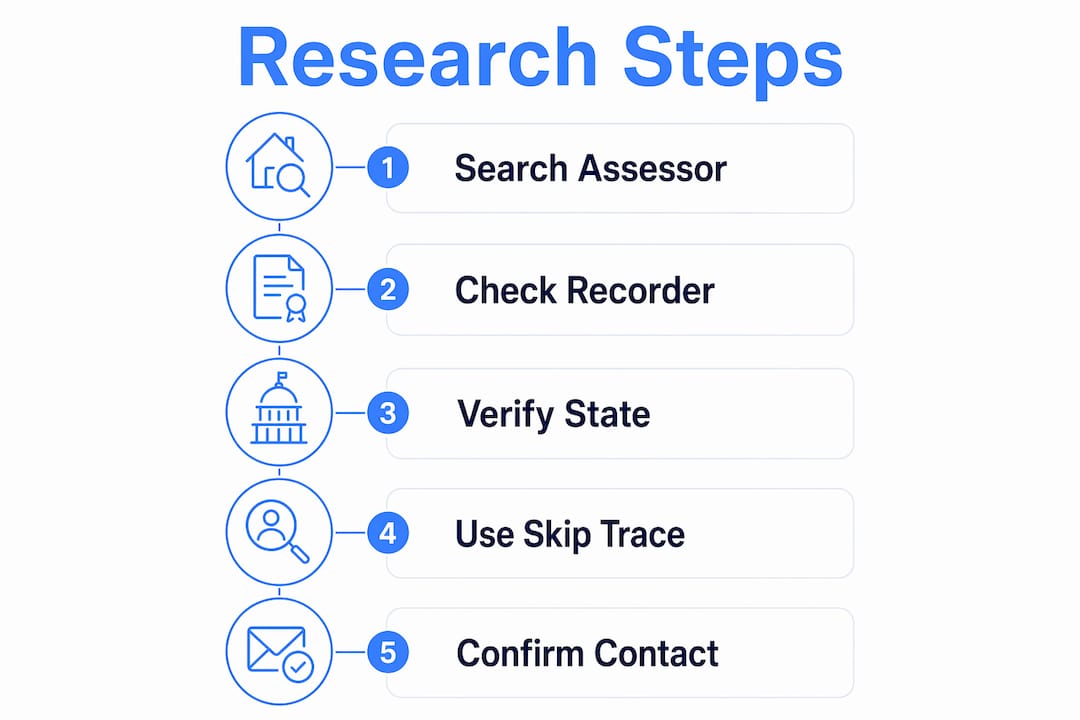
Search the county tax assessor website by property address or APN. Pull the legal owner name, mailing address, and parcel number. This takes 2–5 minutes per property on most county portals.
-
Record the parcel number. This identifier links every public record tied to that property across multiple databases. Never skip this step.
-
Move to the county recorder’s office and search by parcel number. Pull the most recent deed. The deed shows the grantor (seller) and grantee (buyer), which confirms the legal owner and the date of transfer.
-
Check for liens, lis pendens, and quitclaim deeds in the recorder’s index. These filings signal financial distress, ownership disputes, or recent transfers that may not yet appear in assessor records.
-
Identify the ownership type. If the owner name includes “LLC,” “Trust,” or “Corp,” you need an additional step. The assessor record alone does not tell you who controls that entity.
-
Search the Secretary of State business database for the entity name. The filing will list a registered agent and, in many states, the managing members or officers. Secretary of State filings reveal the human contacts behind business entities, which is the critical step most new investors skip.
-
Cross-reference the managing member’s name with online searches, LinkedIn, or social profiles to confirm identity and find additional contact details.
Pro Tip: Keep a simple spreadsheet with columns for APN, legal owner name, entity type, registered agent, mailing address, and contact status. Tracking these identifiers prevents duplicate research and keeps your outreach organized.
What are the challenges of identifying the beneficial owner?
Many properties are held inside LLCs, land trusts, or corporations. County records show the entity as the legal owner, but they do not show the individual who controls it. This is the most common barrier investors hit when trying to find property owners for off-market deals.
The Secretary of State database solves part of this problem. Every LLC must register with the state, making that data public. The registered agent listed in the filing is often the owner’s attorney or the owner directly. Either way, it gives you a real name to research further.
Skip tracing fills the remaining gap. Public records rarely include phone numbers or personal email addresses. Skip tracing services compile this data from multiple public and commercial sources, reducing research time from hours to minutes per property. This speed matters when you are working a large list of tax-delinquent or probate leads.
Here are the most effective techniques for unmasking beneficial owners:
- Deed history review: Look for quitclaim deeds, which often signal transfers between related parties or into a trust. A recent quitclaim deed can reveal the original individual owner’s name.
- Lien and lis pendens searches: These filings name the parties involved in financial or legal disputes tied to the property, often exposing the controlling individual.
- Secretary of State cross-referencing: Search the entity name and then search the registered agent’s name separately. One agent may manage multiple LLCs owned by the same person.
- Online name searches: Combine the owner or agent name with the city or county. News articles, court records, and social profiles frequently surface useful contact details.
- Neighbor outreach: Neighbors often know whether a property is absentee-owned, recently inherited, or facing distress. This qualitative insight complements your public record research.
Pro Tip: Always verify ownership details across at least two sources before making contact. Assessor records and deed records can differ, especially after a recent sale or estate transfer.
How do you verify accuracy in property owner research?
Ownership records are not always current. A property can sell, transfer into a trust, or change hands through probate without the assessor’s database reflecting it immediately. Deeds show the actual transfer of ownership with grantor and grantee names, while assessor records show the taxpayer, and those two names do not always match. Relying on assessor data alone produces errors.
Use these verification steps for every property you research:
- Compare the assessor record to the most recent deed. If the names differ, the deed controls. The deed is the legal document of ownership.
- Check the recording date on the deed. A deed recorded within the last 90 days may not yet appear in the assessor’s system.
- Search for multiple parcels under the same owner name or entity. Parcel mapping tools let you see all properties tied to one owner, which helps you identify portfolio sellers and prioritize outreach.
- Validate LLC beneficial owners by cross-referencing the Secretary of State filing with the deed grantor name. If they match, you have confirmed the controlling individual.
- Contact a neighbor when records are ambiguous. A neighbor can confirm whether the property is owner-occupied, rented, or vacant, which affects your outreach approach.
- Never rely on a single database. Triangulate across the assessor, recorder, and Secretary of State to build a complete, accurate ownership profile.
The goal of qualifying real estate leads starts with verified ownership data. Bad data wastes calls and kills deals before they start.
Key Takeaways
Effective property ownership research requires layering free public records with business registry data and skip tracing to identify and contact the true owner behind any property.
| Point | Details |
|---|---|
| Start with the county assessor | Search by address or APN to get the legal owner name, mailing address, and parcel number. |
| Use the county recorder for deeds | Deed records confirm the legal owner and reveal liens, quitclaims, and ownership history. |
| Unmask LLC owners via Secretary of State | State business filings list registered agents and managing members for entity-owned properties. |
| Skip tracing fills the contact gap | Paid skip tracing delivers phone numbers and emails that public records do not include. |
| Verify across multiple sources | Cross-reference assessor, deed, and business registry data before making any outreach. |
Why most investors stop one step too short
Most new investors pull the assessor record, see “XYZ Holdings LLC,” and stop. That is the most expensive mistake in ownership research. The assessor record is the starting line, not the finish line.
The investors who consistently land off-market deals treat ownership research as a chain. They start at the assessor, move to the recorder for deed history, then hit the Secretary of State to find the person behind the entity. When that person is still hard to reach, they use skip tracing to get a phone number. Then they call.
What separates the pros is not access to better data. Most of the best data is free. What separates them is the discipline to follow every link in the chain and the patience to cross-check before picking up the phone. I have seen investors burn through entire lead lists because they called the wrong person or used an outdated mailing address. A 15-minute verification process per property prevents that entirely.
The other thing worth saying plainly: understanding off-market property dynamics changes how you prioritize your research. Distressed owners, absentee landlords, probate heirs, and tax-delinquent sellers are not browsing the MLS. You have to find them. And finding them starts with knowing exactly who owns the property and how to reach that person directly.
— Dave
Put your research to work with ClosersLeague
You have done the research. You have the owner’s name and a phone number. Now the real work begins.

ClosersLeague is an AI-powered cold calling training platform built specifically for real estate investors and wholesalers. You can practice real estate cold calls using realistic AI roleplay scenarios tailored to seller types like foreclosure, probate, divorce, and tax-delinquent owners. The platform scores your calls, identifies weak spots in your objection handling, and builds the confidence you need to convert researched leads into real conversations. Stop letting good owner data go to waste on calls that fall apart. Practice the conversation before it counts.
FAQ
How do I find the owner of a property for free?
The fastest free method is searching the county tax assessor’s website by property address or APN. Most county portals return the legal owner name, mailing address, and tax status in under five minutes.
What is an APN and why does it matter?
An APN (Assessor Parcel Number) is a unique identifier assigned to every parcel by the county. It links ownership records across the assessor, recorder, and GIS databases, making it the most reliable search key for property ownership research.
How do I find the owner behind an LLC?
Search the LLC name in the Secretary of State business database for the state where the property is located. The filing lists a registered agent and often the managing members, giving you real names to research further.
What is skip tracing in real estate?
Skip tracing is the process of locating a person’s phone number, email, or current address using commercial data sources. Real estate investors use it when public records provide ownership details but no direct contact information.
How do I verify that my ownership research is accurate?
Compare the county assessor record to the most recent deed at the county recorder’s office. If the names differ, the deed is the controlling document. Cross-reference both against the Secretary of State filing for entity-owned properties to confirm the beneficial owner.