
Why automation is essential for real estate investors
Investors using automation are seeing 3-5x ROI within six months, along with 70-90% time savings on tasks like deal analysis and follow-up. If you’ve been hesitant about automation because you fear it strips out the personal touch, you’re not alone. Most investors share that concern. But the data tells a different story. Automation doesn’t replace relationships. It clears the path so you can focus on them. This guide breaks down exactly how real estate investors and wholesalers are using automation to generate more leads, close more deals, and stop wasting hours on admin work that a system can handle better.
Table of Contents
- What automation means for real estate investors
- How automation maximizes lead generation and deal flow
- Comparing manual vs automated processes in real estate
- Overcoming pitfalls and maximizing automation’s value
- Our take: The real edge in modern real estate investing
- Ready to accelerate your growth with automation?
- Frequently asked questions
Key Takeaways
| Point | Details |
|---|---|
| Save time and close more | Automation frees you from repetitive admin so you can focus on closing more deals and growing your portfolio. |
| Maximize lead generation | Qualifying and nurturing leads automatically means more quality prospects with less effort and expense. |
| Proven 3-5x ROI boost | Researchers report automation delivers a 3-5x return on investment in as little as six months. |
| Gain a real edge | 24/7 automation puts you ahead of competitors while you focus on negotiation and relationships. |
What automation means for real estate investors
Automation in real estate isn’t one single tool. It’s a category of technology that handles repetitive, time-consuming tasks so you and your team can focus on what actually moves deals forward: conversations, negotiations, and closings.
For investors and wholesalers, automation covers a broad range of workflows:
- Lead scraping and list building from public records (foreclosure, probate, tax delinquent, divorce)
- Lead qualification using AI scoring to rank which contacts are worth calling
- Automated follow-ups via text, email, or voicemail drops
- Pipeline management that updates deal stages without manual data entry
- Marketing automation including drip campaigns to warm up cold leads
- Appointment scheduling triggered by seller responses
These aren’t futuristic concepts. They’re tools investors are already using today. And they directly address the bottlenecks that slow down most wholesaling operations: too many leads to track, too little time to follow up, and too much energy spent on low-probability contacts.
Pro Tip: Track your time for one week before adopting any automation tool. Most investors discover they’re spending 60-70% of their workday on admin tasks, not actual deal-making. That number alone builds the case for automation fast.
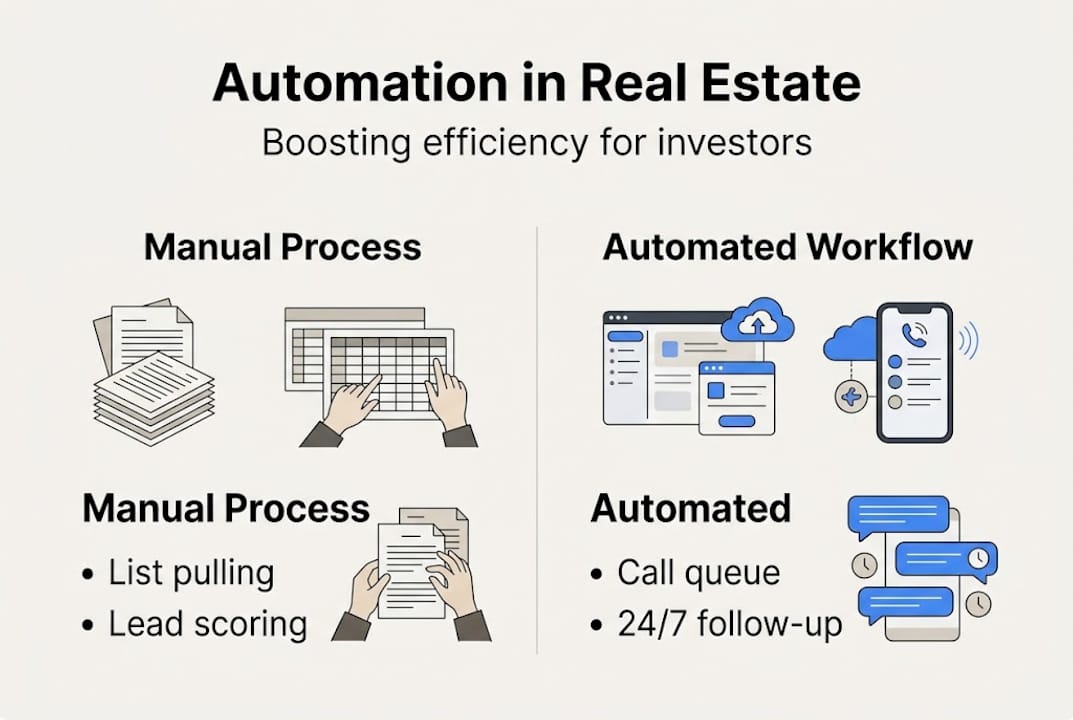
The fear that automation will make your business feel robotic is understandable. But CRM automation benefits show the opposite: when routine work is handled automatically, investors report more meaningful conversations because they’re better prepared and more focused during each call.
Experts note that automation enables 24/7 operations, precise targeting, and a shift away from admin work toward closing, with industry-wide efficiency gains projected at $34 billion. That’s not a marginal improvement. That’s a structural shift in how real estate investing works. Automation is the competitive edge that separates investors who scale from those who stay stuck.
How automation maximizes lead generation and deal flow
Lead generation is the lifeblood of any wholesale operation. The problem isn’t usually a shortage of leads. It’s a shortage of qualified leads. Most cold callers waste more than 50% of their dial time on contacts who have no interest in selling, no urgency, or no motivation. That’s hours of effort with minimal return.
Automation changes that equation entirely. When AI qualifies leads first, reducing wasted dials, your team reaches only the most promising contacts. You handle 10x more leads without adding 10x more staff.
Here’s what the numbers look like in practice:
| Metric | Without automation | With automation |
|---|---|---|
| Time spent on lead qualification | 4-6 hours/day | Under 1 hour/day |
| Cost per qualified lead | High (manual research) | 20-40% lower |
| Close rate | Baseline | 30-40% higher |
| Leads handled per month | Limited by team size | Scales 10x |
A typical automated lead workflow looks like this:
- Data pull: Your system scrapes public records for motivated seller signals (lis pendens filings, probate listings, tax delinquent properties).
- AI scoring: Leads are ranked by motivation level, property value, and contact quality.
- List segmentation: High-priority leads go to your calling queue. Lower-priority contacts enter a drip campaign.
- Auto-dialing and call routing: Your team dials only pre-qualified numbers, with call notes and property data visible on screen.
- Automated follow-up: After each call, the system sends a follow-up text or email based on the call outcome.
- Pipeline update: The CRM logs every interaction without manual entry.
Mastering lead generation basics is still essential. Automation amplifies what you already do well. It doesn’t compensate for poor scripts or weak objection handling. That’s why pairing automation with scripted workflows is so effective: the system handles the pipeline while you sharpen your calls.
Comparing manual vs automated processes in real estate
To really feel the impact, let’s look at what a typical day looks like with and without automation.
Without automation: You wake up, pull a list manually from a county website, cross-reference it with skip tracing data in a spreadsheet, and start dialing. Between calls, you manually update your CRM, write follow-up notes, and schedule reminders. By mid-afternoon, you’ve made 40 calls and talked to 12 people. Three were interested. You’ll follow up tomorrow. Maybe.
With automation: Your system pulled the list overnight, scored every lead, and loaded your call queue. You start dialing at 9 AM with full lead context on screen. After each call, follow-ups are triggered automatically. By mid-afternoon, you’ve touched 120 leads and your CRM is already updated.

Here’s the side-by-side:
| Process | Manual | Automated |
|---|---|---|
| Time spent on data entry | 2-3 hours/day | Near zero |
| Leads contacted per day | 40-60 | 120-180 |
| Cost per qualified lead | High | 20-40% lower |
| Follow-up consistency | Inconsistent | 100% automated |
| Close rate improvement | Baseline | Up to 40% higher |
“Wholesalers adopting automation tools report 3-5x ROI within six months, 30-40% higher close rates, and 70-90% time savings on key tasks.”
The trade-offs worth knowing:
- Manual pros: Full control, highly personal, no setup required
- Manual cons: Not scalable, prone to burnout, inconsistent follow-up
- Automated pros: Scalable, consistent, data-driven
- Automated cons: Upfront setup time, requires monitoring, not a substitute for strong sales skills
The myth that automation eliminates the human side of wholesaling is just that: a myth. The investors who win use automation to handle the mechanics while they focus on wholesale deal strategies and relationship-building. Understanding the full wholesaling process helps you identify exactly where automation fits best.
Overcoming pitfalls and maximizing automation’s value
Automation isn’t plug-and-play. Many investors invest in tools and see little return because they skip critical setup steps or expect the technology to do everything. Here are the most common mistakes:
- Automating broken processes. If your follow-up is inconsistent manually, automating it won’t fix the root problem. Clean up your workflow first.
- Ignoring lead quality inputs. Garbage in, garbage out. If your lists aren’t properly segmented, your automation will generate high volume with low conversion.
- Over-automating early conversations. Motivated sellers in distress need a human voice, not a bot. Use automation for qualification and follow-up, not first impressions.
- Failing to monitor performance. Automation runs in the background. Many investors set it and forget it, missing the signals that something isn’t working.
- Skipping training. Your team needs to know how to handle leads that come through automated funnels. The handoff from automation to human is where deals are won or lost.
Pro Tip: Start with one automation, not ten. Automate your follow-up sequence first. It’s the highest-ROI starting point because effective follow-up strategies are where most deals are actually closed, not on the first call.
To track whether automation is working, monitor these checkpoints weekly:
- Contact rate (calls answered vs. dials made)
- Lead-to-appointment conversion rate
- Cost per qualified lead
- Follow-up sequence open and response rates
- Deals closed per 100 leads touched
Investors who treat automation as a system to be improved, not just installed, consistently outperform their peers. AI tools continue to advance rapidly. The investors building the habit of learning and iterating today are the ones who will have the biggest edge in 2026 and beyond. ROI of 3-5x within six months is achievable, but only when you commit to managing the system actively.
Our take: The real edge in modern real estate investing
Here’s what five-plus years in this field consistently shows: the investors who struggle with automation aren’t failing because of bad tools. They’re failing because they bought a tool without changing a habit.
Automation works when it amplifies a system that already functions. It multiplies your strengths. It also multiplies your weaknesses. If your scripts are weak, if your objection handling is shaky, if your follow-up is half-hearted, automation just delivers those failures faster and at higher volume.
The uncomfortable truth is that most automation falls short because investors treat it as a shortcut instead of a force multiplier. The technology doesn’t close deals. You do. Automation just makes sure you’re spending your energy on the right contacts at the right time.
Focusing on winning wholesale deals requires sharp skills, consistent practice, and a system that puts quality leads in front of you. Automation handles the system. You still have to show up ready to convert.
Relentless follow-up, powered by automation but driven by a real person, remains the single most consistent driver of closed deals we’ve ever seen. Don’t outsource that human element. Amplify it.
Ready to accelerate your growth with automation?
Knowing the strategy is one thing. Executing it under pressure, on a real call with a motivated seller, is another. That’s where most investors leave money on the table.
ClosersLeague is built for exactly this. Our AI cold calling roleplay platform lets you practice live scenarios across every distressed seller situation: foreclosure, probate, divorce, and more. Want to sharpen a specific niche? Try our code violation calling practice to build confidence on some of the toughest conversations in the business. Stop winging it. Start drilling with a platform designed to make every rep count.
Frequently asked questions
What tasks can automation handle for real estate investors?
Automation manages lead scraping, qualification, follow-ups, pipeline updates, and initial outreach, saving you hours each week and allowing your time savings of 70-90% to be redirected toward closing deals.
How much more effective is automated cold calling than manual dialing?
Automated systems help you handle 10x more prospects by qualifying leads before you dial, dramatically cutting wasted calls and improving your contact-to-conversion ratio.
Does automation reduce my control over real estate deals?
Not at all. Automation focuses on closing rather than admin, which means you spend more time on negotiations and relationship-building, the parts of the deal only you can handle.
What ROI can I expect from automating my wholesale business?
Wholesalers typically report a 3-5x ROI within six months, alongside 30-40% higher close rates and meaningful reductions in cost per qualified lead.
Recommended
- Real estate CRM: Benefits, features, and best practices – ClosersLeague Blog
- Real Estate Follow Up: Close More Deals in 2026 – ClosersLeague Blog
- Boost Real Estate Deals with a Proven Investor Script Workflow – ClosersLeague Blog
- Master Real Estate Lead Generation: Cold Calling Basics – ClosersLeague Blog