Adapting scripts live means changing your wording, pace, or ask in real time, mid call, based on what a homeowner says or how they say it. This is not about theater cues or automation. It is about a probate widow who says “I don’t know” in a tone that means “convince me,” and you shifting your next line before she hangs up. The core rule: build a compact wireframe like REAP (Reason, Empathy, Probe, Permission), listen more than you talk, and improvise on the framework, never on the goal. ClosersLeague exists because that skill is trained through repetition, not read about.
- Adapt phrasing and tone, not the outcome you’re calling to secure.
- Use a four-part wireframe as your mental script, not a paragraph to recite.
- Listen for cues before you decide what to change.
Key Takeaways
Adapting scripts live works because callers who improvise on a compact wireframe, listen more than they talk, and drill their exact freeze points close more distressed-seller appointments than callers who memorize full scripts.
| Point | Details |
|---|---|
| Use a wireframe, not a script | Reduce full sentences to four prompts (Reason, Empathy, Probe, Permission) you can hold in memory. |
| Match tone before changing words | Mirror pace and wording before adjusting your ask, so shifts sound natural, not scripted. |
| Drill your actual freeze points | Identify the exact line that trips you up and repeat it ten times, not a generic objection list. |
| Treat objections as engagement | Acknowledge, ask a clarifying question, then guide, since objections often signal interest, not rejection. |
| Practice with realistic pressure | ClosersLeague’s AI voice roleplay and real-time coaching prompts move you from solo reading to live, coached calls faster than practicing alone. |
Table of Contents
- How Do You Adapt Scripts Live Using a Wireframe?
- What Micro-Adjustments Work Best on a Live Call?
- How Should You Practice Adapting Scripts Before Going Live?
- What’s the Fastest Way to Handle Objections Live?
- What Do Successful Live Script Adaptations Sound Like?
- When Should You Stop Adapting and Walk Away?
- Practice Live Adaptation Before You’re on the Phone With a Real Seller
- Sources
- FAQ
How Do You Adapt Scripts Live Using a Wireframe?
A wireframe replaces your full-sentence script with four prompts you can hold in your head. That matters because Sierra Interactive’s research on cold-calling scripts found the secret to sounding unscripted is internalizing a flexible framework instead of memorizing sentences, then asking permission early and talking less than you think. A REAP-adapted wireframe for distressed sellers looks like this:
- Reason — state a specific, relevant reason for the call in the first ten seconds (“I saw the property on Maple went through probate filing last month”).
- Empathy — acknowledge the situation without over-explaining (“That’s a lot to manage on top of everything else”).
- Probe — ask one open question tied to their actual situation, not a script line (“What’s the plan for the house right now?”).
- Permission — ask before you pitch (“Mind if I ask a couple quick questions to see if this is even worth discussing?”).
Converting a scripted line like “Hi, my name is [Name] and I buy houses in your area, I noticed your property is in pre-foreclosure and wanted to see if you’d be interested in a cash offer” into a wireframe means stripping it to four words on a notecard: Reason, Empathy, Probe, Permission. You fill in the sentence live, based on tone.
Shorten the script when the seller talks fast or answers in short bursts, matching their rhythm. Expand it only when they ask a direct question that deserves a full answer.
Pro Tip: Write your wireframe on a sticky note, not a full script page. If you need to glance down for more than two words at a time, it’s too long for a live call.
What Micro-Adjustments Work Best on a Live Call?
Small, fast adjustments beat big script rewrites. The goal is sounding like a person reacting, not a rep reading.
Mirror the seller’s own wording back to them, match their pace (slow down for a hesitant caller, pick up energy for a rushed one), and use reflective phrases like “sounds like the timing’s been rough” instead of generic sympathy lines. These signal you’re actually listening, and Propphy’s cold-calling guide notes the opener should function as a prompt to start a dialogue, not a monologue to recite.
Common on-call moments and ready lines:
- Long silence after your opener: “No pressure, just wanted to check in. Is now a bad time?”
- Seller sounds defensive: “Totally fair. I’m not here to convince you of anything, just asking questions.”
- Seller mentions a family member decides too: “Makes sense. Would it help to loop them in on a follow-up call?”
- Seller gives a one-word answer: Shorten your next ask to one sentence, no preamble.
When a seller shows real urgency (a firm timeline, a specific dollar concern, a “when can you look at it”), escalate straight to booking an appointment. When they’re lukewarm but not closed off, set a low-commitment next step instead, like a text follow-up or a callback date, and log it before you hang up.
One reminder that belongs in every script adaptation conversation: know your DNC and TCPA obligations before you improvise on cadence or call timing. Adapting a script never means adapting your compliance requirements.
How Should You Practice Adapting Scripts Before Going Live?
Confidence on a live call comes from a progression, not a pep talk. Alex Berman’s cold-calling framework lays out five levels: read the script aloud, record yourself, run a pressured roleplay, take live calls with real-time coaching, then adapt autonomously without a net.
- Read aloud — say your wireframe out loud until the four prompts feel automatic.
- Record yourself — listen back for filler words and dead air.
- Pressured roleplay — have someone (or an AI) throw curveball objections at you.
- Live calls with coaching — take real calls with a coach or tool feeding you prompts in real time.
- Autonomous adaptation — you’re improvising on the wireframe with no support.
A 15-minute daily routine compounds this fast: warm up by reading your wireframe aloud for two minutes, run one freeze-point drill (identify the exact line that makes you stumble, then repeat it ten times), then review one real call for five minutes. Sayso’s research on script practice confirms consistent short sessions like this beat occasional long ones.
For AI roleplay, tell the tool exactly what distress type and emotional state to simulate: “Play a pre-foreclosure homeowner who’s defensive and short on time.” That specificity matters more than general practice, because Sayso’s guide found practicing with real pressure and live-call coaching is where callers improve fastest.
- Level 1 to 3: ClosersLeague’s voice roleplay scenarios for probate, divorce, and vacant-property calls.
- Level 4: Real-time coaching prompts during a simulated call.
- All levels: Scorecards that flag exactly where you froze or went silent.
Pro Tip: Pick your freeze point from your worst actual call last week, not a hypothetical one. Real failure points fix faster than imagined ones.
What’s the Fastest Way to Handle Objections Live?
Objections aren’t rejections. They’re a request for more information, and treating them that way changes how you adapt your script in the moment.
The workflow is three steps: acknowledge, ask a clarifying question, then guide toward a next step. Tom Ferry’s objection-handling scripts frame this as earning the next 30 seconds, since an objection often signals engagement rather than a closed door.
Six quick replies to keep on hand:
- “I’m not interested.” — “Totally fair, mind if I ask what’s driving that?”
- “I already have an agent.” — “Got it, are you locked into a listing agreement right now?”
- “Call back later.” — “Sure, what’s a better day this week?”
- “Just send me info.” — “Happy to. Quick question first so I send the right thing.”
- “Timing isn’t right.” — “Understood. What would need to change for the timing to work?”
- “I don’t have money for repairs.” — “That’s actually common with the situations I work with. Can I ask more about the property?”
Objections are opportunities. A calm, short response and a low-commitment next step often preserves the relationship and can convert later, according to Savvy Dispatches’ research on real estate call objections.
Log every objection in your CRM the moment the call ends, then review weekly for the objection that shows up most. That’s the one to drill first, not the one that annoyed you most on a single call.
What Do Successful Live Script Adaptations Sound Like?
Probate call, seller sounds tired and short:
Rep: “I saw the property on Elm went through probate filing.” Seller: “Yeah, it’s been a lot.” Rep adapts, dropping the planned pitch and shortening to one question: “Sounds exhausting. Is the house sitting empty right now?” That single reflective line, borrowed straight from what the seller said, kept the call alive for another two minutes.

Pre-foreclosure call, seller is defensive:
Rep opens with reason and empathy, then seller snaps: “How’d you get my number?” Instead of over-explaining, the rep pivots: “Public notice, totally fair to ask. I’m not here to pressure you, just wondering if a cash sale is even something you’d consider.” The defensive energy drops because the rep matched brevity with brevity.
Divorce-related call, seller mentions a spouse decides jointly:
Rep hears “we’d have to talk about it” and adapts the ask from booking a visit to something smaller: “Makes sense. Would a quick three-way call work better than me guessing?” That’s the shorten-the-ask move in action, tied to a specific script built for divorce-related sellers.
Each example shares the same pattern: the rep heard something specific, then changed the size of the ask, not the goal.
When Should You Stop Adapting and Walk Away?
Not every “no” deserves another adaptation attempt. A firm, honest no is more valuable than a maybe that drains your calling hours for weeks, and that distinction alone separates callers who scale from callers who burn out chasing dead leads.
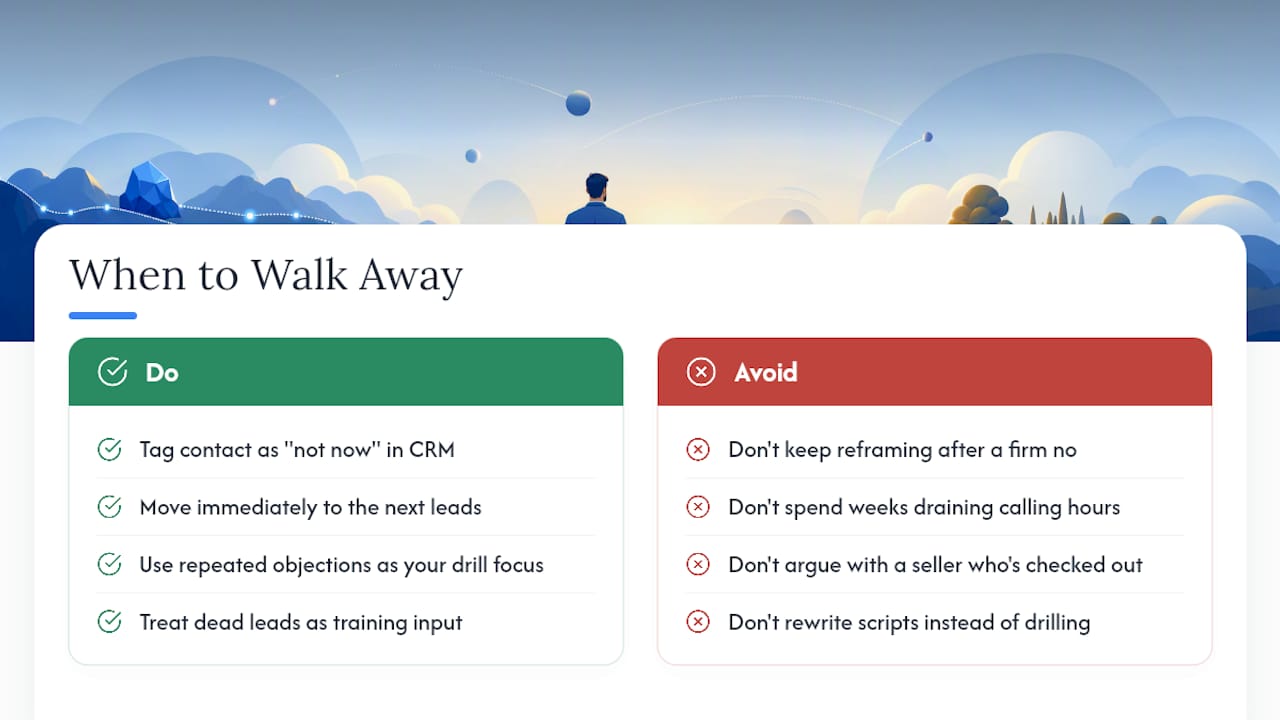
I’d rather see an investor tag a contact as “not now” in the CRM and move to the next fifty leads than spend four more calls trying to reframe a wireframe on someone who has already decided. Use the no as data: if a specific objection (agent already listed, family disagreement, no urgency) shows up across your dead leads, that’s your next drill focus, not your next script rewrite.
The callers who improve fastest treat every dead lead as a training input, feeding their weak points back into practice instead of arguing with a seller who’s already checked out.
— Dave
Practice Live Adaptation Before You’re on the Phone With a Real Seller
Reading about adaptation only gets you halfway there. ClosersLeague gives you a place to fail safely, before that failure costs you a probate lead worth five figures in commission.
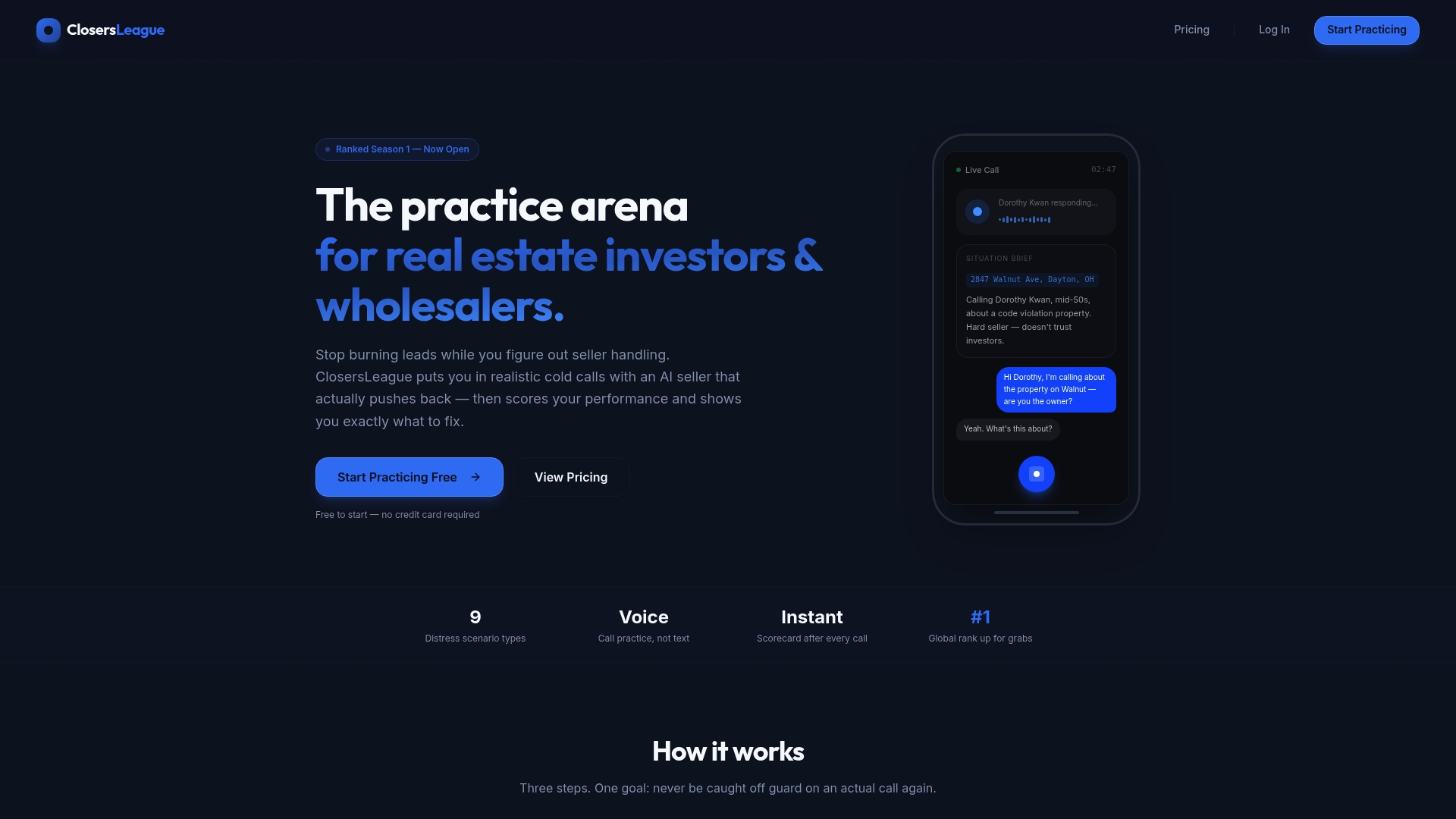
The platform’s AI voice roleplay lets you run the exact wireframe from this article against a simulated seller who talks back, interrupts, and objects the way real homeowners do. Real-time coaching prompts flag when you’ve drifted off the framework mid-call, scorecards show exactly where you froze, and leaderboards let you compare your objection-handling speed against other investors working the same distress categories. Scenario templates cover inherited property calls, code violation properties, and every other seller type in this guide, so your drills match the calls you’re actually making. Once you’ve booked the appointment, SendMLS handles the state-approved paperwork for getting an offer in front of the seller fast.
Start a free trial on the real estate cold calling practice platform and run your first freeze-point drill today.
Sources
- 5 scripts to overcome objections | Tom Ferry
- Real Estate cold calling scripts that don’t sound scripted | Sierra Interactive
- Cold calling real estate scripts | Alex Berman
- How to practice real estate scripts (Sayso)
FAQ
What Does “Adapt Scripts Live” Mean in Cold Calling?
It means changing your wording, tone, or ask during an actual call or AI practice session based on what the homeowner says, rather than reciting a fixed script.
What Framework Should I Use to Adapt Scripts Live?
Use a four-part wireframe like REAP (Reason, Empathy, Probe, Permission) as a mental prompt list instead of a full-sentence script, so you can improvise naturally within a structure.
How Do I Practice Live Script Adaptation Before Real Calls?
Progress through five levels: read the wireframe aloud, record yourself, run pressured roleplay, take live calls with coaching, then adapt autonomously; platforms like ClosersLeague provide the AI roleplay and coaching prompts for levels one through four.
How Should I Handle Objections While Adapting a Script Live?
Acknowledge the objection, ask a clarifying question to uncover the real concern, then guide the seller toward a small next step, since the goal is earning the next 30 seconds of conversation.
Is There a Legal Risk to Adapting Scripts Live?
Yes. Adapting your wording never changes your obligation to follow DNC and TCPA rules, including call timing and consent requirements.