
Most real estate investors think an investor script is a rigid speech you recite to sellers. That misconception kills deals before they start. A well-built investor script is actually a repeatable, scenario-based conversation framework that keeps you on track without sounding robotic. It gives you the right questions, the right opener, and the right mindset for each seller situation. Whether you’re calling a pre-foreclosure lead, a tired landlord, or an inherited property owner, understanding what an investor script is and how to use one will transform your conversations and your close rate.
Table of Contents
- Key Takeaways
- What an investor script really is
- Types of investor scripts for different sellers
- How to write and use an investor script
- Benefits of investor scripts and pitfalls to avoid
- My honest take on scripts after years of real estate calls
- Practice your scripts with AI before calling real sellers
- FAQ
Key Takeaways
| Point | Details |
|---|---|
| Scripts are frameworks, not monologues | An investor script guides your conversation with structure while leaving room to listen and adapt. |
| Tailor scripts to seller type | Pre-foreclosure, probate, and tired landlord calls each require different question pathways and tone. |
| The opener is your highest leverage moment | Scripting the first 20 seconds consistently sets the tone for the entire call. |
| Constraint questions drive deals | Uncovering timeline, condition, price, and decision maker is the core job of any investor script. |
| Scripts build confidence and consistency | Practicing scripted frameworks reduces hesitation and increases the quality of follow-up over time. |
What an investor script really is
In real estate lead generation, an investor script goes by several names: a cold calling script, a motivated seller script, or a conversation framework. All of these describe the same thing. Scripts are repeatable, scenario-based talking points that guide seller conversations without locking you into a robotic recitation.
A well-structured investor script has four core components.
- Opener: A short, permission-based introduction that earns the seller’s attention in the first 15 to 20 seconds.
- Discovery questions: Open-ended questions that uncover the seller’s situation, motivation, and timeline.
- Constraint inquiry: Direct questions about timeline, property condition, price expectations, and who else is involved in the decision.
- Next-step offer: A low-friction close that earns a follow-up appointment or callback, not a signed contract.
Notice that last point. A good script does not try to close a deal on the first call. It earns the next step.
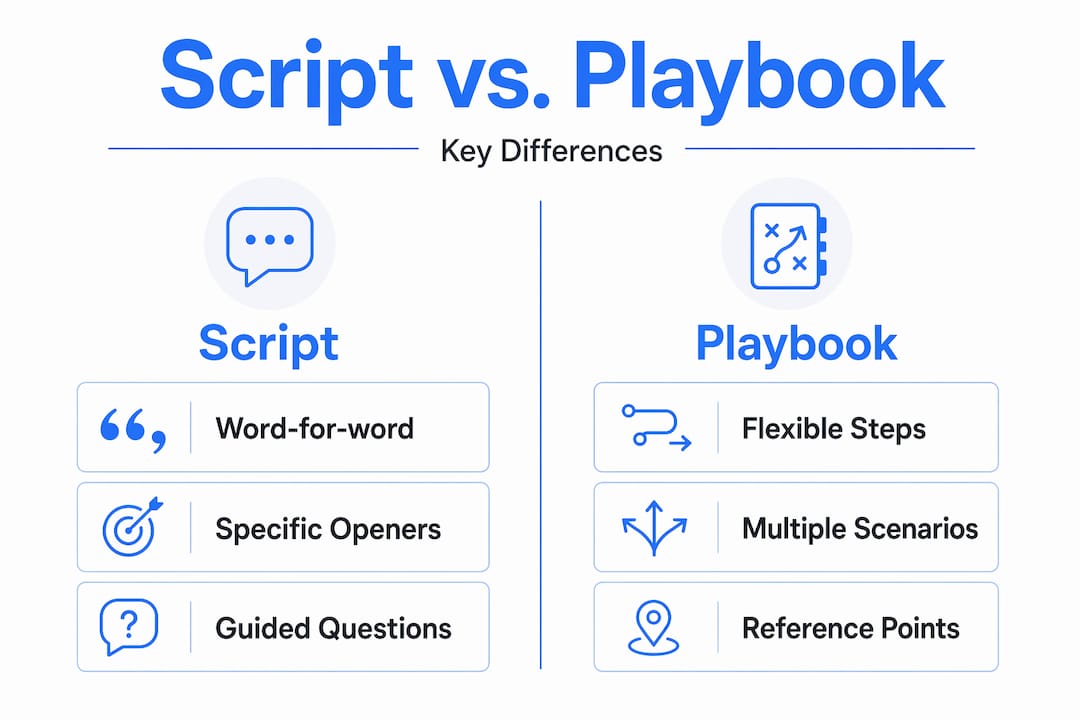
There is also an important distinction between a script, a call plan, and a playbook. Scripts are word-for-word for initial contact and key moments like objection handling. A call plan is a per-prospect strategic outline covering objectives and outcomes. A playbook is the broader strategy tying everything together. You need all three, but the script is what keeps you consistent when you’re nervous, distracted, or calling your 40th seller of the day.
Pro Tip: Write your opener and your constraint questions word-for-word. For everything else, use bullet points as reminders rather than full sentences. This gives you structure without locking you into a robotic read-through.
Types of investor scripts for different sellers
Not every seller situation is the same, and a generic script will show that immediately. Scripts must be tailored by seller type to address different motivations, which means different question pathways and different emotional tones.
Here is a quick look at the most common script types and how they differ:
| Seller Type | Primary Motivation | Tone | Key Questions |
|---|---|---|---|
| Pre-foreclosure | Avoid credit damage, fast relief | Empathetic, urgent | “How far behind are payments? What’s your timeline?” |
| Tired landlord | Escape management stress | Understanding, direct | “How long have you owned it? Any problem tenants?” |
| Inherited property | Emotional closure, split proceeds | Patient, respectful | “Are all heirs in agreement? Any liens on the property?” |
| Tax delinquent | Financial relief | Matter-of-fact, helpful | “Are you aware of the back tax amount? Any other liens?” |
| Driving for dollars | Unknown motivation | Curious, low-pressure | “Have you ever thought about selling this property?” |
Each of these requires a genuinely different approach. If you call an inherited property owner the same way you’d call a tax-delinquent homeowner, you will lose them fast. The inherited seller is grieving. The tax-delinquent seller is embarrassed. Reading the room starts with having the right script for the room you are walking into.
A few more principles that apply across all script types:
- Lead with curiosity, not offers. Ask before you tell.
- Distressed seller scripts that convert consistently open with empathy before any mention of buying.
- Adapt in real time. If the seller mentions a divorce, that is not the moment to pivot to ARV calculations. Stay on their topic.
- Never read the script while the seller is talking. Listen first, then respond from your framework.
How to write and use an investor script
Writing your own script is how you make it yours. Generic templates are a starting point, not the finish line. Here is a practical process to build one that works.
-
Script the opener word-for-word. The first 20 seconds of the call are where most deals are lost. A high-converting opening script includes your name, a quick reason for calling, and a direct permission question. Something like: “Hi, this is [Name]. I came across your property on [Street] and I work with homeowners who are considering selling. Do you have two minutes to chat?” Clean, non-pushy, and specific.
-
Build an open-ended discovery layer. After the opener, you need questions that get the seller talking. “What’s going on with the property right now?” is more powerful than “Are you interested in selling?” Open-ended questions reveal context. Yes/no questions shut conversations down.
-
Layer in constraint questions. Constraint-finding questions are your core leverage point. These cover four areas: timeline (“How soon would you need to close?”), condition (“Has the property had any major repairs needed?”), price expectations (“Do you have a number in mind?”), and decision makers (“Is there anyone else involved in this decision?”). These answers tell you whether to pursue, make an offer, or nurture the lead long-term.
-
Embed your objection responses. Write out the three most common objections you get and build responses into your script. “I’m not interested” gets a different response than “I already have an agent.” Embedded objection handling keeps the conversation moving without you freezing up.
-
Close for the next step, not the deal. The goal of the first call is a follow-up, a walkthrough appointment, or permission to run numbers. Small commitments build trust and lead to better long-term deals. Trying to get a signed contract on call one usually ends the conversation entirely.
Pro Tip: Record yourself running through your script and play it back. If you sound like you are reading, you are reading too much. Trim the script until you only have the phrases you actually need to stay on track.
Benefits of investor scripts and pitfalls to avoid
The benefits of using an investor script go well beyond sounding prepared. Let’s be specific.
Scripts reduce hesitation and enable the kind of consistent follow-up that actually closes deals. When you know what to say, you make more calls. When you make more calls, you build more pipeline. It is not complicated, but most investors skip the preparation and wonder why their numbers are flat.

Seasoned operators treat scripts as compliance and consistency tools that keep communication structured without becoming mechanical. That framing changes everything. You are not trying to manipulate the seller. You are making sure you ask the right questions every single time, no matter how tired or distracted you are.
There are also real pitfalls that hold investors back:
- Over-memorization. If you spend three weeks memorizing every word, you will freeze the first time a seller goes off-script. Practice the structure, not the verbatim text.
- One-size-fits-all thinking. A single script for all seller types is a shortcut that costs you deals. Build scenario-specific versions.
- Ignoring what the seller says. Scripts are not permission to stop listening. Flexible conversation frameworks adapt based on seller responses. If you miss a key signal because you are too focused on your next line, the call is already over.
- Trying to close too fast. Pushing for a commitment before building any rapport is the most common mistake new investors make.
“A script is a compass, not a cage. It tells you which direction to head, but you still have to walk the path based on what the seller shows you.”
Getting this mindset right is what separates investors who use scripts effectively from those who give up on them after a few bad calls.
My honest take on scripts after years of real estate calls
I’ll be straight with you. When I first started using investor scripts, I read them like a teleprompter. Word for word. And sellers could hear it immediately. The pause after a question felt scripted. The transitions felt robotic. I lost calls I should have won.
What changed my results was treating the script as a checklist, not a speech. I stopped trying to memorize and started internalizing the purpose of each section. The opener earns permission. The discovery questions earn context. The constraint questions earn clarity. The next-step ask earns a second conversation.
The uncomfortable truth is that most investors abandon scripts because they sound bad the first ten times. That is not a script problem. That is a reps problem. Scenario-specific scripts genuinely improve connection rates once you drill them enough to internalize the logic behind each question.
I have also seen investors go the other direction and build 20-page scripts for every possible seller objection. That approach creates analysis paralysis on the call. Keep it tight. Build scripts around the seller’s motivation, learn to uncover seller motivation early, and stay genuinely curious. The best calls I have ever had came from a three-page framework and a willingness to actually listen.
— Dave
Practice your scripts with AI before calling real sellers
If you want to master investor scripts faster, you need reps in a low-stakes environment before you dial real homeowners. That is exactly what ClosersLeague was built for.

ClosersLeague is an AI-powered cold calling training platform designed specifically for real estate investors and wholesalers. You can practice your pre-foreclosure, probate, and tired landlord scripts against realistic AI seller personas that push back, go off-script, and test your objection handling. You get scored on your opener, your discovery questions, your constraint-finding, and your close. Every session builds the reps that make your real calls sharper. Stop winging it. Start drilling.
FAQ
What is an investor script in real estate?
An investor script is a repeatable, scenario-based conversation framework used during cold calls or outreach to motivated sellers. It includes an opener, discovery questions, constraint inquiries, and a next-step close.
How is an investor script different from a sales pitch?
A pitch is one-directional and seller-focused. An investor script is question-driven, designed to uncover the seller’s situation and motivation rather than persuade them with a prepared presentation.
What should every investor script include?
Every investor script should include a permission-based opener, open-ended discovery questions, constraint questions covering timeline, condition, and price, and a low-friction close that earns a follow-up rather than a signed contract.
How do you tailor a script to different seller types?
Match your tone and question pathway to the seller’s core motivation. Pre-foreclosure sellers need empathy and urgency. Inherited property sellers need patience. Tired landlords respond to direct, practical questions about their management frustrations.
How many investor script types do I need?
Most investors operate effectively with four to six scenario-based scripts covering their most common lead types, such as pre-foreclosure, probate, tax delinquent, tired landlord, and cold list outreach.