Federal law lets you record a phone call you’re personally on without telling the other person, under the one-party consent rule in the Electronic Communications Privacy Act. About a dozen states override that baseline and require every participant to agree first. Since most states follow the federal rule but a handful of high-population states (California, Florida, Pennsylvania) don’t, the safest business practice is a simple recorded disclosure at the start of every call, no matter where the person on the other end happens to be.
TL;DR:
- In most states, recording a call you participate in is legal without informing the other party, but California, Florida, and Pennsylvania require all-party consent.
- When making cross-state calls, treat the strictest applicable law, often based on the recipient’s location or the location of the parties, to stay compliant.
- Implement a standard disclosure at the start of every call stating it may be recorded, and treat continued participation as implied consent, documenting this process.
- Violating consent rules can result in civil damages up to $10,000 per violation and potential criminal penalties, especially in states with strict laws like California and Florida.
- Regularly verify and update your understanding of each state’s laws, as statutes can change, and legal interpretations vary across jurisdictions.
Table of Contents
- Call Recording Laws by State: The Fast Reference
- How Federal Call Recording Consent Laws Actually Work
- Which States Require All-Party Consent for Recording Calls
- What Happens When a Call Crosses State Lines
- How Businesses Should Build Call Recording Compliance Into Daily Operations
- The Real Cost of Getting Call Recording Wrong
- Where to Verify Your State’s Call Recording Statute
- Why Consistency Beats Cleverness on Every Call
- Ready to Build Consent Into Every Cold Call Your Team Makes?
- Sources
- FAQ
Call Recording Laws by State: The Fast Reference
Here’s the operational math. Most U.S. states, including Washington, D.C., follow one-party consent, meaning you can legally record as long as you’re a participant in the call. A smaller number of states require all-party consent, where every person on the line has to agree before you hit record. Those all-party states include California, Florida, Illinois, Pennsylvania, Washington, and a few others detailed below, according to the Justia 50-state survey.
If you’re cold calling across state lines, which almost every real estate wholesaler and investor does, the practical rule is to treat the strictest law touching the call as the one that applies, as explained in this guide on when a property owner fails to disclose issues. You often don’t know where a cell number physically sits anymore, so guessing wrong carries real legal exposure.
Here’s what to put in place today:
- Add a scripted disclosure at the top of every call: “This call may be recorded for quality and training purposes.”
- Train agents to pause briefly after the disclosure so continued conversation can serve as implied consent.
- Default every outbound campaign to all-party consent standards, regardless of where you think the lead is located.
- Document your consent policy in writing so you have a defensible compliance record if a call is ever challenged.
That four-line checklist covers the majority of real-world exposure. The rest of this guide fills in why those rules exist and where the sharp edges are.
How Federal Call Recording Consent Laws Actually Work
The federal floor comes from the Electronic Communications Privacy Act, specifically 18 U.S.C. § 2511, which permits a person to record a call they’re a party to without notifying anyone else on the line. This is the one-party consent standard, and it’s been federal law since the ECPA amended the earlier Wiretap Act in 1986. If you’re on the call, you can legally hit record under federal law alone, full stop, unless your state says otherwise.
That last clause matters more than most guides admit. Federal law sets a permission floor, not a ceiling. States are free to impose stricter rules, and many do. The FCC’s own consumer guidance confirms this directly:
The FCC does not have a rule that specifically addresses the practice of individuals recording telephone conversations. State law typically governs the recording of intrastate calls, meaning calls that both originate and terminate within the same state.
That’s a notable admission from the federal regulator most people assume oversees this space. There is no single federal recording law that overrides state consent rules for calls within a state. The FCC’s older telephone regulations, found in 47 C.F.R. § 64.501, do require common carriers to provide notice, such as an audible tone or verbal warning, when recording certain interstate calls, but that rule targets carriers and equipment providers more than individual callers or businesses running outbound campaigns.
Violating the federal wiretap statute carries teeth. Under 18 U.S.C. § 2520, someone who was recorded without proper consent can bring a civil claim for the greater of actual damages or a statutory minimum, and criminal penalties can include fines and imprisonment in serious cases.
Statutory damages under § 2520 run to the greater of actual damages suffered or $10,000 per violation in a civil suit, which is why a single batch of unlawfully recorded calls can turn into a costly claim fast, especially if it’s later certified as a class action.
The practical takeaway: federal law gives you permission to record, but it never tells you the whole story. You have to check the state on the other end of the line, and sometimes more than one state, before you can trust that permission holds.
Which States Require All-Party Consent for Recording Calls
State call recording laws split into two broad camps, with a few states that don’t fit cleanly into either. Understanding the split is the difference between a compliant call center and a costly legal mistake.
One-party consent states make up the majority. In these jurisdictions, if you’re a participant in the call, you can record it without informing the other party. Most of the country, including large states like New York, Texas, Ohio, and Georgia, falls into this category.
All-party consent states, often labeled two-party consent states, require every person on the call to agree to being recorded before you start. The canonical list, drawn from the Justia survey and RecordingLaw’s state-by-state guide, includes:
- California — Penal Code § 632 criminalizes recording a confidential communication without the consent of all parties, and it’s one of the most heavily litigated statutes in the country.
- Florida — Fla. Stat. § 934.03 requires all-party consent and treats violations as a felony in many circumstances.
- Illinois — 720 ILCS 5/14-2 requires consent from everyone on the call, following a 2014 rewrite after the state’s original eavesdropping statute was struck down by its supreme court.
- Pennsylvania — 18 Pa. C.S. § 5704 demands all-party consent and has generated significant class-action activity against businesses that record customer calls.
- Washington
- Massachusetts
- Maryland
- Michigan (with notable caveats, covered below)
- Montana
- Nevada (courts have issued conflicting interpretations, covered below)
- New Hampshire
- Connecticut (hybrid, covered below)
About a dozen states are in the all-party consent category, though the exact count shifts depending on how a survey classifies the hybrid states. This is where things get genuinely tricky, because “all-party consent state” isn’t always a clean label.
Connecticut requires all-party consent for recording telephone calls under Conn. Gen. Stat. § 52-570d, but its criminal wiretapping statute is narrower and focused more on surveillance-style interception. The civil standard is what trips up most businesses.
Oregon is a genuine hybrid: it’s one-party consent for telephone conversations but requires all-party consent for recording in-person conversations. That distinction between phone calls and face-to-face conversations catches people off guard constantly, especially real estate agents who record property walkthroughs assuming the same rule that covers their cold calls applies.
Delaware technically reads as all-party consent under its wiretapping statute, but enforcement and case law have been thin, leaving some ambiguity about how strictly courts would apply it to routine business calls.
Hawaii applies one-party consent for calls generally but shifts to all-party consent when the recording happens inside a private place, another example of the phone-versus-location distinction that a flat “one-party or two-party” label misses.
Maine is one-party consent for most purposes, but its statute includes language that has led some legal commentators to flag it as worth extra caution for businesses recording without any disclosure at all.
Michigan is the most cited example of judicial inconsistency in this entire area of law. Michigan’s Eavesdropping Act has been interpreted by different courts to mean different things: some rulings suggest one-party consent is enough because a participant isn’t “eavesdropping” on their own conversation, while others have leaned toward requiring all-party consent, particularly when a business or third party records without informing the person on the phone. Businesses recording calls into Michigan without disclosure are making a bet on which line of cases a future court will follow.
Nevada carries a similar reputation. Its statute reads like a one-party consent law on its face, but the Nevada Supreme Court has issued interpretations, most notably in Lane v. Allstate, suggesting that businesses recording customer calls should get consent from all parties to avoid liability. Nevada is frequently classified as “one-party with all-party judicial gloss,” which is a polite way of saying: don’t test it.
Pro Tip: If your outbound calling list includes leads in Michigan, Nevada, Oregon, Delaware, Hawaii, or Maine, treat every one of those calls as if you’re in an all-party state. The statutory text alone won’t protect you if a court later disagrees with your read.
What Happens When a Call Crosses State Lines
Most real estate cold calling doesn’t happen within a single state. You’re in Texas calling a homeowner in California about a probate property, or you’re a wholesaler in Ohio dialing a distressed seller whose mobile number was originally issued in New Jersey but who now lives in Arizona. Which state’s call recording law controls?
Courts have generally leaned toward applying the stricter state’s law when a call touches more than one jurisdiction. The most frequently cited case is Kearney v. Salomon Smith Barney, where the California Supreme Court held that California’s all-party consent law could apply to a call even though the other party was in a one-party consent state, because the California resident had a reasonable expectation of privacy under California law. That ruling has shaped how compliance teams think about interstate recording ever since: if either party is sitting in a strict-consent state, that state’s rule can govern the whole call.
This creates a genuine operational headache. Area codes don’t reliably indicate physical location anymore. Number porting means a 212 area code could belong to someone who moved to Texas five years ago. Remote work means the person answering a “local” business line might be sitting in an entirely different state. You simply can’t verify location with confidence on a cold call, which is exactly the scenario the choice-of-law rules were not designed to make easy.
A few things to build into your process:
- Never assume an area code reflects the caller’s actual state of residence.
- Treat any call where you can’t confirm both parties’ locations as if the strictest applicable state law controls.
- If your list includes leads pulled from skip tracing or public records, cross-check for signs the person has relocated before assuming their old address’s state law applies.
- Apply the same disclosure standard to every call in a campaign rather than trying to vary your script state by state, which invites human error.
Pro Tip: Building a single, consistent disclosure into your dialer’s opening script removes the guesswork entirely. It costs you two seconds of call time and eliminates the need to track which state each lead is calling from before you decide whether to announce the recording.
How Businesses Should Build Call Recording Compliance Into Daily Operations
Getting call recording compliant isn’t a one-time policy memo. It’s a set of small, repeatable habits your team needs to build into every shift.
Here’s the sequence that actually works in a real outbound calling operation:
- Place the disclosure at the very start of the call, before any substantive conversation happens. A script like “This call may be recorded for quality and training purposes” satisfies notice requirements in every state when delivered clearly and before the discussion begins. If your dialer supports an IVR-style automated message, play it before the agent connects.
- Treat continued participation as evidence of consent, but document it. Courts have generally accepted that if someone hears the disclosure and keeps talking, that constitutes consent in most jurisdictions. Log the disclosure playback in your call records so you have a timestamped record if it’s ever questioned.
- Capture express consent for higher-risk calls. For calls where you’re recording sensitive information, such as financial details or personal circumstances tied to probate or foreclosure, consider an explicit acknowledgment step: “Press 1 to consent to this call being recorded” or a verbal “yes” captured on tape. This is stronger evidence than passive continuation.
- Lock down retention and access. Recordings containing personal or financial details deserve the same access controls you’d apply to any sensitive customer data. If your calls ever touch health information or payment details, HIPAA and PCI DSS considerations layer on top of state consent law, and access to those recordings should be restricted to people with a legitimate business reason to hear them.
- Set a retention window and stick to it. Indefinite storage of recorded calls increases your exposure if a dispute arises years later. Define how long recordings are kept, and delete them on schedule.
- Roleplay the refusal scenario. Train agents on what to do when a prospect declines to be recorded. The agent should be able to smoothly turn off the recording, or the platform should do it automatically, without the call falling apart. A team that’s rehearsed this handles it in three seconds; a team that hasn’t stumbles and sounds unprofessional.
Pro Tip: Run a live roleplay drill where one caller plays a seller who says “wait, are you recording this?” halfway through the pitch. The agents who freeze in that moment are the ones who need more reps before they’re on live calls. Tools like ClosersLeague’s AI roleplay practice let you rehearse that exact objection safely, before it happens with a real seller.
Every one of these steps also intersects with outbound calling rules more broadly. If your team is running high-volume dial campaigns, it’s worth reviewing how Do-Not-Call compliance overlaps with consent requirements, since both live in the same regulatory neighborhood and often get audited together.
The Real Cost of Getting Call Recording Wrong
Unlawful recording isn’t a paperwork violation. It’s a claim with real dollar figures attached, and the exposure compounds when you’re making hundreds of calls a week instead of one.
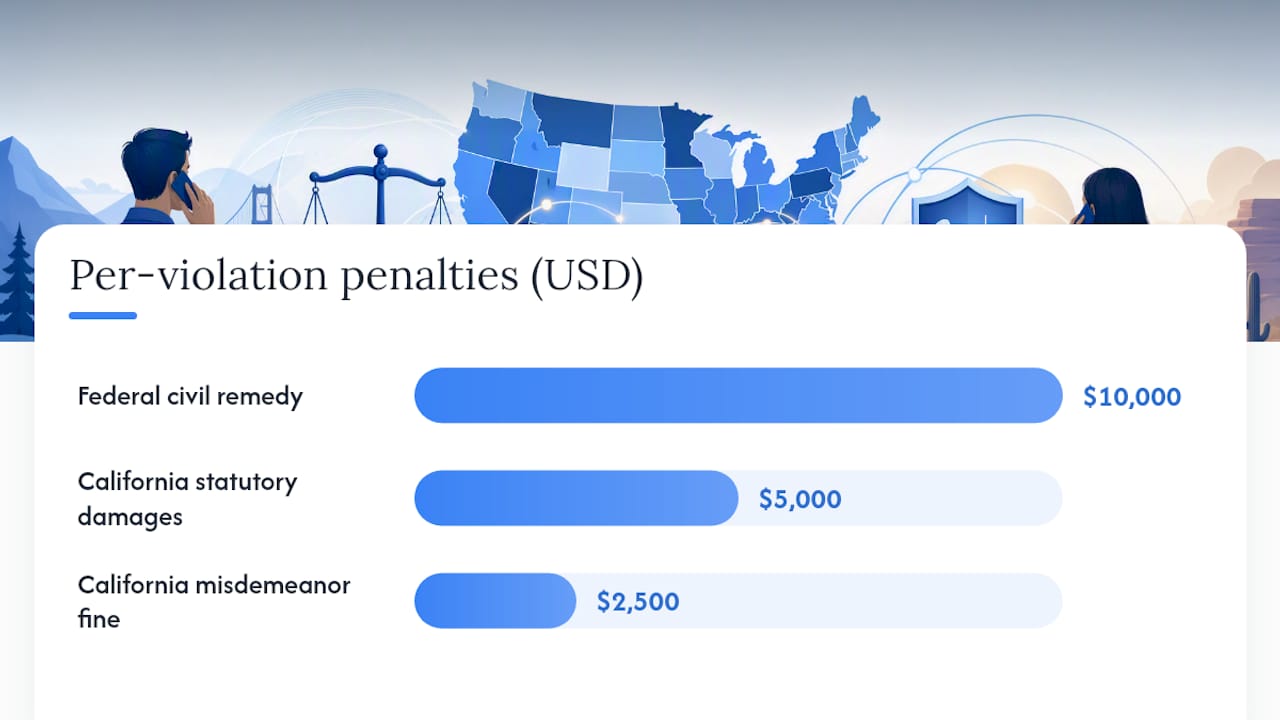
On the federal side, 18 U.S.C. § 2520 lets a person who was illegally recorded sue for the greater of their actual damages or $10,000 per violation, plus punitive damages and attorney’s fees in appropriate cases. Criminal penalties under the federal wiretap statute can include fines and imprisonment, though criminal prosecution of individual callers is rare compared to civil exposure.
State penalties vary widely and sometimes bite harder than the federal floor:
- California treats a first CIPA violation as a misdemeanor carrying fines up to $2,500 and possible jail time, but the bigger threat is civil litigation: courts have allowed statutory damages claims of $5,000 per violation under Penal Code § 637.2, and California has produced a steady stream of class actions against companies that record customer calls without clear consent.
- Florida classifies illegal recording under § 934.03 as a third-degree felony in many cases, with penalties that can include years of imprisonment for willful violations.
- Pennsylvania has become one of the most active states for consumer class actions tied to call recording, with plaintiffs’ firms specifically targeting companies that use call centers without a clear all-party disclosure.
California and Pennsylvania show up again and again in call recording litigation because both states pair a strict all-party consent statute with a private right of action that makes it economically viable for plaintiffs’ attorneys to bring class claims. If your business calls into either state at any volume, that’s where your compliance review should start.
Where to Verify Your State’s Call Recording Statute
Statutes change, and courts reinterpret ambiguous ones, as Michigan and Nevada both demonstrate. Relying on a blog post from a few years ago, even a good one, is how businesses end up compliant with an old version of the law.
Start with the primary source. Every state publishes its own code online, usually searchable by statute number or keyword like “eavesdropping” or “wiretapping.” If you know the citation, such as California Penal Code § 632 or Florida Statute § 934.03, you can pull the current text directly from the state legislature’s website in under a minute.
For a broader view across jurisdictions, two resources stand out:
- The Justia 50-state survey offers a clean, regularly updated summary of every state’s consent requirement, with citations to the underlying statute.
- RecordingLaw’s state-by-state guide goes deeper on hybrid states and includes practical notes on how courts have applied the statutes in practice.
- Your state attorney general’s website often publishes consumer-facing guidance on recording and eavesdropping laws, which can flag recent enforcement priorities.
- Legal databases like Practical Law, available through many business subscriptions, track legislative amendments and court decisions that change how a statute is applied.
Set a recurring reminder, once or twice a year, to re-check the statutes for any state where you do significant call volume. Legislatures amend these laws more often than people expect, and a state that was one-party consent five years ago isn’t guaranteed to stay that way.
Why Consistency Beats Cleverness on Every Call
I’ve watched enough cold calling operations get this wrong to know the pattern. A team tries to get clever, skipping the disclosure on calls to states they believe are one-party consent, tightening it up only for California and a couple of others they’ve heard about. That approach fails constantly, because agents misjudge area codes, lists get pulled from stale data, and nobody remembers the Michigan carve-out three months into the job.
The operations that stay clean are the boring ones. Same script, every call, every state. “This call may be recorded for quality and training purposes.” Two seconds. No exceptions carved out for states the team assumes are safe.
That consistency does something else too: it removes decision fatigue from your agents. A rep juggling probate leads, tax delinquent properties, and a tired landlord who’s three months from foreclosure doesn’t need one more variable to track mid-conversation. Give them one rule, and let them focus on the actual skill that wins the deal, which is reading the seller’s emotional state and responding to it, not remembering whether Oregon treats phone calls differently than face-to-face conversations.
The consent script is also a better sales moment than most agents realize. Said with confidence, it signals professionalism instead of raising suspicion. Sellers in distress situations are often wary of scams; a calm, matter-of-fact disclosure line builds more trust than it costs. This is exactly the kind of moment worth rehearsing through live call coaching before it happens on a real seller’s line, because the agents who deliver it smoothly convert better than the ones who mumble through it like a legal disclaimer they’re embarrassed to say.
— Dave
Ready to Build Consent Into Every Cold Call Your Team Makes?
Getting the legal disclosure right is only half the job. The other half is making sure your agents deliver it naturally, handle a seller who pushes back, and keep the conversation moving toward a signed deal. That takes reps, not just a script taped next to the phone.
ClosersLeague’s AI-powered cold calling practice platform lets your investors and wholesalers rehearse exactly this scenario, a distressed seller reacting to a recording disclosure, alongside objection handling across probate, pre-foreclosure, inherited, divorce, and tired landlord situations. Real-time coaching flags where the disclosure sounds stiff, scorecards track how consistently agents deliver it, and leaderboards turn compliance training into something your team actually wants to practice. Start with a free trial call and see how your script holds up under real objection pressure.
Sources
- 18 U.S.C. § 2520 — Civil remedy for violation
- Recording telephone conversations — FCC consumer guide
- Recording phone calls and conversations — 50-state survey (Justia)
- US recording laws by state (RecordingLaw)
FAQ
Can someone record a call without your permission?
Yes, in the roughly 38 one-party consent states, anyone who’s a participant in the call can record it without telling you, under the federal baseline set by 18 U.S.C. § 2511. In the dozen or so all-party consent states, recording you without your agreement is generally illegal.
Can I sue someone for recording me without my permission?
If you’re in an all-party consent state and were recorded without agreeing, you can typically bring a civil claim under your state’s wiretapping statute, and federal law under 18 U.S.C. § 2520 allows a civil suit with damages of the greater of actual harm or $10,000 per violation in qualifying cases.
Do you legally have to tell someone the call is being recorded?
It depends on the state on the other end of the line. In all-party consent states like California, Florida, and Pennsylvania, yes, you must get agreement from everyone before recording; in one-party consent states, you don’t have to disclose it, though most compliance-conscious businesses do it anyway.
Which states am I prohibited from recording in without consent?
The states that require all-party consent include California, Florida, Illinois, Pennsylvania, Washington, Massachusetts, Maryland, Montana, New Hampshire, and Connecticut, along with Michigan, Nevada, Oregon, Delaware, Hawaii, and Maine under varying hybrid rules, according to the Justia and RecordingLaw surveys.