Yes, real estate agents and brokerages must follow federal Do-Not-Call rules for every outbound sales call, text, and autodialed contact. Two actions matter most right now: scrub your calling list against the National Do Not Call Registry within 31 days before calling, or confirm you have documented prior express written consent before using an autodialer, sending texts, or playing a prerecorded message.
The three governing authorities you need to know:
- National Do Not Call Registry (donotcall.gov) — the federal registry consumers use to opt out of telemarketing calls
- Federal Trade Commission (FTC) / Telemarketing Sales Rule (TSR) — governs telemarketing conduct and registry compliance
- Federal Communications Commission (FCC) / Telephone Consumer Protection Act (TCPA) — governs dialing technology, autodialers, prerecorded voices, and text messages
Key Takeaways
Real estate DNC compliance requires scrubbing lists within 31 days before calling, matching consent level to dialing technology, and documenting every exemption and opt-out at the time it occurs.
| Point | Details |
|---|---|
| Scrub within 31 days | Run your list against the National DNC Registry no more than 31 days before each call; re-scrub every campaign. |
| Match consent to technology | Autodialers, texts, and prerecorded or AI voices require prior express written consent; live manual calls have a lower threshold. |
| EBR windows are time-limited | Established Business Relationship allows calls for 18 months after a transaction or 3 months after an inquiry, at the federal level. |
| Per-call damages compound fast | TCPA violations carry $500–$1,500 per call; a single automated campaign without consent records can generate massive exposure. |
| ClosersLeague builds compliant habits | AI roleplay practice drills compliant scripts and objection handling so required disclosures become automatic under pressure. |
Table of Contents
- What federal laws govern real estate DNC regulations?
- Which exemptions actually apply to real estate calls?
- How do rules differ for FSBOs, expired listings, and business numbers?
- How do you scrub your calling list against the DNC registry?
- What are the penalties for violating DNC and TCPA rules?
- What does a compliant brokerage calling policy look like?
- The compliance gap most agents ignore
- ClosersLeague trains you to call with confidence and compliance
- Sources
- FAQ
What federal laws govern real estate DNC regulations?
Two statutes divide the compliance work. The TSR, enforced by the FTC, controls who you can call and when, establishes the National Do Not Call Registry, and sets the rules for established business relationships and required disclosures. The TCPA, enforced by the FCC, controls how you call: autodialers, prerecorded messages, AI-generated voices, and text messages all require a higher consent threshold under TCPA than a live manual call does.
Under the TSR, telemarketers must call only during permitted hours, identify themselves and the seller at the start of every call, and disclose that the call is a sales call. Under the TCPA, using an automatic telephone dialing system (ATDS) or playing a prerecorded or AI-generated voice to a cell phone requires prior express written consent, full stop. The FCC now treats AI-generated voices as subject to the same consent standards as prerecorded messages.
For authoritative source text, consult donotcall.gov, ftc.gov, and fcc.gov.
Which exemptions actually apply to real estate calls?
Several exemptions exist, but most are narrower than agents assume. Here is what actually permits a call to a registered number:
- Established Business Relationship (EBR) — transaction: you may call for up to 18 months after a purchase, lease, or financial transaction with the consumer
- EBR — inquiry: you may call for up to 3 months after a consumer makes an inquiry or submits an application to your business
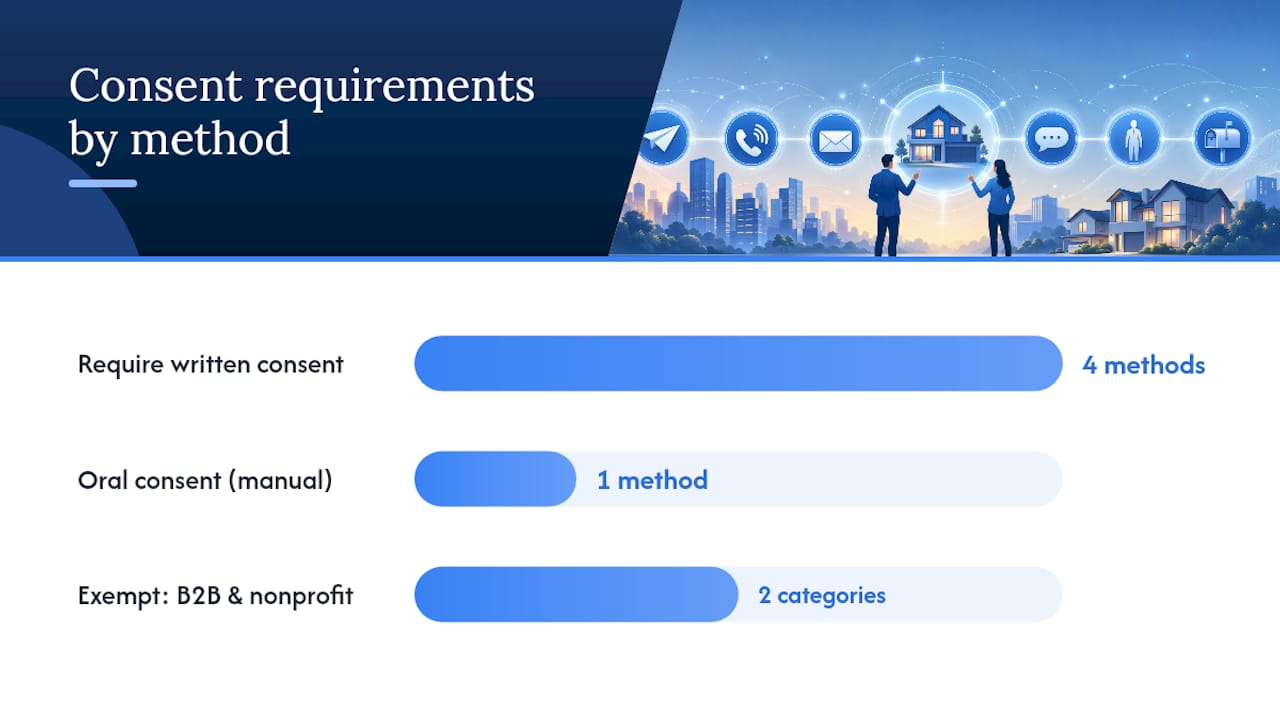
- Prior express written consent: the consumer has signed (including electronically) a clear agreement authorizing calls from your specific business
- Prior express oral consent: sufficient for live manual calls to registered numbers in some circumstances, but not for autodialers, prerecorded messages, or texts
- B2B calls: calls to a business number for a business purpose are generally exempt from the National DNC Registry
- Non-commercial calls: political, nonprofit, and survey calls are exempt from the TSR’s DNC provisions, though TCPA technology rules still apply
The TSR’s EBR framework sets the 18-month and 3-month windows at the federal level. State rules can shorten those windows, so verify your state’s specific limits before relying on EBR alone.
Consent level determines your technology options. Prior express written consent is required whenever you use an autodialer, send a text, or play a prerecorded or AI-generated voice. A compliant written consent record includes the exact disclosure language shown to the consumer, the URL of the page where consent was captured, the consumer’s IP address, a timestamp, and the consumer’s affirmative action (checkbox click, e-signature, or recorded verbal agreement). A generic “marketing partners” checkbox on a lead form is unlikely to survive scrutiny under current FCC guidance.
Pro Tip: EBR does not override TCPA consent requirements. If you are using an autodialer or sending texts, EBR alone is not enough — you still need prior express written consent regardless of your prior transaction history with that consumer.
How do rules differ for FSBOs, expired listings, and business numbers?
This is where many agents get into trouble. A For Sale By Owner (FSBO) listing or an expired listing is still a consumer, and a sales call to their personal cell phone is covered by both the TSR and TCPA. Posting a phone number on a yard sign or MLS does not constitute consent to receive solicitation calls.
The B2B exemption works like this:
- The number must be a genuine business line, not a personal cell phone used for business purposes.
- The call must be for a business purpose, not a residential sales solicitation.
- Even a legitimate business line can be registered on the National DNC Registry, so scrubbing still matters.
Calling a landlord’s personal cell to discuss buying their rental property is a residential call, not a B2B call, even if the landlord operates an LLC. Calling the main office line of a property management company about a commercial transaction is a different situation. The distinction turns on the nature of the number and the purpose of the call, not the caller’s intent to conduct business.
A homeowner who previously inquired about your services gives you a 3-month EBR window for follow-up calls. Document that inquiry with a date, the channel (web form, inbound call, referral), and the specific number they used. That record is your defense if the call is later challenged.
Pro Tip: When relying on any narrow exemption, document it at the time of the call, not after a complaint arrives. A log entry showing the EBR date, the basis for the exemption, and the agent’s name is far more credible than a reconstructed record.
How do you scrub your calling list against the DNC registry?
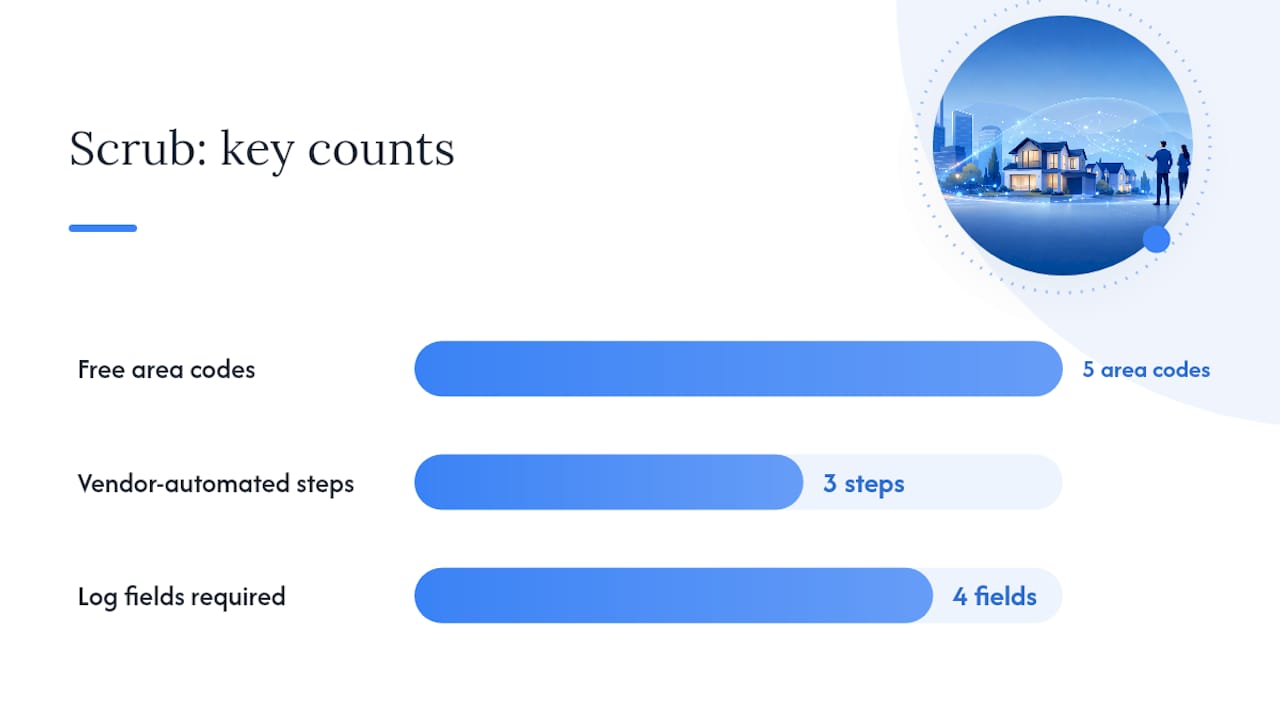
Scrubbing must happen within 31 days before each call. A scrub done at campaign launch and never repeated does not satisfy the requirement. Here is a compliant scrub workflow:
- Register your organization at the telemarketing portal on Donotcall and verify your account.
- Subscribe to the area codes you plan to call. The first five area codes are free for a single entity; additional area codes cost $82 each for fiscal year 2026, per registry fee guidance.
- Download the registered numbers for your subscribed area codes.
- Run your list against the registry data and remove every match before dialing.
- Log the scrub: record the date, the area codes covered, the list version used, and who ran the scrub.
- Re-scrub every 31 days or before any new calling campaign, whichever comes first.
For larger operations, third-party scrubbing vendors integrate directly with dialers and automate steps 3 through 5. When evaluating a vendor, verify that it provides timestamped audit logs, covers all subscribed area codes, and updates its registry data at least monthly. Audit logs are not optional — they are the evidence you need to claim safe-harbor protection if a complaint is filed.
Pro Tip: Integrate scrubbing directly into your dialer so no number can be dialed without a current scrub result attached to it. Manual scrub workflows fail when agents bypass them under call-volume pressure.
What are the penalties for violating DNC and TCPA rules?
The exposure is significant and compounds fast. Per-call statutory damages under the TCPA run $500 per violation and up to $1,500 per willful violation. Those figures apply to each individual call or text, not to a campaign as a whole.
Enforcement comes from three directions:
- FCC: enforces TCPA violations, including autodialer and prerecorded-call violations; can impose civil penalties
- FTC: enforces TSR violations, including National DNC Registry violations; can seek civil penalties and injunctive relief
- State attorneys general: enforce state-level DNC laws, which often carry their own per-call penalties and may impose stricter rules than federal law
Private plaintiffs can also sue directly under the TCPA without waiting for agency action. Class actions are common when a brokerage runs an automated campaign without proper consent, because every recipient becomes a potential plaintiff. A campaign of 10,000 autodialed texts to numbers without documented written consent carries theoretical exposure of $5 million to $15 million before any class multiplier.
Bubeck Law’s guidance confirms that enforcement can name both the individual agent and the brokerage, regardless of whether the agent is an employee or independent contractor. Status does not remove regulatory obligation.
What does a compliant brokerage calling policy look like?
The highest-impact single action is a documented written DNC/TCPA policy combined with automated scrubbing and a consent capture system. Everything else builds on that foundation.
Brokerage-level checklist:
- Written DNC and TCPA policy distributed to every agent, with signed acknowledgment on file
- Internal Do Not Call list maintained and honored within 10 business days of any opt-out request
- Automated 31-day scrub integrated into the dialer, with timestamped logs retained
- Consent capture system storing disclosure text, URL, IP address, timestamp, and consumer action
- Dialer configured to block calls outside 8 AM to 9 PM local time and to display accurate caller ID
- Call scripts reviewed for required TSR disclosures (identity, seller name, sales purpose)
- Opt-out processing unified across voice, SMS, and email channels
- Recordkeeping policy specifying retention periods for consent records, scrub logs, and call records
- Annual training with documented attendance for all agents making outbound calls
Vendor vetting checklist:
- Lead sellers: request the actual consent record for every purchased lead (disclosure text, timestamp, IP, named buyer). Do not accept a vendor’s assurance that leads are “compliant” without seeing the artifact.
- Dialer vendors: confirm ATDS compliance documentation and whether the system can enforce pre-dial consent verification.
- Scrubbing vendors: require timestamped audit logs and area-code subscription confirmation.
Industry guidance consistently flags purchased-lead consent as the most common failure point. Many agents assume their lead supplier’s consent claim is sufficient. It is not — you are the caller, and the liability attaches to you.
Pro Tip: For consent capture, store the full event: the exact language shown to the consumer, the full URL, IP address, user agent, timestamp, and the consumer’s affirmative action. A generic opt-in checkbox without those artifacts will not protect you in litigation.
For a broader view of compliant real estate telemarketing workflows, including script structure and campaign setup, the ClosersLeague blog covers the operational side in detail. You can also review sign compliance considerations for listing marketing to keep your full property marketing approach within legal bounds.
The compliance gap most agents ignore
Most of the DNC and TCPA guidance you will find online focuses on the rules themselves. What gets agents and brokerages into trouble is the gap between knowing the rules and actually practicing compliant calls under pressure.
Real estate cold calling is a skill that degrades under stress. When a seller pushes back hard, agents improvise. They skip disclosures, they make promises they cannot keep, and they forget to log the call. That improvisation is where compliance breaks down, not in the written policy.
The agents who stay out of trouble are the ones who have drilled compliant scripts so thoroughly that the required disclosures come out automatically, even when a seller is hostile. They have practiced handling the do not call objection without panic, because they know exactly what their exemption basis is and can state it calmly. Documented training is also a mitigation record. If a complaint is filed, showing that your brokerage required and documented compliance training is meaningful evidence in your defense.
Liability attaches to both agent and brokerage. That means brokerages cannot simply hand agents a policy document and consider the obligation met. The training has to be real, repeated, and logged.
ClosersLeague trains you to call with confidence and compliance
Knowing the rules is step one. Executing them under pressure, on a live call with a distressed homeowner, is where most investors and wholesalers fall short. ClosersLeague is an AI-powered cold calling training platform built specifically for real estate investors and wholesalers working probate, pre-foreclosure, inherited, tax delinquent, and other distressed property scenarios.
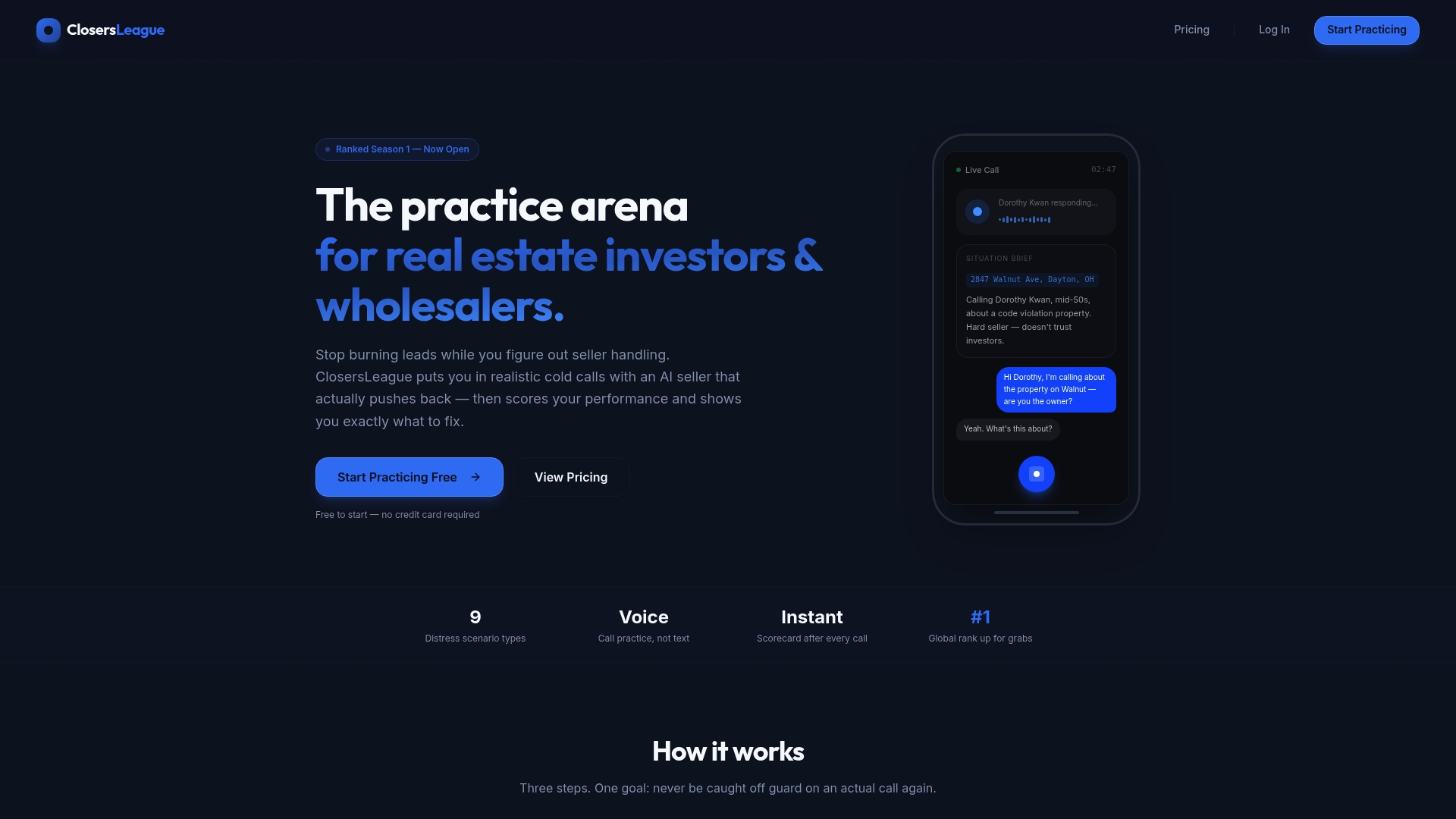
The platform runs scenario-based voice practice with real-time coaching, performance scorecards, and targeted skill drills that include compliant script delivery and objection handling. You can practice the do not call objection, the consent disclosure, and the EBR explanation until they are automatic. Every session is simulation, not a live call, so you build the muscle memory before the stakes are real. For legal questions specific to your state or situation, consult a qualified attorney.
Start drilling compliant scripts today with AI cold calling practice built for every seller type, including inherited property scenarios where consent and EBR questions come up constantly.
Sources
Every compliance lead at a brokerage should bookmark these primary sources and check them for updates at least annually.
- Q&A for Telemarketers & Sellers About DNC Provisions in TSR
- FCC do-not-call resources
- National Do Not Call Registry — FAQ
- Real Estate Agents: Before You Call or Text, Read This — Bubeck Law
- Is Real Estate Cold Calling Legal? Rules and Penalties – LegalClarity
This article is general information, not legal advice. Consult a qualified attorney to confirm how current federal and state rules apply to your specific calling practices.
This article is general information, not a substitute for advice from a qualified lawyer. Consult a qualified legal professional about your own circumstances before acting on anything here.
FAQ
Can realtors call people on the DNC list?
Generally no, unless a specific exemption applies: an established business relationship within the permitted time window (18 months after a transaction, 3 months after an inquiry), or documented prior express written consent from the consumer.
What are the main DNC rules real estate agents must follow?
Agents must scrub calling lists against the National Do Not Call Registry within 31 days before calling, call only between 8 AM and 9 PM local time, identify themselves and the purpose of the call, and honor opt-out requests within 10 business days.
What calls are exempt from the DNC registry?
Calls covered by an established business relationship, calls made with prior express written consent, genuine B2B calls to business lines, and non-commercial calls (political, nonprofit, survey) are the primary exemptions, though TCPA technology rules still apply to how those calls are made.
What is the penalty for violating DNC or TCPA rules?
Private plaintiffs can recover $500 per violation and up to $1,500 per willful violation under the TCPA, with each individual call or text counting separately. The FTC and FCC can also pursue civil penalties, and state attorneys general enforce additional state-level DNC laws.