AI-powered real-time call coaching, specifically scenario-based voice roleplay with instant feedback, is the fastest way for real estate investors and wholesalers to scale cold-calling skill and cut time-to-ramp. Start with ClosersLeague: it’s built for distressed-property outreach, covers every major seller scenario, and includes a free trial with no long-term commitment required.
Key Takeaways
AI-powered real-time call coaching through scenario-based roleplay is the fastest way for real estate investors and wholesalers to cut time-to-ramp and build repeatable cold-calling skill on distressed-property leads.
| Point | Details |
|---|---|
| Define it correctly | Real-time call coaching here means AI scenario roleplay with instant scorecards, not live in-call agent prompts. |
| Evidence supports it | Faculty pilots found statistically significant skill gains; some organizations report up to 50% faster onboarding. |
| Benchmark your live calls | Target connect rates of 12–18%, appointment rates of 3–5% per connect, and close rates of 30% per appointment. |
| Practice volume matters | Scripts are training wheels; plan for 300–500 practice reps to fully internalize call flows. |
| Start with ClosersLeague | ClosersLeague covers all major distressed-property scenarios with a free trial and call-volume subscription tiers. |
Table of Contents
- What does “real time call coaching” mean for investors?
- How does a real-time coaching session actually work?
- What does the evidence say about benefits?
- When should you introduce AI coaching?
- What features should you require in a platform?
- Your 30/60/90-day implementation plan
- What metrics should you track?
- What are the real limits of AI coaching?
- How ClosersLeague supports distressed-property outreach
- Why the practice-first approach is the right call
- Try ClosersLeague with a free trial
- Sources
- FAQ
What does “real time call coaching” mean for investors?
For real estate investors and wholesalers, real-time call coaching means practicing live voice conversations with an AI seller, receiving instant scored feedback after each call, and drilling specific objections until the response becomes automatic. It is not enterprise live-agent assist software that feeds prompts to a rep during an actual customer call. That’s a different product for a different audience.
The scenarios that matter for this work include:
- Probate and inherited properties — navigating grief and family complexity
- Pre-foreclosure — urgency without pressure tactics
- Tax delinquent — explaining the seller’s options clearly
- Code violation — addressing embarrassment and financial stress
- Vacant and out-of-state owners — building trust remotely
- Tired landlords — acknowledging frustration and offering relief
- Divorce situations — staying neutral while moving the conversation forward
Each scenario carries a distinct emotional register. AI coaching in real estate trains you to read those registers and respond without freezing.
How does a real-time coaching session actually work?
You pick a scenario, say pre-foreclosure, and the AI plays the seller. The conversation runs in real time: the AI responds to your tone, your pacing, and your word choices. Push too hard and the seller gets defensive. Go quiet and the call stalls. The AI adapts.

After the call ends, you get a scorecard covering categories like motivation, listening, filler-word frequency, and objection handling. Short clips flag the exact moments where the conversation shifted. A transcript highlights the lines that cost you rapport. Then the platform recommends a targeted drill, maybe a single objection type you fumbled, and you run it again.
Repeat that loop across dozens of sessions and the analytics layer starts showing patterns: which objections trigger your worst responses, where your connect-to-appointment rate breaks down, how your scores trend week over week. Mastering distressed-call roleplay requires exactly this kind of structured repetition. Scripts are training wheels for the first 300–500 calls; the AI environment is where you log those reps without burning real leads.
What does the evidence say about benefits?
The evidence is early but consistent. A faculty pilot found statistically significant performance differences between students who used generative AI avatar training and those who did not, with adoption rates climbing when use was mandated rather than optional. A separate university study found that AI role-plays reduced instructor grading time while producing rubric-aligned feedback students found confidence-building. Industry reporting from Training Magazine notes that some organizations saw onboarding time cut by as much as 50% after moving practice into AI-driven environments.
| Benefit | Evidence source | Strength |
|---|---|---|
| Faster onboarding (up to 50% reduction) | Sales leaders, Training Magazine | Practitioner reports; not controlled trials |
| Statistically significant skill gains | Hammond et al. faculty pilot | Controlled academic study |
| Reduced instructor/coach time | Georgia Southern pilot | Academic pilot, limited sample |
| Psychological safety for repetition | TEKsystems/Degreed pilot | Practitioner case study |
The TEKsystems pilot is particularly relevant: practitioners cited psychological safety as a primary driver. Learners practiced repeatedly without manager oversight, which accelerated confidence before live calls. For a wholesaler who dreads the first 50 cold calls, that matters.
The evidence is clearest for three use cases: new-caller onboarding, objection-handling drills, and ongoing skills reinforcement for mid-level dialers.
When should you introduce AI coaching?
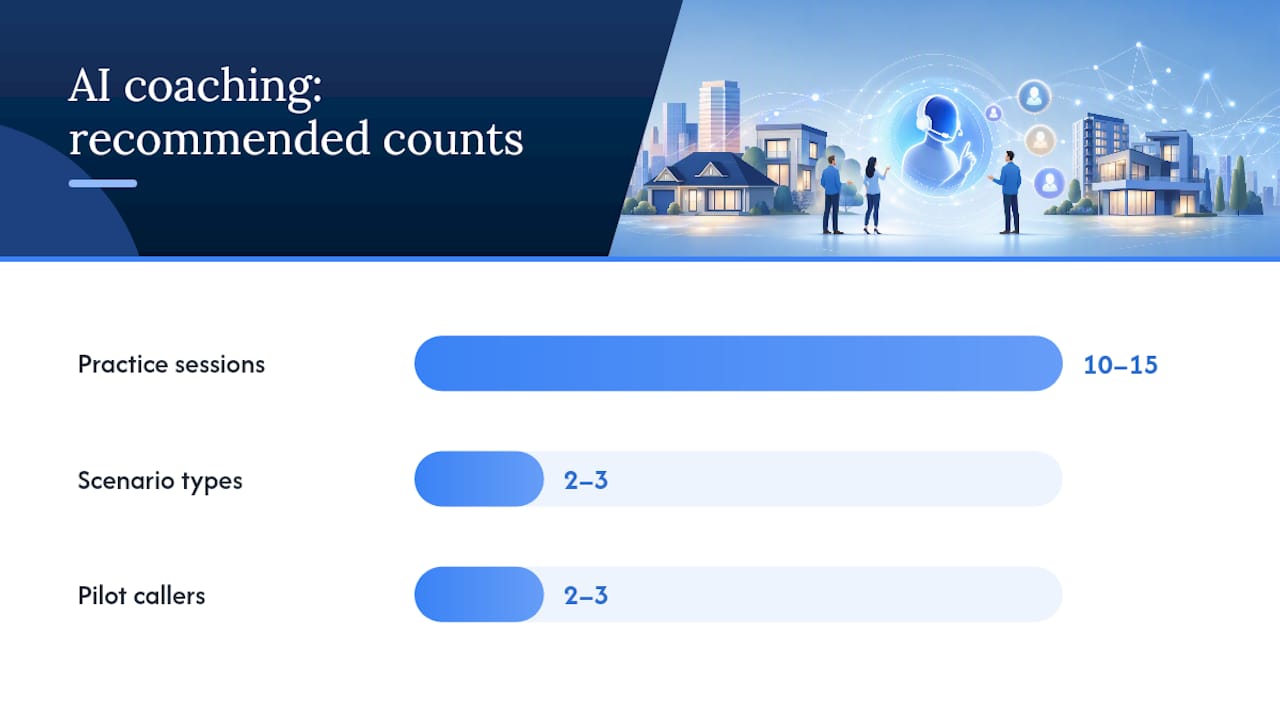
Introduce it on day one for new callers. Before a new team member touches a real lead list, they should complete at least 10–15 AI practice sessions across two or three scenario types. For experienced dialers, use it for targeted drills when scorecards reveal a specific weak point.
Readiness checklist before full rollout:
- Basic phone etiquette and active listening fundamentals in place
- A quiet space and a decent headset (audio quality affects AI feedback accuracy)
- CRM access for logging practice outcomes alongside live call data
- At least one scenario library aligned to your primary lead type
Change-management tactics that work:
- Pilot with two or three willing callers first, then share their scorecard improvements with the wider team
- Mandate a minimum weekly practice volume for new hires rather than leaving it optional (the Hammond et al. pilot found adoption was higher when mandated)
- Appoint one “practice champion” who reviews leaderboards and calls out weekly wins
Pro Tip: Run your first AI practice session on the scenario type that matches your current lead list. If you’re working pre-foreclosure leads this month, that’s where you drill. Mismatched practice builds the wrong muscle memory.
What features should you require in a platform?
Not every call coaching tool is built for distressed-property outreach; the rise of AI and PropTech engineering Singapore’s real estate future shows how technology is reshaping the industry. Generic sales roleplay platforms often lack the scenario depth and emotional nuance that a probate or pre-foreclosure call demands. When you evaluate options, require these:
- Scenario libraries tuned to distressed contexts — probate, pre-foreclosure, tax delinquent, code violation, divorce, vacant, and tired landlord scenarios, not just generic “cold call” templates
- Objection and emotion analysis — the platform should flag when a seller’s tone shifts, not just what they said
- Objective scorecards — categories like motivation, listening, filler words, and empathy, scored consistently across every session
- Short call clips — specific 10–30 second clips tied to scorecard flags, not just a full recording
- Targeted drills — the ability to isolate a single objection type and repeat it until the score improves
- Leaderboards and team workflows — visibility into who is improving and who needs attention
- Exportable analytics — so you can correlate practice scores with live call outcomes in your CRM
- Free trial or sandbox access — never commit to a subscription without testing the scenario quality first
- TCPA and recording-consent awareness — the platform should not encourage recording real calls without proper consent; practice sessions on AI are separate from live call compliance, but the vendor should acknowledge this distinction
Pricing models vary. Calls-per-month tiers tend to suit solo investors and small teams better than per-seat enterprise pricing. Confirm what the free trial includes before signing up. AI roleplay for wholesaling has specific scenario requirements that generic platforms often miss.
Your 30/60/90-day implementation plan
Days 1–30: Setup and baseline
- Load your primary scenario type (match it to your current lead list).
- Complete 10–15 practice sessions per caller before any live dialing.
- Establish a baseline scorecard average across motivation, listening, and objection handling.
- Log practice session outcomes in your CRM alongside live call data.
- Review scorecards weekly; identify the one objection type each caller struggles with most.
Days 31–60: Drill and calibrate
- Run targeted drills on the top two objection types from the baseline review.
- Increase practice volume to 5 sessions per week per caller.
- Compare live call connect rates and appointment rates against the pre-coaching baseline.
- Adjust scenario selection based on which lead types are generating the most live calls.
- Hold a 30-minute team review of leaderboard data; celebrate score improvements publicly.
Days 61–90: Scale and measure
- Add a second scenario type to the rotation.
- Set a minimum weekly practice requirement for all callers, not just new hires.
- Run a simple A/B comparison: coached callers vs. any uncoached callers on the same lead list.
- Export analytics and map practice score trends to live appointment-set rates.
- Decide whether to expand to additional scenario libraries based on ROI signals.
Pair this cadence with a cold-call scheduling workflow and strong list data for the fastest results. High-performing operations treat list quality, CRM discipline, and call coaching as equally critical levers.
What metrics should you track?
Track these KPIs from day one:
- Time-to-ramp — days from first practice session to first appointment set
- Connect rate — calls answered divided by total dials
- Appointment rate per connect — appointments set divided by live conversations
- Inspection-set rate — property walkthroughs booked per appointment
- Close rate per appointment — contracts signed divided by inspections
- Call-quality score trend — weekly average scorecard across all practice sessions
Field reporting from distressed cold-calling campaigns provides useful benchmarks:
| Metric | Realistic range | Notes |
|---|---|---|
| Connect rate | 12–18% | Varies by list quality and time of day |
| Appointment rate per connect | 3–5% | Higher with strong objection handling |
| Close rate per appointment | 30% | Depends on seller motivation and market |
For attribution, run a simple pilot: two callers on the same lead list, one using AI coaching and one not. After 60 days, compare appointment rates. That’s enough signal to justify scaling or adjusting the program.
What are the real limits of AI coaching?
AI coaching is a practice tool, not a replacement for judgment. Know these limits before you commit:
- Overreliance risk — high practice scores don’t automatically translate to live call performance; the AI can’t replicate every seller’s emotional state
- Scenario quality matters — a poorly tuned scenario library produces misleading feedback; audit your scenarios quarterly
- List quality is upstream — no amount of practice fixes a bad lead list; data quality is a separate problem
- Emotion detection has limits — AI analysis of seller emotional state is improving but not perfect; treat it as a signal, not a verdict
- Resistance is real — experienced callers sometimes dismiss AI feedback; pairing AI scores with human coaching review reduces this
Mitigate these risks by keeping a human coach in the loop for weekly scorecard reviews, updating scenario scripts when market conditions shift, and never skipping baseline skills training before AI roleplay begins.
Compliance note: TCPA and state call-recording consent laws apply to live calls, not AI practice sessions. Confirm your platform’s data handling policies and consult a qualified attorney for guidance on your specific calling operation.
How ClosersLeague supports distressed-property outreach
ClosersLeague is built specifically for the scenarios real estate investors and wholesalers face every day. The platform covers:
- Scenario libraries for inherited, probate, pre-foreclosure, tax delinquent, code violation, divorce, out-of-state, vacant, and tired-landlord seller types
- Real-time AI seller responses that adapt to your tone and pacing
- Objective scorecards across motivation, listening, filler words, and objection handling
- Short call clips tied to scorecard flags for targeted review
- Drills that isolate specific objection types for focused repetition
- Competitive leaderboards and team workflows for accountability
- Exportable analytics to connect practice performance to live call outcomes
The free trial includes a limited number of AI practice calls across multiple scenario types, enough to assess scenario quality and scorecard accuracy before committing to a paid plan. Subscription tiers scale by monthly call volume, so a solo investor pays for what they actually use. Inherited property practice sessions are available immediately on signup.
Why the practice-first approach is the right call
The conventional wisdom in real estate investing is that you learn cold calling by making cold calls. That’s partly true. But burning through real leads while you’re still fumbling probate objections is expensive. Every awkward pause on a live call is a motivated seller who moved on.
The smarter sequence is to practice the hard conversations before they cost you anything. AI coaching doesn’t replace the live call experience; it compresses the learning curve so that when you do pick up the phone for real, you’ve already heard the objection fifty times. The role of coaching in wholesaling has always been about repetition and feedback. AI just makes both available at scale, without scheduling a manager’s time.
The one thing I’d caution against: treating a high scorecard as the goal. The scorecard is a diagnostic, not a trophy. Use it to find the gap, drill the gap, then get back on the phones.
Try ClosersLeague with a free trial
Cold calling distressed sellers is one of the highest-leverage skills in real estate investing, and ClosersLeague gives you a direct path to building it faster. The free trial puts you inside real scenario-based practice sessions covering inherited property, code violation, and other distressed seller types, with full scorecard feedback from your first call.
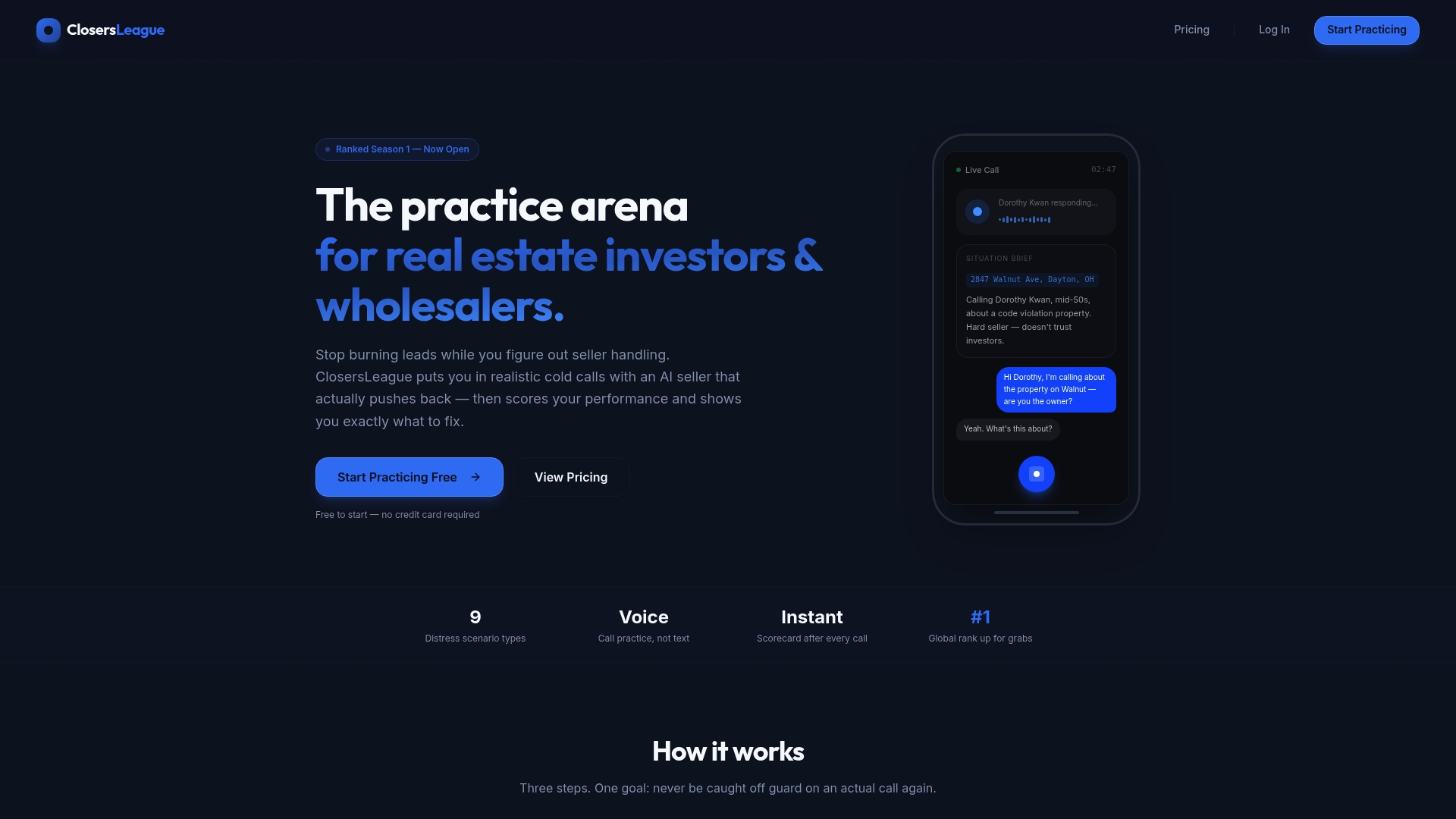
Sign up, run your first five sessions on the scenario that matches your current lead list, and check your scorecard. If the feedback surfaces a gap you didn’t know you had, that’s the tool working. Paid plans scale by call volume, so you only pay for the practice you actually do. Start your free trial at ClosersLeague.
Sources
- Why AI-powered role-play belongs in sales enablement | Training Magazine
- Generative AI avatar sales training pilot — Hammond et al. | MBR
- When AI joins your teaching team: Reinventing sales education with AI | Georgia Southern proceedings
- TEKsystems improves sales readiness with Dynamic AI learning | Degreed
FAQ
What is real-time call coaching for real estate investors?
Real-time call coaching for investors means AI-powered scenario roleplay with instant scored feedback after each practice call, covering distressed-property seller types like probate, pre-foreclosure, and tax delinquent. It is not live in-call prompting software for contact center agents.
How much practice does it take to improve cold-calling skills?
Field guidance suggests 300–500 practice calls to fully internalize call flows; AI coaching lets you log those reps against realistic distressed-seller scenarios without burning real leads.
What metrics prove that AI coaching is working?
Track time-to-ramp, appointment rate per connect, and call-quality score trends week over week. A simple A/B comparison between coached and uncoached callers on the same lead list after 60 days gives a clear signal.
Does ClosersLeague offer a free trial?
Yes. ClosersLeague’s free trial includes a limited number of AI practice calls across multiple distressed-property scenario types, with full scorecard feedback, before any paid commitment is required.
Is AI coaching compliant with TCPA and recording-consent laws?
AI practice sessions do not involve real sellers, so TCPA restrictions on live calls do not apply to the practice environment itself. Recording-consent laws apply to live calls; consult a qualified attorney for guidance specific to your calling operation.
Recommended
- Real Estate Cold Calling Practice — AI Roleplay for Every Seller Type | ClosersLeague
- Real estate telemarketing: A complete guide for investors – ClosersLeague Blog
- Master Real Estate Lead Generation: Cold Calling Basics – ClosersLeague Blog
- 10 proven cold calling tips for real estate investors – ClosersLeague Blog