Short activity sprints, tiered prizes, and visible streaks deliver the fastest lift in cold-calling activity. Teams that add real-time visibility and rotating short challenges to their calling blocks have reported a 25% increase in daily dials within 60 days. You don’t need new software or a big budget to start. You need a clear rule set, a fair scoring method, and a reason for your team to check the board every hour.
Here’s what to do this week:
- Schedule a 1-hour Call Blitz for tomorrow afternoon and track total connects on a shared screen.
- Set a 5-day streak target for daily dial minimums and post names publicly as reps hit it.
- Budget one small recognition prize (a $20 gift card, a reserved parking spot, first pick of leads) for the winner.
- Pick one metric to watch first: daily dials or meetings booked. Don’t track both yet.
Run this as a 2-week pilot before rolling it into your regular cadence. If dials climb and nobody complains about fairness, expand it. If they don’t, adjust the scoring before you add more games.
Key Takeaways
Cold call gamification works best when short activity sprints, fair scoring, and visible leaderboards are paired with real skill practice, not extrinsic rewards alone.
| Point | Details |
|---|---|
| Start with one game | Pilot a single format, like Call Blitz, for 2 weeks before adding more mechanics. |
| Track one metric first | Watch daily dials or meetings booked, not both, until your baseline is clear. |
| Keep contests short | One to two week seasons keep mid-tier reps engaged and prevent early leaders from coasting. |
| Weight points toward outcomes | Give more credit for booked appointments than raw dials to avoid rewarding the wrong behavior. |
| Pair practice with contests | ClosersLeague’s AI role-play scores calls before reps go live, closing the gap between activity and skill. |
Table of Contents
- What Cold Call Gamification Ideas Actually Look Like
- 10 Cold Call Gamification Ideas You Can Run This Week
- How to Pick the Right Game and Run a Fair Pilot
- Why AI Role-Play Makes Gamification Stick
- Metrics That Prove Your Gamified Program Is Working
- Pitfalls That Quietly Undermine Gamification
- Ready-to-Run Contest Templates You Can Copy Today
- What Actually Moved the Needle for Our Teams
- Scale Your Gamified Practice With AI Role-Play
- Sources
- FAQ
What Cold Call Gamification Ideas Actually Look Like
Cold call gamification means applying game mechanics, points, streaks, leaderboards, tiers, and timed challenges to the repetitive work of prospecting so reps stay engaged and managers get more consistent activity. It’s not about turning your sales floor into an arcade. It’s about giving reps a scoreboard for behaviors that usually go unrecognized: the 40th dial of the day, the seller who hung up but got a real objection out first, the rep who called back exactly when they said they would.
Most gamification programs draw from a small set of mechanics you’ll see repeated throughout this article:
- Points — awarded for specific actions (a completed call, a booked appointment, a handled objection).
- Streaks — consecutive days or hours hitting an activity target, which reward consistency over one-off bursts.
- Leaderboards — public rankings, either real-time or updated at set intervals.
- Sprints — short, timed bursts of focused calling (30 to 90 minutes) with a clear start and stop.
- Tiers — grouping reps by experience or current performance so competitions stay fair.
- Role-play simulations — practice calls, sometimes AI-driven, scored against a rubric before a rep ever dials a real seller.
- Mystery rewards — variable, unpredictable prizes tied to milestones, which keep engagement fresh longer than fixed rewards do.
Here’s how the mapping works in practice. A rep earns 1 point per dial, 5 points per live conversation, and 15 points for a booked appointment. A streak tracks whether they hit 50 dials every day this week. The leaderboard shows both numbers side by side, so a slower talker who books more appointments still has a shot at the top spot. That’s the whole system. Everything below builds on these six mechanics.
10 Cold Call Gamification Ideas You Can Run This Week
Every idea below includes setup rules, what to measure, prize suggestions at two budget levels, a remote/office variation, and a way it can go wrong.
1. Rejection Games
Give points for collecting rejections, not avoiding them. A rep earns a point every time they get told “no” in a way that shows they actually pitched (not just left a voicemail). Track total rejections logged per rep over a set window, usually a half-day or full day.
Prize options: a $10 coffee card for most rejections logged (low budget), or first choice of leads for the following week (operational). Remote teams log rejections in a shared spreadsheet or Slack channel in real time; in-office teams use a physical tally board.
Fairness risk: reps might rush calls just to rack up rejections. Fix it by requiring a one-line note on what objection they heard, which forces a real conversation before the point counts.
2. Call Bingo
Build a 5×5 bingo card with squares like “spoke to decision maker,” “handled a price objection,” “got a callback time,” or “mentioned probate timeline.” Reps mark a square each time they complete that action on a live call, and the first to get five in a row wins.
Track squares completed and time to bingo. Low-budget prize: a branded mug or bragging rights on the team channel. Operational prize: an extra hour of flexible schedule that week. Remote teams use a shared digital bingo card (Google Sheets works fine); in-office teams post physical cards at each desk.
Fairness risk: if squares aren’t standardized, some reps get lucky calls that fill squares faster. Fix it by rotating the card weekly and pulling squares directly from your seller objection list, so every rep faces the same range of scenarios.
3. Call Blitz
A focused, timed sprint, usually 60 to 90 minutes, where the only goal is total dials or connects. Everyone starts and stops together. This is the simplest format to run and the one most likely to move your daily dial number fast.
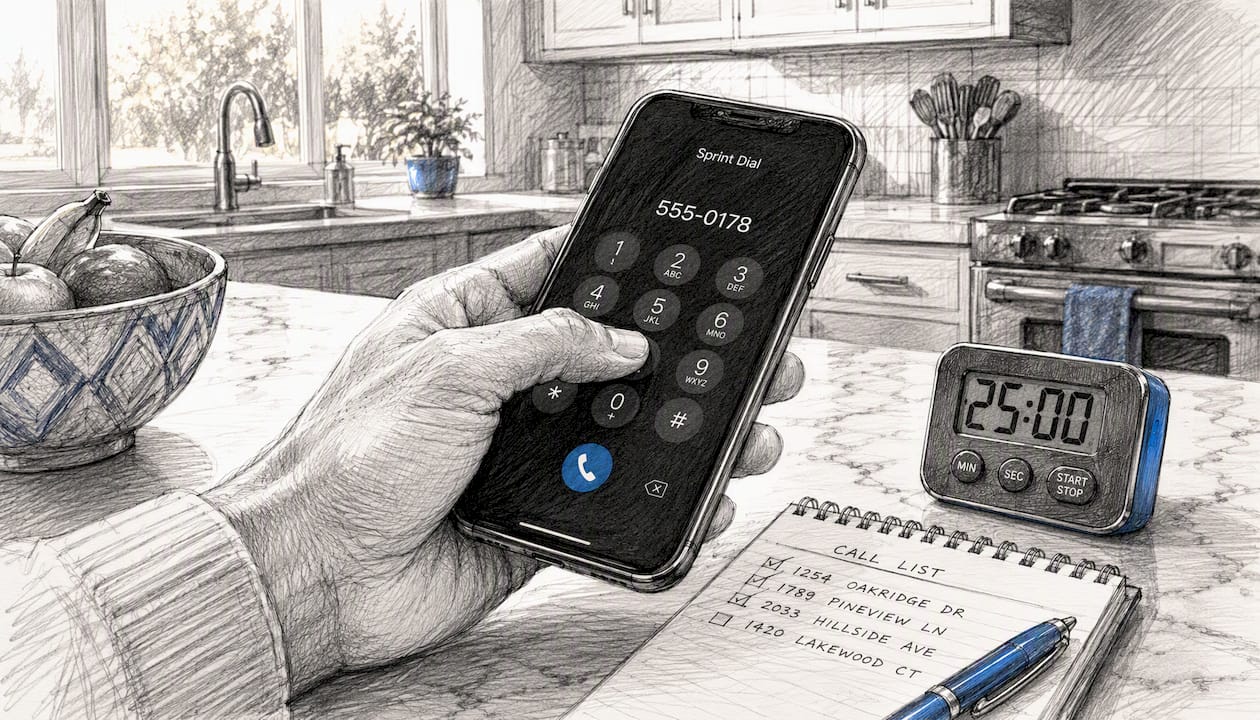
Track total dials and connects during the window. Low-budget prize: lunch brought in for the winner. Operational prize: skip the next team meeting. Remote teams run this over a shared Zoom call with cameras on and a live tally in chat; in-office teams use a whiteboard.
Fairness risk: reps with easier lead lists (warmer, more recent) have an unfair edge. Fix it by randomizing lead assignment before the blitz starts, every time.
4. Role-Play Challenges
Before reps touch live leads, they run a scripted role-play against a common objection (probate delay, “just not interested,” out-of-state owner skepticism) and get scored on a rubric: tone, objection handling, next-step ask. Highest score that week gets recognized.

Track rubric scores and improvement over time, not just the single high score. Low-budget prize: a shoutout in the weekly team email. Operational prize: the top scorer coaches the next role-play session. Remote and in-office teams both run this the same way, live or recorded, since it doesn’t depend on real calling volume.
Fairness risk: subjective scoring breeds resentment. Fix it with a written rubric everyone sees in advance, ideally scored by more than one person.
5. Teamwide Challenges
Split your floor into two or three teams and set a collective goal, total appointments booked in a week, for example. Everyone on the winning team gets the prize, which shifts the incentive from “beat my coworker” to “help my team.”
Track team totals daily so momentum is visible. Low-budget prize: a team lunch. Operational prize: the winning team gets first pick of a new lead source. This works identically remote or in-office since it’s about aggregate numbers, not physical presence.
Fairness risk: one strong performer can carry a weak team and demoralize the other side. Fix it by re-drafting teams every cycle instead of letting the same groupings run for months.
6. Mystery Box
Every time a rep hits a milestone (10 dials, 1 booked appointment, 1 handled objection), they draw from a “mystery box,” a randomized reward that could be small (a candy bar) or bigger (a $25 gift card). The unpredictability is the point.
Track milestones hit per day. Budget it as a mixed pool: mostly low-cost items with a few bigger ones mixed in so the excitement stays real. Remote teams use a random number generator tied to a prize list; in-office teams use an actual box.
Fairness risk: if the “big” prizes are too rare, reps stop caring. Fix it by making sure at least one meaningful prize gets drawn every single day.
7. Daily Spin
A literal or digital spin wheel that a rep gets to use once they hit their daily activity number. The wheel has a mix of prizes and point bonuses. This works well as a daily habit-builder because it rewards showing up consistently, not just winning outright.
Track daily target completion rate across the team. Low-budget prize: small items on the wheel (candy, a free coffee). Operational prize: a wedge worth “leave 30 minutes early.” Remote teams can use a free online spin-wheel tool shared on screen.
Fairness risk: reps might inflate activity numbers just to spin. Fix it by tying the spin to a quality-checked metric (a connect, not just a dial attempt).
8. Collaboration Games
Pair reps up, one newer, one more experienced, and score them as a duo. Points are earned jointly, which pushes the stronger rep to coach instead of compete. This format is especially useful during onboarding stretches.
Track pair totals and, separately, the newer rep’s individual growth curve. Low-budget prize: paired lunch on the company. Operational prize: the winning pair gets a lighter lead-review load that week. Works the same remote or in-office, since coaching can happen over a call.
Fairness risk: a strong rep might do all the talking and let the newer one coast. Fix it by requiring the newer rep to log a minimum number of their own dials to qualify.
9. End-of-Day Showdowns
A quick, 15-minute head-to-head at the end of the day between the top two performers, decided by a live tiebreaker call or a quick role-play in front of the team. It’s fast, visible, and turns the last few minutes of the day into something people want to stick around for.
Track wins and showdown appearances over the month. Low-budget prize: a trophy that travels desk to desk. Operational prize: choice of tomorrow’s lead list. Remote teams run this on a shared call; in-office teams do it live at the front of the room.
Fairness risk: it can feel like a spectacle that embarrasses the loser. Fix it by framing it as recognition for both finalists, not a public failure for one.
10. Hall of Fame Leaderboards
A running, longer-term leaderboard (monthly or quarterly) that tracks cumulative wins across all your shorter games, separate from the daily or weekly boards. This is where consistency gets rewarded, not just a single hot week.
Track total contest wins, streak length, and overall activity trend. Low-budget prize: a name plaque or digital badge. Operational prize: a permanent perk like first choice of shift or leads for the following period. Works identically for remote and in-office teams since it’s just a running tally.
Fairness risk: if one rep dominates for months, everyone else stops trying. Fix it by resetting the board each quarter and archiving past winners separately, so it never feels unreachable.
Pro Tip: Rotate which 3 or 4 of these games you run each month. The same contest every week gets stale fast, but a rotating mix keeps reps guessing and re-engaged without any extra cost to you.
How to Pick the Right Game and Run a Fair Pilot
Not every idea above fits every team. Run through this checklist before you commit to one:
- Does the game’s metric actually match the behavior you want more of? A points system built around raw dial count will get you more dials, not more booked appointments.
- Can everyone on the team realistically win, regardless of tenure or lead quality? If not, add tiers or randomize lead assignment.
- Is the data already sitting in your CRM or dialer, or will someone need to track it manually? Manual tracking breaks down fast once the novelty wears off.
- Is the reward proportional to the effort? Overpaying for a trivial activity trains reps to chase the wrong number.
Once you’ve picked a game, run it as a short pilot, not a permanent program:
- Week 1: Announce the rules in writing, including scoring, tiebreakers, and the prize. Ambiguity here is where trust breaks down fastest.
- Week 2: Run the contest exactly as written. Don’t change scoring mid-stream even if someone’s winning by a wide margin.
- End of week 2: Pull the numbers. Compare activity during the contest window against your baseline from the two weeks prior.
- Debrief: Ask reps what felt fair and what didn’t before you run it again. This 10-minute conversation catches problems a spreadsheet won’t show you.
Most CRM and dialer platforms already log dials, connects, and talk time, so pull your baseline numbers from there rather than asking reps to self-report. Self-reported numbers invite disputes and, worse, quiet resentment when someone suspects a coworker inflated their count. If your prospecting process already defines what counts as a “connect” versus a “conversation,” use that same definition here so scoring doesn’t create a second argument on top of the game itself.
Pro Tip: Segment competitions by tenure or current pipeline size before you launch. A rep three weeks into the job shouldn’t be measured against your top closer on raw dial count, run them in separate brackets, or the newer rep will disengage within days.
Why AI Role-Play Makes Gamification Stick
Gamification gets reps to show up and dial more. It doesn’t automatically make them better at the call itself. That’s the gap most contest-only programs never close, and it’s why the strongest programs combine gamified activity tracking with focused skill practice before reps ever pick up the phone. Research on gamified sales onboarding backs this up: programs that paired points and leaderboards with realistic simulation reported far higher engagement than traditional training alone, and the difference showed up in both faster ramp times and better conversion rates.
A 30 to 60 day sequence that ties practice to performance looks like this:
- Days 1 to 10: Reps run scored role-play scenarios against common objections, probate hesitation, “how did you get my number,” out-of-state skepticism, before touching a live seller list. Each session gets a rubric score.
- Days 11 to 30: Reps move into live calling with short daily or weekly sprints layered on top, points for dials, bonus points for handling an objection they’d practiced.
- Days 31 to 45: A leaderboard tracks both simulation scores and live-call outcomes side by side, so managers can see whether practice is actually translating.
- Days 46 to 60: Coaching reviews use the leaderboard data to target specific weak spots, not general feedback.
The metric that matters most here isn’t the simulation score by itself. It’s whether a high simulation score predicts a better real-call outcome. If a rep scores well in practice but their live conversion doesn’t move, the rubric needs adjusting, not the rep.
One privacy note worth building into any recorded practice program: keep call recordings and scores limited to coaching purposes, and tell reps upfront how the data gets used. That transparency keeps the practice loop feeling like development, not surveillance.
This is the exact gap ClosersLeague was built to close for real estate investors and wholesalers. It runs scenario-based AI role-play across distress property types, probate, pre-foreclosure, divorce, tax delinquent, and scores each call against a rubric before a rep touches a real seller, then layers leaderboards on top so managers can see the practice-to-performance link directly.
Pro Tip: Give more points for a qualified discovery conversation than for a raw dial. If your top scorer on the leaderboard is also your worst performer on booked appointments, your point system is rewarding the wrong behavior.
Metrics That Prove Your Gamified Program Is Working
Two categories of numbers matter here, and confusing them is the fastest way to declare victory too early. Leading activity metrics tell you whether reps are doing the work. Outcome metrics tell you whether the work is producing results.
Leading indicators worth tracking daily: total dials, live conversations, meetings booked, and streak length (consecutive days hitting an activity floor). These move fast, often within the first week of a new contest, which makes them useful for short-term motivation but risky if you stop there.
Outcome metrics move slower and matter more: conversion rate from conversation to appointment, pipeline created, ramp time for new hires, and quota attainment. These are the numbers that tell you whether gamification changed behavior in a way that actually closes deals.
| Metric | How to measure | Short-term signal (2 to 3 weeks) | Medium-term goal (60 to 90 days) |
|---|---|---|---|
| Daily dials | CRM or dialer log, per rep per day | 10 to 20% lift over baseline | Sustained lift without burnout |
| Meetings booked | CRM stage change to “appointment set” | Small uptick, high variance | Steady week-over-week growth |
| Conversion rate | Conversations divided by dials | Should hold steady or improve | Should trend upward, not just flatten |
| Ramp time (new hires) | Days to first booked appointment | Not yet meaningful | Shorter ramp vs. prior cohort |
| Streak length | Consecutive days at activity target | Most reps hitting 3 to 5 days | Fewer reps breaking streaks |
Instrument these directly in your CRM or dialer wherever possible, and define each term the same way for every rep. “Connect” should mean the same thing whether it’s logged by your newest hire or your top performer, or your leaderboard becomes an argument waiting to happen. Watch especially for double-counting, a call transferred between reps or logged in two systems can quietly inflate numbers and erode trust in the whole board once someone notices.
Pitfalls That Quietly Undermine Gamification
Most gamified programs don’t fail because the idea was bad. They fail because of predictable mistakes nobody caught early enough.
- Over-rewarding trivial activity. Giving equal points for a dial and a booked appointment trains reps to chase volume over quality. Mitigation: weight points toward outcomes, not just attempts.
- Long contests that demotivate the middle tier. A month-long leaderboard usually gets decided by week two, and everyone else disengages. Shorter seasons of one to two weeks reset the race and keep more reps in contention.
- Unfair leaderboards driven by lead quality. A rep with a fresher, warmer lead list will win regardless of skill. Mitigation: randomize lead distribution before any contest starts.
- Misaligned metrics. Tracking dials when your actual goal is appointments sends everyone chasing the wrong number. Mitigation: pick one primary outcome metric per contest and build scoring around it.
- Privacy and data misuse. Publicly shaming low performers on a leaderboard, or using call recordings punitively, kills trust fast. Mitigation: keep recognition positive and recordings scoped to coaching.
Research on gamification’s psychological effects backs up the underlying risk here: extrinsic rewards can reliably boost short-term activity, but overreliance on them without genuine skill development tends to produce a temporary spike rather than a lasting change in performance.
Pro Tip: Rotate mechanics every 4 to 6 weeks, streaks one month, team relays the next, a mystery box the month after. The variety itself prevents the burnout that comes from running the identical contest on repeat.
Ready-to-Run Contest Templates You Can Copy Today
Paste any of these directly into a Slack post or team email to launch this week.
- Call Blitz. Duration: 90 minutes, one afternoon. Scoring: 1 point per dial, 5 points per live connect. Tiebreaker: total talk time. Prize: winner picks tomorrow’s lead list (operational) or a $25 gift card (low-cost).
- Streak Challenge. Duration: 2 weeks. Scoring: 1 streak day for every day a rep hits 50 dials and 3 live connects. Tiebreaker: longest current streak at the two-week mark. Prize: a floating half-day off for the longest streak.
- Team Relay. Duration: 1 week. Scoring: cumulative appointments booked per team of 4 to 5 reps. Tiebreaker: total connects if appointments tie. Prize: winning team gets lunch and first pick of next week’s leads.
- Sales Bingo. Duration: 1 week, new card each cycle. Scoring: five squares in a row completed on live calls. Tiebreaker: first to complete a full card wins outright, regardless of week’s end. Prize: branded swag or a shoutout at the next team meeting.
- Poker-Style Monthly. Duration: 4 weeks. Scoring: reps draw a “card” (point value) for each qualifying outcome, hand strength at month’s end determines rank. Tiebreaker: total qualifying actions. Prize: a tiered payout, biggest prize for first place, smaller consolation prizes for second and third.
Budget these across three tiers: low-cost rewards ($10 to $25 gift cards, branded items, public recognition), operational rewards (lead priority, flexible scheduling, lighter admin load), and experience rewards (team lunch, an afternoon off, a larger prize pool for a monthly finale). Announce winners the same way every time, a consistent Slack post or team-meeting shoutout, so the recognition itself becomes part of the routine reps look forward to.
What Actually Moved the Needle for Our Teams
The formats that produced the fastest visible change weren’t the flashiest ones. Short, one-to-two-week sprints with a single clear metric consistently beat month-long leaderboards, and pairing a quick role-play warmup before a Call Blitz improved the quality of connects during the sprint itself, not just the quantity. Reps who’d rehearsed an objection response that morning handled it better on a live call that afternoon, which is exactly the practice-to-performance link the research on gamified sales training points to.
The clearest proof point we’ve seen: teams that ran a 2-week Call Blitz pilot with a randomized lead assignment and a modest recognition prize saw activity climb within days, and it held after the contest ended, because the habit had already formed, not because the prize was memorable.
If you’re starting from zero, don’t try to run five of these games at once. Pick one, run the 2-week pilot outlined earlier, and measure before you expand.
Scale Your Gamified Practice With AI Role-Play
Running a Call Blitz or a streak challenge gets reps dialing more. It doesn’t teach them what to say when a probate seller gets defensive or an out-of-state owner hangs up mid-pitch. That’s the layer most gamification programs are missing, and it’s the layer ClosersLeague was built around: scenario-based AI voice practice, real-time coaching, and performance scorecards tied to real seller objections across probate, pre-foreclosure, divorce, tax delinquent, and other distressed property types.
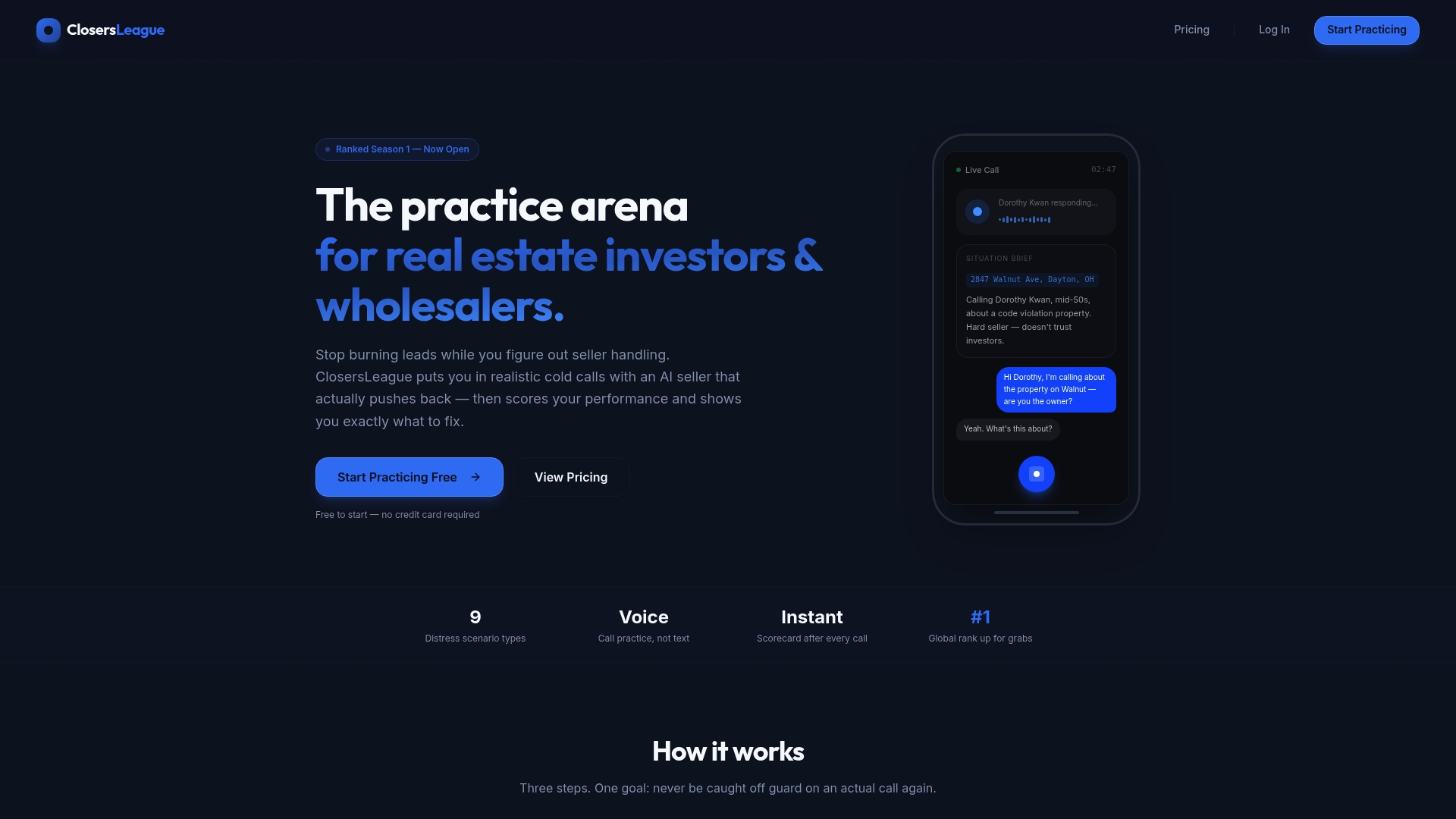
Reps practice against realistic seller pushback before they ever burn a real lead on a shaky pitch, and every session feeds a scorecard and leaderboard so managers can see who’s actually improving, not just who’s dialing the most. It pairs directly with the games in this article: run role-play drills as your warmup, then track live results in your regular contest cadence.
Pilot your gamification internally first using the templates above, then bring in structured practice once you know which behaviors you need reps to improve. Start a free trial at ClosersLeague to see how scenario-based practice and leaderboards work together before you commit a full team to it.
Sources
- Sales Gamification In Salesforce: How Arcade Boosts Dials
- The Impact of Gamification on Sales Performance: A New Approach to Increasing Sales Volume
- Gamification Sales Training: Evidence & Implementation Guide — QUOTA Training
FAQ
What are some fun games to play while cold calling?
Call Bingo, Rejection Games, and Call Blitz sprints are among the most popular because they turn repetitive dialing into a visible, scored activity. Mystery Box rewards and Daily Spin wheels add variety without requiring a big budget.
What is the 80/20 rule in cold calling?
Can you give me some examples of gamification?
Points for completed calls, streaks for consecutive days hitting a dial target, leaderboards ranking reps in real time, and tiered prizes for different performance brackets are all common gamification mechanics. AI-scored role-play, like the scenario practice ClosersLeague runs for real estate cold callers, is a newer form that ties gamified scoring to actual skill development.
What are some cold calling tips that pair well with gamification?
Randomize lead assignment before any contest to keep competitions fair, and weight your point system toward booked appointments rather than raw dial count so reps aren’t rewarded for empty activity. Pairing a short role-play warmup before a calling sprint, as outlined in this real estate calling guide, also tends to improve call quality during the contest itself.
How long should a cold call contest run?
One to two week seasons work best for keeping engagement high, since longer contests tend to get decided early and demotivate reps who fall behind in week one. Reset the leaderboard and rotate the game format each cycle to keep the competition fresh.
Recommended
- 10 proven cold calling tips for real estate investors – ClosersLeague Blog
- Tired Landlord Cold Calling Practice — AI Roleplay for Real Estate Investors & Wholesalers
- Code Violation Property Cold Calling Practice — AI Roleplay for Real Estate Investors & Wholesalers
- Cold Calling Best Practices: Your 2026 Success Guide