
Cold calling is proactive outbound phone outreach to prospects who have had no prior contact with you. Done right, it still books pipeline like almost nothing else in sales. The practices that work in 2026 are built on intent-driven targeting, verified data, and structured conversations — not raw volume or charm.
Here is what separates callers who consistently book meetings from those grinding through dead lists:
- Research first. Identify real buying signals or life triggers before you dial.
- Use direct dials. Verified mobile and direct numbers dramatically improve connect rates over switchboards.
- Time your calls. Wednesday and late afternoon (roughly 4–5 PM) produce the highest pickup rates.
- Open with permission. A pattern-interrupt opener that acknowledges the cold nature of the call outperforms a scripted pitch every time.
- Diagnose, don’t pitch. Ask discovery questions. Listen more than you talk.
- Run a multi-touch cadence. Coordinate phone, email, and LinkedIn in a tight sequence.
- Stay compliant. The FTC Telemarketing Sales Rule and FCC TCPA rules set hard limits on when and how you can call. Violations carry civil penalties up to $53,088 per violation.
- Track the right metrics. Dial-to-connect ratio and connect-to-meeting rate tell you far more than total dials.
How to prepare for cold calls the right way
Preparation is where most callers lose before they ever pick up the phone. Cold calling success is driven primarily by the quality of your lists and research, not by call volume or charisma. Get this part right and everything downstream gets easier.
Build a tight prospect list.
- Define your ideal prospect by firmographics, situation type, and a trigger that signals readiness. For real estate investors, that trigger might be a notice of default, a probate filing, or a tax delinquency.
- Narrow the list ruthlessly. Dialing a broad, loosely targeted list means most conversations are with the wrong person.
- Verify contact data before you dial. B2B data decays roughly 2% per month, and stale numbers waste more rep time than any other single factor.
- Prioritize direct dials and mobile numbers. They connect at significantly higher rates than office switchboards.
Write a structured script, not a monologue.
- Build a pattern-interrupt opener that earns the next 30 seconds, not one that launches into a pitch.
- Include a specific, account-relevant reason for calling tied to a real trigger, such as a recent life event, a hiring change, or a technology shift. Pre-call context like this raises conversion rates more than 30% over generic outreach.
- Prepare a bank of 11–14 discovery questions so you diagnose the prospect’s situation rather than present a solution they haven’t asked for.
- Use a qualification framework like BANT (Budget, Authority, Need, Timeline) to keep calls focused and efficient.
Practice out loud.
Scripts that only live on paper fall apart on the phone. Read your opener aloud, record yourself, and role-play objections with a colleague or a training simulator. The goal is to internalize the structure so you can stay present in the conversation instead of reading.
Pro Tip: Set a daily call goal tied to conversations, not dials. Fifty dials on a stale list is wasted effort. Ten conversations with verified, well-researched prospects moves the needle.
How to execute cold calls for maximum impact
Execution is where preparation pays off. The best callers follow a recognizable structure while leaving room for a real human conversation inside it.
Reach the right person at the right time.
- Call the decision-maker directly. Gatekeepers slow you down and filter your message.
- Wednesday produces the highest pickup rates. Late afternoon, around 4–5 PM local time, consistently outperforms late morning.
- Leave a short, specific voicemail when you miss someone. A callback has roughly a 27% chance of reaching the prospect, so a voicemail that prompts a return call is worth the 20 seconds it takes.
Open with permission, not a pitch.
Opening with something like “How have you been?” pattern-matches to a familiar contact and buys conversational room. Follow immediately with your specific, trigger-anchored reason for calling. Generic value propositions kill calls. A reason tied to a real event, a foreclosure notice, a probate filing, a recent hire, converts far better.

Diagnose before you present.
Top performers ask 11–14 questions per call and talk less than they listen. The first cold call is almost never the place to close. Its job is to earn a qualified next step by understanding enough of the prospect’s situation to show the conversation is worth continuing. Successful cold calls average about 93 seconds; the most effective calls focus on a crisp ask for a next qualified step, rather than a long presentation.
Coordinate across channels.
Phone alone leaves connects on the table. Multi-channel sequences that integrate phone, email, and LinkedIn significantly improve connection and meeting rates, as explained in How Digital Marketing Drives Success in SoCal Real Estate. A LinkedIn view before the first dial, an email after a voicemail, each touch aware of the others. The phone is one instrument in a coordinated sequence.
| Touch | Timing | Channel | Purpose |
|---|---|---|---|
| 1st attempt | Day 1 | Phone + voicemail | Introduce, leave specific message |
| 2nd touch | Day 2 | Reference voicemail, add value | |
| — | — | Phone | Follow up on email |
| 4th touch | Day 5 | Connect with relevant insight | |
| 5th attempt | — | Phone | Final attempt, then move on |
Pro Tip: If you’re calling real estate leads around distressed situations like foreclosure or probate, check out cold calling tips for real estate investors for scripts and openers built specifically for those conversations.
Advanced psychology and 2026 compliance you need to know
The callers who consistently outperform aren’t just better at talking. They’re better at listening, and they stay out of legal trouble.
Building rapport as emotional precision
Rapport isn’t surface friendliness. Top sales performers treat it as precision listening and calm pacing, especially in the first 30 seconds. Matching your tone to the prospect’s energy, slowing down when they’re guarded, and acknowledging their time all signal safety rather than pressure.
Prospects enter a defensive mode the moment they detect a sales pitch. Shifting the conversation from “here’s what I’m selling” to “let me understand your situation” moves them from resistance to engagement. That shift is the difference between a hang-up and a booked meeting.
Offering a relevant insight early also establishes reciprocity. When you give something useful before asking for anything, you earn the right to continue the conversation. That’s not manipulation. It’s respect.
2026 compliance requirements
The legal framework for cold calling in the United States is specific and enforced. Ignorance is not a defense.
- Calling hours: The FTC Telemarketing Sales Rule prohibits calls before 8 AM or after 9 PM local time. No exceptions.
- Do Not Call registry: Scrub your lists against the national DNC registry before every campaign. Registration does not expire, per FCC rules.
- Mandatory disclosures: On every outbound sales call, you must promptly disclose your identity, the seller’s identity, and that the purpose of the call is to sell goods or services, before any sales pitch begins.
- One-to-One Consent: The FCC’s 2026 rule requires specific, seller-unique prior express written consent for telemarketing robocalls. Consent must identify the legal entity by name. Blanket consent forms that cover multiple sellers are no longer compliant.
- Recordkeeping: The FTC’s updated TSR requires retention of call detail records, consent documentation, and telemarketing scripts.
Compliance is not optional, and it’s not a competitive disadvantage. Callers who run clean, well-documented programs build trust faster and avoid the enforcement risk that shuts down entire operations.
Pro Tip: Before launching any new calling campaign, cross-reference your list against the DNC registry at telemarketing.donotcall.gov and document your consent records. One audit-ready file per campaign saves significant headaches.
Common cold calling mistakes that kill your results
Most cold calling failures trace back to a handful of fixable errors. Here’s what to watch for and how to correct each one.
- Dialing stale data. Reps lose more than a quarter of their time to wrong numbers and disconnected lines. The fix is verified, freshly enriched direct dials refreshed regularly, because data decays constantly.
- Pitching instead of diagnosing. Reps who launch into a pitch on the first call talk past the prospect. Ask questions. Aim for a next step, not a close.
- Calling too few or too many times. Stopping after one attempt forfeits most conversations. Calling beyond five times wastes effort on prospects who have already decided. A disciplined three-to-five attempt cadence, front-loaded across days, is the right shape.
- Ignoring multi-channel outreach. Calling in isolation from email and LinkedIn leaves connects on the table. Each channel should be aware of the others.
- Breaking calling hour rules. Calling before 8 AM or after 9 PM local time violates the FTC Telemarketing Sales Rule and exposes you to civil penalties. State laws sometimes set tighter windows.
- Using generic scripts. A script with no specific trigger or account-relevant reason sounds like every other cold call the prospect has ever received. Personalization tied to a real event is what earns attention.
- Mixing up your metrics. A dial-to-meeting rate and a conversation-to-meeting rate are different numbers. Blending them hides which list segments are converting and which are dead weight. Track granular metrics per rep, per list, and per segment.
For real estate investors specifically, handling the “I’m not interested” response is one of the most common sticking points. The right response to that objection isn’t to push harder. It’s to pivot toward a qualifying question that opens the door to a real conversation.
Key Takeaways
The single most important cold calling principle in 2026: fix your list before you fix your script, because verified data and tight targeting outperform any opener on a stale, broad list.
| Point | Details |
|---|---|
| Data quality comes first | Verified direct dials and fresh, trigger-based lists drive results more than script changes. |
| Time your calls deliberately | Wednesday and late afternoon (4–5 PM) produce the highest pickup rates. |
| Diagnose before you present | Ask 11–14 discovery questions per call; the goal is a qualified next step, not a close. |
| Run a coordinated cadence | Three to five attempts across phone, email, and LinkedIn, then move to a fresh prospect. |
| Stay legally compliant | Call only between 8 AM and 9 PM local time, scrub DNC lists, and document consent per 2026 FCC and FTC rules. Violations outside these hours risk heavy enforcement penalties, so strict compliance is essential. |
The discipline behind great cold calling
Cold calling gets a bad reputation because most people do it wrong. They dial too broadly, pitch too early, and quit after one attempt or grind past the point of diminishing returns. The callers who consistently book meetings aren’t necessarily more charismatic. They’re more prepared, more disciplined, and more honest about what a first call can realistically accomplish.
The psychological shift that separates good callers from great ones is moving from “how do I sell this person” to “do I even have something this person needs?” That reframe changes everything. Your tone relaxes. Your questions get sharper. The prospect feels heard instead of hunted. And paradoxically, that’s when you close more.
The legal landscape in 2026 reinforces this. The FCC and FTC rules aren’t obstacles to good calling. They’re a floor that forces you to be intentional. Callers who scrub their lists, document consent, and respect calling hours are also the ones building the kind of trust that converts. Compliance and quality aren’t in tension.
AI-powered training tools are changing how quickly callers can develop these skills. Practicing objection handling in a realistic roleplay environment, getting scored on tone and question quality, and drilling specific scenarios like probate or foreclosure calls builds the muscle memory that makes structure feel natural. That’s exactly what ClosersLeague is built for: deliberate practice on the specific conversations that matter most to real estate investors and wholesalers.
Stop winging it. Start drilling.
Practice your cold calls with ClosersLeague
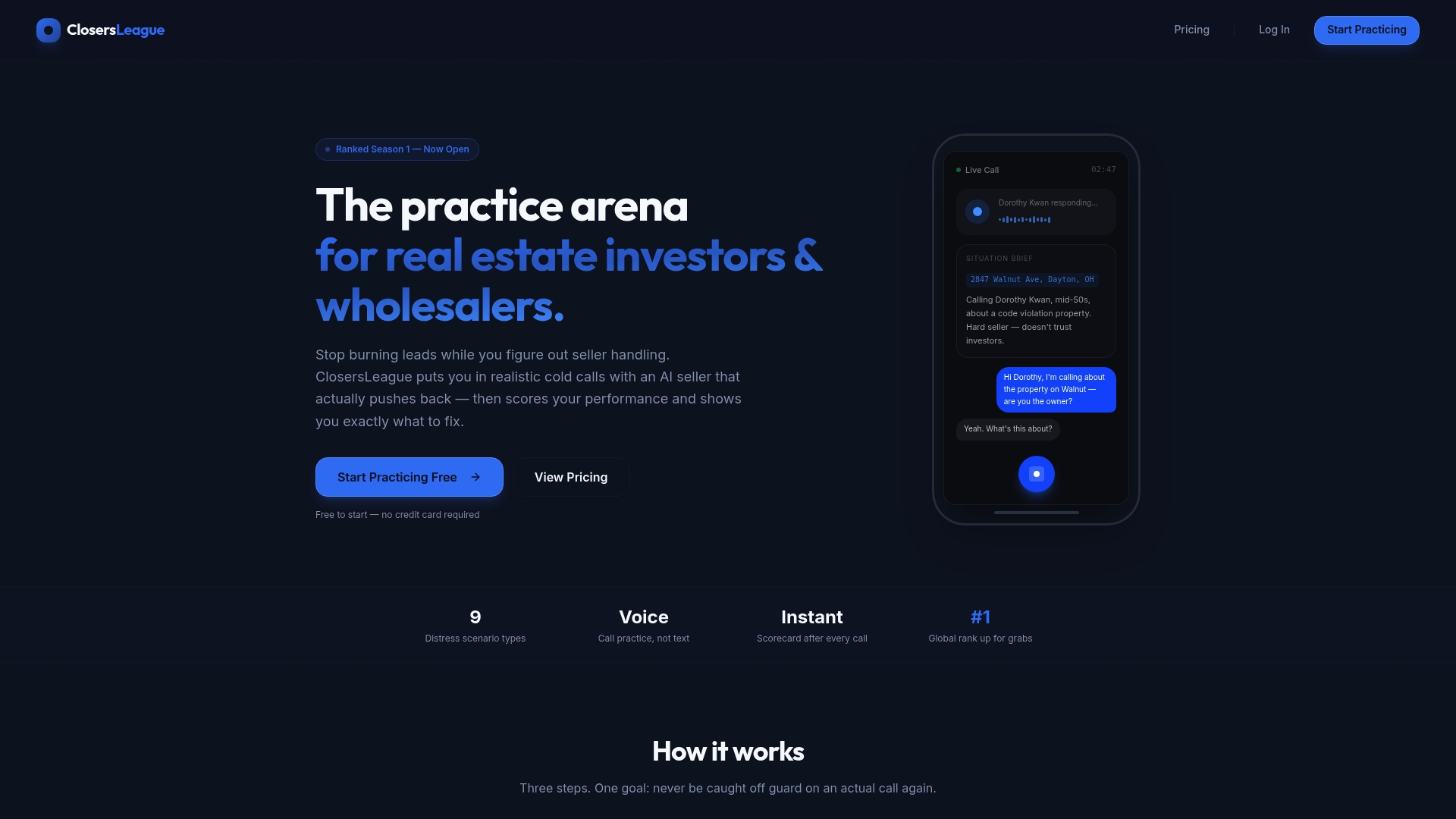
Real estate cold calling requires a different skill set than standard B2B outreach. You’re calling homeowners in distressed situations, and the conversation has to feel human, not scripted. ClosersLeague gives you AI-powered roleplay practice built specifically for those calls.
Whether you’re working inherited property leads or code violation lists, ClosersLeague simulates the real conversations you’ll face, scores your performance, and helps you improve rep by rep. No guesswork. No winging it.
FAQ
What is cold calling and does it still work in 2026?
Cold calling is outbound phone outreach to prospects with no prior relationship. It still works in 2026, particularly when callers use verified data, trigger-based targeting, and structured multi-channel cadences rather than high-volume random dialing.
What are the best times to make cold calls?
Wednesday produces the highest pickup rates, and late afternoon around 4–5 PM local time consistently outperforms other windows. Federal law also prohibits calls before 8 AM or after 9 PM local time under the FTC Telemarketing Sales Rule.
How many times should you call a prospect before moving on?
A three-to-five attempt cadence, front-loaded across days, captures the vast majority of conversations you’ll ever have with a given prospect. Calling beyond five times rarely produces results and is better replaced with outreach to a fresh contact.
What do I have to disclose on a cold call?
Before any sales pitch, you must promptly disclose your name, the seller’s identity, and that the purpose of the call is to sell goods or services. This is required under the FTC Telemarketing Sales Rule for all outbound sales calls.
How do I handle objections on a cold call?
Pivot toward a qualifying question rather than pushing back. When a prospect says they’re not interested, ask a brief, open-ended question about their situation to determine whether there’s a real fit. Discovery beats pressure every time, and the real estate prospecting process works the same way.