A cold caller leaderboard is an in-platform ranking that scores trainees on real cold-calling performance metrics, not just call counts, so everyone can see who is improving and where. For real estate investors and wholesalers practicing seller outreach, that visibility drives more consistent practice and faster skill-building. ClosersLeague builds leaderboards this way, ranking trainees on competency scores earned through AI roleplay.
TL;DR:
- Leaderboards paired with detailed feedback can significantly increase practice time and improve cold-calling skills more effectively than volume alone.
- Upward leaderboards motivate ongoing learning and exploration, making them ideal for experienced callers, while relative leaderboards help beginners build confidence.
- Competency-based metrics like scenario success rate, compliance, empathy, and objection handling create clearer targets than just call volume, improving skill development.
- Training must incorporate compliance practices such as scrubbing against the Do Not Call list and teaching correct disclosure phrasing to manage legal risks.
- Implementing leaderboards with clear metrics, regular review, and private options can drive results without encouraging gaming or decreasing motivation.
Table of Contents
- Why leaderboards boost practice: evidence and practical benefits
- Leaderboard design: upward, relative, and absolute leaderboards
- What to rank: competency metrics vs. raw volume
- Compliance and risk: practicing without creating legal exposure
- Implementing a cold caller leaderboard in an AI training platform
- Measuring impact: KPIs, A/B testing, and when to pull back
- Balancing competition with competence
- ClosersLeague: how we build leaderboards and scorecards
- FAQ
- Sources
Why leaderboards boost practice: evidence and practical benefits
Gamified training works because it changes behavior before it changes skill. Research on leaderboard design found that points, levels, and leaderboards increased how much people practiced, though volume alone didn’t guarantee better intrinsic motivation or higher-quality output. That’s an important distinction for cold calling: more reps matter, but only when paired with real feedback on what those reps revealed.
Leaderboards paired with strong feedback loops can meaningfully raise time-on-task, which is the real lever behind skill gains in cold-calling practice.
For investors and wholesalers, the practical payoff looks like this: BRRRR investing method exemplifies how systematic approaches can enhance local real estate investment strategies.
- More scenario repetition across distressed seller types, from probate to pre-foreclosure
- Faster recognition and handling of common objections
- Habit formation around daily practice instead of sporadic effort
A leaderboard without feedback is just a scoreboard. The difference is whether trainees can see why their rank moved, not just that it did.
Leaderboard design: upward, relative, and absolute leaderboards
Not every leaderboard should work the same way. Three common formats serve different training goals:
- Absolute leaderboards rank everyone against the same fixed scale, useful for benchmarking a whole team
- Relative leaderboards rank trainees against peers at a similar skill level, which lowers pressure for newcomers
- Upward leaderboards show a trainee’s position relative to people just ahead of them, encouraging reach without overwhelming comparison
Research on leaderboard direction in gamified learning found that upward leaderboards encourage exploration and sustained learning effort, while relative leaderboards reduce peer pressure and support personal goal setting. For a wholesaling team, that suggests relative leaderboards during onboarding and upward leaderboards once callers have a baseline skill level.
Pro Tip: Start new hires on a relative leaderboard against other beginners, then graduate them to an upward view once they clear their first few scored scenarios.
What to rank: competency metrics vs. raw volume
Ranking trainees by call count rewards the wrong behavior. A caller who rushes through twenty scripted pitches a day isn’t necessarily better than one who completes eight calls with strong objection handling and compliant disclosures. The fix is building the leaderboard around competency metrics an AI scorecard can actually measure:
- Scenario success rate, meaning how often a trainee reaches the call’s goal (appointment, qualifying info, or next step)
- Compliance score, covering required disclosures and consent language
- Empathy rating, reflecting how well the caller reads and responds to a seller’s emotional state
- Objection handling, scored across common pushback like “not interested” or “how did you get my number”
A composite index that blends these numbers into one rank gives trainees a clearer target than volume alone.
Compliance and risk: practicing without creating legal exposure
Cold calling carries real legal risk, and training environments should teach compliant habits from day one rather than bolt them on later. The FTC’s guidance on the Telemarketing Sales Rule recommends scrubbing call lists against the National Do Not Call Registry on a monthly cycle, maintaining call records, and training personnel to qualify for safe-harbor protections under the TSR and TCPA.
Scrubbing lists against the national registry on a 31-day cycle is one of the clearest, most actionable TSR compliance steps a wholesaling team can put on a calendar.
Practice environments need their own safeguards, separate from live outreach:
- Use simulated phone numbers and sandbox seller datasets, never real homeowner data
- Log consent templates so trainees practice asking for and recording consent correctly
- Build compliant phrasing into the scorecard itself, rewarding correct disclosures the same way it rewards objection handling
This approach treats compliance as a trainable skill, not an afterthought, which matters for teams making high-volume outreach calls.
Implementing a cold caller leaderboard in an AI training platform
Adding or refining a leaderboard works best as a short, deliberate rollout rather than a single feature flag:
- Define the metric set first: competency index, compliance score, consistency, and improvement rate, not raw call count
- Set a sampling window, such as a rolling 14-day period, so one bad day doesn’t dominate a trainee’s rank
- Choose visibility rules: relative leaderboards for new hires, upward or absolute for experienced callers
- Build in privacy controls so trainees can opt into or out of public ranking while still tracking private progress
- Onboard users deliberately, explaining what each metric means and setting individual goals before the leaderboard goes live
- Schedule maintenance: weekly DNC scrubs for any live-adjacent data, audit logs, and a regular feedback loop with team leads
Pro Tip: Review leaderboard weighting every few weeks against actual live-call outcomes. If the top-ranked trainees aren’t also your best performers on real calls, the weighting needs adjusting.
Our own onboarding checklist for new cold callers walks through grouping and goal-setting in more detail.
Measuring impact: KPIs, A/B testing, and when to pull back
A leaderboard is only worth keeping if it moves the numbers that matter. Track a short list of KPIs:
- Practice sessions per week, per trainee
- Scenario completion rate across distressed seller types
- Competency score lift over a rolling 30-day window
- Downstream live-call metrics, like appointment-set rate, once trainees graduate to real calls
A simple A/B test, splitting new hires between a leaderboard group and a private-dashboard-only group for four to six weeks, shows whether ranking itself is driving the lift. Early gamification research found points, levels, and leaderboards increased practice quantity without automatically improving quality, which is exactly what an A/B test should confirm or challenge in your own data.
Watch for red flags: trainees gaming the system with quick, low-effort calls just to rank higher, or motivation dropping among people stuck near the bottom. Either signal means it’s time to adjust weighting or move struggling trainees to a private, progress-only view for a while.

Balancing competition with competence
Coaching real estate cold callers for any length of time teaches you that competition is a tool, not a goal. The teams that improve fastest are the ones where the leaderboard points at a skill gap instead of just a rank. A caller sitting at the bottom because their disclosure language is off needs a different conversation than one sitting there because they haven’t logged enough sessions.
A short checklist keeps the leaderboard healthy: check weekly whether rank correlates with actual call quality, rotate who appears at the top of visible categories so it doesn’t calcify into the same five names, and give struggling trainees a private path back to confidence before putting them back in public view.
— Dave
ClosersLeague: how we build leaderboards and scorecards
We built ClosersLeague around the idea that a leaderboard only earns its place if it is tied to real skill data, not call volume. Our AI roleplay practice covers nine distressed seller types, from probate to tax delinquent to tired landlords, and every session feeds a multi-category scorecard covering objection handling, empathy, and compliant phrasing. That scorecard is what populates the leaderboard, so climbing the rankings means actually getting better at the conversations that matter.
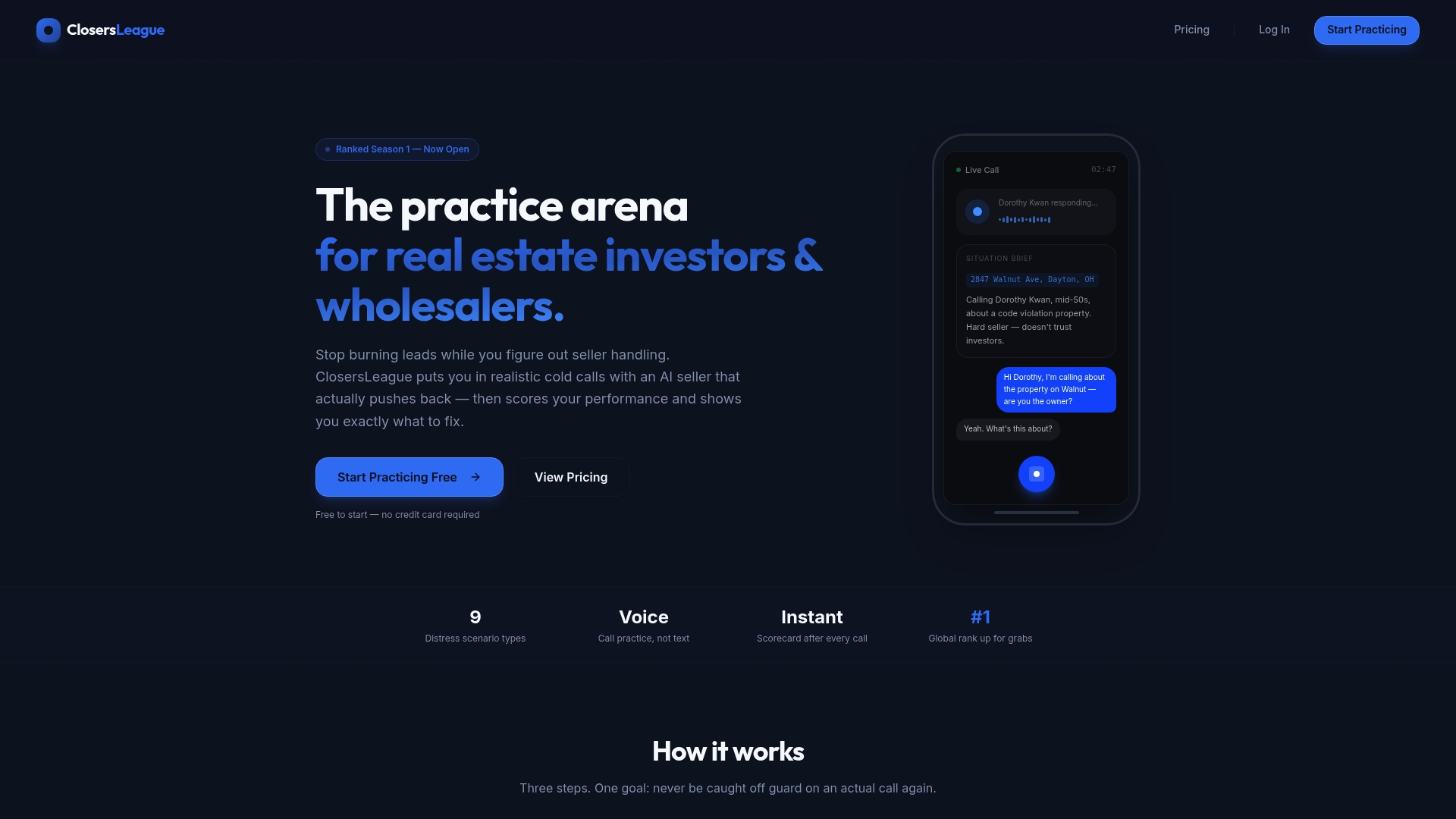
Trainees get targeted drills based on where their scores lag, and team leads get a clear view of who’s ready for live calls versus who needs another week of reps. Plans start with a free trial, and our Starter, Growth, and Pro plans run $5, $10, and $18 per month. Check Closersleague to start a trial or compare plan details.
FAQ
What is a cold caller leaderboard in an AI training platform?
It’s an in-platform ranking of trainees based on cold-calling performance metrics like scenario success rate, compliance score, and objection handling, not just call volume. The goal is to surface who is improving and on what skill, so coaching can target the right gaps.
Do leaderboards actually improve cold calling practice?
Research on gamification found that leaderboards and similar elements increased practice quantity, though volume alone doesn’t guarantee better quality without feedback. Pairing a leaderboard with detailed scorecards and coaching is what turns extra reps into real skill gains.
Which type of leaderboard is best for new cold callers?
Research on leaderboard direction suggests relative leaderboards work better for beginners because they reduce peer pressure and support personal goal setting. Upward leaderboards tend to suit callers who already have a skill baseline and respond well to reaching toward a nearby peer.
How do you keep cold calling practice TCPA and TSR compliant?
Keep practice calls in a sandbox using simulated numbers and never real homeowner data, and scrub any list connected to live outreach against the National Do Not Call Registry at least every 31 days. Training scorecards can also grade required disclosures directly, building compliant phrasing into practice before it reaches live calls.
What does ClosersLeague cost?
ClosersLeague offers three plans: Starter at $5 per month, Growth at $10 per month, and Pro at $18 per month, after a free trial with limited practice calls.
Sources
- Towards understanding the effects of individual gamification elements on intrinsic motivation and performance
- Influences of leaderboard direction on learning performance and satisfaction in gamified e-learning
- Q&A for telemarketers and sellers about the DNC provisions of the TSR