
Cold calling is defined as the practice of contacting property owners who have not previously expressed interest in selling, making it the most direct lead generation method available to real estate investors and wholesalers. Understanding why cold calling matters separates investors who build consistent pipelines from those who chase deals reactively. The industry average success rate reached 2.7% in 2026, with top performers hitting 6–15% through quality data and structured cadences. For real estate professionals targeting foreclosure, probate, divorce, and tax-delinquent sellers, no other channel delivers the same direct access to motivated homeowners.
Why cold calling matters: the data behind its effectiveness
The numbers behind cold calling effectiveness are more compelling than most investors realize. 57% of C-level and VP executives prefer phone communication over email or social media. That preference holds true for motivated sellers too. A homeowner facing foreclosure or probate is far more likely to have a real conversation on the phone than to reply to a text blast.

Top performers separate themselves through process, not personality. The industry average of 2.7% means roughly 3 deals per 100 targeted calls when done correctly. Top performers achieve 6–15% by combining verified data, structured scripts, and consistent follow-up cadences. That gap between average and top performance is entirely a skills and systems problem.
Persistence is the single most underrated factor in cold calling success. 93% of successful conversions happen after six or more follow-up attempts. Yet 44% of reps quit after one failed attempt. That statistic explains why most investors feel cold calling “doesn’t work.” They stop before the deal was ever going to happen.
Real estate investors working distressed seller lists should expect the following benchmarks:
- Industry average connect rate: roughly 1 in 18–20 dials results in a real conversation
- Top performer connect rate: 1 in 7–10 dials with verified direct-dial mobile numbers
- Conversion to appointment: 1 in 8–12 conversations for trained callers
- Calls to closed deal: varies by market, but structured cadences consistently outperform single-touch attempts
Pro Tip: Track your connect rate and conversation rate separately. If your connect rate is low, the problem is your data. If your conversation rate is low, the problem is your script.
How does cold calling compare to email and social media outreach?
Cold calling delivers something email and social media cannot: a real-time, two-way conversation. Real-time feedback from live calls lets you adjust your pitch, handle objections, and qualify a seller in under three minutes. An email sits in an inbox for days, if it gets opened at all.
Senior decision-makers and motivated sellers respond differently to each channel. Phone calls create immediacy. A homeowner behind on mortgage payments is not browsing LinkedIn. They are answering their phone, especially when the caller sounds credible and prepared.
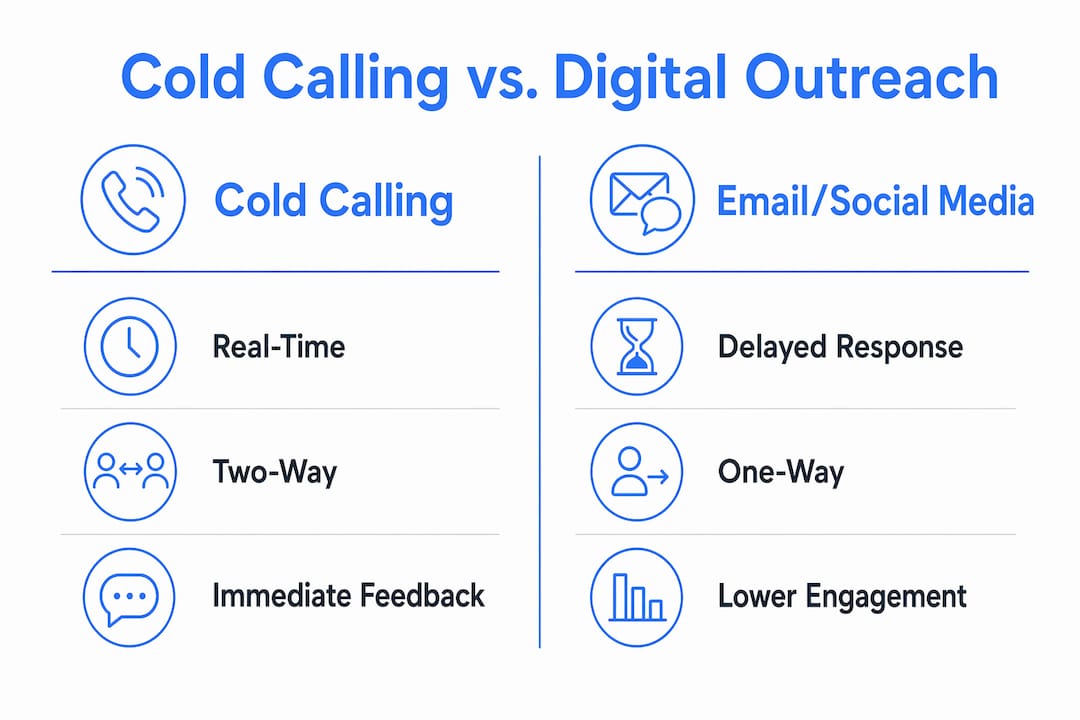
The strongest outreach programs combine all three channels in sequence. Stacking cold calls with personalized email and LinkedIn boosts conversion rates by 28% over single-channel outreach. The phone call opens the door. The follow-up email reinforces credibility. The LinkedIn touch adds a face to the name.
A practical multi-channel sequence for real estate investors looks like this:
- Day 1: Cold call with a direct opener tied to a specific seller situation (foreclosure, probate, code violation)
- Day 2: Personalized follow-up email referencing the call
- Day 4: Second call attempt with a new angle or updated offer
- Day 7: Final email with a clear next step
Pro Tip: Treat your call and email as one conversation, not two separate outreach attempts. Reference the call in your email and reference the email on your next call. Sellers notice the consistency.
For investors looking to sharpen their overall approach, understanding real estate buyer strategies alongside cold calling tactics builds a more complete acquisition system.
What are the best cold calling practices for real estate success?
Cold calling best practices in real estate start with data quality, not script quality. Verified direct-dial mobile numbers reduce wasted dials by 25% and dramatically increase connect rates. Calling a landline that was disconnected two years ago is not a cold calling problem. It is a data problem.
Build your list before you build your script
Your contact list determines your ceiling. For distressed seller lists, prioritize:
- Recency: Pull lists updated within the last 30–60 days. Foreclosure timelines move fast.
- Direct mobile numbers: Skip-traced mobile numbers outperform landlines for connect rates.
- Situation specificity: Separate your probate list from your tax-delinquent list. Each requires a different opener.
- Geographic focus: Tight geographic targeting lets you reference local market conditions credibly.
Structure your calls for real conversations
A strong cold call opener does one thing: earns 30 more seconds. It does not pitch. It does not list features. It acknowledges the seller’s situation and asks a simple question. For a probate lead, that might sound like: “I understand you may have recently inherited a property. I work with families in that situation. Is that something you are currently dealing with?”
Objection handling is where most investors lose deals they could have won. The most common objections in distressed seller calls are “I’m not interested,” “I already have an agent,” and “What’s your offer?” Each requires a prepared, practiced response. Winging objections costs you deals. Drilling them in practice builds the confidence to stay in the conversation.
Call timing also matters. Mid-morning calls between 9:00 AM and 11:00 AM and late-afternoon calls between 4:00 PM and 6:00 PM consistently produce higher connect rates than midday attempts. Sellers are more available and less distracted at those windows.
For a deeper breakdown of how to structure your prospecting calls, the real estate prospecting process at ClosersLeague covers cadence and scripting in detail.
What challenges do real estate investors face with cold calling?
The biggest challenge in cold calling is not rejection. It is the cumulative weight of repeated rejection without a feedback loop. Most investors dial, get rejected, and have no idea whether the problem was their opener, their tone, their list, or their timing. Without that feedback, they either quit or repeat the same mistakes.
Poor cold calling results usually come from lack of preparation and data quality, not from the channel itself. That distinction matters. Blaming cold calling for bad results is like blaming a hammer for a crooked nail.
Common challenges and their direct solutions:
- High voicemail rate: Leave a short, specific voicemail (under 20 seconds) that references the seller’s situation. Generic voicemails get deleted. Specific ones get callbacks.
- Call fatigue: Cap solo dial sessions at 90 minutes. Quality drops sharply after that. Take a break, review your notes, and reset.
- Stale contact lists: Refresh your lists every 30–45 days for active distressed seller campaigns. Old data kills momentum faster than any objection.
- Low volume ceiling: Solo operators dialing 150–200 calls for one lead burn out quickly. Virtual assistant teams and predictive dialers scale that volume to thousands of dials daily.
Pro Tip: Record your calls and review three per week. You will catch patterns in your delivery that you cannot hear in the moment. Most investors are surprised by what they actually sound like on a call.
Calling distressed homeowners requires a specific approach that balances empathy with directness. Practicing those conversations before live calls is the fastest way to close the gap between your current results and your potential.
Leads also go cold fast. Immediate post-call follow-up, such as scheduling a walkthrough the same day a seller expresses interest, improves conversion significantly. Waiting 24 hours to follow up on a warm lead is often the difference between a deal and a dead end.
Key Takeaways
Cold calling remains the most direct and measurable lead generation channel for real estate investors when backed by quality data, structured cadences, and consistent follow-up.
| Point | Details |
|---|---|
| Data quality drives results | Verified direct-dial numbers reduce wasted dials by 25% and raise connect rates. |
| Persistence closes deals | 93% of conversions happen after six or more attempts; quitting early is the top reason investors fail. |
| Multi-channel sequences outperform solo calls | Combining calls, email, and LinkedIn boosts conversions by 28% over single-channel outreach. |
| Script and objection prep are non-negotiable | Practicing openers and objections before live calls directly improves conversation rates. |
| Follow up the same day | Leads go cold fast; same-day follow-up after a warm conversation is a proven conversion lever. |
Cold calling is still the foundation, and here is why I believe that
I have watched investors spend thousands on direct mail, pay-per-click ads, and list services, then wonder why their pipeline is inconsistent. The answer is almost always the same: they are avoiding the phone. Cold calling is uncomfortable. It requires you to be present, handle rejection in real time, and keep going. That discomfort is exactly why it works. Most of your competition has already given up on it.
The technology around cold calling has changed significantly. AI-powered practice tools, predictive dialers, and skip-tracing services have removed most of the excuses for poor data and poor preparation. What has not changed is the fundamental truth: a motivated seller who picks up the phone and hears a credible, prepared investor is far more likely to have a real conversation than one who receives a postcard.
The investors I have seen build the most consistent deal flow are not the most charismatic. They are the most prepared and the most persistent. They practice their scripts. They review their calls. They show up the next day and dial again. That is the real edge in this business.
If you are serious about building a pipeline through outbound prospecting, the cold calling basics guide at ClosersLeague is a strong starting point for building that foundation correctly.
— Dave
ClosersLeague: practice cold calling before it counts
Real estate investors and wholesalers who practice before live calls close more deals. ClosersLeague is an AI-powered cold calling training platform built specifically for investors targeting distressed sellers, including foreclosure, probate, divorce, and code violation leads.
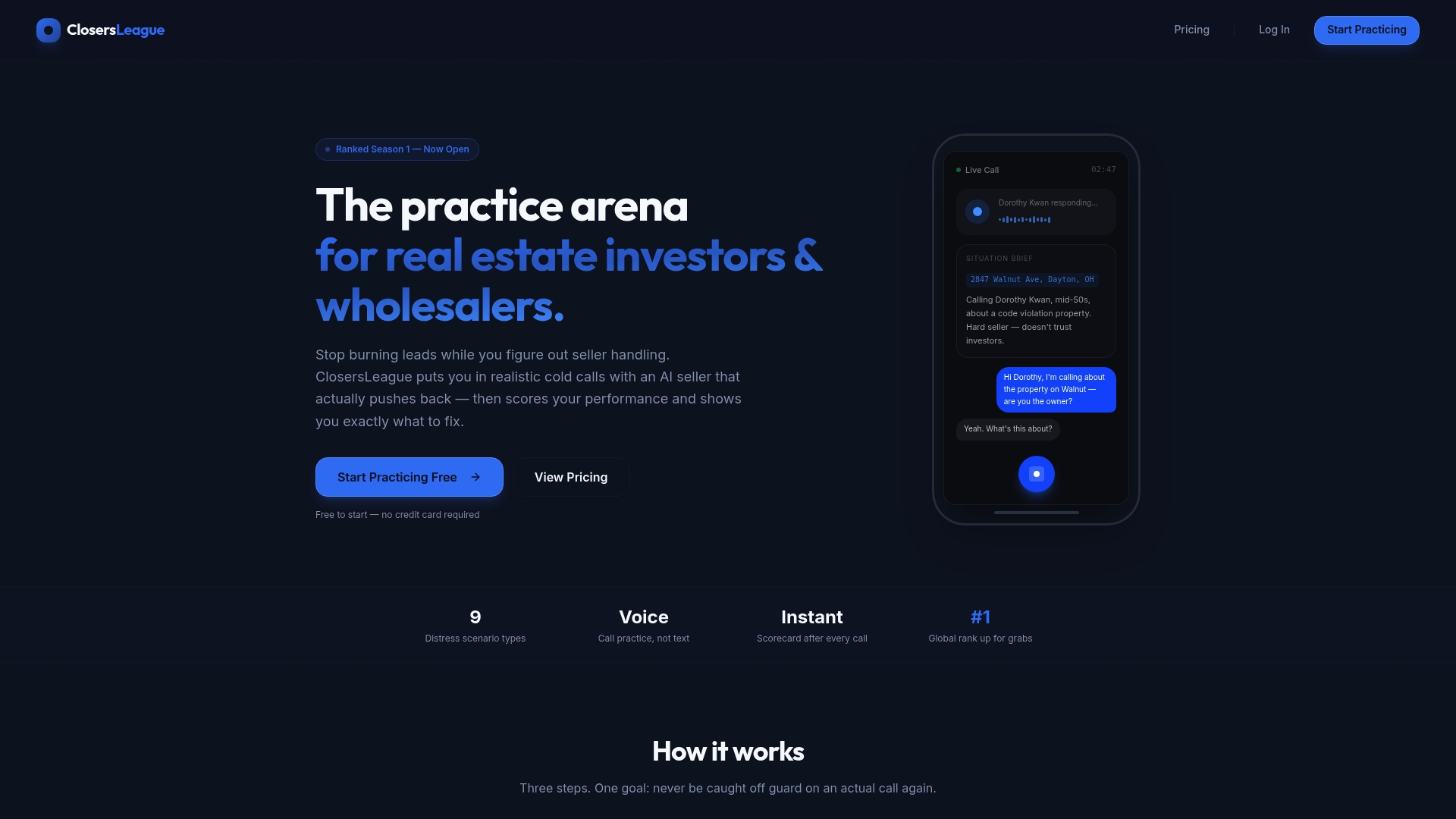
The platform offers scenario-specific AI roleplay for lead types like inherited property calls, vacant property outreach, and tired landlord conversations. Each session scores your performance and gives you specific feedback on your opener, objection handling, and close. Stop winging it. Start drilling the exact conversations you will have on your next call session.
FAQ
Why does cold calling still work in real estate?
Cold calling works because it creates direct, real-time access to motivated sellers who are not actively searching for buyers. No other outreach channel delivers the same immediacy or two-way conversation quality.
What is a realistic cold calling success rate for real estate investors?
The industry average success rate is 2.7%, while top performers reach 6–15% by using verified data and structured call cadences. Your rate improves directly with data quality and script preparation.
How many times should you call a lead before giving up?
Research shows 93% of successful conversions happen after six or more contact attempts. Most investors quit after one or two tries, which means persistence alone is a competitive advantage.
What is the best time to make cold calls to homeowners?
Mid-morning between 9:00 AM and 11:00 AM and late afternoon between 4:00 PM and 6:00 PM consistently produce the highest connect rates for residential cold calling campaigns.
How does ClosersLeague help with cold calling practice?
ClosersLeague provides AI-driven roleplay sessions built around specific distressed seller scenarios, including probate, foreclosure, and code violation leads, with scoring and feedback after each practice call.
Recommended
- Cold calling for investors: why direct outreach still wins – ClosersLeague Blog
- 10 proven cold calling tips for real estate investors – ClosersLeague Blog
- Real Estate Cold Calling Practice — AI Roleplay for Every Seller Type | ClosersLeague
- Master Real Estate Lead Generation: Cold Calling Basics – ClosersLeague Blog