The fastest, lowest-risk way to onboard cold callers is to hire from a proven channel, vet with a role-play test plus a short paid trial, then run a structured 30/60/90 ramp backed by KPI-driven QA. Start today by writing a five-minute role-play scenario based on a real seller objection and using it to screen your next three candidates before you pay for a single hour of calling.
TL;DR:
- Using agency-managed placements accelerates volume but may require less control, while freelancers offer more script customization at the cost of increased training efforts.
- A rigorous screening process, including a role-play test and short paid trial, is essential to identify candidates who recover from objections and follow scripts adaptively.
- The 30/60/90 onboarding plan should focus on building foundational knowledge, increasing independence, and handling complex scenarios with regular QA reviews.
- Ongoing performance management relies on tracking contact, appointment, and lead rates, supplemented by weekly call review and targeted coaching rather than one-off audits.
- An AI-based role-play platform streamlines training by providing scenario-based practice, instant feedback, and motivation tools, but real call review remains essential for sustained success.
Table of Contents
- Where to source cold callers and virtual assistants
- How to vet and hire: screening, role-play test, and paid trial
- Onboarding and training plan (30/60/90) with scripts and practice drills
- Managing performance and QA for cold-calling teams
- Pay, contracts, and engagement models (how to budget)
- Compliance essentials: DNC registry, TCPA basics, calling hours, and consent
- Tools, systems, and workflows to support onboarding and daily operations
- Applied training framework from ClosersLeague: roleplay, scoring, and skill drills
- Best practices for setting expectations and defining clear goals during onboarding
- Cultural and local market nuances in real estate cold calling to tailor scripts and approaches
- Strategies for motivation and retention of cold callers in real estate
- Author perspective: prioritize learning velocity or stability depending on growth stage
- ClosersLeague: how the AI roleplay platform accelerates onboarding (trial and pricing links)
- Sources
- FAQ
Where to source cold callers and virtual assistants
Where you find your callers shapes everything that follows: cost, consistency, and how much babysitting you’ll do in month one. Four channels dominate real estate cold calling, and each fits a different budget and risk tolerance.
-
Freelance marketplaces (general VA platforms) offer the lowest hourly rates and the fastest start, but quality varies widely and you do all the vetting yourself.
-
General VA agencies pre-screen for basic skills and replace underperformers, though most agents have never cold called a distressed homeowner before.
-
Real-estate-specialized agencies supply callers already trained on probate, pre-foreclosure, and tired-landlord scripts, which shortens the ramp but costs more per hour.
-
Referrals from other investors come with a track record you can verify firsthand, though availability depends entirely on someone else’s schedule.
When evaluating any provider, ask for a recorded sample call, confirm whether they scrub against the National Do Not Call Registry before dialing, and ask how they handle a seller who gets upset or hangs up. A provider who can’t answer the DNC question clearly is a liability, not a shortcut.
Agency-managed placements make sense when you need volume fast and don’t have time to manage individual contractors. A freelancer makes more sense when you want direct control over scripts, hours, and CRM access, and you’re willing to invest in training yourself. Many investors start with one agency-managed caller to establish a baseline, then add freelancers once their own onboarding system is proven.
How to vet and hire: screening, role-play test, and paid trial
A resume tells you almost nothing about how someone handles a seller who’s three months behind on their mortgage and defensive about it. Build your hiring funnel around a short screening call, a scripted role-play test, and a paid trial before committing to a long-term arrangement.
- Screen for clear spoken English, prior phone sales or appointment-setting experience, and basic CRM comfort (ask them to describe navigating a pipeline or tagging a lead).
- Run a 10-minute role-play where you play a distressed seller (pick probate or pre-foreclosure) and score the candidate on opening rapport, objection handling, and whether they ask qualifying questions instead of pushing straight to a pitch.
- Offer a short paid trial, typically three to five days of real calls on a warm list, and measure contact rate, appointments set, and how closely they follow your script’s structure.
- Review a recording from day one of the trial and give direct feedback before day two, then check whether the caller adjusts.
- Make the hire or pass decision using a simple scorecard, not a gut feeling, so you can compare candidates against each other fairly.
Pass criteria should be specific: a candidate who freezes on the first objection or reads the script word for word without adapting tone is a fail, regardless of accent or price. A candidate who recovers smoothly from “I’m not interested” and asks a follow-up question is a strong signal.
Pro Tip: Score the role-play on empathy and qualification separately. A caller can sound warm and still skip the questions that tell you whether a lead is worth a callback.
Onboarding and training plan (30/60/90) with scripts and practice drills
Treat the first 90 days as a ramp with checkpoints, not a single orientation call. Before day one, confirm the caller has access to your CRM, dialer, call recording, and the specific script and objection sheet they’ll use. Missing system access on day one is the single most common reason new hires stall.
Days 1 to 30: foundation
-
Walk through the full script line by line and explain the reasoning behind each question, not just the words.
-
Shadow five to ten live calls, then have the caller make calls while you listen in and debrief after each session.
-
Set an expected output of 60 to 80 dials per day with at least one scored role-play session per week.
Days 31 to 60: independence
- Reduce direct shadowing but review two to three recorded calls daily.
- Introduce objection-specific drills (price pushback, “how did you get my number,” family disagreements on probate properties).
- Expect contact rates and appointment-setting to stabilize; a caller still improving sharply at this point is normal, one who has plateaued low needs a correction plan.
Days 61 to 90: full ramp
- Caller should handle a full daily call volume independently with QA review on a rotating sample rather than every call.
- Introduce more complex scenarios: tax delinquent properties, code violations, out-of-state owners who are hard to reach.
- Set a 90-day benchmark for appointments or qualified leads generated, agreed with the caller in writing before the ramp starts.
Pay transparency matters here: accessing the National Do Not Call Registry requires an annual subscription with per-area-code fees, a recurring cost worth building into your onboarding budget from day one rather than discovering it in month two.
Scored role-play isn’t a one-time hiring gate, it’s a recurring tool. Weekly fifteen-minute sessions where the caller practices the toughest objection from that week’s real calls, scored against a simple rubric, tend to speed up the ramp more than extra shadowing hours. Pair it with our guide to opening scripts so new hires have a reference beyond the live coaching.
Managing performance and QA for cold-calling teams
Once a caller is ramped, the job shifts from training to maintenance: catching drift before it costs you leads. A light but consistent QA system beats an occasional deep audit.
- Track contact rate (connected calls divided by dials) to catch list quality or dialing-time problems early.
- Track appointment or qualified-lead rate as your core output metric, since dials alone tell you nothing about results.
- Track average call duration and talk-to-listen ratio to flag callers who are rushing or talking over sellers.
- Score a rotating sample of recorded calls weekly against a scorecard covering opening, rapport, objection handling, and qualification questions asked.
- Set an escalation rule: two consecutive weeks below target triggers a coaching session; a third week triggers a replacement conversation.
Review cadence matters as much as the metrics themselves. A quick daily glance at dial counts, paired with a weekly deeper scorecard review, catches problems while they’re still small. Use recordings for coaching, not punishment: play back a specific moment, ask the caller what they were thinking, then offer one concrete adjustment rather than a list of five. Callers improve faster when feedback is narrow and immediate than when it’s broad and delayed. Our prospecting process guide covers how to disposition leads coming out of these calls so QA and follow-up stay connected.
Pay, contracts, and engagement models (how to budget)
How you pay a cold caller should match how you want them to behave. Hourly pay rewards volume, per-lead pay rewards results but can tempt shortcuts, and salary plus bonus rewards consistency for callers you plan to keep long term.
- Hourly pay works best early in the relationship, when you’re still measuring whether the caller is worth a performance-based structure.
- Per-qualified-lead pay works well once you trust the caller’s judgment on what counts as “qualified,” since it aligns incentives directly with your goal.
- Salary plus bonus fits in-house hires you’re building a long-term team around, where stability matters more than squeezing maximum volume from a single week.
Whatever the structure, your contract should spell out a trial period, a replacement clause if the caller doesn’t meet agreed benchmarks, and explicit language confirming the caller will follow your DNC and TCPA procedures, not improvise their own.
To calculate cost per qualified lead, divide total weekly pay by qualified leads produced that week. A caller paid for 40 hours who produce five qualified leads costs eight hours of pay per lead, a number worth comparing against what you’d pay a marketing channel for the same lead.
Compliance essentials: DNC registry, TCPA basics, calling hours, and consent
Compliance isn’t optional paperwork, it’s the difference between a sustainable calling operation and one exposed to real financial risk. Every caller on your team, whether in-house or contracted, needs to understand these basics before their first dial.
- Scrub every list against the National Do Not Call Registry before calling, and budget for the recurring per-area-code subscription fee.
- Follow Telemarketing Sales Rule calling-hour limits, which restrict residential calls to between 8 a.m. and 9 p.m. in the called party’s local time zone.
- Understand TCPA restrictions on autodialers and prerecorded or artificial voice calls, which require prior express consent before calling a cell phone with that technology.
- Keep a written, company-specific DNC list and train every caller to log a request to be removed immediately, a practice the National Association of Realtors recommends alongside a documented internal policy.
- Document consent and call records so you can demonstrate compliance if a complaint ever surfaces.
Maintaining a written internal do-not-call policy and training staff on it helps establish the safe-harbor protections available under telemarketing law.
Enforcement isn’t theoretical. Sellers and consumer advocates do file complaints, and resources like the Javitch Law Office’s guide to documenting TCPA violations illustrate how specific those complaints can get, down to call timestamps and recordings. Treat list scrubbing and call-hour discipline as standard operating procedure, not an afterthought you handle after a complaint arrives.
Tools, systems, and workflows to support onboarding and daily operations
The right stack removes friction before it slows down a new hire. At minimum, your dialer needs to log calls automatically, support time-zone-aware scheduling to respect calling-hour rules, and integrate with your CRM so no lead sits untouched.
- Dialer requirements: automatic call logging, recording, and local presence dialing if you’re working multiple markets.
- CRM integration: every call outcome should sync to the lead record without manual entry, so dispositions stay accurate.
- List-scrubbing workflow: run new lists against the National Do Not Call Registry and your internal DNC list before they reach a caller’s queue.
- Roleplay and coaching tools: a dedicated practice environment lets new hires rehearse objections before they cost you a real lead.
- Dashboard visibility: contact rate, appointment rate, and QA scores should be visible to both the caller and the manager, not buried in a spreadsheet only you see.
Before go-live, confirm every tool talks to the others: a dialer that doesn’t sync to your CRM creates blind spots exactly when a new caller needs the most oversight.
Applied training framework from ClosersLeague: roleplay, scoring, and skill drills
The onboarding steps above work best when role-play isn’t a one-time hiring gate but a recurring habit. ClosersLeague built its training around that idea: scenario-based AI roleplay tailored to the seller types that actually show up in a wholesaler’s pipeline, including probate, pre-foreclosure, inherited, tax delinquent, code violation, divorce, out-of-state, vacant, and tired landlord situations.
Each practice session generates a scorecard broken into categories like rapport, objection handling, and qualification, so a caller and their manager can see exactly where a call fell apart instead of guessing from a gut feeling. A low score in one category points directly to a drill: weak empathy scores call for short empathy-focused roleplay reps, while weak qualification scores call for rehearsing the specific questions that uncover motivation and timeline.
Running these sessions weekly, scored and reviewed rather than practiced once and forgotten, turns feedback into a measurable skill curve instead of a vague sense of “getting better.” Leaderboards add a layer of friendly competition for teams managing more than one caller, which tends to keep motivation up during the repetitive stretch of early ramp. Our AI cold call simulator guide walks through how to structure these sessions in more detail.
Stop winging it. Start drilling.

Best practices for setting expectations and defining clear goals during onboarding
Vague goals produce vague results. Before a new caller’s first live dial, agree in writing on daily dial targets, expected contact and appointment rates by day 30, 60, and 90, and what “qualified lead” actually means for your business.

Put these numbers in a short document the caller signs, not just a verbal conversation on day one. Review the same document at each checkpoint so both sides can see progress against the original target rather than relying on memory.
Expectations should also cover behavior, not just output: how fast a caller should log a disposition, how they should handle an angry seller, and what counts as an immediate DNC request. Callers who know exactly what success looks like from day one ramp faster than those left to infer it from occasional feedback. Revisit and adjust targets at each 30-day mark rather than locking in numbers that no longer fit as the caller’s skill improves.
Cultural and local market nuances in real estate cold calling to tailor scripts and approaches
A script that works in one region can fall flat in another. Homeowners in rural markets often expect a slower, more conversational opening before any mention of buying their property, while callers working dense urban areas may need to get to the point faster to hold attention.
Local market knowledge also shapes credibility. A caller who can reference a nearby landmark, a known flooding issue, or a recent change in property taxes sounds like they understand the area, not like they’re reading from a generic list. Train callers to spend a few minutes researching the neighborhood before a calling session, not just the individual lead.
Distressed situations carry their own regional and cultural sensitivities. Probate conversations touch on grief and family dynamics that vary by community, and tired landlord conversations in markets with strong tenant protections require a different tone than in markets without them. Build these nuances into your script library as separate modules rather than a single one-size-fits-all script, and update them as callers report what’s landing and what isn’t.
Strategies for motivation and retention of cold callers in real estate
Cold calling is repetitive and emotionally draining work, and turnover is the quiet cost most investors underestimate. Retention starts with realistic expectations set during onboarding, since a caller blindsided by how often sellers hang up will burn out fast.
Recognition matters more than most managers assume. A quick acknowledgment of a strong week, shared in a team channel or a short call, costs nothing and keeps morale up during slow stretches. Leaderboards and friendly competition can do the same job for teams with more than one caller, turning a solitary task into something with visible progress.
Clear paths for growth help too: a caller who knows that strong performance leads to a pay increase, more leads, or a path toward managing other callers has a reason to stay past the first rough month. Regular, specific coaching also signals investment in the person, not just the output, which tends to matter more for retention than a slightly higher hourly rate elsewhere.
Author perspective: prioritize learning velocity or stability depending on growth stage
Early in building a calling team, speed matters more than polish. Hiring two or three callers at once and accepting that one won’t work out is a reasonable trade when you’re still learning what a good caller looks like for your market.
Once you have a caller who’s hitting targets, the priority flips. That’s when QA, list quality, and consistent coaching matter more than adding headcount, because a bad list or a sloppy script wastes a good caller’s time just as fast as a weak one.
My tactical recommendation: don’t scale past two callers until your QA scorecard and 30/60/90 ramp are documented well enough that someone else could run them without you in the room.
— Dave
ClosersLeague: how the AI roleplay platform accelerates onboarding (trial and pricing links)
Every step in this guide, the role-play test, the 30/60/90 ramp, the weekly drills, gets faster when the practice environment is built specifically for distressed-seller conversations rather than generic sales training.
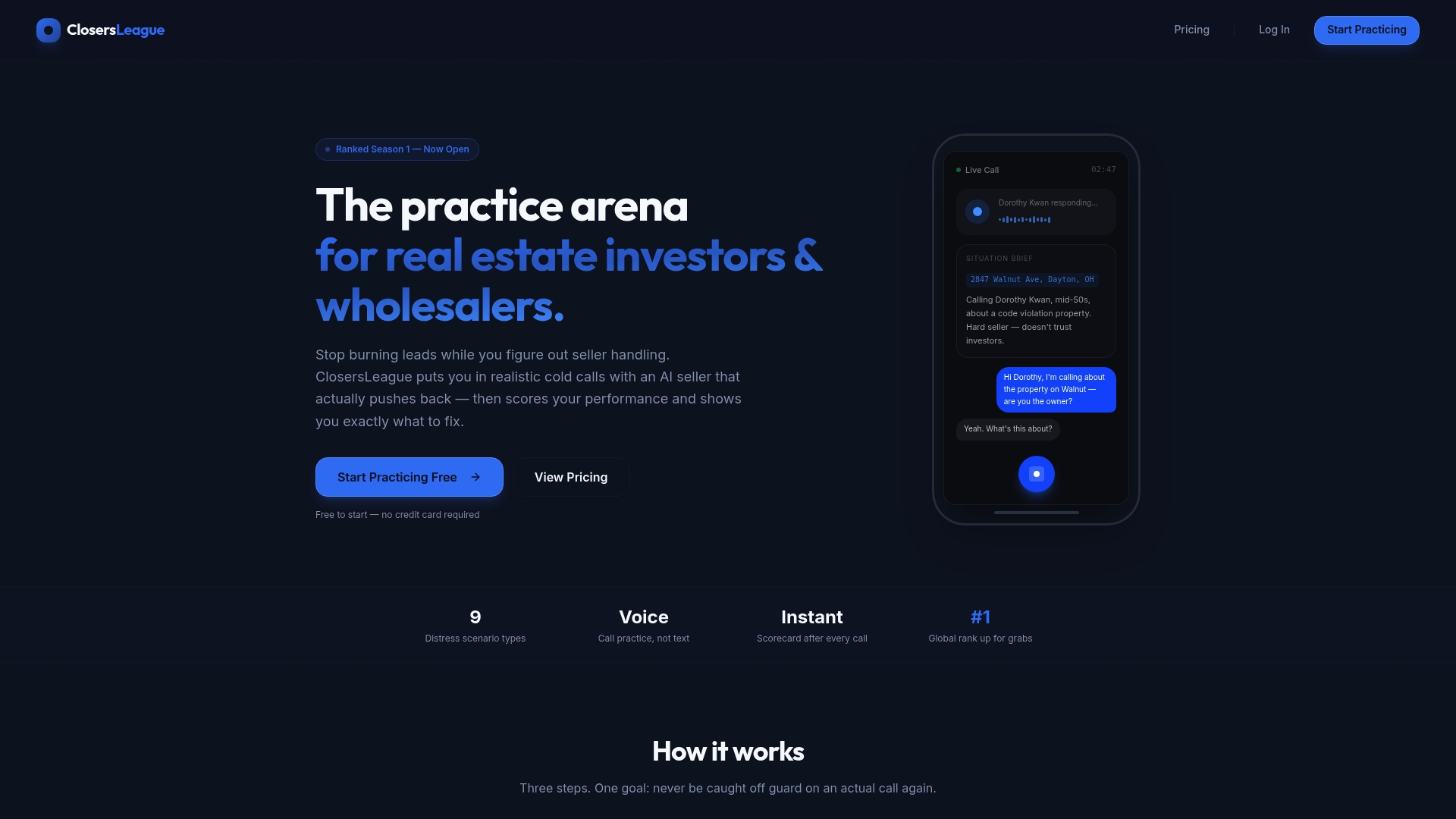
An AI cold calling practice platform can provide new callers scenario-based roleplay across several distressed seller types, instant scorecards broken into specific skill categories, and leaderboards that keep a growing team motivated during the repetitive early weeks. Instead of relying on a colleague to play a reluctant seller convincingly, a new hire can run through a probate conversation or a pre-foreclosure objection as many times as it takes to get comfortable, with detailed feedback after every attempt.
Results still depend on lead quality and consistent coaching on your end. The platform sharpens the skill, it doesn’t replace the list or the manager who reviews real calls. If you’re building or tightening a calling team, check the Starter, Growth, and Pro plans or visit the real estate cold calling practice page to see how the scenarios map to the seller types your callers handle most.
Sources
Compliance decisions should rest on primary sources, not secondhand summaries. These references cover the core legal obligations discussed above and are worth bookmarking before you scale a calling team.
- Telemarketing Sales Rule — Federal Trade Commission
- FTC Announces 2027 Telemarketer Fees to Access the National Do Not Call Registry
- Rules and Regulations Implementing the Telephone Consumer Protection Act (summary) — FCC
- Do not call rules update — National Association of Realtors
For sellers found through the calling process, SendMLS offers a path for submitting offers on MLS listings with state-approved contracts once a lead turns into a deal worth pursuing.
FAQ
What is the 80/20 rule in cold calling?
The 80/20 rule in cold calling generally refers to the idea that a small share of calls or callers produce most of the results, so managers focus coaching time on the patterns that drive the biggest share of appointments. In practice, this means reviewing your top-performing calls to identify what’s working and replicating that approach across the rest of the team rather than treating every call as equally instructive.
Is cold calling allowed in real estate?
Yes, cold calling is allowed in real estate as long as callers follow telemarketing rules, including scrubbing against the National Do Not Call Registry and respecting calling-hour restrictions under the Telemarketing Sales Rule. Investors and wholesalers calling homeowners directly still need to follow the same consent and consumer-protection rules that apply to any telemarketer.
What are the 5 stages of cold calling?
Definitions vary across training programs, but a common version covers the opening and rapport-building, stating the purpose of the call, handling objections, qualifying the seller’s situation and motivation, and setting a next step such as a follow-up or appointment. The exact labels differ by script, but the underlying flow, from rapport to a clear next action, stays consistent across most real estate cold calling frameworks.
What are the four pillars of real estate cold calling?
There’s no single, universally recognized “four pillars” framework in real estate cold calling, so treat any specific version with some skepticism. Most effective programs do consistently emphasize a strong opening, genuine rapport, structured objection handling, and clear qualification questions as the core skills worth building and scoring during training.
How long should onboarding take for a new cold caller?
A structured 30/60/90 day ramp, covering systems access and shadowing in the first 30 days, reduced oversight with ongoing objection drills through day 60, and full independent call volume by day 90, gives most new callers enough time to reach consistent performance. Teams using scored weekly roleplay alongside this ramp tend to see callers stabilize faster than those relying on shadowing alone.