
Most investors think the real money is made in finding the right deal. But the truth is, you can have a perfect lead list and still lose deals every week because you stumble over your words when it counts most. The language you use on a cold call, in a negotiation, or while presenting an offer is what separates investors who close from those who just talk to homeowners. This guide breaks down every essential term you need, explains how each one works in real scenarios, and shows you how to put them to work from your first cold call to your final closing.
Table of Contents
- Why vocabulary matters in real estate investing
- The essential deal terms every investor should know
- Valuation and underwriting terms for investors
- Legal and contract terms: getting from offer to closing
- Tax-deferral, licensing, and regulatory essentials
- A practical perspective: What most guides miss about real estate language
- Sharpen your real estate conversations with AI roleplay tools
- Frequently asked questions
Key Takeaways
| Point | Details |
|---|---|
| Deal terms are power | Knowing key terms boosts credibility and makes negotiations smoother. |
| Understand valuation metrics | Metrics like ARV, cap rate, and DSCR determine your profit and risk. |
| Legal language matters | Contract terms like escrow, contingencies, and assignment protect your interests. |
| Licensing and compliance count | Check legal and licensing rules before wholesaling in any state. |
| Practice mastery beats theory | Real skill comes from rehearsing offer and negotiation language until fluent. |
Why vocabulary matters in real estate investing
Words are your tools. When you call a distressed homeowner going through foreclosure or probate, you have maybe 60 seconds to establish credibility. The moment you sound uncertain or misuse a term, the seller mentally checks out. Your cold calling strategies need a vocabulary foundation, not just a script.
Terms in real estate investing fall into three distinct clusters:
- Seller urgency terms: Used to identify motivation, timeline, and pain points during discovery calls. Examples include equity position, pre-foreclosure, notice of default, and subject-to.
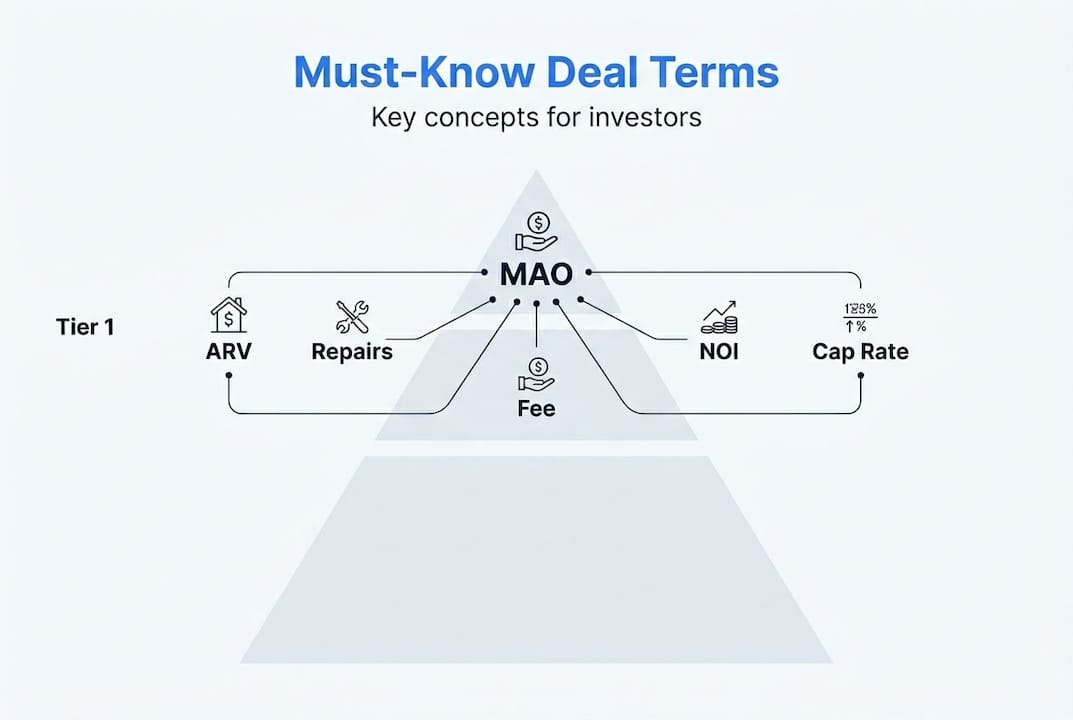
- Deal math vocabulary: Used to calculate, justify, and present offers. Examples include ARV, MAO, cap rate, NOI, and repair estimates.
- Contract and closing vocabulary: Used to structure, protect, and close transactions. Examples include earnest money, assignment clause, contingency, and escrow.
As noted in wholesaling practice, cold-calling and negotiation language that performs best usually separates seller urgency, underwriting vocabulary, and financing/closing vocabulary. Most newer investors only know one cluster well. That gap creates hesitation, and hesitation kills deals.
Misusing a term is worse than not knowing it at all. Telling a seller you want to “assign the contract” when you mean “purchase the property” instantly signals that you do not know what you are doing. Sellers talk to multiple buyers, and they will move on quickly.
Experienced investors use precise language because it builds trust fast. When you correctly explain your offer math to a skeptical seller or walk them through what escrow means for their timeline, you position yourself as a professional worth dealing with. That reputation compounds over time.
The essential deal terms every investor should know
Now that you understand why these terms matter, let’s break them down individually using examples and offer math. These are the essential industry terms you will use on nearly every deal.
| Term | What it means | Negotiation impact |
|---|---|---|
| ARV | After Repair Value: estimated value after full rehab | Sets the ceiling for all offer math |
| MAO | Maximum Allowable Offer: the highest you can pay and still profit | Keeps your bids disciplined |
| 70% Rule | MAO = (ARV x 70%) minus repairs minus wholesale fee | Quick filter on any deal |
| EMD | Earnest Money Deposit: cash put up when going under contract | Shows seller you are serious |
| Inspection contingency | Right to inspect and exit if issues are found | Protects you from surprises |
| Assignment clause | Allows you to transfer contract rights to a buyer | Core tool for wholesalers |
| Closing date | The agreed date when title transfers and funds clear | Creates urgency and sets expectations |
The real estate wholesaler process flows through these terms in sequence. Here is how they connect in a typical deal:
- Identify the ARV by pulling comparable sales within one mile, same size, same condition, sold in the last 90 days.
- Estimate repairs by walking the property or using a per-square-foot rule of thumb for a quick ballpark.
- Calculate your MAO using the 70% rule formula: Maximum Offer = (ARV x 70%) minus repairs minus your wholesale fee.
- Present the offer with a clear closing date, a reasonable EMD, and an inspection contingency that gives you a due diligence window.
- Include the assignment clause in your purchase contract so you can legally transfer the deal to your end buyer.
Pro Tip: When a seller pushes back on your offer price, walk them through the ARV and repair math out loud. Saying “I cannot pay more because comparable homes in your area are selling for $180,000 after updates, and this property needs $40,000 in work” is far more persuasive than just repeating a number. Numbers with reasoning win arguments.
For example, say the ARV is $180,000, estimated repairs are $35,000, and you want a $10,000 wholesale fee. Your MAO would be ($180,000 x 0.70) minus $35,000 minus $10,000, which equals $81,000. That is your ceiling. Practicing this math until it is automatic builds credibility on every call.

Valuation and underwriting terms for investors
With deal structure terms in place, valuation and underwriting comes next. These metrics keep your analysis sharp when you evaluate rental properties, small multifamily deals, or any income-producing asset.
Investors use NOI and relate it to cap rate, GRM, and related underwriting metrics to quickly assess whether a deal makes sense before spending hours on full analysis.
| Metric | Formula | Best used for |
|---|---|---|
| NOI | Gross rents minus operating expenses | Any income property |
| Cap rate | NOI divided by purchase price | Comparing markets or assets |
| GRM | Purchase price divided by gross annual rent | Fast initial screen |
| DSCR | NOI divided by annual debt service | Qualifying for investment loans |
Here are practical benchmarks investors and lenders use:
- A cap rate of 5% to 7% is typical in competitive urban markets; rural or higher-risk markets often demand 8% or higher.
- A GRM under 10 is generally considered attractive for single-family or small multifamily deals in most U.S. markets.
- Most lenders require a DSCR between 1.20 and 1.40x for commercial and investment property loans. A DSCR of 1.0 means the property barely covers its debt. Lenders want a cushion.
- Lenders using DSCR loans (popular with real estate investors avoiding W-2 income documentation) typically set a floor of 1.25x.
Scenario callout: Imagine you are evaluating a small duplex with gross annual rent of $24,000. Operating expenses total $9,600. That gives you an NOI of $14,400. If your annual mortgage payment is $11,000, your DSCR is 14,400 divided by 11,000, which is 1.31x. Most lenders would approve that loan. If the DSCR dropped to 0.95x, no lender would touch it without significant additional collateral.
Knowing these numbers on a call also helps you craft winning real estate pitches. A seller who owns a distressed rental is often impressed when you can quickly explain what the property is worth as an income asset versus what it would sell for on the open market. That knowledge puts you in control of the conversation.
Legal and contract terms: getting from offer to closing
Understanding the numbers is only half the job. You also need contract knowledge to actually close or assign your deals. Let us break down these legal essentials.
Common legal and contract terms include being under contract, contingencies, earnest money, escrow, inspection contingencies, and consequences for breach or termination. Each one carries real financial and legal weight.
Here are the top contract protections and risks every investor should know:
- Under contract: Once a seller signs your purchase agreement, you are legally bound. Once signed, neither party can back out without consequences unless a valid contingency allows it.
- Earnest money deposit (EMD): This is your skin in the game. A typical EMD ranges from $500 to $5,000 for wholesale deals. If you breach the contract without a valid contingency, you lose your EMD.
- Inspection contingency: Gives you a set number of days (commonly 7 to 14) to inspect the property and cancel without penalty if you find unacceptable issues.
- Financing contingency: Protects a buyer if their loan falls through; less common in wholesale deals but critical in retail buyer transactions.
- Assignment clause: Allows you to legally transfer your equitable interest in the contract to a third party (your end buyer). Without this clause, you cannot wholesale the deal.
- Escrow: A neutral third party holds funds and documents until all conditions are met. Escrow protects both the buyer and the seller from fraud or default.
- Closing costs: These are fees paid at settlement, including title insurance, recording fees, and transfer taxes. Investors often negotiate who pays what.
Pro Tip: When presenting your offer to a seller, always explain the assignment clause clearly. Say something like: “I may bring in a partner to close this with me, but your terms stay exactly the same.” This framing prevents confusion and avoids deals falling apart at the last minute when your end buyer steps in.
Strong deal follow-up strategies also depend on knowing these terms. When you follow up with a seller who has been under contract before with another buyer who backed out, you can speak directly to why your offer is more secure, by referencing your contingency structure and your track record of closing.
Tax-deferral, licensing, and regulatory essentials
Top investors do not stop at deal math. They understand the compliance and tax terms that protect their profits and keep their business legally sound over time.
1031 exchange basics:
A 1031 exchange, sometimes called a like-kind exchange, lets you sell an investment property and defer capital gains taxes by rolling proceeds into another qualifying property. Investors use the 1031 exchange to defer capital gains, sometimes indefinitely, by repeating the process across multiple transactions.
Here are the compliance steps you must follow:
- Close the sale of your relinquished property (the one you are selling).
- Identify replacement property within 45 days of closing. You can identify up to three properties.
- Close on the replacement property within 180 days of selling the relinquished property.
- Use a qualified intermediary to hold the funds between transactions. You cannot touch the money.
- Meet like-kind requirements: Both properties must be held for investment or business purposes. Personal residences do not qualify.
Licensing and wholesaling legality:
This is where many investors get into trouble. Some states require a license to conduct business as a wholesaler, and failing to comply can result in fines or voided contracts. States like Illinois and Oklahoma have passed specific rules around wholesaling disclosures and assignment fees.
The practical solution is to master real estate lead generation in your target market while also learning your state’s specific rules around contract assignment, marketing unlisted properties, and disclosures. What is legal in Texas may require a license in Illinois.
Statistic callout: As of 2024, more than a dozen U.S. states have introduced or passed legislation specifically addressing real estate wholesaling practices, licensing, or mandatory disclosures. This trend is accelerating.
A practical perspective: What most guides miss about real estate language
Every article about real estate terms will hand you definitions. But definitions alone do not close deals. Here is what we have learned coaching hundreds of investors and wholesalers through cold call training.
Most investors do not lose deals because they got the math wrong. They lose deals because of how they sound when they are under pressure. A seller in foreclosure has heard from multiple buyers. What they are really filtering for is whether you sound calm, knowledgeable, and honest. That comes from negotiation tactics that are grounded in fluency, not just data.
The subtle language cues matter enormously. There is a real difference between saying “I would like to make an offer” and “Based on what I am seeing, I can be at $85,000 with a 14-day close and a small earnest money deposit.” The second version communicates that you know exactly what you are doing. Sellers respond to precision because it signals you will follow through.
Here is our hard-won advice: Do not just study these definitions. Speak them out loud. Practice your offer math while driving. Rehearse how you would explain an assignment clause to a skeptical seller at 7 pm when they are tired and defensive. Role-play what happens when a seller asks, “Why can’t you pay more?” and you have to walk them through your repair estimate and ARV logic in real time.
Script-driven role-play builds more confidence than reading ever will. Knowing a term intellectually is completely different from using it naturally under the mild stress of a live call. The investors who win consistently are the ones who have rehearsed these conversations until the vocabulary is automatic.
Sharpen your real estate conversations with AI roleplay tools
Ready to move from studying terms to actually using them under pressure? ClosersLeague is built for exactly that shift.

We give you a risk-free AI environment to practice real deal conversations, handle seller objections, and rehearse your offer math before you ever pick up the phone on a live lead. Whether you are working inherited property cold calling practice, sharpening your response to code violations with code violation cold calling practice, or building your overall confidence with real estate cold calling practice, our platform scores your performance and gives you instant feedback. Stop winging it. Start drilling. The vocabulary you just learned only pays off when you can use it naturally, and that takes deliberate practice.
Frequently asked questions
What is the 70% rule in real estate wholesaling?
The 70% rule means your maximum offer is 70% of the after-repair value, minus estimated repair costs and your wholesale fee, keeping your offer profitable for the end buyer.
What is ARV and why is it important for investors?
ARV, or After Repair Value, is the estimated market value of a property after all repairs are completed, and it serves as the foundation for calculating your maximum offer and projecting profit margins.
What is a 1031 exchange in real estate investing?
A 1031 exchange lets you defer capital gains taxes by selling one investment property and reinvesting the proceeds into a like-kind property within strict IRS deadlines, including a 45-day identification window and a 180-day closing window.
Why do investors talk about DSCR?
DSCR, or Debt Service Coverage Ratio, tells lenders and investors whether a property generates enough net income to cover its debt payments, with most lenders requiring at least 1.20x to approve a loan.
Are there states where real estate wholesaling is illegal?
Wholesaling is legal across the U.S. when done correctly, but some states require a license or mandate specific disclosures, so always verify your state’s current laws before marketing properties under contract.
Recommended
- Master essential industry terms for real estate investors – ClosersLeague Blog
- Master Real Estate Negotiation Tactics for Better Deals – ClosersLeague Blog
- Mastering real estate objections: proven tactics for investors – ClosersLeague Blog
- Qualify real estate leads: proven methods for investors – ClosersLeague Blog