Local presence dialing works, but only under specific conditions: your caller ID numbers must be real, owned or leased, authenticated through STIR/SHAKEN, and rotated carefully. Skip any of those steps and the feature does nothing for a burned or flagged number. It amplifies healthy calling programs. It does not fix broken ones.
TL;DR:
- Local presence dialing only boosts answer rates if the caller ID numbers are owned, authenticated through STIR/SHAKEN, and rotated to avoid carrier flags.
- Its effectiveness is highest in territory-based outreach, localized offers, and high-volume local service campaigns, but less so for mobile numbers or broad national lists.
- Maintaining number health through rotation, caps, and monitoring is crucial, as overusing a number triggers spam flags regardless of script quality.
- Using numbers you own or lease with proper routing is legal and different from spoofing, which involves numbers beyond your control and is illegal when used to deceive.
- Evaluating actual lift requires testing with controlled experiments, tracking answer rates, conversion, block rates, and callback success while ensuring compliance measures.
Table of Contents
- What Local Presence Dialing Is and Which Sales Situations Benefit Most
- How Local Presence Dialing Works Behind the Scenes
- Do Answer Rate Gains From Local Presence Hold Up?
- Keeping Your Number Pool Healthy: Rotation and Reputation
- Local Presence vs. Spoofing: The Compliance Line
- Rolling Out Local Presence: Checklist and Test Design
- Training Reps to Use Local Presence Responsibly
- Sources
- FAQ
What Local Presence Dialing Is and Which Sales Situations Benefit Most
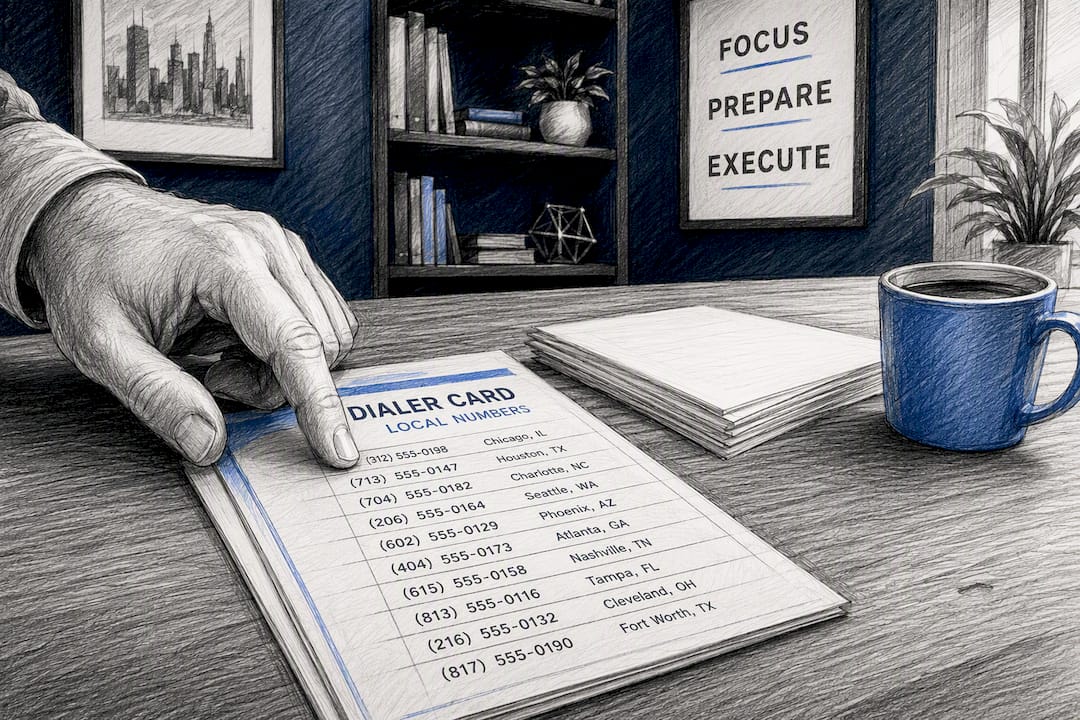
Local presence dialing swaps your outbound caller ID for a number that shares the prospect’s area code, pulled dynamically from a pool you control. The system matches the area code on the dialed number, checks your pool for a corresponding local number, and substitutes it before the call connects. Simple in concept. The payoff depends heavily on who you’re calling.
You’ll see the biggest lift in these scenarios:
- Territory-based outreach, where reps work defined zip codes or counties and prospects genuinely expect a local call
- Localized offers, like property acquisition calls tied to a specific neighborhood or municipality
- High-volume local services, where call volume per area code is high enough to justify a dedicated number pool
You’ll see less benefit calling national B2B executives who screen every unknown call regardless of area code, or dialing lists heavy with mobile numbers that were ported from a different region years ago. Area code no longer means what it used to.
How Local Presence Dialing Works Behind the Scenes
The technical flow behind local presence dialing involves four coordinated steps, and understanding them helps you ask sharper questions when evaluating a dialer or telephony vendor.
- Area-code extraction: the system reads the prospect’s phone number and identifies its area code before the call is placed.
- Number lookup: the platform searches your number pool for a caller ID that matches or geographically approximates that area code.
- Caller ID substitution: the matched number replaces your default outbound ID, so the prospect sees a familiar-looking local number.
- Callback routing: if the prospect calls that number back, the system routes the call to you or your team rather than to a dead line.
Ownership matters more than most sales teams realize. Owned or leased number pools let you control callback routing and protect your own reputation data. Shared pools, where several unrelated businesses cycle through the same numbers, put your answer rates at the mercy of someone else’s spam complaints. STIR/SHAKEN attestation and accurate ANI and billing number information also affect how carriers label your calls, and carriers use these signals for emergency routing as well as spam filtering.
Do Answer Rate Gains From Local Presence Hold Up?
Evidence here is genuinely mixed, and any vendor promising a fixed lift percentage is oversimplifying. Some independent analyses of large call volumes find negligible difference between local and non-local caller ID, while other operators report meaningful gains, particularly in local-service verticals like real estate, insurance, and home services.
What the data actually shows: Pew Research Center found that most Americans avoid answering calls from unknown numbers. That single behavioral pattern is the entire mechanism local presence tries to exploit. It works only to the degree the prospect still associates their area code with local calls, which is weaker than it used to be given how many people keep old numbers after moving.
Number health drives the variance more than any other factor. Local presence acts as a multiplier on numbers that are already clean and authenticated, not a fix for numbers carriers already distrust. Mobile-heavy lists dilute the effect further, since mobile carriers apply spam filtering more aggressively than landline exchanges do.
Keeping Your Number Pool Healthy: Rotation and Reputation
Numbers burn. Dial the same number too many times in a short window and carriers start tagging it “spam likely,” regardless of how clean your script is. This happens because volume and pattern, not content, trigger most carrier-side flags. A number that dials 200 unique contacts in an hour looks like a robocall operation even when a human is dialing every call manually.
Practical controls that keep a pool alive:
- Set a hard daily cap per number rather than letting the dialer max out capacity.
- Maintain multiple numbers per high-volume area code so no single line absorbs your entire local campaign.
- Rotate numbers on a fixed cadence instead of reactively, once complaints already show up.
- Track block rates, spam-likely flags, CNAM (caller name) entries, and complaint volume weekly, not monthly.
Rotation and monitoring guidance from industry operators consistently warns that aggressive churn without monitoring creates the exact carrier signature spam filters are built to catch.
Pro Tip: Check your CNAM listings monthly. A number can pass every technical compliance check and still show up on a prospect’s phone as “Spam Risk” or “Scam Likely” because a carrier’s proprietary algorithm flagged the calling pattern, not the number’s ownership status.
Local Presence vs. Spoofing: The Compliance Line
Legitimate local presence and illegal caller ID spoofing look identical on a prospect’s screen. The difference is entirely about intent and ownership, and that distinction carries real legal weight.
- The Truth in Caller ID Act rules prohibit transmitting misleading caller ID information with intent to defraud, cause harm, or wrongfully obtain something of value. Using a number you own or lease, that routes calls back to your organization, is not itself a violation.
- The FCC’s own guidance confirms enforcement targets intent to defraud, not the mere act of displaying a local number.
- TCPA consent requirements and Do Not Call obligations don’t change because you’re using local presence. Real-time DNC scrubbing still has to happen before every dial, and you’ll want to review your state’s specific Do Not Call rules since requirements vary.
- Keep documented vendor attestations showing your provider handles STIR/SHAKEN correctly and your numbers are properly registered, not borrowed from an unverified pool.
Rolling Out Local Presence: Checklist and Test Design
Run this sequence before flipping local presence on for a live campaign:
- Inventory every number in your pool and confirm actual ownership or lease status.
- Verify STIR/SHAKEN attestation with your carrier or provider for each number.
- Configure callback routing so a prospect calling back reaches a live agent, not a dead line.
- Confirm real-time DNC scrubbing runs before every dial, not on a batch delay.
- Set per-number daily caps and a fixed rotation cadence, and build time-zone-aware dialing windows so you’re not calling prospects outside reasonable hours.
Once the controls are in place, measure actual lift with a randomized holdout: split your list, keep scripts, agents, and call times identical, and dial one half with local presence and one half without. Cold-call answer rates typically hover in the low single digits, so your sample needs enough volume per group to detect a small percentage-point difference reliably.
| Metric | Why it matters |
|---|---|
| Answer rate | Primary signal for whether local presence is working |
| Conversion rate | Confirms lift in answers actually turns into pipeline |
| Block/report rate | Early warning that a number pool is burning |
| Callback completion | Tests whether your routing infrastructure holds up |
Training Reps to Use Local Presence Responsibly
Most local presence failures aren’t technical. They’re behavioral. A rep who doesn’t know how to handle a callback, or who dials the same number too aggressively because a script felt “hot,” burns a number faster than any carrier algorithm would on its own.
Roleplay built around real scenarios surfaces these gaps before they cost you a number pool. Have reps practice calls where the prospect calls back moments later, confused about who’s on the line, and measure whether the rep handles that callback smoothly or fumbles it. Track call length and objection handling the same way you’d track any other skill, because reckless number use usually traces back to reps who never practiced the callback conversation, not to a technology failure.

ClosersLeague’s scenario-based cold calling practice builds exactly this kind of muscle memory, including out-of-state owner scenarios where callback handling and local rapport matter most. Reps who drill these situations before they hit live calls report fewer awkward callback moments and better objection recovery, which shows up downstream as lower complaint rates and steadier number health.
Want your team calling with the confidence to handle a local presence callback the moment it rings? Practice the scenario before it happens live.
— Dave
Sources
The regulatory backbone here comes from the Truth in Caller ID Act rules and the FCC’s implementing guidance, both of which define the legal boundary between compliant local presence and spoofing.
- Federal Register: Truth in Caller ID rules (FR-2011-07-20)
- Truth in Caller ID Rules | Federal Communications Commission
- Most Americans don’t answer cellphone calls from unknown numbers — Pew Research Center
- What Is Local Presence Dialing and Does It Improve Connect Rates? — Klenty
- Local presence dialing vs spoofing — Call Logic
FAQ
Is Local Presence Dialing Legal?
Yes, when you own or lease the number and it routes back to your organization. The Truth in Caller ID Act prohibits misleading caller ID only when there’s intent to defraud, cause harm, or wrongfully obtain something of value.
What’s the Difference Between Local Presence and Spoofing?
Local presence uses numbers you own or lease with legitimate callback routing. Spoofing uses numbers you don’t control, often with intent to deceive, which the FCC treats as a distinct enforcement target.
Does Local Presence Actually Increase Answer Rates?
It can, but results vary widely depending on number health, list quality, and how mobile-heavy your prospect list is. Some independent tests show negligible lift, while others report meaningful gains in local-service verticals.
How Many Numbers Should Be in a Local Presence Pool?
Enough that no single number absorbs your entire daily volume for a given area code. Set a hard per-number daily cap and add numbers as volume grows, rather than pushing more calls through the same line.
Does Local Presence Dialing Bypass TCPA or DNC Requirements?
No. Consent requirements under the TCPA and Do Not Call obligations apply exactly the same way regardless of caller ID. Real-time scrubbing still has to happen before every dial.