When a homeowner says “I need to think about it,” say this immediately: “Totally fair — most people do. Can I ask what’s the one thing you’d want to be sure about before moving forward?” Then follow three moves: validate their hesitation, narrow it to a single concern, and offer a low-commitment next step. That sequence, grounded in the LAER framework (Listen, Acknowledge, Explore, Respond), keeps you in control without sounding pushy. Cold calling still drives real pipeline volume for investors and wholesalers — but only when you can convert stalls like this one into a scheduled next step.
- Validate: “That makes sense — this is a big decision.”
- Narrow: “What’s the main thing on your mind right now?”
- Micro-commit: “Could we set a quick 10-minute call Thursday to go over that one thing?”
Pro Tip: The think it over objection almost never means “no.” It usually means the seller has a question they haven’t asked yet. Your job is to surface it.
The Validate → Question → Redirect pattern keeps the prospect open: acknowledge their response, ask a question that reopens the conversation, then redirect to a micro-commitment. Use it every time.
Key Takeaways
Mastering the “I need to think about it” objection requires three moves: validate, narrow the hesitation to one concern, and secure a specific low-commitment next step before ending the call.
| Point | Details |
|---|---|
| Use the three-move sequence | Validate, narrow to one concern, and offer a micro-commitment on every stalled call. |
| Tailor by seller type | Pre-foreclosure, probate, divorce, and tax-delinquent sellers each have a different hidden reason for stalling. |
| Follow up within 72 hours | Text at hour 2, email at hour 24, call at hour 48, and text again at hour 72 to reopen stalled leads. |
| Track two core KPIs | Monitor call-to-appointment conversion and objection-handling success rate weekly during the 4-week drill plan. |
| Practice with ClosersLeague | AI roleplay sessions with real-time scorecards let you drill every distressed-seller scenario and measure improvement. |
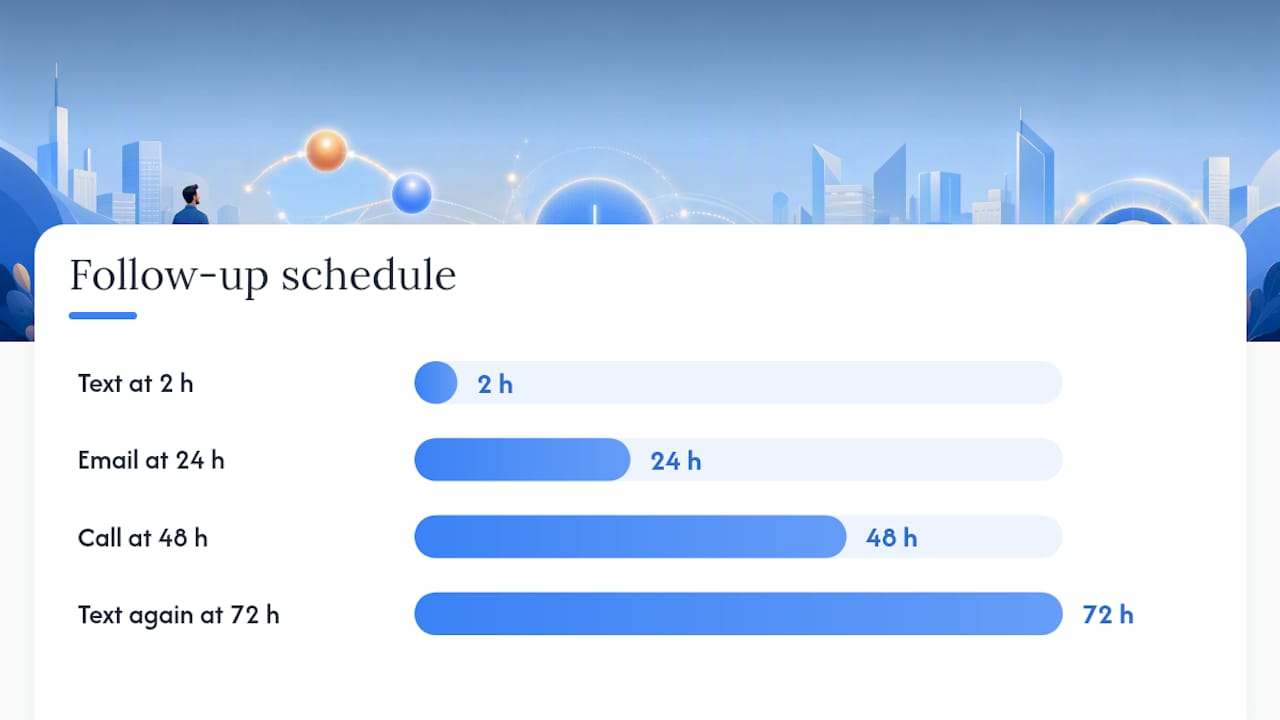
Table of Contents
- What do you say right after “I need to think about it”?
- How do you tailor the rebuttal for each distressed-seller type?
- How should you sound when a seller needs time to decide?
- What does a full call flow look like from opener to follow-up?
- How do you build a 4-week practice plan that actually moves the needle?
- Annotated transcripts that show the scripts in action
- What are the legal and ethical limits for cold calling sellers?
- Pro tips and common mistakes on the “think it over” objection
- What I’ve seen change when investors actually drill these lines
- ClosersLeague turns these scripts into measurable skills
- Sources
- FAQ
What do you say right after “I need to think about it”?
Three scripts. Pick the one that fits the moment.
Script 1: Appointment-focused (seller seems time-constrained)
Script 2: Qualification + calendar micro-commitment (unsure about readiness)
Script 3: Empathy + conditional offer (high-emotion or distressed seller)
Pro Tip: Swap lines between scripts during practice. Script 1’s appointment ask works inside Script 3’s empathy frame. Mixing them keeps your delivery natural instead of memorized.
How do you tailor the rebuttal for each distressed-seller type?
The think it over objection sounds the same from every seller, but the reason behind it differs by situation. Here’s how to adapt.
| Seller Type | Two-Line Rebuttal Snippet | Key Qualifying Question |
|---|---|---|
| Pre-foreclosure | “I know the timeline can feel tight. Can I share what options typically exist at this stage?” | “How many months are you behind, roughly?” |
| Probate/Inherited | “Totally understandable — there are often other family members involved. Would it help if I walked through options you could share with them?” | “Is there an executor or attorney already handling the estate?” |
| Divorce | “Makes sense — these decisions usually involve more than one person. Is your attorney or spouse part of this conversation?” | “Are both parties aligned on selling, or is that still being worked out?” |
| Absentee/Out-of-state | “Of course — managing this from a distance adds a layer. What’s the biggest concern from where you’re sitting?” | “How long has the property been vacant, and are you handling it solo?” |
| Tax delinquent | “I get it. A lot of people want to understand all their options before committing. Do you know roughly how much is owed in back taxes?” | “Have you received any notices about a sale date?” |
| Vacant property | “No rush at all. Is the property currently insured and maintained, or is that becoming a burden?” | “What’s your ideal outcome — sell quickly, or are you open to other arrangements?” |
For probate and inherited properties, scripts that ask permission to share options with heirs and offer to coordinate with estate executors reduce resistance and speed decisions. ClosersLeague’s inherited property roleplay scenarios are built specifically for these conversations.
Warning flags — stop pushing and mark for gentle follow-up:
- Seller mentions an attorney told them not to discuss the property
- Tone shifts from hesitant to hostile
- Seller says “I already have someone handling this”
- They ask you to stop calling
Pro Tip: Active listening and empathy techniques like Feel–Felt–Found reduce seller defensiveness. Try: “I understand how you feel — others have felt the same way — and what they found was that just one conversation gave them a lot more clarity.”
How should you sound when a seller needs time to decide?
Tone carries as much weight as the words. A great script delivered with the wrong energy still loses the call.
Do:
- Slow your pace by about 20% after the objection lands
- Drop your pitch slightly — lower registers read as calm and trustworthy
- Pause for 1–2 seconds before responding (it signals you actually heard them)
- Use open-ended questions: “What’s on your mind?” not “Is it the price?”
Don’t:
- Speed up or talk over their hesitation
- Use “I just want to” or “I’m not trying to pressure you” — both signal pressure
- Repeat the same ask twice in one call
- Fill silence with filler words (“um,” “so,” “basically”)
Pro Tip: Record yourself on practice calls. Most callers don’t realize they rush through objections. A micro-pause of two seconds after “I need to think about it” feels long to you and natural to the seller.
Words that escalate defensiveness: “But,” “Actually,” “You should,” “What I need you to understand.”
Words that build trust: “That makes sense,” “I hear you,” “No pressure,” “Whenever works for you.”
What does a full call flow look like from opener to follow-up?
Call flow template:
- Opener (10 seconds): Name, reason for calling, permission ask. “Hi, this is [Name] — I work with homeowners in [area] who are thinking about selling. Did I catch you at an okay time?”
- Discovery (60–90 seconds): Two to three qualifying questions about timeline, situation, and motivation.
- Objection (seller says “I need to think about it”): Deploy Script 1, 2, or 3 based on context.
- Micro-commitment (15 seconds): Lock in a specific next step — a date, a text, a document.
- Close the loop: Confirm the next step, repeat it back, and end warmly.
72-hour follow-up cadence (use after a stalled call):
- Hour 2: Text — “Great speaking with you, [Name]. I’ll send that one-pager over now. Let me know if anything comes up.”
- Hour 24: Email — Subject: “Quick note from our call.” Body: Two sentences recapping what you discussed, one sentence offering a specific next step.
- Hour 48: Call — Reference the text and email. Ask one new qualifying question.
- Hour 72: Text — “Just checking in — happy to answer any questions whenever you’re ready.”
Disciplined follow-up sequences with added value (recent comps, market updates) typically reopen stalled sellers within 48–72 hours.
Rules:
- Book an appointment if the seller gives you a specific concern you can address
- Qualify out if they’ve asked you to stop or confirmed they’re under contract
- Move to nurture if they’re genuinely 6+ months from a decision
A real estate CRM makes tracking these touchpoints and stop-requests far easier than a spreadsheet.
How do you build a 4-week practice plan that actually moves the needle?
Stop winging it. Start drilling. Here’s the schedule:
- Week 1 — Script fluency: Read each script aloud 10 times daily. Record yourself. Focus on pacing and natural delivery, not memorization.
- Week 2 — Objection drills: Run live roleplay sessions using ClosersLeague’s AI-powered cold calling practice for distressed-seller scenarios. Target one seller type per session.
- Week 3 — Qualifier integration: Add qualifying questions to each rebuttal. Practice transitioning from objection to micro-commitment in under 20 seconds.
- Week 4 — Scored sessions: Run full call simulations with performance scorecards. Review your objection-handling success rate and call-to-appointment conversion.
| Metric | What to Track | Target |
|---|---|---|
| Call-to-appointment conversion | Appointments booked | Improve week over week |
| Objection-handling success rate | Times you secured a next step after the objection | Improve week over week |
| Talk/listen ratio | Your speaking time vs. seller’s | Aim for more listening than talking |
Pro Tip: A 4-week progressive drill plan yields measurable improvement when it pairs daily micro-drills with weekly scored roleplays and a simple KPI dashboard. Log your numbers every Friday — the trend line tells you more than any single session.
Annotated transcripts that show the scripts in action
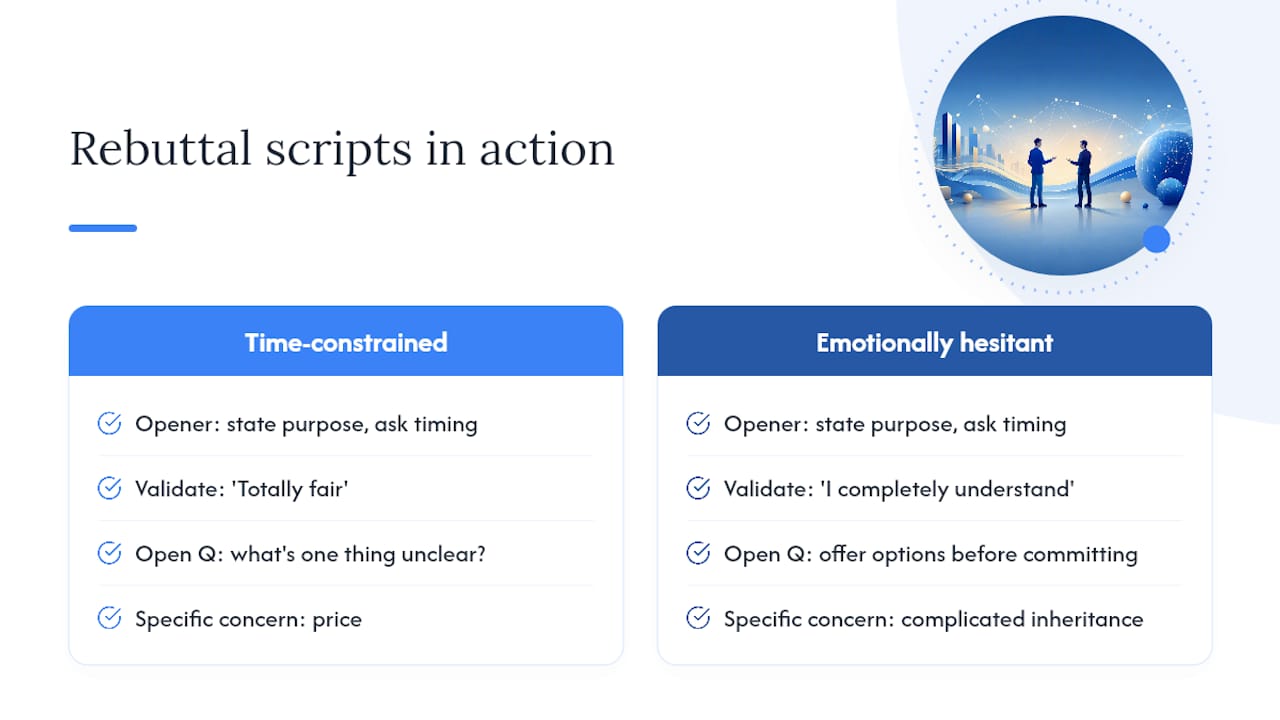
Transcript A: Time-constrained seller — appointment conversion
Caller: “Hi, this is Marcus — I work with homeowners in the area who are thinking about selling. Did I catch you at an okay time?”
Seller: “I guess. What’s this about?”
Caller: “I noticed the property on Elm has been vacant for a while. I work with investors who buy as-is — no repairs needed. Are you the owner?”
Seller: “Yeah, but I need to think about it.”
Caller: “Totally fair. Can I ask — what’s the one thing you’d want to be clear on before deciding?” (pause)
Seller: “Mostly the price, I guess.”
Caller: “That makes sense. I can give you a rough number in about 10 minutes. Would Thursday at 2 work?”
Annotation: Marcus validated, asked one open question, and converted the stall into a specific concern (price). He then offered a low-commitment next step tied directly to that concern.
Transcript B: Emotionally hesitant seller — qualify + scheduled follow-up
Caller: “Hi, I’m calling about the property on Cedar — I understand you may have inherited it recently. Is this a good time?”
Seller: “Sort of. It’s complicated. I need to think about it.”
Caller: “I completely understand — these situations usually are. A lot of people I talk to just want to know their options before committing to anything. Would it be okay if I sent you a quick one-pager and followed up in a couple of days?” (pause)
Seller: “Yeah, that’s fine.”
Caller: “Perfect. I’ll send it today. Would Friday morning work for a quick call?”
Annotation: The caller used Feel–Felt–Found framing without naming it, offered a document (low-commitment), and secured a specific follow-up time rather than a vague “I’ll call you.”
Pro Tip: The pause after your rebuttal question is doing work. Sellers fill silence — and what they say next tells you the real objection. Don’t rescue the silence.
What are the legal and ethical limits for cold calling sellers?
Keep it short and keep it clean. Here’s what you must know:
- TCPA compliance: The Telephone Consumer Protection Act restricts automated calls and texts to cell phones without prior written consent. Manual cold calls to landlines have more flexibility, but cell phone rules are strict.
- Do-Not-Call (DNC) Registry: Scrub your list against the National Do Not Call Registry before every campaign. Calling a registered number can result in fines up to $51,744 per violation.
- Stop-requests: If a seller says “Don’t call me again,” “Take me off your list,” or any clear variant, stop immediately. Log the request in your CRM with a timestamp.
- Record-keeping: Document every stop-request. If a complaint is filed, your log is your defense.
Compliant stop-call script: “Absolutely — I’ll remove you from my list right now. I’m sorry for the interruption. Have a good day.”
Pro Tip: When in doubt, consult a real estate attorney familiar with TCPA. The rules around cell phones, text messages, and autodialers shift frequently — a $51,744 fine per call makes legal advice cheap by comparison.
Pro tips and common mistakes on the “think it over” objection
Top tips:
- Use the seller’s first name once after the objection — it personalizes the rebuttal
- Ask one question, not two — stacking questions creates confusion
- Offer a specific time for the follow-up, not “sometime this week”
- Reference something they said earlier in the call to show you were listening
- Keep your rebuttal under 30 seconds — longer reads as desperation
- Preemptive clarity (asking what specifically they need to think about) prevents the stall from recurring on the next call
- Match your energy to theirs — a grieving probate seller needs a slower pace than a frustrated landlord
- End every call with a confirmed next step, even if it’s just “I’ll text you Thursday”
Common mistakes and recovery lines:
- Mistake: Repeating the same ask twice. Recovery: “No worries — I’ll follow up by text and you can reach out whenever you’re ready.”
- Mistake: Arguing with the objection. Recovery: “You’re right to take your time. What would make this easier to think through?”
- Mistake: Going silent and hanging up. Recovery: “Before I let you go — can I send you one thing that might help?”
When the seller is genuinely not ready, accept it. Mark the lead for a 30-day nurture sequence and move on. Pushing a seller who needs time to decide past their comfort zone closes the door permanently.
What I’ve seen change when investors actually drill these lines
Most investors I’ve worked with through ClosersLeague training come in with the same habit: they hear “I need to think about it” and either fold immediately or push too hard. Both responses kill the call. The shift happens when they stop treating the objection as a wall and start treating it as an opening question.
The callers who run the 4-week drill plan and track their numbers consistently see their objection-handling success rate climb — not because the scripts are magic, but because repetition builds the kind of calm that sellers can hear. One trainee went from booking zero appointments in a week of calls to securing three in a single session, simply by adding the pause and the one-question rebuttal. Measure your results from day one. The numbers will tell you exactly where to focus next.
ClosersLeague turns these scripts into measurable skills
Cold calling scripts on paper are a starting point. What converts them into consistent appointments is repetition against a realistic seller — and that’s where ClosersLeague delivers. The platform’s scenario-based voice practice puts you in live distressed-seller conversations across every type covered in this guide: pre-foreclosure, probate, divorce, tax delinquent, and more. Real-time coaching flags the moments you rush, go silent, or miss the qualifying question. Performance scorecards show your objection-handling success rate and call-to-appointment conversion after every session, so you know exactly what improved and what to drill next.

The 4-week plan in this guide maps directly to ClosersLeague’s drill structure. Start your first AI roleplay session today — the free trial gets you into a live scenario immediately, no setup required.
Sources
- Real Estate Cold Call Scripts: The Complete Guide for 2026 | Sayso Blog | Sayso
- Real Estate Objection Handling: How Top Agents Turn Client Concerns into Opportunities – REMAX Europe
- How to Handle “We Need to Think About It” (Without Losing the Listing) – BAM
FAQ
What does “I need to think about it” really mean from a seller?
It usually signals a hidden concern — missing information, uncertainty about price, or a need to consult someone else. Ask “What’s the one thing you’d want to be sure about?” to surface the real issue.
How many times should you follow up after a seller stalls?
Follow up four times within 72 hours: a text at hour 2, an email at hour 24, a call at hour 48, and a final text at hour 72. After that, move the lead to a 30-day nurture sequence.
What’s the fastest way to improve your objection-handling success rate?
Run daily roleplay drills against realistic seller scenarios and track your call-to-appointment conversion weekly. ClosersLeague’s AI roleplay sessions with performance scorecards make this measurable from your first session.
Are there legal limits on how often you can call a homeowner?
Yes. The TCPA restricts automated calls and texts to cell phones without prior written consent, and the National Do Not Call Registry requires list scrubbing before every campaign. Honor any stop-request immediately and log it with a timestamp.
Does the rebuttal script change for probate or inherited-property sellers?
It does. For probate sellers, ask permission to share options with heirs and offer to coordinate with the estate executor. Slower pacing and a document offer (one-pager) work better than an immediate appointment ask.