
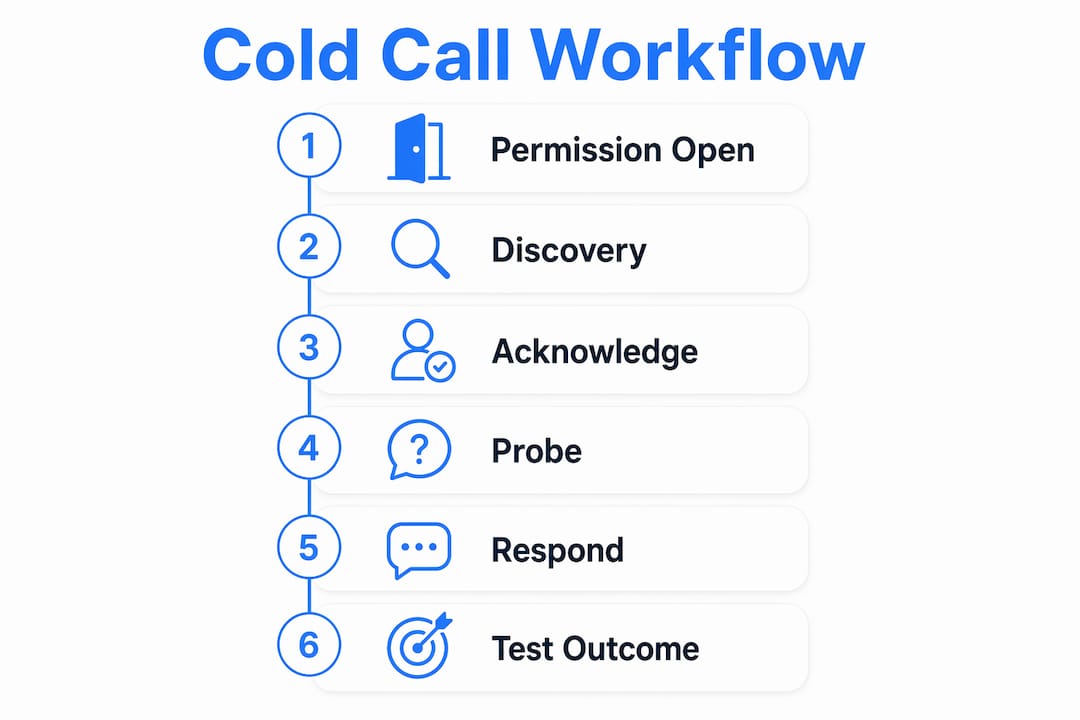
The most effective cold call objection handling workflow follows five steps: open with permission, run a focused discovery, cycle through the acknowledge-probe-respond loop, move to a clear next step, then log and follow up. Master that sequence and you’ll convert more distressed sellers from “not interested” to appointment.
- Open (0–30 seconds): Earn the right to keep talking. State who you are, why you called this specific property, and ask one permission question.
- Objection loop (30–240 seconds): Acknowledge the objection, probe once to find the real concern, then respond with a reframe or conditional offer. Repeat up to three times before moving to a soft close.
- Close and log (final 30–60 seconds): Confirm a next step, whether that’s an appointment, a callback, or a voicemail follow-up, then log the outcome in your CRM before the next dial.
The sections below give you scripts for every common objection, a decision-tree, a practice routine with scorecards, TCPA/DNC compliance basics, and how ClosersLeague’s AI roleplay maps to each stage.
Table of Contents
- What does a cold call objection handling workflow look like minute by minute?
- What objections do distressed sellers actually throw at you?
- How do you turn an objection into an appointment? A step-by-step decision tree
- How to practice this workflow until it becomes automatic
- What compliance rules apply to distressed-seller cold calls in the U.S.?
- Copy-paste scripts and voicemail templates for real calls
- Key Takeaways
- Why acknowledgment beats argument every time
- ClosersLeague trains you on this exact workflow
- Useful sources
- FAQ
What does a cold call objection handling workflow look like minute by minute?
A single distressed-seller call has five distinct windows, and knowing what to accomplish in each one keeps you from burning time or pushing too hard.

| Stage | Timing | Goal |
|---|---|---|
| Permission open | 0–30 s | Identify yourself, name the property, earn 2 minutes |
| Discovery | 0–30 s | Surface the seller’s situation and motivation |
| Objection loop | 30–240 s | Acknowledge, probe, respond (up to 3 cycles) |
| Test close | 240–300 s | Propose appointment or next step |
| Log and follow-up | Post-call | CRM note, schedule callback, trigger follow-up sequence |
Talk-to-listen ratio matters here. Aim to speak no more than 40% of the call during discovery. Sellers who feel heard are far more likely to stay on the line. When a seller repeats the same objection after your third probe, stop pushing. Offer a polite exit: “No problem at all. Can I check back in a couple of weeks?” That keeps the door open for the follow-up sequence that often closes the deal.
Pro Tip: Permission-based openers work best for pre-foreclosure leads. Avoid mentioning “foreclosure” unless the seller brings it up first. Name the address and ask if now is a good time instead.
What objections do distressed sellers actually throw at you?
Objections rarely mean “no” — they are filters. Sellers use them to separate trustworthy buyers from noisy ones. Recognizing what each objection signals lets you respond to the real concern, not the surface words.
| Objection | What It Really Means | Short Rebuttal (Acknowledge → Probe → Respond) |
|---|---|---|
| “I’m not interested.” | Low trust, caught off guard | “Totally fair. Most people say that at first. Can I ask one quick question about the property before I let you go?” |
| “I need to talk to my spouse.” | Needs cover to think; not a hard no | “Of course. What’s the best time to reach you both? I can call back whenever works.” |
| “Your offer is too low.” | Anchored to retail value; may prioritize speed | “I hear you. What would make my offer work for you — is it the price, the timeline, or something else?” |
| “How did you get my number?” | Privacy concern; needs transparency | “Property ownership is public record. If you’d prefer I don’t call again, just say the word. I only reached out because I buy in your area.” |
| “I’m embarrassed about the situation.” | Shame; needs normalization | “I talk to homeowners in similar spots every week. There’s zero judgment here. I’m just here to see if there’s a fit.” |
| “Call me later.” | Not ready; needs time | “Absolutely. What day works best? I’ll put it in my calendar right now.” |
- Sellers dealing with pre-foreclosure or tax delinquency often lead with shame before they lead with price concerns.
- “Call me later” is frequently a soft yes. Always confirm a specific day and time before hanging up.
- Pricing objections often resolve when you ask what would make your offer work — sellers frequently prioritize speed or certainty over top dollar.
How do you turn an objection into an appointment? A step-by-step decision tree
The AUR framework (Acknowledge, Understand, Respond) gives you a reliable structure for every branch of the conversation. Here’s how to execute it in real time.
Step 1 — Acknowledge: Never argue. Match the seller’s emotion first.
Step 2 — Probe: Ask one clarifying question. You get up to three probes before you move to a close or exit.
Step 3 — Respond: Reframe, offer a conditional next step, or propose an appointment.
Branch A — Seller says “I’m not ready to decide”:
- Probe: “What would need to happen for you to feel ready?”
- Reframe: “I’m not asking for a decision today. I’d just like to see the property and give you a real number. No obligation.”
- Soft close: “Would Tuesday or Thursday work for a quick 15-minute walkthrough?”
Branch B — Seller says “Your price is too low”:
- Probe: “What number were you hoping for?”
- Conditional offer: “If I could get closer to that number, would you be open to moving forward this week?”
- If no: “I understand. Can I follow up in a few weeks in case your situation changes?”
Branch C — Seller repeats the same objection three times:
- Graceful exit: “I don’t want to take up more of your time. Can I send you my contact info in case things shift down the road?”
Pro Tip: Use time-limited offers only when they’re genuine. Sellers in distress have often been burned by pressure tactics. A real deadline tied to your funding availability builds credibility. A fake one destroys it.
How to practice this workflow until it becomes automatic
Stop winging it. Start drilling. A short, repeatable training cadence produces measurable gains faster than any single call session.
Daily routine (10–15 minutes):
- 5-minute warm-up: run one opening script out loud, record yourself, listen back.
- 10-minute scenario drill: pick one objection type (e.g., “price too low”) and roleplay the full AUR cycle.
Weekly routine (20–30 minutes):
- One scored mock session using a scorecard. Track these five metrics:
| Metric | What to Track | Target Benchmark |
|---|---|---|
| Acknowledgment rate | % of objections where you acknowledged before responding | — |
| Probe rate | % of objections where you asked a clarifying question | — |
| Appointment rate | % of connected calls that result in a scheduled next step | 10–15% |
| Talk-to-listen ratio | % of call time you spent talking | Under 40% |
| Objection resolution rate | % of objections that moved the call forward | — |
A short, repeatable training cadence plus measured scorecards produces predictable improvement in objection handling for wholesalers. Review your scorecard weekly, identify the one metric furthest from benchmark, and drill that scenario the following week.
Pro Tip: AI roleplay tools let you simulate emotional distress scenarios — probate grief, pre-foreclosure shame, divorce tension — that are hard to replicate with a practice partner. ClosersLeague’s scenario-based modules cover all of these, with real-time coaching and measurable objection-handling behaviors scored after every session.
The 3-3-3 outreach rule pairs well with this cadence: 3 touches in 3 days, then 3 weeks, then 3 months. Urgency from foreclosure or other trigger events rises over time, so persistence with a structured cadence increases contact and conversion rates.
What compliance rules apply to distressed-seller cold calls in the U.S.?
TCPA and FTC Do-Not-Call rules apply to every outbound call you make. Violations carry per-call fines that add up fast. Here’s your pre-call checklist:
- Scrub the National Do Not Call Registry before every campaign. The FTC requires this for any list you haven’t called in 31 days.
- Respect state DNC registries. Several states maintain their own lists separate from the federal registry.
- Call only between 8 AM and 9 PM local time for the recipient, per TCPA rules.
- Document consent before sending any prerecorded message or ringless voicemail. Live calls to cell phones without prior consent carry TCPA risk.
- Follow state recording laws. Some states require all-party consent before recording a call. Check your state and the seller’s state before recording.
- Log opt-outs immediately. If a seller says “don’t call me again,” remove them from your list before the next dial session.
- Lead with transparency on distressed leads. State your name, that you’re a real estate investor, and that the call may be recorded. Distressed sellers are already suspicious; transparency builds faster trust than any script.
This article is general information, not legal advice. Confirm current TCPA and state DNC requirements with a qualified attorney before launching any calling campaign.
Copy-paste scripts and voicemail templates for real calls
Permission-based opening (pre-foreclosure)
Objection rebuttals (copy into your CRM)
“I’m not interested”:
“Completely understand. Most people say that at first. Before I let you go — are you facing any challenges with the property, or is everything going smoothly?”
“Your offer is too low”:
“I hear you. What would make the number work for you? Sometimes it’s not just price — it’s the timeline or the certainty of closing that matters most.”
“How did you get my number?”:
“Property ownership is public record, and that’s how I found your information. If you’d prefer I don’t call again, just say so. I only reached out because I buy properties in [City] and thought there might be a fit.”
Voicemail template
SMS follow-up (after voicemail)
Key Takeaways
A repeatable cold call objection handling workflow built on Acknowledge-Probe-Respond, consistent practice, and TCPA compliance is the fastest path from cold list to closed deal.
| Point | Details |
|---|---|
| Acknowledge before anything else | Never argue an objection — match the seller’s emotion first, every time. |
| Probe up to three times | Ask one clarifying question per cycle; move to a soft close or exit after the third probe. |
| Track five core metrics | Acknowledgment rate, probe rate, appointment rate, talk-to-listen ratio, and objection resolution rate. |
| Scrub DNC lists before every campaign | TCPA and FTC rules require a fresh scrub for any list not called in the past 31 days. |
| ClosersLeague for scenario practice | AI roleplay modules cover probate, pre-foreclosure, and inherited property scenarios with real-time scoring. |
Why acknowledgment beats argument every time
Most investors lose distressed sellers in the first 30 seconds because they lead with their offer instead of their ears. A seller facing pre-foreclosure or probate isn’t processing your pitch logically. They’re managing shame, grief, or cognitive overload. When you argue price or push a timeline before they feel understood, you trigger defensiveness, not cooperation.
The acknowledge-probe-respond loop works because it mirrors how trust actually forms under stress. You’re not selling a transaction. You’re demonstrating that you’re different from every other caller who led with a lowball number. That distinction is what gets you the appointment.
ClosersLeague’s scenario-based training is built around exactly this psychology. The platform’s distressed-seller roleplay modules force you to practice empathy responses under pressure, not just script delivery, so the behavior becomes automatic on live calls.
ClosersLeague trains you on this exact workflow
Most investors know the workflow in theory. The gap is execution under pressure, when a seller is emotional and the clock is running. ClosersLeague closes that gap with AI-powered roleplay built specifically for distressed-seller scenarios: probate, pre-foreclosure, inherited property, tax delinquent, and more.
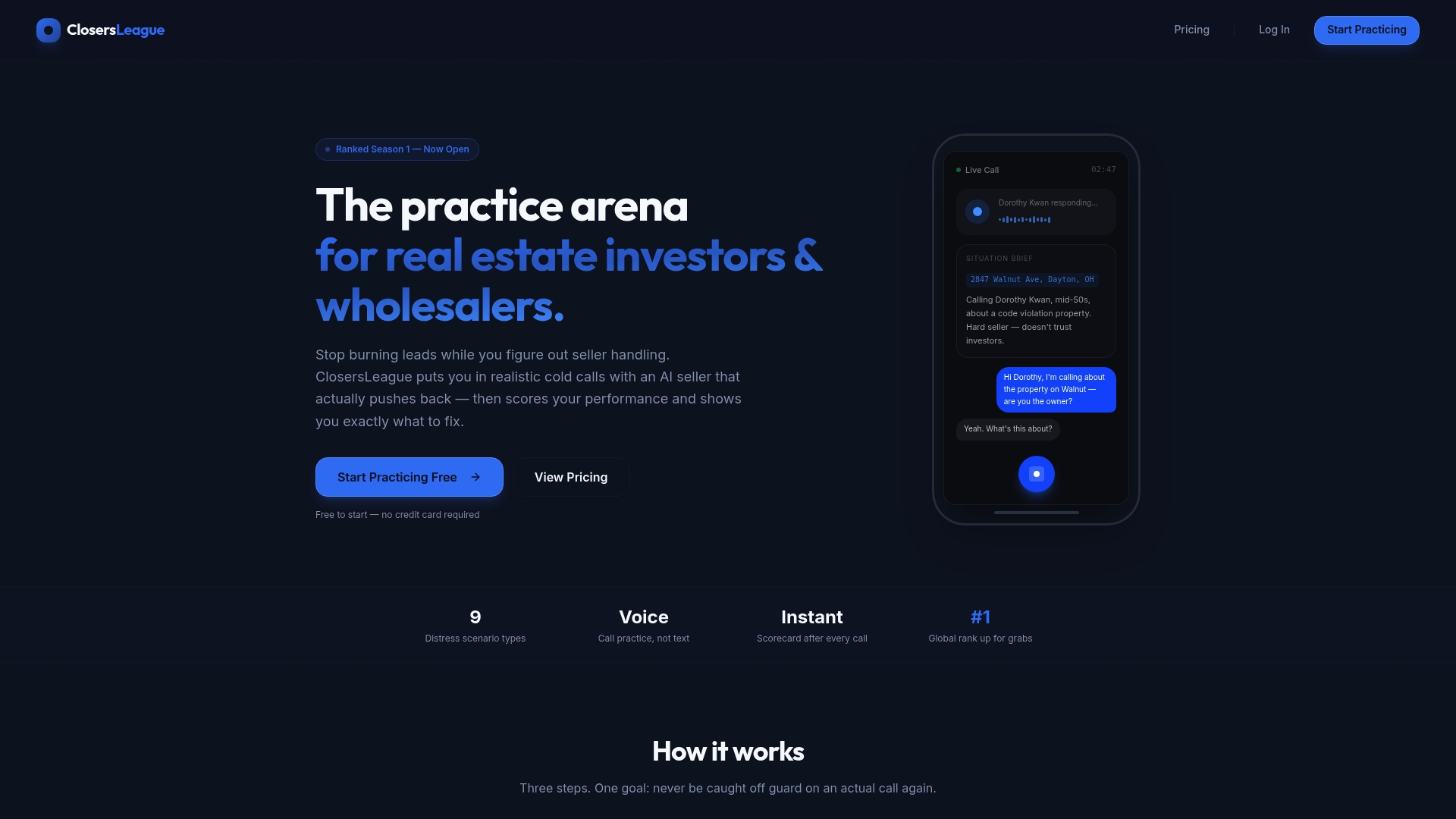
Every session scores your acknowledgment rate, probe rate, and appointment conversion against the benchmarks in this article. Real-time coaching flags the moment you skip a probe or argue instead of acknowledge. The AI roleplay platform maps directly to the daily and weekly practice routine above, so your scorecard improves week over week. Start your free trial and run your first scenario drill today.
Useful sources
- FTC National Do Not Call Registry: donotcall.gov — official registry for DNC scrubbing compliance.
- FCC TCPA rules: fcc.gov/consumers/guides/stop-unwanted-robocalls-and-texts — authoritative source for consent and recording requirements.
- ClosersLeague — cold calling tips for investors: Practical best practices for opening calls and improving connect rates.
- ClosersLeague — distressed seller scripts: Script bank for probate, pre-foreclosure, and tax-delinquent scenarios.
- ClosersLeague — how to close more deals cold calling: Tactical advice on moving prospects from call to close.
FAQ
What is the core cold call objection handling workflow?
The five-step workflow is: permission open, focused discovery, acknowledge-probe-respond loop (up to three cycles), test close or appointment, then log and follow up in your CRM.
How many times should you probe before moving on?
Probe up to three times per objection. If the seller repeats the same concern after the third probe, offer a graceful exit and schedule a follow-up rather than pushing further.
What compliance rules apply to cold calling distressed sellers?
TCPA and FTC Do-Not-Call rules require you to scrub the National DNC Registry, call only between 8 AM and 9 PM local time, and document consent before sending prerecorded messages. State recording laws vary and require separate review.
How do you practice objection handling effectively?
A daily 10–15 minute drill (one warm-up script plus one scenario) combined with a weekly scored mock session produces consistent improvement. ClosersLeague’s AI roleplay modules simulate distressed-seller emotional states and score your acknowledgment and probe rates automatically.
What does “I need to think about it” really mean from a distressed seller?
It usually signals the seller needs cover to process the situation, not a firm refusal. Confirm a specific callback day and time before hanging up, and treat it as a warm lead in your follow-up sequence.