Neighbor cold calling means phoning the homeowners around a target property, or around a recent local event like a sale, to start a conversation about the street and, when it fits, about selling. Done well, it is a low-cost way to hear about homes before they hit any list. Done badly, it burns your list and your reputation on one street. This guide covers who to call, what to say, how to stay inside the law and how to get your first calls right before a real homeowner picks up.
TL;DR
- Neighbor calls work when you have a real reason to dial: a nearby sale, a distressed property on the block, or a street you farm on purpose.
- Open with who you are, why you are calling this street and what is in it for them. Then stop talking and listen.
- Scrub every list against the National Do Not Call Registry and call only between 8 a.m. and 9 p.m. in the homeowner’s local time.
- Never pretend to be someone you are not. Honest calls build the trust that leads to referrals.
- Practice the opening and the objections out loud before you dial. ClosersLeague lets you do that with AI sellers.
Table of Contents
- What neighbor cold calling is (and what it is not)
- Why neighbors are worth a call
- Who to call: building a tight list
- What to say: the neighbor call script
- Handling the objections you will actually hear
- The rules: what the law says about calling homeowners
- Follow up without becoming a pest
- Measuring your results
- Practice before you dial
- Try your opening on an AI seller
- Our perspective
- FAQ
- Sources
What neighbor cold calling is (and what it is not)
There are two versions of this tactic, and investors mix them up.
Circle calling around a trigger. You pick a trigger, such as a house that just sold or went under contract, and call the homes immediately around it. The event gives you a credible reason to dial. In residential sales this is usually called circle prospecting, and the same logic applies to investors: “a home on your street just changed hands, and I buy houses in this area.”
Calling neighbors of a distressed property. You already know about a house that looks neglected, vacant or inherited. The people next door often know things no data platform shows. They may know who owns it, whether the owner lives out of state and how the owner feels about the place. Some will pass along a name or a number. Others will simply tell you the owner would never sell, which saves you a skip trace.
What it is not: a trick. You are not asking neighbors to spy, and you are not posing as a relative or a city inspector. You are a local buyer asking a polite question. That honesty is also what keeps you on the right side of the rules covered below.
Why neighbors are worth a call
Neighbors give you three things a purchased list does not.
- Context. A neighbor can tell you whether the house is occupied, whether the owner passed away, or whether a tenant moved out months ago. That helps you decide whether the property deserves a skip trace and a direct call.
- Warm introductions. People sell through people they trust. In the 2025 Profile of Home Buyers and Sellers, as reported by one industry guide, 37% of sellers found their agent through a referral from a friend, neighbor or relative. Investors do not get the same data, but the lesson carries over: when you are the buyer a street already knows, your name comes up in the conversation.
- Cheap volume. The cost is your time and a phone line. You can test a street in an afternoon.
The tradeoff is that neighbor calls convert slowly. Most answers will be “not interested” or “I don’t know the owner.” That is normal, and it is the reason to track your numbers and practice your opening until it feels natural.
Who to call: building a tight list
Start small and local. A ring of a few dozen homes around your trigger beats a thousand random numbers.
Pick the trigger
Good triggers for an investor:
- A recent sale or accepted offer on the street
- A vacant or visibly neglected house you want to learn about
- A probate or pre-foreclosure property in your target zip code
- A tired landlord’s rental with a poor-condition exterior
- A street where you already closed a deal and can say so
If you are working a distressed house, pull the ownership details first: owner name, mailing address, equity estimate, how long they have owned it and tax status. Then use the neighbors to fill in what the data cannot. Many wholesalers build their strongest lists by stacking signals, such as absentee ownership plus tax delinquency, so the property you ask about is already a real candidate.
Keep the radius tight
Call the homes within a few blocks, not the whole zip code. Guides on circle prospecting commonly suggest staying within roughly a quarter to a half mile of the trigger and calling quickly after it happens, while the event is still news. The closer the call is to the event, the more natural your reason sounds.

Scrub before you dial
Before a single call, check the list against the National Do Not Call Registry and your own internal do-not-call list. The legal section below explains why. Also remove numbers that have already told you no. A clean list is a respectful one.
What to say: the neighbor call script
Your first ten seconds decide whether the homeowner stays on the line. Cover three things: who you are, why you called this street, and what is in it for them. Then stop.
An opening for a trigger event
“Hi, this is [name]. I’m a local investor, and I’m calling a few homes on [street] because a house nearby just [sold/went under contract]. I buy houses in this neighborhood, and I wanted to ask whether you’d ever consider selling yours, or if you know anyone who might. Do you have a minute?”
An opening about a specific house
“Hi, this is [name]. I’m a local home buyer. I’m interested in the house at [address] and I’m trying to reach the owner. I thought you might know the best way to get in touch. Do you know the family?”
Notice what these scripts do not do. They do not claim to be a friend of the owner, a city employee or an agent with a buyer. They state a real purpose. If the neighbor asks “Who are you with?”, answer plainly. Hesitating on that question is where many callers lose the room.
Run discovery when the homeowner is the seller
When the person you reach is open to talking about their own house, switch to discovery. Many wholesalers organize it around four areas: condition, timeline, motivation and price. The goal of the first call is not to close. It is to learn why they might sell and set a follow-up or an appointment.
Listen for the details that reveal motivation: a medical bill, a difficult tenant, a recent divorce, an inherited house they cannot keep up. Callers who ask more and talk less hear these things first. For question ideas that respect emotional moments, read our guide to questions cold callers use to qualify seller emotion cues. For full scripts by seller type, see distressed seller cold calling scripts that convert.
Handling the objections you will actually hear
Neighbor calls produce a predictable set of replies. Prepare a short, calm answer for each.
| What you hear | What it usually means | A good response |
|---|---|---|
| “How did you get my number?” | Suspicion, not hostility | “It’s from public property records. I’m only calling homes near [street]. If you’d rather not hear from me, I’ll take you off my list right now.” |
| “Who are you with?” | They want to place you | Say your name and company or “I’m a local investor.” Keep it short and true. |
| “I’m not selling.” | Not now, or not to you | “Understood. Is there anyone on the street who has talked about moving?” |
| “I don’t know the owner.” | Dead end for this house | “No problem. Do you know who lives on either side?” |
| “Take me off your list.” | A legal request | “Done. Sorry for the interruption.” Then log it immediately. |
The last row matters most. When someone asks to stop, you stop, and you record it the same day. That is both the right thing and a legal requirement, covered next.
The rules: what the law says about calling homeowners
Neighbor calls are still cold calls. Know the basics before you build a list. This is general information, not legal advice. Have a qualified attorney review how the rules apply to your campaign, especially if you call in several states.
Calling hours. Under the federal rule at 47 CFR 64.1200, no one may make a telephone solicitation to a residence before 8 a.m. or after 9 p.m. local time at the called party’s location. The FTC’s Telemarketing Sales Rule guidance sets the same window and requires callers to identify themselves and honor both the National Do Not Call Registry and company-specific do-not-call requests.
The Do Not Call Registry. The same rule bars solicitation calls to numbers on the national registry. Per the FTC, violations can carry civil penalties of up to $53,088 per violation. The safe-harbor procedures call for registry data that is no more than 31 days old, as noted in an investor guide from the Dreia investor association.
Is a call to buy a house a “solicitation”? This is less settled than many investors assume. The FCC has said that calls made on behalf of a potential buyer to someone advertising a property for sale, solely to discuss a sale to that buyer, are not telephone solicitations. A federal court in Arizona reached the same view in 2025, but federal district courts remain split, and the same analysis notes that an autodialed or prerecorded call to buy a home can still raise separate TCPA issues. Calling a neighbor to ask about someone else’s house, or to promote your services, is further from that exemption. The safest habit is to scrub everything and treat every call as covered.
Autodialers and artificial voices. The FCC’s overview of the TCPA explains that the law restricts automatic dialing systems and prerecorded or artificial voice messages, with the tightest limits on calls to cell phones. Keep your neighbor calls human and manual unless counsel clears another approach.
State rules. States add their own hours, call limits and registration requirements. Check your state attorney general or consumer protection office before you launch in a new market.
A practical compliance checklist:
- Scrub against the national registry and your internal list before each batch
- Call only between 8 a.m. and 9 p.m. at the homeowner’s local time
- State your name at the start of the call
- Log every do-not-call request the same day
- Never misrepresent who you are or why you are calling
Follow up without becoming a pest
Most neighbor leads do not decide on call one. A simple cadence keeps you present without crowding anyone:
- Day 0: the call, with notes on what you learned
- Day 2: a short follow-up message, only where the person agreed to be contacted that way
- Day 7: a quick check-in call
- Day 14: a light “any change in your plans?”
- Day 30: a monthly touch, then spread out further
If someone says no clearly, stop. If someone says “not now,” put them on a slower rhythm of every few months. Write down what they told you, such as “retiring next spring” or “waiting for the tenant lease to end,” so the next call starts where the last one ended.
Measuring your results
Treat neighbor calling like a funnel and track it. At a minimum, log:
- Dials and live conversations
- Conversations that produced a lead (a motivated owner, a useful tip or a phone number for a target property)
- Appointments or offers that came from those leads
- Do-not-call requests and how fast you honored them
- Time spent per lead
Published benchmarks for cold calling vary a lot by list quality and market, so use them loosely. Build your own baseline over your first few hundred dials, then diagnose the earliest stage where your numbers drop. If lots of people answer but few stay on the line, the problem is your opening. If they stay on but give you nothing, the problem is your questions. If they open up but never book a next step, work on your close.
When you analyze a promising lead, run the numbers before you make an offer. Tools for AI deal analysis and instant appraisals can help you size up the property you heard about on the street.
Practice before you dial
The weak point in most neighbor calling is the first ten seconds, and the only way to improve it is repetition. Calls to real homeowners are a costly place to practice. A burned number on a street you want to farm is hard to recover.
We built ClosersLeague so you can rehearse the exact calls in this guide with AI sellers: probate, pre-foreclosure, inherited, tax delinquent, code violation, divorce, out-of-state, vacant and tired landlord. You get real-time coaching, a scorecard after each call, targeted skill drills and a leaderboard to push you. Run your neighbor opening ten times, hear how it lands, and tighten it.
Try your opening on an AI seller
Plans start at $5 per month for Starter, with Growth at $10 per month and Pro at $18 per month, tiered by the number of AI practice calls. A free trial includes a limited number of calls, so you can run your neighbor script before you commit. See the plans and pricing or go straight to AI cold calling practice for investors.
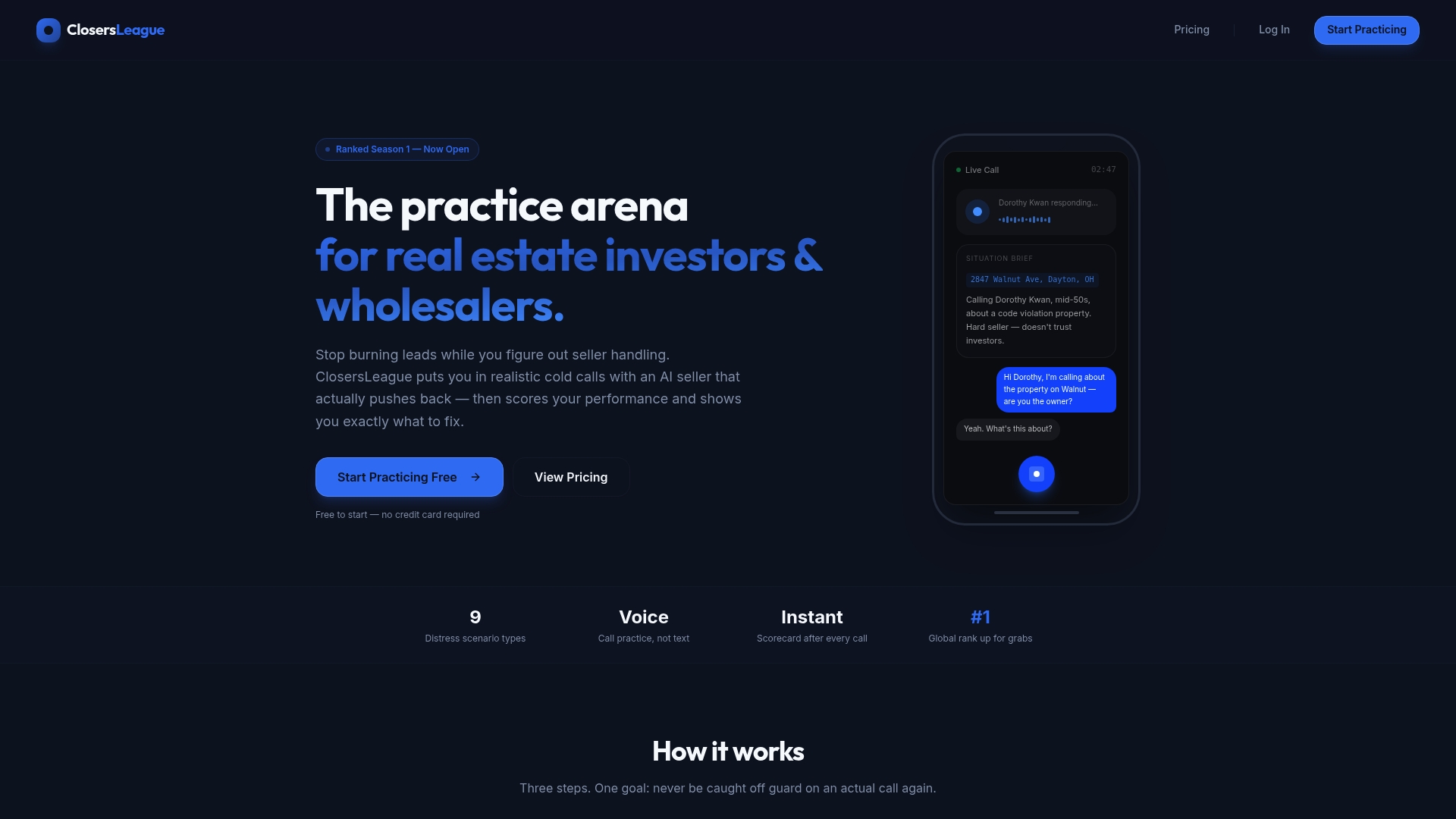
Stop winging it. Start drilling. For more on structuring calls, see our step-by-step wholesaling calls guide and our 10 cold calling tips for real estate investors.
Our perspective
Most investors we talk to do not fail at cold calling because they lack a list. They fail in the first few seconds, when a nervous opening gives the homeowner an easy reason to hang up.
Neighbor calls raise the stakes. The person on the phone is not a lead yet. They are a stranger deciding whether you are trustworthy, and they may be talking about someone else’s difficult situation. Tone matters as much as words.
That is why we believe in deliberate practice over volume. Our platform is built around the distressed situations investors actually face, with realistic AI sellers that push back, get emotional and raise objections. You see a scorecard after every call, so you know what to fix instead of guessing.
Make your calls honest, short and respectful. Practice until the opening is automatic, and then spend your live dials listening.
Dave
FAQ
Is neighbor cold calling legal?
Calling homeowners is legal when you follow the federal and state rules: call between 8 a.m. and 9 p.m. local time, honor the National Do Not Call Registry and respect every request to stop. Whether a call to buy a home counts as a solicitation is unsettled in federal courts, so scrub your lists anyway. Ask a qualified attorney about your specific campaign.
How many neighbors should I call around one property?
Start with a small ring, a few dozen homes within a few blocks of your trigger. That is enough to learn how the street responds without burning the area. Expand only after you see what your opening produces.
What should I say when a neighbor asks how I got their number?
Tell the truth: it came from public records or a list you built for the area, and you are happy to remove them. Say it calmly and offer to take them off your list. Honest answers lower suspicion and often keep the conversation going.
How do I get better at these calls quickly?
Rehearse out loud with realistic pushback, then review what happened. ClosersLeague scores each practice call across multiple skill categories and gives you drills for your weak spots, so your live calls start from a stronger place.
Sources
- eCFR: 47 CFR Part 64, Subpart L
- FTC: Complying with the Telemarketing Sales Rule
- FCC: Unlawful Communications, Robocalls and Caller ID Spoofing
- Roth Jackson: Are Real Estate Purchase Calls Telephone Solicitations?
- Driving for Dollars investor guide (Dreia)